

Most Americans Want to Age at Home — A New Survey Shows Why Long-Term Care Planning Matters More Than Ever
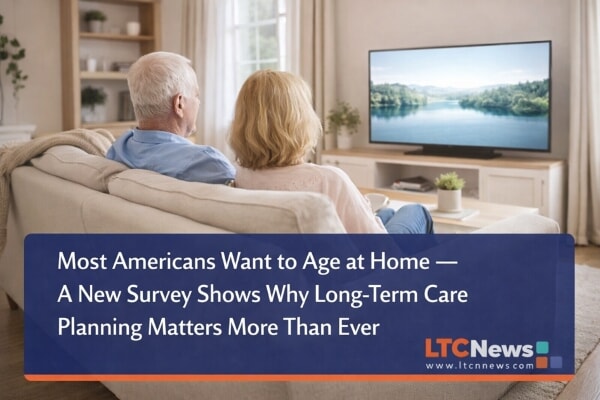

You probably hope to stay in your own home as you age. According to a new national survey, you are far from alone.
A Talker Research survey reported in the New York Post, about 2,000 U.S. adults with living parents, found that Americans are significantly more likely to favor in-home care for aging loved ones than assisted living, memory care, or other institutional options. Nearly four in 10 respondents said home care would be their preferred choice, compared with far smaller shares choosing assisted living or senior care facilities.
The findings reinforce a long-standing reality: Americans want to age at home. But the survey also highlights a growing disconnect between preferences and preparedness, with major implications for retirement planning, family caregiving, and long-term care costs.
What the Survey Found — And Why It Matters
The Talker Research survey asked adults to consider how they would want aging parents cared for if help became necessary.
The results were clear:
- In-home care was the top choice, favored by nearly 40 percent of respondents
- Assisted living ranked far lower
- Even fewer participants chose memory care and other senior facilities
Those numbers matter because the survey focused on real-world decision makers, the adult children who are often responsible for coordinating and finding paying for care when health declines.
This preference reflects more than sentiment. It signals how families want care delivered and where they expect resources to be directed as parents age.
Independent Data Confirms the Trend
The Talker Research findings align closely with decades of independent research.
- A 2024 AARP Home and Community Preferences Survey found 75 percent of adults age 50 and older want to remain in their homes and communities as they age.
- National polling, including AP-NORC surveys, has consistently shown as many as 88 percent of Americans prefer home- or family-based care over institutional care.
- Multiple studies show that older adults associate home care with greater independence, dignity, and emotional well-being.
The consistency across surveys suggests this is not a temporary preference. It is a deeply held expectation. Emily Nabors, associate director of innovation for the National Council on Aging, said in an article in Kiplinger that aging in place helps you maintain access to resources in the community and social your connections; supporting your independence
Aging in place helps us maintain access to resources in the community and social connections … it supports our independence. Homes are places of comfort and privacy and security and they contain our memories. Homes are where so much of our lives take place and they can really be part of our identity. — Emily Nabors, Associate Director of Innovation, National Council on Aging.
Why In-Home Care Is So Strongly Preferred
The survey results reflect several underlying concerns and priorities:
- Familiar surroundings matter. Home reduces stress and helps preserve routines.
- Independence lasts longer. Home care allows people to remain in control of daily decisions.
- Trust issues persist. Public confidence in nursing homes and institutional care remains low.
- Family involvement feels easier. Loved ones often feel more connected and informed when care happens at home.
For many families, the choice is not about rejecting assisted living entirely. It is about preserving options and delaying institutional care as long as possible.
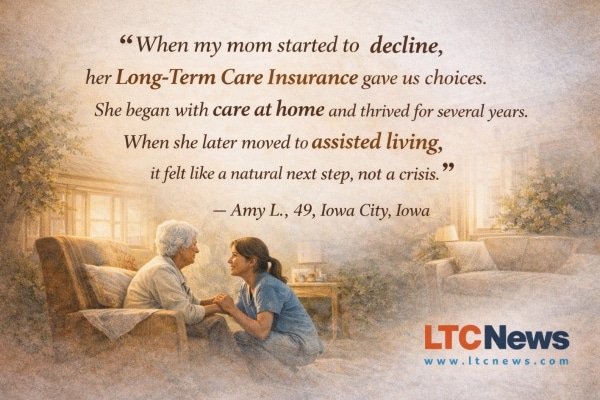
Share your experiences and insights on aging, caregiving, health, retirement, and long-term care with LTC News —Contact LTC News.
The Planning Gap the Survey Does Not Measure — But Reveals
What the Talker Research survey does not ask—but indirectly exposes—is whether families are financially and practically prepared to support home-based care.
That gap is significant.
According to the U.S. Department of Health and Human Services, 56 percent of Americans who reach age 65 will need long-term care, defined as help with at least two activities of daily living or cognitive impairment. The likelihood increases with age, and care often lasts for years.
At the same time:
- Medicare and health insurance do not cover long-term care.
- Medicare pays only for short-term skilled care under limited conditions.
- In-home care, assisted living, and memory care are largely paid out of pocket unless other planning, such as Long-Term Care Insurance, is in place.
The survey shows what families want. The data show what families will likely face.
Growing Interest in Long-Term Care Insurance
The strong preference for home-based care revealed in the survey helps explain why Long-Term Care Insurance is increasingly viewed as a retirement planning tool, not just a healthcare product.
You may want to stay at home. You may want assisted living rather than a nursing home if care becomes necessary. What most people do not want is to lose choice because of cost.
Long-Term Care Insurance provides guaranteed, tax-free benefits that can be used to pay for care where you want it, most often at home, but also in assisted living or other settings if health needs change.
That flexibility aligns directly with the preferences expressed in the survey.
Without coverage, families often face difficult tradeoffs:
- draining retirement savings
- selling a home
- relying heavily on unpaid family caregivers
For many older adults, in-home care supports a better quality of life, especially when supported by professional caregivers. Long-Term Care Insurance helps make that option financially realistic without shifting the burden onto spouses or adult children.
Gerontology research and home care evidence consistently show that personalized support in the home helps seniors stay engaged, reduces anxiety, and supports emotional well-being.
Home-based care helps older adults remain in familiar surroundings, maintain independence, and preserve daily routines—all of which contribute to better quality of life.
What the Survey Signals for Families and Policymakers
The Talker Research findings send a clear message:
- Americans want care delivered at home whenever possible
- Families expect flexibility, not one-size-fits-all solutions
- Planning matters long before care is needed
As the population ages and extended care costs rise, aligning personal planning, insurance solutions, and public policy with these preferences will become increasingly important.
As the aging population continues to increase, the need for a comprehensive long-term care program in the United States intensifies. — Rayna Stoycheva, PhD, and Chloe Lepak, The Harkin Institute.
What You Can Do Now
If the survey reflects how you feel, the next step is preparation:
- Learn what Medicare and health insurance do not cover
- Understand local care costs using the LTC News Cost of Care Calculator
- Talk with family members about preferences and expectations
- Explore Long-Term Care Insurance before health changes limit your options
If care is needed now, the LTC News Caregiver Directory can help you find in-home care providers, assisted living options, and other long-term care resources in your area.
If a loved one has an LTC policy and you need help filing a claim, LTC News can help. LTC News partners with Amada Senior Care to offer free, no-obligation assistance with Long-Term Care Insurance claims. Trained professionals can help guide you through the process and ensure benefits are submitted correctly and efficiently — File a Long-Term Care Insurance Claim.
The survey confirms what many families already know. Aging at home is the goal. Planning is what makes it possible.