

Florida’s Aging Boom: Why Retirees Face Growing Pressure to Plan for Long-Term Care


If you live in Florida, you understand many of the benefits of living in the state. If you don't live in Florida, you might picture the state as a retirement haven: warm weather, no state income tax, and communities built around golf carts and grandkids.
That image is still real, but it now comes with a sharper edge.
Florida has the highest share of residents age 65 and older in the nation, nearly 22 percent, according to a 2025 Florida Health Justice Project report that cites U.S. Census QuickFacts and Florida’s State Plan on Aging.
The same analysis notes that Florida’s age wave means more people will need help with daily living, memory care, and medical support in the years ahead.
For you and your family, that translates into two big questions:
- How will you pay for extended care if your health changes?
- Will your loved ones be forced into crisis caregiving if you do not plan ahead?
Florida’s numbers make those questions hard to ignore.
Florida - Still a Retirement Magnet – With Warning Signs
Florida remains a top draw for retirees. A 2025 WalletHub-based ranking summarized by Kiplinger again ranked Florida as the top state for retirement, citing tax advantages, shoreline, and senior-focused amenities, not to mention the weather, especially during the winter months, which many people find appealing.
Migration data focused on older adults tells a similar story. An August 2025 analysis of Census figures found that Florida ranked first for net migration among people 60 and older in 2023, with more than 143,000 retirees moving in and a net gain of 44,504 older residents.
At the same time, the trend is more fragile than it looks. A 2024 AARP Florida brief on migration trends reported that Florida’s net in-migration fell by about half between 2022 and 2023, even as the state still gained more people than it lost.
Jeff Johnson, AARP Florida state director, warned in that report that many older adults love the idea of moving to Florida but are being squeezed by costs.
Choosing to move to Florida is often a heartfelt decision for many, representing a lifelong dream or a fresh start,” he said, noting that housing, utilities, and access to care can push some retirees out. – Jeff Johnson, AARP Florida state director.
If you hope to stay in Florida or are considering moving to the state, planning for both living costs and care costs becomes essential, not optional.
Florida’s Older Population is Growing Fast
Longevity is good news in many ways, but the system that supports older adults is already under strain.
Unless you have Long-Term Care Insurance or qualify for Medicaid benefits because of limited financial resources, long-term care costs are your responsibility.
The growing demand for extended care services and a lack of planning are driving up the cost of long-term care nationwide, including in Florida, according to a survey by LTC News.
A few key numbers from the Florida Health Justice brief underline that pressure aging and long-term care are placing older adults and their families in Florida:
- More than 147,000 older adults and people with disabilities rely on home- and community-based services through Florida’s Statewide Medicaid Managed Care Long-Term Care program.
- Over 2.7 million adults in Florida are family caregivers, about 15% of the adult population.
- The state’s direct care workforce is about 168,000 people, including home health aides, personal care aides, and nursing assistants.
- The value of unpaid family caregiving in Florida exceeds $40 billion a year.
Florida’s Long-Term Care Insurance Story: Billions in Tax-Free Benefits
LTC Insurance is already playing a major role for Florida families. The 2025 AHIP report, “Long-Term Care Insurance Coverage: State-to-State,” shows that in 2024 alone, Long-Term Care Insurance paid $977,468,390 in benefits to Florida policyholders.
Since insurers first began selling Long-Term Care Insurance in the state, total benefits paid have reached $14,670,512,410.
Those benefits help families:
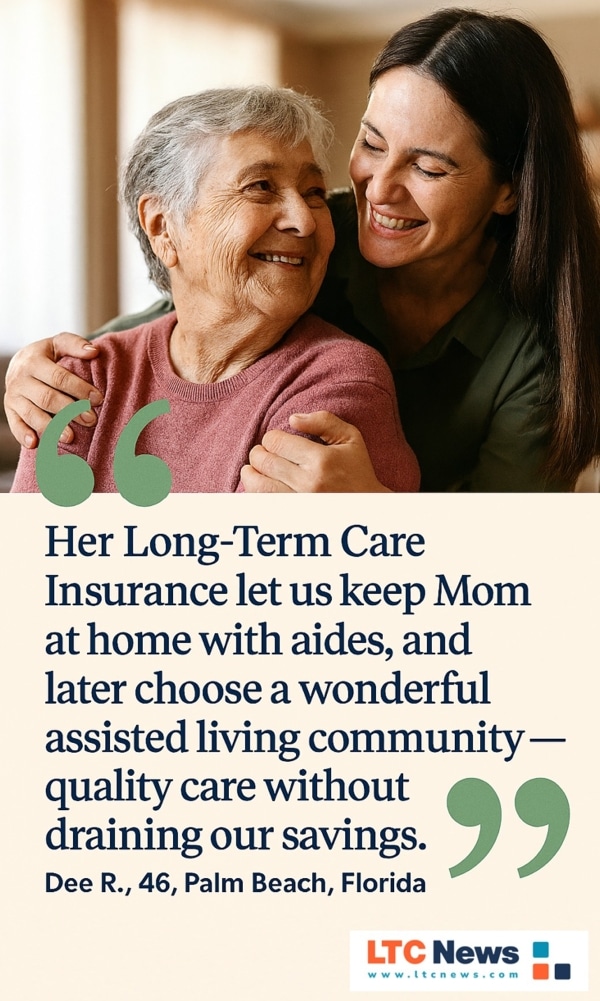
- Keep a loved one at home with paid home health or personal care aides.
- Afford quality assisted living or memory care instead of only the lowest-cost options.
- Delay or avoid Medicaid spend-downs by covering years of private-pay care.
Every dollar of tax-free benefit is a dollar that does not have to come from your savings or your adult children’s finances.
Share your thoughts and experiences about aging, caregiving, health, retirement, and long-term care with LTC News —Contact LTC News.
Florida’s Long-Term Care Partnership: Extra Protection for Your Assets
Florida also participates in the federal Long-Term Care Partnership Program. Partnership-qualified Long-Term Care Insurance policies offer a unique advantage: dollar-for-dollar asset protection if you ever exhaust your LTC Insurance benefits and need to apply for Medicaid.
The Florida Department of Financial Services explains that, under the Partnership, for every dollar that a Partnership policy pays in benefits, a dollar of assets can be disregarded in Medicaid eligibility calculations.
In practice, that means:
- If your Partnership LTC policy pays $300,000 in benefits, you can keep an extra $300,000 in countable assets and still qualify for Medicaid long-term care if your policy benefits are exhausted and you otherwise meet Medicaid rules.
- The state also cannot pursue those protected assets through Medicaid estate recovery after you die, up to the amount of Partnership-protected benefits.
When you are planning in Florida, choosing a Partnership-qualified LTC policy can be a key strategy to protect your home and savings if a long care event lasts longer than your policy benefits.
Florida Has a Dense Network of Care Providers
Because of this aging boom, Florida has built a large ecosystem of in-home care agencies, assisted living facilities, memory care units, and nursing homes.
LTC News’s Cost of Long-Term Care in Florida in 2025 article, based on the LTC News Cost of Care Calculator, notes that the state offers:
- Extensive home healthcare agencies, including skilled nursing and non-medical home care.
- Thousands of assisted living and memory care communities, especially in metro areas like Tampa Bay, Orlando, Jacksonville, and South Florida.
- A wide range of nursing homes and skilled nursing facilities for higher-acuity needs.
Even within a few counties, provider counts are striking. For example, one Area Agency on Aging plan for northeast Florida (PSA 4) lists hundreds of licensed home health agencies and more than 300 assisted living communities across seven counties, reflecting just one region’s capacity.
You can see how dense the market is by searching the LTC News Care Directory, which lists home care, assisted living, memory care, and nursing homes across Florida by ZIP code. That density gives you choices, but it also creates wide price and quality differences between communities and agencies.
The directory has the largest database of caregivers and long-term care facilities in the United States. The free resources available in Florida are extensive.
- Claim your free listing on the LTC News Caregiver Directory and/or upgrade the listing to enhance visibility and highlight your staff and services through the LTC News Directory Business Portal.
What Long-Term Care Really Costs in Florida
Sticker shock is often the moment families realize they waited too long to plan. According to the LTC News Cost of Care Calculator and LTC News Florida cost analysis, median 2025 costs in Florida look like this:
Cost of Care Comparison: Florida vs. United States (2025 Median Costs)
Cost data based on the LTC News Cost of Care Calculator.
| Type of Care | National Median Cost (Annual) | National Median Cost (Monthly) | Florida Median Cost (Annual) | Florida Median Cost (Monthly) |
| Adult Day Care | $22,393 | $1,866 | $20,760 | $1,730 |
| Assisted Living Facility | $58,025 | $4,835 | $55,120 | $4,593 |
| Home Healthcare | $65,757 | $5,480 | $62,966 | $5,247 |
| Memory Care | $65,773 | $5,481 | $64,531 | $5,377 |
| Nursing Home (Private Room) | $125,447 | $10,454 | $132,514 | $11,043 |
Key Takeaways for Florida Retirees
These are median costs. There are additional surcharges for assisted living and memory care, which will be added to the base cost listed. In many coastal or high-demand communities, you may see much higher prices for memory care or private-pay nursing home rooms.
You can search the average costs in any zip code by using the LTC News survey of long-term care costs calculator.
- Florida remains slightly less expensive than the national median for home care, adult day care, assisted living, and memory care.
- Florida is more expensive than the U.S. average for nursing home care, driven by demand in metro and coastal markets.
- Rising demand from the state’s large 65+ population puts upward pressure on prices, especially in dense retirement regions.
For Florida, projections show significant increases in long-term care costs by the 2040s, which can easily push nursing home costs well above $200,000 a year in many metro areas if inflation trends continue.
If you are counting on Social Security and a portfolio that moves with the markets, imagine how long those resources would last against several years of $6,000 to $10,000-a-month in long-term care expenses.
Obviously, those with Long-Term Care Insurance have guaranteed tax-free benefits (in addition to tax incentives) to pay for some of these costs. Based on historical data, LTC Insurance has already performed very well, paying billions in benefits to Florida policyholders and their families.
Medicaid and Long-Term Care in Florida
However, Medicaid remains the primary source of long-term care funding in Florida and nationally, paying well over half of the $415 billion spent on LTSS (long-term services and supports).
In Florida, Medicaid supports both nursing homes and the Statewide Medicaid Managed Care Long-Term Care program for home- and community-based services.
Medicaid is vital, but it is means-tested, and eligibility requires meeting strict income and asset limits. That is where Long-Term Care Insurance becomes central for middle-class and upper-middle-class families. Even very wealthy individuals find it very cost-effective to use LTC Insurance rather than selling off assets and creating the tax complications that come with that.
Floridians Take Advantage of Care Options with LTC Insurance
The billions paid in Long-Term Care Insurance benefits in Florida have helped families protect savings, reduce the emotional and financial strain on loved ones, and give policyholders the freedom to choose where they receive care, including the option to age at home.
Planning with LTC Insurance gives you more freedom to choose:
- Stay home longer with paid caregivers.
- Move into a higher-quality assisted living community without financially punishing your spouse.
- Transition to memory care or nursing home care without wiping out family assets.
The Bottom Line – And a Next Step for You
Florida remains one of the most attractive places in the country to grow older, yet it also sits on the front lines of America’s long-term care challenge. High demand, rising costs, and workforce shortages create both risk and opportunity for you and your family.
Most people purchase Long-Term Care Insurance between the ages of 47 and 67. If you plan ahead, tools like Long-Term Care Insurance, Florida’s Partnership Program, and the state’s broad network of care providers can help you protect your independence and safeguard family finances.
If you do nothing, you may leave your loved ones to navigate a crowded, expensive system in crisis mode. Florida has become an example of how planning works, helping policyholders access quality extended care without draining their assets or burdening those they love.