Spring and Summer Storms and Older Adults: How Caregivers and Families Can Prepare Now
About This Article
You watch the skies darken and wonder if you’re ready. If you care for an older adult—or live independently after 60—spring and summer storms demand a plan.

Mallory Knee
Mallory Knee is a freelance writer for multiple online publications where she can showcase her affinity for all things beauty and fashion.
Table of Contents
- Build a 72-Hour Emergency Kit
- Create a Clear Communication Plan
- Secure the Home Before Storm Season
- Plan for Power Outages and Medical Equipment
- Monitor Approaching Storms Before They Reach You
- If Your Loved One Lives in a Long-Term Care or Senior Living Community
- Address the Emotional Impact of Disasters
- Why Storm Planning Is Part of Aging Planning
- Prepare Before the Forecast Turns
Spring storms can be powerful and unpredictable. Knowing how to prepare for severe spring and summer weather gives you and your entire family greater peace of mind.
Using this caregiver emergency guide to protect older adults, safeguard medications, and secure the home before severe weather strikes is one of the most important steps you can take for you or an older family member.
Unlike hurricanes, where you get a lot of advance warning, spring and summer storms can come up quickly. You might hear the weather alert on the radio, TV, or your smartphone before you see the clouds. Sometimes, the storm hits in minutes with little or no warning.
Spring and summer thunderstorms can escalate rapidly with little warning, often forming in the late afternoon or early evening and reaching dangerous levels within a short time frame—which is why staying weather-ready and having multiple ways to receive alerts is crucial. — National Weather Service severe weather guidance.
For you, storm season is not just about hail or high winds. It is about medications that must stay cold. Oxygen machines that must stay powered. A parent who moves slowly down the stairs if they need to move to a place of safety.
If you are a caregiver—or an older adult living independently—spring and summer storms require more than batteries and bottled water. They require planning.
Severe Weather – A Real Concern
The risk is real. According to the National Oceanic and Atmospheric Administration (NOAA), the United States experienced 28 separate billion-dollar weather and climate disasters in 2023 and 27 in 2024. Preliminary data for 2025 show another active year with multiple billion-dollar events, according to NOAA’s National Centers for Environmental Information (2026 update, U.S.).
Severe storms and flooding accounted for a large share of those disasters. Since 1980, the United States has experienced more than 370-billion-dollar weather and climate disasters, adjusted for inflation.
Storm seasons are becoming more costly and more frequent. Older adults face higher risks of injury, power-related medical complications, and displacement.
Here is how you prepare—before the sirens sound.
Build a 72-Hour Emergency Kit
Federal emergency officials recommend having enough supplies for at least three days. The Department of Homeland Security’s Ready.gov advises households to maintain a 72-hour emergency kit.
Your kit should include:
- One gallon of water per person per day
- Non-perishable food
- Manual can opener
- Flashlights and extra batteries
- Battery-powered or hand-crank weather radio
- Portable phone chargers
- First-aid supplies
- Copies of identification and insurance documents
If you care for someone with medical needs, add:
- A complete medication list with dosages and the prescribing doctor
- At least a seven-day supply of medications when possible
- Extra hearing aid batteries
- Backup glasses
- Written instructions for medical equipment
The Centers for Disease Control and Prevention (CDC) advises older adults to prepare, including keeping medical information in waterproof containers and easily accessible in case of evacuation. Preparation reduces panic.
Create a Clear Communication Plan
Storm damage often overwhelms local phone lines. Text messaging may work when calls fail. Choose an out-of-state contact person. Every family member should know who to call to check in.
Write emergency numbers down and store copies:
- In your emergency kit
- On the refrigerator
- In wallets or purses
Older adults who live alone should share their emergency plan with neighbors. Community awareness saves lives.
Secure the Home Before Storm Season
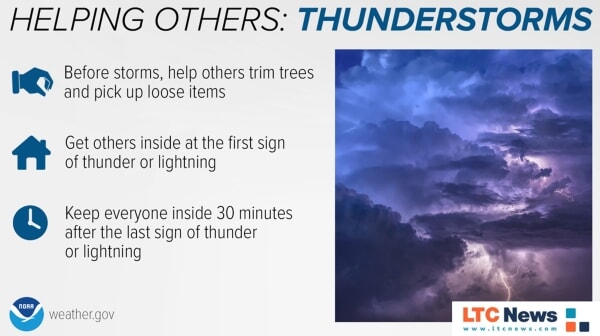
Storm safety starts outside. The Federal Emergency Management Agency (FEMA) recommends clearing gutters, securing outdoor furniture, trimming unstable tree limbs, and reinforcing loose roofing materials before severe weather arrives.
Inspect the yard for potential hazards, such as overgrown or unstable trees, and address them early, for example, by following preemptive storm season tree removal tips to keep the home safe before severe weather strikes.
Inside the home:
- Anchor heavy furniture
- Store important documents in waterproof containers
- Keep valuables elevated in flood-prone areas
- Identify a safe interior room for tornado warnings
Small preventive steps reduce fall risk during chaos. Falling debris and unstable shelving cause avoidable injuries, especially for older adults.
Plan for Power Outages and Medical Equipment
Power outages pose an immediate danger to seniors who rely on electricity for medical devices.
If your loved one uses:
- Oxygen concentrators
- CPAP or BiPAP machines
- Motorized wheelchairs
- Refrigerated medications such as insulin
Contact the equipment supplier now. Ask about battery backups. Ask how long the equipment runs without electricity.
Many utility companies maintain priority restoration lists for medically vulnerable customers. Call your local provider and register.
Pharmacists can explain how long medications remain stable without refrigeration. Do not guess. Ask directly.
Prepare for Evacuation—Even If You Hope to Stay Home
Flooding and extended outages may force evacuation.
Your go-bag should include:
- Medications and medical records
- Insurance policies
- Contact lists
- Mobility aids
- Comfortable clothing and sturdy shoes
Medicare does not pay for long-term custodial care beyond limited skilled nursing coverage. Medicaid requires financial qualification.
If a storm permanently damages a home, care decisions may need to be made quickly. For those receiving in-home care and have Long-Term Care Insurance, the policy can provide guaranteed, tax-free benefits for extended care not only at home, but in assisted living or nursing facilities.
Monitor Approaching Storms Before They Reach You
Storm safety begins with awareness. Unlike hurricanes, which often provide days of tracking and advance notice, spring and summer storms can develop quickly. The National Weather Service warns that severe thunderstorms can intensify rapidly, sometimes reaching dangerous levels within a short period of time. Minutes matter.
You should never rely on just one source of information.
Here are the most reliable ways to monitor approaching weather:
NOAA Weather Radio
A battery-powered or hand-crank NOAA Weather Radio provides continuous updates directly from the National Weather Service. These radios sound automatic alerts when warnings are issued for your area. They work even when cell service fails.
Local Television Stations
Local TV news meteorologists provide real-time radar tracking and neighborhood-specific coverage. During tornado warnings or flash flood alerts, live coverage often gives clearer direction than national broadcasts.
Local AM/FM Radio
Battery-powered radios remain one of the most dependable tools during power outages. Many communities use local stations to broadcast emergency instructions and shelter information. Be sure to listen to a radio station with live, local staff who can provide weather information.
Smartphone Alerts
Wireless Emergency Alerts (WEA) automatically push tornado, flash flood, and severe thunderstorm warnings to smartphones. Make sure alerts are enabled in your phone’s emergency settings.
Weather apps from trusted sources such as the National Weather Service or local TV and radio stations provide radar tracking and push notifications.
Community Alert Systems
Many counties and municipalities offer text or email emergency alert systems. Check your local emergency management website and register in advance.
Older adults living alone should keep at least two alert methods available. If Wi-Fi fails, a battery radio still works. If batteries die, smartphone alerts may still come through.
Redundancy protects you.
If Your Loved One Lives in a Long-Term Care or Senior Living Community
You may assume the king-term care facility has everything covered. Perhaps. Most licensed long-term care facilities and assisted living communities are required to maintain emergency preparedness plans. However, you should never assume. Ask questions before storm season begins.
Federal regulations require Medicare- and Medicaid-certified nursing homes to maintain comprehensive emergency preparedness programs under Centers for Medicare & Medicaid Services (CMS) rules.
These plans must address natural disasters, power outages, evacuation procedures, and communication with families.
Independent living communities may not be subject to the same federal regulations, so policies can vary.
Here are key questions you should ask the administrator or executive director:
Power and Backup Systems
- Does the facility have a generator?
- What systems does it power—medical equipment, elevators, air conditioning, refrigeration?
- How long can it operate without refueling?
Evacuation Protocols
- Under what conditions would residents be evacuated?
- Where would they go?
- How are transportation and medical records handled?
Staffing During Severe Weather
- Do staff remain on-site during major storm warnings?
- Is there a plan for extended coverage if roads become impassable?
Communication With Families
- How are families notified during emergencies?
- Is there a designated hotline or emergency webpage?
Medication and Medical Equipment
- How are refrigerated medications protected during outages?
- What protocols are in place for residents using oxygen or other powered equipment?
After Hurricane Irma in 2017, federal and state oversight of emergency power and evacuation planning intensified, particularly in hurricane-prone states. Many states now require assisted living and nursing facilities to maintain backup power for climate control and medical needs.
Even so, oversight does not replace personal involvement.
If your loved one lives in independent senior housing, the responsibility may fall more heavily on the resident and family. Independent living communities often offer fewer medical supports. You may need to create a parallel family emergency plan that includes:
- Transportation arrangements
- A personal emergency kit kept in the apartment
- Copies of medical records stored offsite
- A clear family evacuation plan
Storm season is the right time to schedule a meeting with the facility director. Review policies calmly, not during a warning.
If you are searching for a long-term care facility for a loved one now, be sure to ask how they handle weather emergencies. Use the LTC News Caregiver Directory to help in your search for quality extended care.
Address the Emotional Impact of Disasters
Storms disrupt routines. For someone with early dementia or balance issues, disruption increases confusion and fall risk.
The CDC reports that disasters can worsen anxiety and depression, especially among older adults. Routine matters. Stability matters.
Ask yourself: If your parent had to leave home tonight, would you have a calm plan—or a crisis?
Review Your Plan Every Spring
Preparation fades if ignored.
Each season:
- Replace expired food and batteries
- Update medication lists
- Confirm emergency contacts
- Test generators
- Reassess mobility needs
Aging changes circumstances. Your emergency plan should change with it.
Why Storm Planning Is Part of Aging Planning
The U.S. Department of Health and Human Services reports that 56 percent of Americans age 65 and older will require long-term services meeting the federal definition, meaning assistance with two or more activities of daily living or cognitive impairment.
Storms expose vulnerabilities. They also reveal whether planning is in place. Emergency readiness and long-term care planning go hand in hand. You can explore additional resources on LTC News and locate care providers through the LTC News Caregiver Directory.
Prepare Before the Forecast Turns
Storm season is predictable. Damage is not. You cannot control the weather. You can control preparation. Take one hour this week. Build or refresh your emergency kit. Update your medical list. Review evacuation routes.
When the alert sounds, preparation becomes peace of mind.


Sponsored