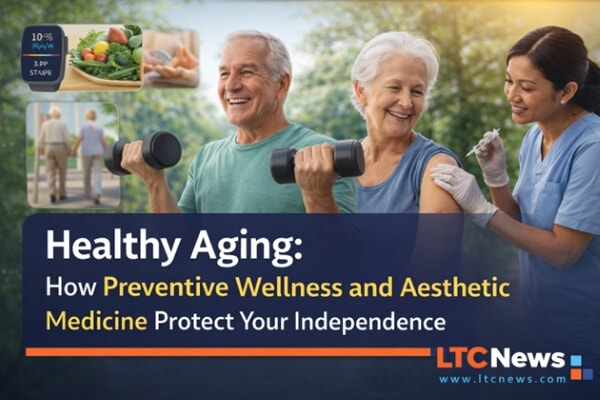
Healthy Aging - How Preventive Wellness and Aesthetic Medicine Protect Your Independence
About This Article
Healthy aging is about extending healthspan. Learn how preventive wellness, aesthetic medicine, and Long-Term Care planning protect independence.
Marcus Howard
Marcus Howard writes about alternative health topics for older adults such as CBD, acupuncture, and herbal medicine.
Table of Contents
- More Than Adding Years to Your Life
- The Reality: Most Americans Will Need Long-Term Care
- What Science Says About Healthy Aging
- Strength Training: The Most Underrated Anti-Aging Tool
- Protein and Nutrition: Fuel for Independence
- Sleep, Stress, and Brain Health
- Psychological Side of Healthy Aging
- Where Aesthetic Medicine Fits
- Understanding Med Spas and Medical Oversight
- Technology and Personalized Prevention
- Prevention and Long-Term Care Planning: Both Matter
- Aging With Intention, Not Fear
- How You Age
Aging is changing, and so is the conversation. For decades, conversations about aging focused on decline — loss of strength, increasing dependence, and eventual need for long-term care. Planning for longevity still matters. Life expectancy has increased. But that is only part of the story.
Increasingly, adults are redefining aging as a proactive stage of life. Instead of waiting for illness to emerge, many are prioritizing preventive health strategies, lifestyle optimization, and carefully considered aesthetic treatments to support confidence and independence.
A modern view of aging emphasizes extending healthspan, the years you live with physical strength, cognitive clarity, and minimal need for assistance.
Healthspan means living better, not just longer. We’re talking about those years that are free from any significant chronic disease or any significant disability that might affect one’s quality of life. — Dr. Corey Rovzar, postdoctoral fellow at the Stanford Prevention Research Center.
More Than Adding Years to Your Life
Maybe it’s slower recovery after a workout. A new ache in your knee. Or looking in the mirror and wondering when your reflection began to change.
Aging does not arrive all at once.
But independence can quietly erode if you ignore the warning signs. For adults 40 and older, the goal is not simply adding years to life. It is protecting the years when you can still:
- Move freely
- Think clearly
- Travel independently
- Work if you choose
- Live on your own terms
That is healthspan. And protecting it requires more than hope.
The Reality: Most Americans Will Need Long-Term Care
Planning for long-term care is not pessimistic. It is realistic. According to the U.S. Department of Health and Human Services (HHS), 56 percent of Americans turning 65 today will need long-term services that meet the federal definition — assistance with two or more activities of daily living (ADLs) or significant cognitive impairment.
Preventive wellness can delay dependency. It cannot eliminate risk. That is why healthy aging and long-term care planning must work together.
What Science Says About Healthy Aging
The World Health Organization defines healthy aging as maintaining “functional ability that enables well-being in older age”. Functional ability includes:
- Mobility
- Cognition
- Emotional resilience
- Social participation
In simple terms, you want to:
- Stay strong
- Stay sharp
- Stay socially connected
- Stay independent
The earlier you act, the greater the return.
Strength Training: The Most Underrated Anti-Aging Tool
Muscle loss accelerates after age 50. Loss of muscle mass — known as sarcopenia — is directly tied to falls, fractures, and loss of independence.
The CDC reports that strength training at least twice weekly improves balance, reduces fall risk, and preserves functional ability in older adults.
Falls are a leading cause of injury-related disability in adults over 65. If you want to reduce long-term care risk, lift weights.
Even moderate resistance training improves:
- Bone density
- Blood sugar control
- Mobility
- Cognitive performance
Strength is not cosmetic. It is protective.
Protein and Nutrition: Fuel for Independence
Research from the PROT-AGE Study Group, published in The American Journal of Clinical Nutrition, recommends 1.0 to 1.2 grams of protein per kilogram of body weight daily for older adults, particularly those who are active (Bauer et al., 2013).
Adequate protein supports:
- Muscle preservation
- Immune function
- Recovery from illness
- Reduced frailty
Balanced nutrition also lowers the risk of heart disease and diabetes, two major drivers of long-term care need. You cannot prevent aging. But you can influence how resilient your body remains.
Sleep, Stress, and Brain Health
Chronic stress elevates inflammatory markers and disrupts hormone balance. Poor sleep is associated with increased cardiovascular and cognitive risk.
The National Institute on Aging notes that sleep disruption is linked to memory problems and dementia risk.
While we cannot confirm that not sleeping enough actually increases the risk of dementia, there are plenty of reasons why a good night’s sleep might be good for brain health. — Dr. Séverine Sabia of Inserm and University College London.
Seven to eight hours of restorative sleep is not indulgent. It is preventive medicine.
Psychological Side of Healthy Aging
Healthy aging is not purely physical. Research published in Psychology for Life in Old Age (Vainre et al., 2018) found that strong social networks and positive self-perception correlate with better physical and cognitive outcomes.
Isolation increases morbidity. Engagement protects longevity. When you feel confident, you are more likely to:
- Attend social gatherings
- Exercise publicly
- Volunteer
- Travel
- Continue working
Confidence changes behavior. Behavior changes outcomes.
Where Aesthetic Medicine Fits
Aesthetic medicine has evolved significantly over the past decade. Modern procedures focus on subtle, natural enhancement rather than dramatic alteration.
Even though aesthetic medicine is sometimes dismissed as superficial, it can play a thoughtful role in healthy aging when approached responsibly.
Common non-surgical treatments include:
- Laser resurfacing
- Collagen-stimulating injectables
- Ultrasound-based skin tightening
- Regenerative dermatologic therapies
When performed by licensed, board-certified medical professionals, these treatments can safely restore skin quality and facial structure.
The purpose is not vanity. It is the alignment between how you feel and how you look.
If you avoid social events because you feel self-conscious, your physical health may suffer. If modest aesthetic improvements increase confidence and engagement, there can be indirect mental and social health benefits.
Aesthetic procedures should:
- Be medically supervised
- Align with overall wellness goals
- Be approached realistically
They complement preventive care. They do not replace it.
Understanding Med Spas and Medical Oversight
Med spas — short for medical spas — combine elements of traditional spa services with medical-grade aesthetic treatments performed under clinical supervision. Unlike a standard spa focused on relaxation, a med spa offers procedures involving prescription products, medical devices, or injections.
Common services include:
- Neuromodulator injections such as Botox
- Dermal fillers
- Laser resurfacing
- Chemical peels
- Microneedling
- Skin tightening procedures
- Body contouring
Most med spas operate under physician oversight, though regulations vary by state. Treatments may be performed by nurse practitioners, physician assistants, registered nurses, or licensed aestheticians, depending on the scope of practice laws in each state.
Med spas differ from dermatology or plastic surgery practices. Dermatologists treat medical skin conditions. Plastic surgeons perform surgical reconstruction or cosmetic surgery. Med spas focus primarily on non-surgical cosmetic enhancement.
Technology and Personalized Prevention
Wearables and lab testing now allow earlier detection of health risks.
Fitness trackers monitor:
- Heart rate variability
- Sleep patterns
- Activity levels
Lab testing can identify:
- Vitamin deficiencies
- Hormonal imbalances
- Metabolic dysfunction
Early correction reduces long-term complications.
Instead of waiting for symptoms, you can intervene earlier and often more effectively.
Prevention and Long-Term Care Planning: Both Matter
You may exercise, eat well, and manage stress and still face illness, injury, or cognitive decline. That is why financial planning remains essential.
Your need for long-term care is still real; it can be delayed depending on your lifestyle and how proactive you are with your health. The impact of extended care is substantial, affecting you and your loved ones physically, emotionally, and financially.
Since your health insurance and Medicare only cover short-term skilled care, planning proactively will safeguard assets, ensure access to quality care, and reduce the stress and burden that would otherwise be placed on those you love. For many American families, a Long-Term Care Insurance policy will provide the resources to ensure you have quality care choices without draining assets.
The cost of extended care services will impact your nest egg. LTC News Cost of Care Calculator allows you to see current long-term care costs in your ZIP code and project future expenses. The LTC News Education Center explains how Long-Term Care Insurance protects retirement assets and reduces family burden.
Aging With Intention, Not Fear
Healthy aging is not about eliminating every wrinkle or avoiding every health challenge.
It is about:
- Maintaining mobility
- Protecting cognition
- Preserving confidence
- Planning responsibly
You are not trying to outrun time. You are trying to extend the years when you control your life.
The conversation about aging has changed. It is no longer about decline. It is about participation.
How You Age
You cannot prevent aging. But you can shape it. Preventive wellness extends healthspan. Aesthetic medicine can support confidence and social engagement. Long-term care planning protects your independence if health challenges arise.
The question is not whether you will age. It is whether you will age intentionally. Strengthen your body. Strengthen your habits. Then strengthen your financial protection.
Your future self is depending on it.


Sponsored