Top Healthcare Software Development Companies 2026: What It Means for Patients, Families, and Healthcare Providers
About This Article
See how leading healthcare software companies in 2026 improve long-term care coordination, home health integration, cybersecurity, and patient safety.

Anastasiia Pastukh
Anastasiia Pastukh is an IT professional with 10+ years of experience building assistive technologies and integrated software-hardware solutions.
Table of Contents
- The Healthcare Technology Shift: From Legacy Systems to Integrated Care
- AI in the Exam Room and Beyond
- Benefits for Long-Term Care and Home Health
- Technologies Being Tested That Could Impact Aging Adults
- Leading Healthcare Software Development Companies
- Industry Pressures Driving Outside Partnerships
- Choosing a Partner and Reading the Market
You notice it when systems fail. Your aging parent’s medication list is incomplete. A hospital discharge summary never reaches the rehab facility. A home health nurse shows up without the most recent care plan.
Behind nearly every breakdown in care coordination is a technology problem. Healthcare providers do everything they can to ensure that technology enhances, not hinders, patient care.
In 2026, healthcare software development companies are not just building infrastructure for hospitals and insurers. They are shaping how quickly care plans move between providers, how securely patient data is protected, and how well long-term care facilities and home health agencies integrate into the broader medical system.
For families managing chronic illness, dementia, mobility limitations, or post-hospital recovery, these systems matter.
The Healthcare Technology Shift: From Legacy Systems to Integrated Care
Many provider organizations still rely on legacy systems built decades ago. Older HL7 messaging frameworks often operate alongside newer FHIR-based APIs and cloud data platforms.
Now, providers are layering on:
- FHIR (Fast Healthcare Interoperability Resources) APIs
- Cloud-based health data exchanges
- AI-powered documentation tools
- Real-time analytics and population health dashboards
The result is a hybrid environment where old and new systems must work together.
Why This Matters to Families
When integration works:
- Discharge summaries reach skilled nursing facilities immediately
- Medication reconciliation errors decrease
- Home health agencies receive updated care plans in real time
- Families avoid duplicate testing and confusion
- Care transitions become safer
When integration fails, readmissions increase, billing errors multiply, and families carry the administrative burden.
AI in the Exam Room and Beyond
One of the most visible changes in 2025 and 2026 has been the expansion of ambient clinical documentation tools.
Nuance Communications released DAX Copilot, which transcribes doctor-patient conversations and auto-generates clinical notes. Large systems, including Mass General Brigham and CommonSpirit Health, have deployed similar tools across multiple sites.
Suki AI has also expanded its AI documentation platform across health networks.
Benefits for Long-Term Care and Home Health
In addition to hospitals and clinics, long-term care providers use the latest technology to deliver high-quality care.
- More accurate documentation during hospital stays
- Clearer discharge instructions for rehabilitation centers
- Improved medication lists for assisted living staff
- Reduced physician burnout, which improves continuity of care
For residents in long-term care facilities, accurate documentation can prevent medication errors and missed diagnoses. For home health agencies, structured and standardized notes allow nurses to follow updated plans without delay.
Technologies Being Tested That Could Impact Aging Adults
Several emerging technologies may significantly affect how long-term care facilities and home health agencies operate.
Federated Learning
AI models train across institutions without transferring raw patient data.
Impact on LTC Facilities: Stronger data privacy protections while still benefiting from broader clinical intelligence.
Patient Digital Twins
Companies such as Siemens Healthineers and Dassault Systèmes are testing digital replicas to simulate treatment outcomes.
Potential Benefit: More precise surgical planning for older adults with complex conditions.
Wearable-to-EHR Integration
Organizations, including Mayo Clinic and Geisinger, have piloted programs that integrate wearable device data directly into medical records.
For Home Health and Aging in Place:
- Early detection of arrhythmias
- Fall-risk monitoring
- Continuous glucose tracking
- Remote chronic disease management
For families trying to keep loved ones at home longer, real-time monitoring can reduce emergency hospitalizations.
AI for Coding and Billing
Automation of ICD coding reduces manual entry time and billing discrepancies, but many providers still rely on specialized solutions like a rehab medical billing service to ensure accuracy, compliance, and faster reimbursements.
Benefit to Long-Term Care Providers:
- Faster reimbursement cycles
- Reduced administrative overhead
- Lower risk of claim denials
That stability can improve staffing levels and operational consistency in facilities.
Leading Healthcare Software Development Companies
The market isn't monolithic. There are large system integrators serving national health systems, boutique shops of 50 developers, and everything in between. Below are five companies that are actively shaping today's agenda — not by marketing budgets, but by actual deployments.
1. DXC Technology
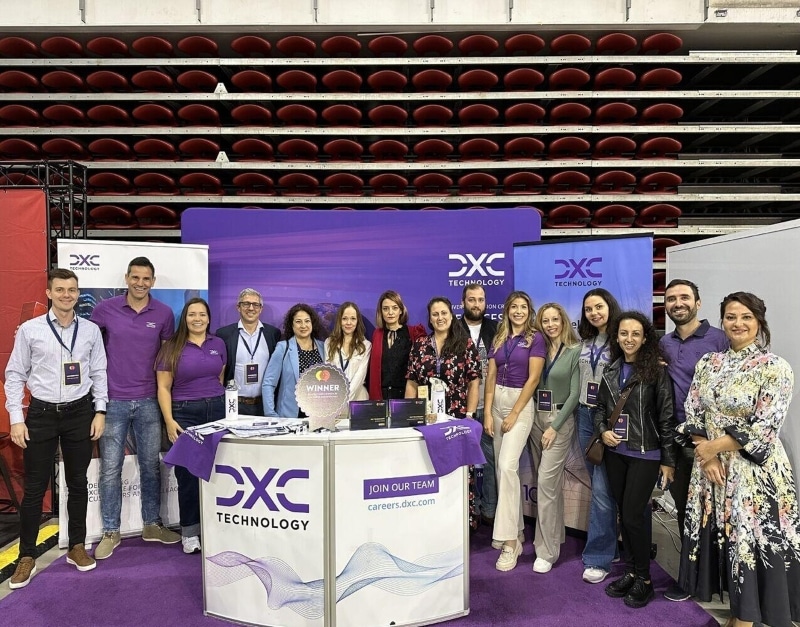
DXC operates in more than 130 countries and is one of the largest IT services organizations in the world. For healthcare, the company covers the full lifecycle: modernizing clinical information systems, cloud migration, AI integration into clinical workflows, and cybersecurity for regulated environments. Core focus areas include HL7 FHIR interoperability, administrative automation for insurance payers, and helping large providers move off legacy infrastructure without breaking what's already running.
What sets DXC apart from pure-play vendors is breadth. The IT solutions for healthcare industry that DXC delivers span consulting, managed services, and cybersecurity — built on partnerships with Microsoft Azure Health Data Services, Oracle Health, and SAP. After the wave of ransomware attacks on medical infrastructure in 2024–2025, that security layer stopped being a checkbox and became a core requirement. DXC had the architecture for it already in place.
Strengths:
- Hospital modernization
- Cloud migration for regulated industries
- Cybersecurity architecture
- Insurance payer platforms
Benefit for Post-Acute Care:
Better data sharing between hospitals, labs, and long-term care providers reduces fragmentation.
Relevance to Long-Term Care:
Secure, interoperable systems reduce ransomware exposure and ensure data exchange between hospitals and post-acute facilities.
Impact on Families:
- Faster prior authorizations
- Improved claims accuracy
- Reduced delays in extended care services
The company is a major player in health sciences and claims processing through its TriZetto platform.
When claims process smoothly, transitions to skilled nursing or home health services happen faster.
Key differentiators:
- Genuine global scale — active deployments with NHS England, Australian health networks, and Scandinavian public sector organizations
- Specialized payer solutions for insurance companies processing millions of claims per month
- Proprietary cloud migration methodology designed specifically for regulated industries
- SAP, Microsoft, Oracle, and ServiceNow partnerships bundled into a single delivery portfolio
2. Cognizant Health Sciences

With annual revenues above $19 billion, Cognizant's Health Sciences division is one of its largest by revenue. The company placed two clear bets: RPA for automating medical billing and prior authorizations, and the Cognizant Neuro AI platform for clinical data analysis. Clients include major U.S. insurers like Cigna and regional hospital networks across North America.
The TriZetto platform — acquired back in 2014 — became the standard for insurance claims processing at dozens of American payers. It's a rare case of an outsourcer actually owning a product with real market share, not just selling development capacity.
3. Persistent Systems

Pune-based Persistent Systems often gets overlooked next to Infosys and TCS, but in digital health it has built a solid reputation as one of the serious custom healthcare software development companies for interoperability work. The company specializes in FHIR implementations, interoperability platform builds, and patient engagement applications. Persistent is a certified HL7 partner and participates in the standards working groups — meaning its engineers actually read the spec.
In 2024, Persistent introduced its Healthcare Data Fabric — an architectural solution for unifying data from heterogeneous sources (EHR systems, labs, wearables) into a single semantic model. The prototype was demoed at HIMSS 2024 in Orlando and generated real interest from prospective clients, not just polite conference applause.
4. CitiusTech
Focused exclusively on healthcare IT. Founded in Mumbai in 2005, CitiusTech does one thing: healthcare IT. Nothing else. That focus shows — with over 8,500 specialists, the engineers here actually understand the difference between CPT and HCPCS codes, know what prior authorization means in practice, and don't confuse HIPAA with GDPR. That kind of domain depth is genuinely hard to find at scale.
The portfolio covers value-based care, revenue cycle management, and population health analytics. The SEMBL platform for Healthcare Data Management standardizes clinical vocabularies and ensures semantic data compatibility across systems — a non-trivial problem given that the US alone runs on 50+ different EHR platforms.
For long-term care facilities operating under value-based reimbursement models, accurate data reporting directly affects financial stability.
5. Orion Health

New Zealand-based Orion Health has been known for Health Information Exchange platforms across more than 30 countries. Their Amadeus HIE platform runs in large regional networks in Canada, Denmark, and New Zealand. Not the biggest player on the list — but wherever real interoperability between independent providers is needed, Orion shows up in shortlists far more often than its size would suggest.
In 2025, the company announced an AWS partnership to move Amadeus to cloud-native architecture. Among healthcare software development companies, Orion is one of the few that deliberately avoids the mass market and focuses on complex integration projects — which means less revenue but a much sharper product.
Industry Pressures Driving Outside Partnerships
Healthcare organizations continue to face:
- Interoperability mandates under the 21st Century Cures Act
- Expanding cybersecurity threats
- Staffing shortages in specialized IT roles
- Aging legacy systems
The 2024 ransomware attack on Change Healthcare disrupted claims processing nationwide and triggered widespread security audits across the industry. For long-term care providers and home health agencies, cybersecurity is no longer optional. A breach can interrupt billing, medication management, and resident records.
Large organizations increasingly turn to specialized development firms for:
- FHIR implementation
- Secure API architecture
- HIPAA-compliant cloud migration
- Legacy system modernization
Choosing a Partner and Reading the Market
For healthcare providers the healthcare software market in 2026 isn't a build-vs-outsource decision. It's about finding the right partnership configuration for a specific problem. A large system integrator makes sense for multi-year transformation programs with complex SLAs and a need for global coverage. A 200-person shop that lives entirely inside FHIR and HL7 might be the better call for a specific integration project — and often delivers faster.
Practical checklist when evaluating healthcare software development companies:
- Verify experience in your specific segment — payer vs. provider vs. pharma have very different requirements
- Ask for specific FHIR or HL7 v2 implementations with project references, not generic 'healthcare experience' claims
- Confirm the vendor has a documented PHI handling process and will sign a BAA
- Match team size and specialization to the actual scale of the project
- Find out who will actually be on the team — large companies sometimes win bids with senior staff and deliver with mid-levels
Technologically, the market is moving toward greater modularity and standardization. FHIR R5 is gaining traction, Smart on FHIR apps are becoming the de facto standard for clinical applications, and cloud providers — AWS HealthLake, Google Cloud Healthcare API, Azure Health Data Services — are turning into commodity infrastructure. That lowers the entry barrier for new vendors while raising the premium on what actually differentiates: AI components and deep domain expertise.
The next two to three years will sort out who stays in the top tier and who gets displaced by leaner, AI-native teams. Healthcare has always been conservative in vendor selection — patient data is too sensitive for experimentation. But regulatory pressure, cyber threats, and the genuine capabilities of new platforms are forcing even the most cautious organizations to accelerate. Whether that's good or just necessary is a separate question.
What This Means for You and Your Family
You may never hear the names of these companies.
But their systems determine:
- Whether your parent’s records follow them from hospital to rehab
- Whether a home health nurse receives updated care instructions
- Whether wearable health alerts reach a physician
- Whether a long-term care facility is protected from cyber disruption
- Whether insurance approvals delay care
Technology is no longer just back-office infrastructure. It directly affects patient safety, care coordination, staffing stability, and family stress.
If your loved one needed a hospital transfer tomorrow, would every provider involved see the same accurate, up-to-date information?
In 2026, that question depends as much on software architecture as it does on clinical skill.

Sponsored