Helen Reddy Dies With Dementia at Age 78
About This Article
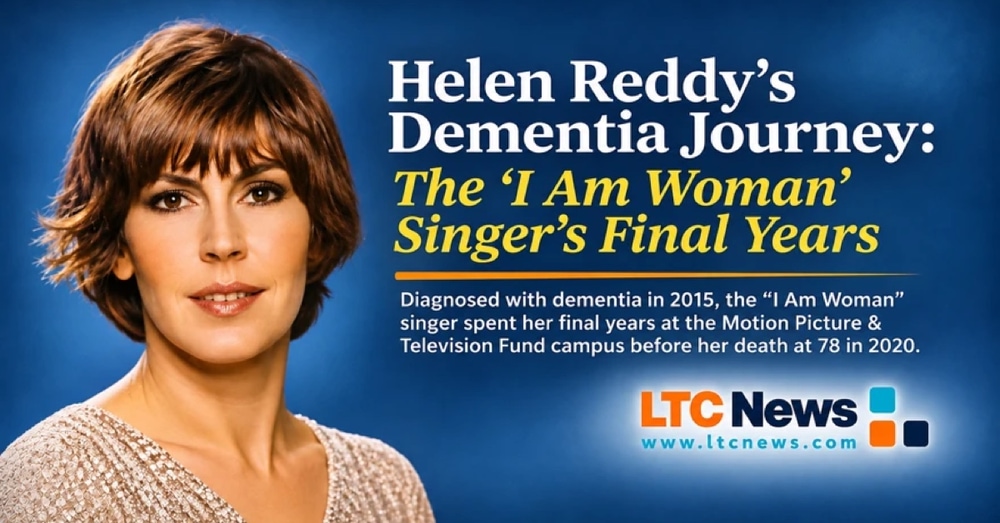
Helen Reddy, the Australian singer behind the 1972 anthem “I Am Woman,” died Sept. 29, 2020, in Los Angeles at age 78. She was diagnosed with dementia in 2015 and spent her final years on the Motion Picture & Television Fund (MPTF) campus in Woodland Hills, California, a care community for entertainment industry members.

James Kelly
LTC News staff writer specializing in long-term care and aging.
Table of Contents
- How did Helen Reddy die?
- When was Helen Reddy diagnosed with dementia?
- Where did Helen Reddy live in her final years?
- Helen Reddy’s music career and hit songs
- Musicians who lived with dementia
- How common is dementia today?
- What families can learn from Helen Reddy’s story
- Planning before your health declines is key
You probably remember the voice before you remember the face. If you grew up with Top 40 radio in the 1970s, Helen Reddy was part of the soundtrack. “I Am Woman.” “Delta Dawn.” “Angie Baby.”
The woman who sang “I am strong, I am invincible” spent her last five years living with dementia. Her story still draws readers today because so many families are living a version of it right now.
How did Helen Reddy die?
Reddy died on the afternoon of Sept. 29, 2020, in Los Angeles. Her children, Traci and Jordan, announced her death in a statement posted to her official fan page.
“It is with deep sadness that we announce the passing of our beloved mother, Helen Reddy, on the afternoon of September 29th, 2020, in Los Angeles,” the statement said.
She was a wonderful mother, grandmother and a truly formidable woman. Our hearts are broken. But we take comfort in the knowledge that her voice will live on forever.”
The family did not give a cause of death. Her former husband and manager, Jeff Wald, said their daughter Traci spent the morning with her and that Reddy died soon after, under the care of the Motion Picture & Television Home.
When was Helen Reddy diagnosed with dementia?
Reddy was diagnosed with dementia in 2015. That August, entertainment journalist Alan Duke reported on his site Lead Stories that she had been diagnosed and moved into a Los Angeles care facility, interrupting a planned career comeback. Duke cited two sources, including her son. One described the illness as early stage, with Reddy asking the same question every few minutes. The other described more advanced symptoms: misplacing things and then suspecting someone had stolen them.
Both symptoms are common in dementia. Repeating questions reflects short-term memory loss. Misplacing items and blaming others can come from confusion and a changing sense of what is real. The family publicly confirmed the move to a care facility at the time but initially denied the dementia diagnosis. Major news outlets, including NPR, Variety and The Guardian, reported the 2015 diagnosis when she died.
The specific type of dementia was never made public.
Where did Helen Reddy live in her final years?
Reddy was cared for on MPTF’s Wasserman Campus in Woodland Hills, California. News reports at the time of her death placed her at the Samuel Goldwyn Jr. Center for Behavioral Health, a 12-bed unit for adults 55 and older that treats conditions including dementia with behavioral symptoms.
MPTF has cared for people who worked in film and television since 1921. Its campus includes independent and assisted living, skilled nursing and memory care. Its motto, “We take care of our own,” reflects a safety net few industries offer.
Most families don’t have an MPTF. They have to build their own plan.
The illness did not silence her right away. In January 2017, Reddy sang “I Am Woman” at the Women’s March in Los Angeles, Lead Stories reported, while she was still living in care. Music memory often lasts long after other memories fade, as fans also saw with Glen Campbell and Tony Bennett.
Helen Reddy’s music career and hit songs
Reddy’s voice dominated pop radio in the 1970s. Her 1971 cover of “I Don’t Know How to Love Him” from “Jesus Christ Superstar” became her first U.S. hit, reaching No. 13 on the Billboard Hot 100.
Over the decade she placed 15 singles in the Hot 100 top 40. Six reached the top 10, and three went to No. 1 on the U.S. Billboard Hot 100:
- “I Am Woman”: No. 1 on Dec. 9, 1972
- “Delta Dawn”: No. 1 on Sept. 15, 1973
- “Angie Baby”: No. 1 on Dec. 28, 1974
“Leave Me Alone (Ruby Red Dress)” peaked at No. 3 on the Hot 100 in early 1974, though it topped the rival U.S. Cash Box chart. She also had eight No. 1 hits on Billboard’s U.S. Adult Contemporary chart, then called Easy Listening.
“I Am Woman,” which she co-wrote with Ray Burton, won the Grammy for Best Female Pop Vocal Performance in 1973. She was the first Australian to win a Grammy. She was the world’s top-selling female vocalist in 1973 and 1974.
Reddy also acted. She played a singing nun in “Airport 1975” and starred in Disney’s “Pete’s Dragon” in 1977. Her life story became the 2019 film “I Am Woman,” released in the U.S. in September 2020, weeks before her death.
Musicians who lived with dementia
Reddy joined a long list of musicians whose careers were cut short by Alzheimer’s disease or another form of dementia:
- Tony Bennett, singer: Diagnosed with Alzheimer’s in 2016 and went public in 2021. Died July 21, 2023, at 96. [Link: LTC News, “Singer Tony Bennett Loses Fight with Alzheimer’s”]
- Malcolm Young, AC/DC co-founder: Left the band in 2014 for dementia treatment. Died Nov. 18, 2017, at 64.
- Glen Campbell, country star: Revealed his Alzheimer’s diagnosis in 2011 and documented his farewell tour in “Glen Campbell: I’ll Be Me.” Died Aug. 8, 2017, at 81.
- John Mann, Spirit of the West singer-songwriter: Diagnosed with early-onset Alzheimer’s at 51. Died Nov. 20, 2019, at 57.
- Perry Como, singer and TV host: Lived with Alzheimer’s for about two years. Died May 12, 2001, at 88.
- Sir Rudolf Bing, Metropolitan Opera general manager: Died of complications of Alzheimer’s on Sept. 2, 1997, at 95.
- Kay Swift, composer of “Fine and Dandy”: Diagnosed with Alzheimer’s in 1991. Died Jan. 28, 1993, at 95.
- Thomas A. Dorsey, the “Father of Gospel Music”: Died of complications of Alzheimer’s on Jan. 23, 1993, at 93.
- Aaron Copland, composer: Died of Alzheimer’s and respiratory failure on Dec. 2, 1990, at 90.
Malcolm Young and John Mann show that dementia is not only a disease of very old age. Early-onset dementia can strike in your 40s or 50s, in the middle of a career.
How common is dementia today?
An estimated 7.4 million Americans age 65 and older are living with Alzheimer’s disease in 2026, according to the Alzheimer’s Association’s 2026 Alzheimer’s Disease Facts and Figures report. That number is projected to reach 13.8 million by 2060. Alzheimer’s is the most common cause of dementia, but not the only one. Dementia is an umbrella term for a decline in memory, thinking and reasoning serious enough to interfere with daily life.
The need for care extends well beyond dementia. The U.S. Department of Health and Human Services (HHS) estimates that 56 percent of Americans turning 65 will need long-term care at some point. HHS defines that as needing help with two or more of six activities of daily living for 90 days or more, or needing substantial supervision due to severe cognitive impairment. [Link: LTC News glossary, 56 percent statistic]
What families can learn from Helen Reddy’s story
Reddy had something most families don’t: an industry-backed care community ready to take her in. If you or a parent develops dementia, the plan has to come from you.
Watch for early signs. Repeating questions, misplacing things, accusing others of theft and getting lost in familiar places are all reasons to see a doctor. An early diagnosis gives you time to make decisions while your loved one can still take part.
Understand the levels of care. Dementia care often moves from help at home to assisted living to a secure memory care unit or nursing home. Costs rise at each step. Use the LTC News Cost of Care Calculator to see current costs where you live, and the Caregiver Directory to find home care, assisted living and memory care providers, in addition to nursing homes.
Know what Medicare won’t cover. Medicare does not pay for long-term custodial care, the everyday help with bathing, dressing and supervision that dementia eventually requires. Medicaid pays only after you spend down most of your savings.
Plan while you’re healthy. Long-Term Care Insurance pays for care at home or in a facility, including memory care. Most people apply between 47 and 67, and you have to qualify on your health. A dementia diagnosis or early cognitive symptoms will make you ineligible. Learn more in the LTC News Learning Center. Be sure to find a qualified Long-Term Care Insurance specialist to get accurate quotes on traditional LTC Insurance, hybrid LTC Insurance, and other extended care options.
Get your legal documents in order. A durable power of attorney and a health care power of attorney let someone you trust act for you if you can no longer decide for yourself.
Interestingly enough, music has been shown to benefit those who have dementia. MUSIC & MEMORY® is a non-profit organization that has worked in this area. The group creates music playlists for those with dementia who live in long-term care facilities. These music playlists have helped patients reduce their dependence on antipsychotic medication. The music has shown to lessen their disruptive behavior. Research suggests that music-based therapy probably improves depressive symptoms and may improve overall behavioural problems by the end of treatment.
Music therapy is unlikely to significantly impact agitation, aggression, emotional well-being, or cognition but, when compared to other interventions, there is some evidence that it may improve social behaviour and could decrease anxiety.
Why it matters for later stages: Even when someone with dementia can no longer speak they may still be able to hum or play along with music. That connects to Helen Reddy singing “I Am Woman” in 2017, and to Glen Campbell and Tony Bennett performing well into their illness.
Planning before your health declines is key
You should avoid a family crisis and start now planning for the future costs and burdens of aging, including the impact of dementia. You will have more affordabel otpiosn when youa re younger and have better health.

Sponsored