Maurice White Dies at Age 74
About This Article
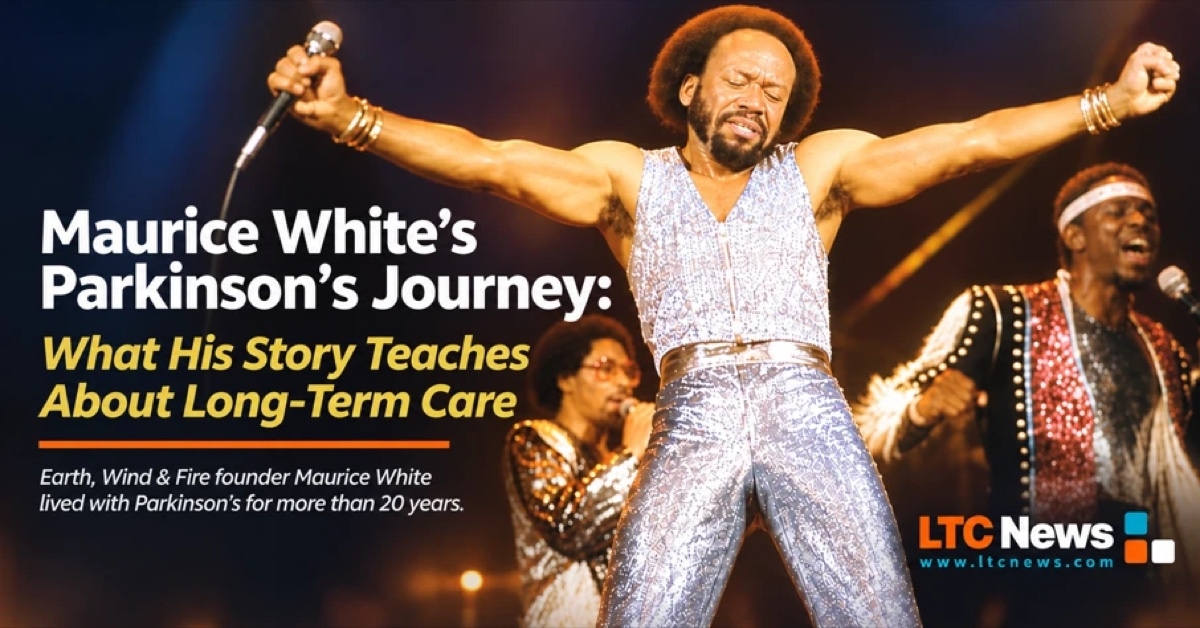
Maurice White, founder of Earth, Wind & Fire, was diagnosed with Parkinson’s disease in 1992. He kept it private until 2000 and died on Feb. 3, 2016, at age 74. About 1.1 million Americans live with Parkinson’s, and nearly 90,000 more are diagnosed each year.
James Kelly
LTC News staff writer specializing in long-term care and aging.
Table of Contents
- Who Was Maurice White?
- When Did Maurice White Reveal He Had Parkinson’s?
- What Is Parkinson’s Disease?
- How Many Americans Have Parkinson’s Disease?
- Can Parkinson’s Start Before Age 50?
- How Much Does Parkinson’s Cost?
- Does Medicare Pay for Long-Term Care for Parkinson’s?
- How Can You Plan Ahead for Long-Term Care?
You probably know the songs. “September.” “Shining Star.” “Boogie Wonderland.” You might not know that the man behind them spent the last two decades of his life living with Parkinson’s disease, a progressive condition that slowly takes away a person’s ability to move freely and live on their own.
Maurice White’s story is about music. It is also about something millions of families face quietly: what happens when a chronic illness means you need help with everyday life.
Who Was Maurice White?
Maurice White founded Earth, Wind & Fire and served as its main songwriter, producer and co-lead singer alongside Philip Bailey. The band sold more than 90 million albums. White was nominated for 21 Grammy Awards and won seven.
He was born in Memphis on Dec. 19, 1941, and moved to Chicago as a teenager. There he built his career as a session drummer for Chess Records, playing behind blues and R&B artists such as Etta James and Buddy Guy, before joining the Ramsey Lewis Trio. He later moved to Los Angeles, where Earth, Wind & Fire took shape.
The group blended jazz, funk, gospel, soul and African influences into a big, brass-heavy sound. Its live shows were famous for elaborate staging and dazzling costumes. White also produced records for other artists, including Barbra Streisand and Cher, and co-wrote and co-produced “Best of My Love,” a No. 1 hit for The Emotions.
The band entered the Rock and Roll Hall of Fame in 2000. White joined the Songwriters Hall of Fame in 2010, and the group received Kennedy Center Honors in 2019.
When Did Maurice White Reveal He Had Parkinson’s?
White went public in 2000, just days before Earth, Wind & Fire’s Rock and Roll Hall of Fame induction. He was 58. He had been diagnosed in 1992 and kept it private for about eight years. His symptoms dated back to the late 1980s.
White stopped touring with the band in the mid-1990s, though he stayed active writing and producing. He told Rolling Stone that the disease played a role.
“With Parkinson’s, you do need more rest,” White said. He added that three decades of travel had also worn him down.
White died in his sleep at his Los Angeles home on Feb. 3, 2016. He was 74.
What Is Parkinson’s Disease?
Parkinson’s disease is a progressive brain disorder. It damages nerve cells that produce dopamine, a chemical messenger the brain needs for smooth, controlled movement.
Common movement symptoms include:
- Tremor, often starting in one hand
- Slowness of movement
- Muscle stiffness
- Trouble with balance and walking
Many people also have symptoms that aren’t about movement, such as sleep problems, depression, constipation and changes in thinking or memory. Parkinson’s is the second-most common neurodegenerative disease after Alzheimer’s. There is no cure, but medication, exercise and therapy can help manage symptoms for years.
As the disease advances, many people need help with daily activities like bathing, dressing and getting around safely. That help is long-term care.
How Many Americans Have Parkinson’s Disease?
According to the Parkinson’s Foundation, about 1.1 million people in the United States live with Parkinson’s. That number is expected to reach 1.2 million by 2030. Nearly 90,000 Americans are diagnosed each year. That figure comes from a 2022 study backed by the Parkinson’s Foundation and is about 50 percent higher than the older estimate of 60,000 a year.
Age is the biggest risk factor, and men are 1.5 times more likely than women to have Parkinson’s.
Can Parkinson’s Start Before Age 50?
Yes. The Parkinson’s Foundation defines young-onset Parkinson’s disease (YOPD) as Parkinson’s that starts before age 50. An estimated 4 percent of people with Parkinson’s are diagnosed before that age. Most people develop symptoms at 50 or older.
Michael J. Fox is the best-known example. He was diagnosed in 1991, at age 29.
Which Other Well-Known People Have Had Parkinson’s?
Like White, many public figures have spoken openly about living with Parkinson’s, which helps raise awareness:
- Michael J. Fox, actor and founder of The Michael J. Fox Foundation for Parkinson’s Research
- Muhammad Ali, boxing champion
- Alan Alda, the “M*A*S*H” star, who announced his diagnosis in 2018
- Neil Diamond, who stopped touring after his diagnosis in 2018
- Ozzy Osbourne, who announced his diagnosis in 2020 and died in July 2025
Not every Parkinson’s-like condition is Parkinson’s disease. Former President George H.W. Bush, for example, had vascular parkinsonism. It causes similar walking and balance problems but usually comes from small strokes. Getting an accurate diagnosis from a movement disorder specialist matters, because different conditions respond differently to treatment.
How Much Does Parkinson’s Cost?
A study led by The Michael J. Fox Foundation put the economic burden of Parkinson’s in the U.S. at about $52 billion in 2017. About $25.4 billion was direct medical costs, such as hospital stays and medication. The other $26.5 billion was indirect and nonmedical costs, including lost wages, early retirement and time spent by family caregivers. The Parkinson’s Foundation projects the total will reach $80 billion a year by 2037.
Families feel those costs most once someone needs ongoing help at home or in a care facility. Costs vary a lot by location and type of care. You can look up local prices with the LTC News Cost of Care Calculator and find providers in the LTC News Caregiver Directory.
Does Medicare Pay for Long-Term Care for Parkinson’s?
Generally, no. Medicare covers doctor visits, hospital care, prescriptions under Part D and limited short-term skilled care. It does not pay for custodial care, which is hands-on help with daily activities such as bathing, dressing and eating, when that is the only care someone needs.
Regular health insurance doesn’t cover it either. Families usually pay out of pocket, rely on unpaid family caregivers, spend down savings to qualify for Medicaid or use Long-Term Care Insurance.
How Can You Plan Ahead for Long-Term Care?
Parkinson’s is one reason people need long-term care. It is far from the only one. Federal research from the U.S. Department of Health and Human Services (HHS) finds that 56 percent of Americans turning 65 will need long-term care. That means needing help with at least two of six activities of daily living for 90 days or more, or substantial supervision because of severe cognitive impairment.
Timing matters. Long-Term Care Insurance requires medical underwriting, so you have to qualify based on your health.
Once someone is diagnosed with Parkinson’s, they generally can’t qualify for Long-Term Care Insurance. The best time to plan is while you’re healthy, usually in your 40s, 50s or early 60s.” — Matt McCann, CLTC, a well known expert on long-term care planning and former radio personality who played many Earth, Wind & Fire songs on the radio.
If you or a parent already has a policy, an LTC policy will help pay for care at home, in assisted living or in a nursing home once benefit requirements are met. A specialist can help you compare options from multiple insurers. LTC News and Amada Senior Care provide free no cost and no obligation help in processing a claim for any LTC Insurance policy — File a Long-Term Care Insurance Claim.

Sponsored