How to Choose a Senior Living or Long-Term Care Community Wisely
About This Article
Aging and declining health happen fast. Understanding how to compare senior living communities with health care and long-term care services, their costs, safety features, and lifestyle now will make life easier, especially before making a life-changing move.

Beth Rush
Beth Rush writes about health and wellness to help readers learn how to make healthier lifestyle choices.
We all have a mental picture of what "old age" looks like, and usually, it’s someone else. We tell ourselves, no matter our age, that senior living is a bridge we’ll cross much further down the road. Long-term care? Not going to happen. But often, the road gets shorter faster than we expect.
It usually starts with a "what if." What if a sudden illness or a fall changes everything? What if the house you’ve loved for decades starts to feel like a burden rather than a sanctuary? Or what if you’re simply tired of managing the logistics of daily life and want to spend your energy on the people and hobbies that actually matter?
The truth is, choosing a senior living community isn’t a sign of "giving up"—it’s a strategic move to protect your future. It’s a decision that sits at the intersection of your finances, your health, and your happiness.
The Evolution of Choice
Modern senior living has moved far beyond the "nursing homes" of the past. To make an informed choice, you need to weigh three distinct factors:
| Factor | What It Covers |
| The Care Spectrum | Transitioning from total independence to assisted support or memory care. |
| Financial Strategy | Understanding entrance fees, monthly rentals, and long-term asset protection. |
| Lifestyle Fit | Evaluating the social pulse, dining quality, and daily autonomy of the campus. |
This isn't just a real estate transaction; it's a plan for your future quality of life, and that of your family. Remember, aging and long-term care affect not only you but also your loved ones.
Senior living communities, including assisted living, memory care, and nursing homes, that offer health care services and help with everyday living activities will provide safety, structure, and social connection.
But choosing the right one requires careful evaluation. This is not just a housing decision. It is a lifestyle, financial, and long-term care planning decision.
By asking the hard questions now, while you have the clarity and time to do so, you ensure that your next chapter is defined by your choices, not by a crisis.
Understanding the Different Levels of Senior Living
Not all senior living communities are the same. The right choice depends on your current health and what you may need in the future. Independent living communities are designed for adults 55 and older who are largely independent.
These communities typically offer:
- Maintenance-free housing
- Dining options
- Transportation services
- Housekeeping
- Social programming
Health care and long-term care services are usually not provided on-site, but residents may arrange in-home care services on their own.
Independent living works well if you or a loved one wants convenience and social connection without the need for medical supervision and help with daily activities.
You pay for independent living on your own, sometimes by purchasing a condo in a development, or renting in a community.
Assisted Living
Assisted living supports older adults who need help with activities of daily living (ADLs), such as:
- Bathing
- Dressing
- Eating
- Toileting
- Personal Hygiene
- Medication management
- Mobility support
According to the National Center for Assisted Living, nearly 1 million Americans live in assisted living communities. These settings provide housing, personal care, and 24-hour supervision but do not typically offer the intensive medical services found in nursing homes.
Some communities also include memory care for those living with mild Alzheimer’s disease or other forms of dementia.
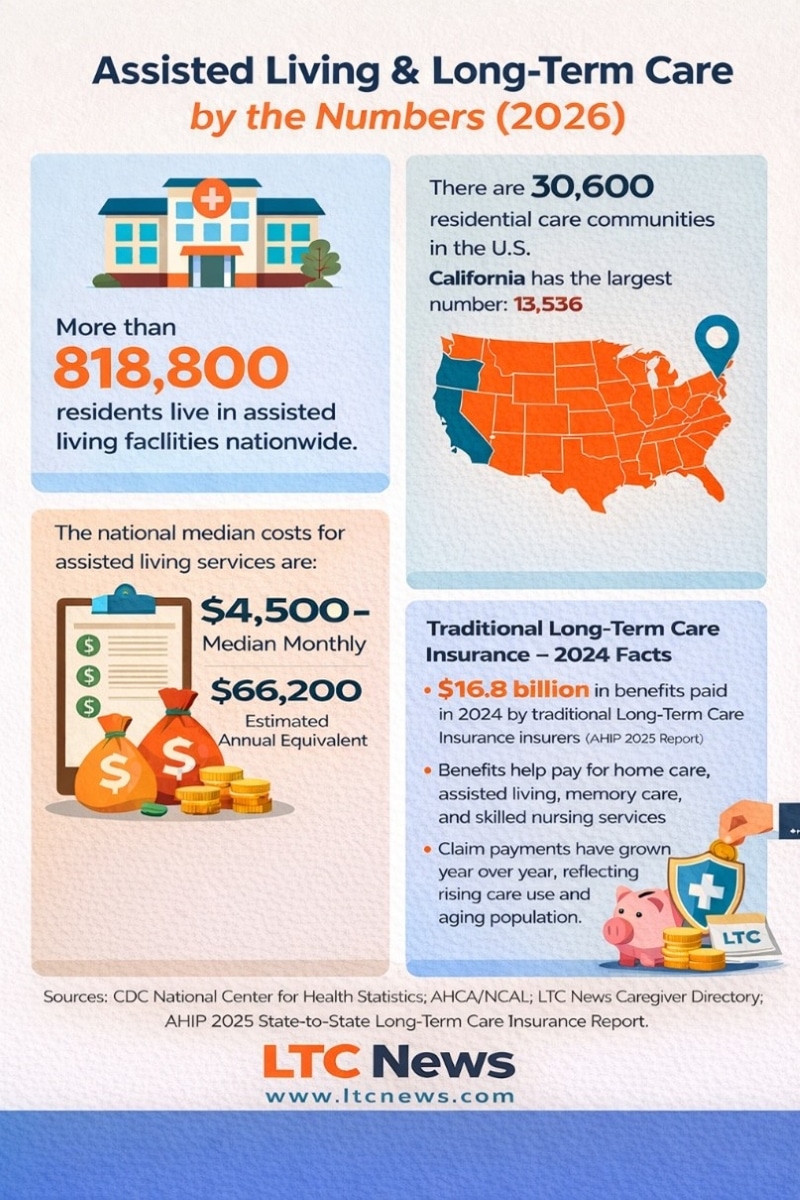
You will pay for assisted living from your own income and assets, or with Long-Term Care Insurance. Remember, you must have an LTC policy before you need an assisted living facility or other extended care service.
Memory Care: Specialized Support for Those with Cognitive Decline
Memory care is a specialized level of long-term care designed for individuals living with Alzheimer’s disease or other forms of dementia.
An estimated 7.2 million Americans age 65 and older are living with Alzheimer’s dementia, the highest number on record, according to the Alzheimer's Association.
Memory care can exist as:
- A standalone memory care community
- A secured wing within an assisted living facility
- A dedicated unit inside a skilled nursing facility
The environment is structured to provide safety, routine, and cognitive support.
What Makes Memory Care Different?
Memory care communities are specifically designed for residents with significant memory loss. Features typically include:
- Secured entrances and exits to prevent wandering
- Structured daily routines
- Specially trained staff in dementia care
- Lower staff-to-resident ratios
- Cognitive stimulation programs
- Calm, simplified layouts to reduce confusion
Unlike traditional assisted living, memory care staff receive training in managing behavioral changes such as agitation, sundowning, and communication challenges.
Skilled Nursing (Nursing Homes)
Skilled nursing facilities provide 24/7 skilled medical care, including supervision and care for those with significant memory loss.
This level of care is appropriate if someone needs:
- Ongoing IV medications
- Complex wound care
- Ventilator or respiratory therapy
- Daily physical, occupational, or speech therapy
These communities are medically regulated and staffed with licensed nurses and rehabilitation professionals.
Before choosing any community, confirm it can meet both current needs and potential future needs.
Example: A Closer Look: Cornwall Manor in Central Pennsylvania
There are numerous senior communities throughout the country. One example is Cornwall Manor in Central Pennsylvania. Located in Cornwall, Pennsylvania, in Lebanon County near Lancaster and Hershey, Cornwall Manor operates two campuses: the 85-acre Buckingham Campus and the 109-acre Woods Campus.
This independent living community emphasizes whole-person wellness, offering:
- On-site Wellness Office
- Campus nurse and physicians
- Access to therapy services
- Fitness center and therapeutic pool
- Walking trails and green space
- Chapel and hobby programs
- Pet-friendly housing
- Dining and transportation services
As with any community, prospective residents should independently verify services, pricing, and contract terms.
Finding Quality Senior Living and Extended Care Communities for a Loved One
It is the heaviest weight a child or a spouse can carry: the realization that the person who once took care of you can no longer safely take care of themselves.
Suddenly, you aren't just a family member; you are a protector, a researcher, and a decision-maker for a life that isn't your own. It’s a role fueled by the deep desire to honor their dignity while ensuring their safety. You want them to have more than just a room—you want them to have a life.
This is an emotional time. Before you dive into the paperwork, acknowledge the transition you are leading. This journey is rarely a straight line, and it often involves balancing three competing needs:
- Dignity vs. Safety: Finding the sweet spot where they are protected without feeling policed.
- Guilt vs. Reality: Understanding that professional care isn't a failure of your love—it’s an extension of it.
- Legacy vs. Logistics: Preserving their story and personality within the framework of a structured community.
Use the LTC News Caregiver Directory
Finding providers randomly online can be overwhelming. The LTC News Caregiver Directory allows families to search by location and level of care.
Unlike surveys that rely on limited provider participation, the directory surveys providers monthly to reflect current availability and pricing.
You can:
- Compare independent senior communities (if appropriate), assisted living, memory care, and skilled nursing options
- View regional cost ranges
- Identify home care agencies if aging in place is still possible
- Contact providers directly
Using one centralized, regularly updated source reduces confusion and saves time during a stressful period.
Determine If Your Loved One Has Long-Term Care Insurance
Many adult children do not know whether a parent has a Long-Term Care Insurance policy.
Ask directly. Look for:
- Policy documents in financial files
- Annual premium notices
- Statements from insurance carriers
- Business cards from an LTC Insurance specialist
- Advisors listed in estate planning documents
If a policy exists, do not assume it only covers nursing homes. Most modern policies cover:
- In-home care
- Adult day care
- Assisted living
- Memory care
- Nursing homes
Call the insurance company and request:
- A copy of the policy
- A summary of benefits
- Clarification on elimination periods
- Daily or monthly benefit limits
- Benefit triggers (ADLs or cognitive impairment)
You can contact LTC News, working with Amada Senior Care, who will help you file the claim so your loved one can get their benefits and care they deserve — File a Long-Term Care Insurance Claim.
Understanding this early can dramatically make things easier for everyone involved.
How to Use a Long-Term Care Insurance Policy
Most LTC Insurance policies activate when:
- A licensed health care provider certifies the need for help with two or more ADLs, or
- Cognitive impairment is documented.
Steps typically include:
- Notify the carrier of a potential claim.
- Submit physician certification.
- Complete an assessment (often by a nurse).
- Track the elimination period.
- Submit invoices for reimbursement.
Keep detailed records. Claims are smoother when documentation is organized and timely.
If the policy was purchased years ago, review whether it includes inflation protection. That will impact how much coverage is available today.
When Should You Start Looking?
Earlier than you thought. Planning before a health or age crisis gives you:
- More housing options
- Better financial planning
- Greater control over the decision
Choosing a senior living community with health care and extended care services is not just about aging. It is about preserving independence, protecting assets, and maintaining quality of life.
Take your time. Visit multiple communities with your loved one. Review finances carefully.
For yourself, exploring Long-Term Care Insurance as part of your retirement planning will make aging easier on you and your loved ones. Most people acquire an LTC policy between the ages of 47 and 67.
For an older family member, they deserve a place that supports their health, respects their independence, and allows them to live life on their terms.

Sponsored