How the Summer of ’76 Connects Aging in America Today

About This Article
The teenagers and young adults who celebrated America’s Bicentennial in 1976 are now entering the years when long-term care planning becomes urgent. New data on caregiving, assisted living, and Long-Term Care Insurance shows why aging Americans and their families are confronting difficult financial and emotional realities today.

James Kelly
LTC News staff writer specializing in long-term care and aging.
Table of Contents
- The Soundtrack of a Generation Now Facing Aging Reality
- Three Networks, One Living Room
- Movies That Defined a Generation
- The Long-Term Care Reality, Nearly 50 Years Later
- From 13 to 73: What the Bicentennial Generation Is Navigating Now
- The Crisis Starts – Fireworks Begin
- The Waltons Had a Plan. Most Families Don’t.
- The Fireworks You Don’t Plan For
- Take the Next Step
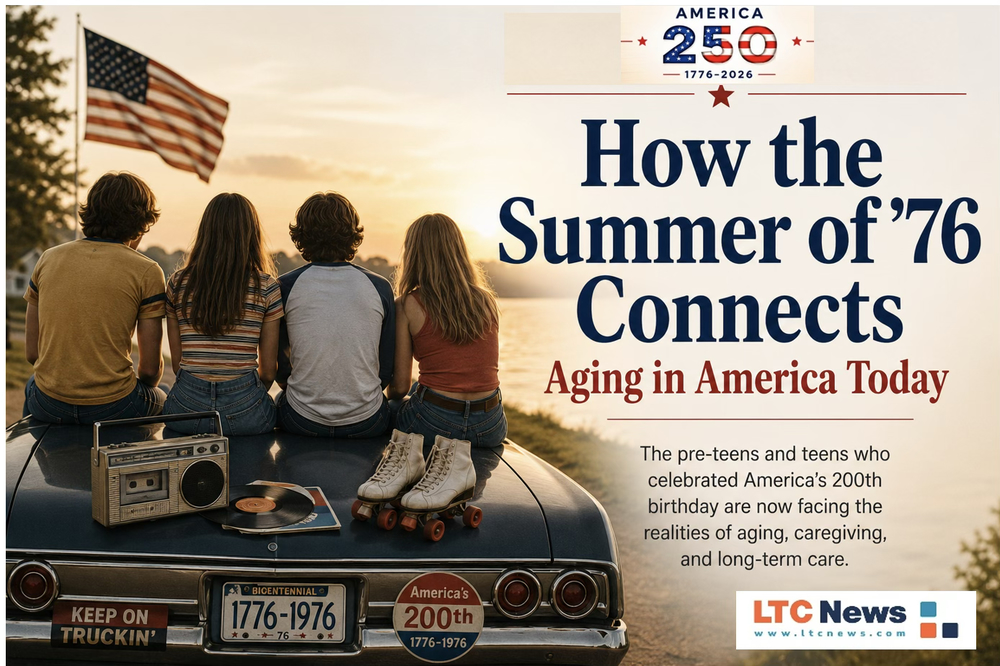
The summer of 1976 felt like America celebrating itself. Disco ruled the dance floor. Rock blasted from car radios. Country music was entering its outlaw era. Fireworks filled the sky as the nation marked 200 years of independence.
Do you remember where you were that summer?
This July 4th, America marks another milestone — its 250th birthday. From fireworks and concerts to gatherings across the country, America250 will spark three days of shared celebrations from July 3 to July 5, with signature events in New York City, Philadelphia, and communities nationwide. Tall ships will return to American harbors. Families will spread out blankets and watch the sky light up, just as they did 50 years ago.
The generation that was there for both celebrations has a unique vantage point. Maybe you were 13, pressing your ear against a transistor radio while Wings dominated the charts with “Silly Love Songs.” Maybe you were 17, standing in line to see Rocky and cheering for a small-time Philadelphia boxer who refused to quit. Or maybe you were 21, finishing college as America celebrated its Bicentennial with tall ships in New York Harbor, Olympic headlines from Montreal, and patriotic fireworks lighting up the night sky.

The summer of 1976 felt endless. But nearly 50 years later, the generation shaped by that moment is entering a very different chapter of life.
The youngest middle schoolers from the Bicentennial are now in their early 60s. Teenagers from that July 4th celebration are approaching or already past 65. College students dancing to Elton John, Donna Summer, and the Bee Gees are now in their early 70s.
And many are confronting something nobody thought about during that celebration-filled summer: aging, caregiving, retirement uncertainty, and the growing likelihood of needing long-term care.
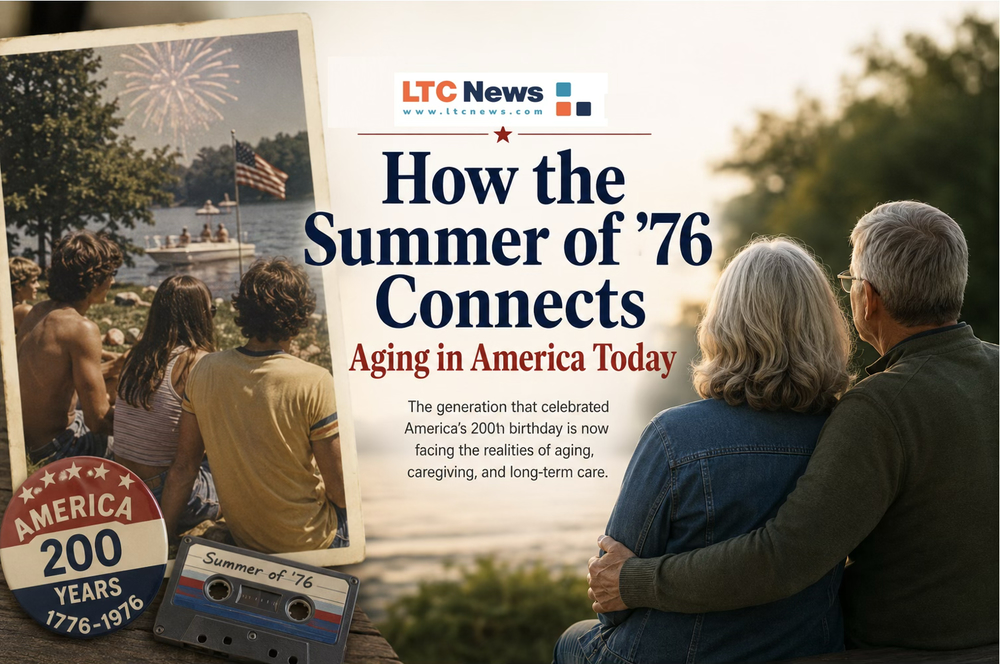
Many of their children are now planning their own retirements while simultaneously helping aging parents, often stepping into caregiving roles themselves. As America approaches its 250th birthday on July 4, 2026, this is more than a moment to look back. It is also a moment to think ahead.
The Soundtrack of a Generation Now Facing Aging Reality
The Billboard charts of 1976 captured a country changing in real time.
Paul McCartney’s Wings topped the year-end charts with “Silly Love Songs.” Elton John and Kiki Dee dominated the radio with “Don’t Go Breaking My Heart.” Wild Cherry’s “Play That Funky Music” became a disco-era anthem. Queen introduced many Americans to “Bohemian Rhapsody,” a song few teenagers in 1976 imagined would still be playing nearly 50 years later.
Country music was changing too. Waylon Jennings and Willie Nelson helped push outlaw country into the mainstream with “Good Hearted Woman.” Crystal Gayle earned her first No. 1 hit. “Convoy” by C.W. McCall turned CB radio culture into a national phenomenon.
If those songs still appear on your playlist, at the grocery store, or on an oldies station today, there’s a reason. The music stayed with people. So did the memories attached to it.
Three Networks, One Living Room
Before streaming, cable, or DVRs, families gathered around one television set. ABC, CBS, and NBC dominated American entertainment in 1976. Happy Days finished the 1976–77 television season as the nation’s top-rated show. Laverne & Shirley, MASH*, Charlie’s Angels, The Waltons, and Little House on the Prairie shaped how Americans viewed family life.

Those shows also reflected a caregiving reality few people recognized at the time.
In The Waltons, grandparents lived at home surrounded by family. Adult children provided support naturally, without discussing “caregiving” or “long-term care planning.” Little House on the Prairie portrayed multigenerational living the same way. Caregiving was simply part of life.

That model still exists today, but modern families face far greater financial, geographic, and emotional pressures than families did in 1976. The children who once watched The Waltons with their grandparents are now becoming grandparents themselves. Many are also becoming caregivers.
Movies That Defined a Generation
If you want to understand the emotional DNA of the bicentennial generation, watch the films they saw as teenagers and young adults in 1976.
Rocky hit theaters in November 1976 and won Best Picture at the Academy Awards. Sylvester Stallone was 29 when he wrote the screenplay and starred as Rocky Balboa — a small-time club fighter from Philadelphia who gets one shot at the heavyweight championship and refuses to let it pass him by. Every middle schooler, high schooler, and college student who watched that film understood the message: you show up, you work hard, you don't quit.

Stallone is now 79. The real-life teenagers who watched Rocky are in their early to mid-60s. The story of refusing to quit is no longer a sports metaphor for them — it's a health story, a financial story, a caregiving story.
Taxi Driver placed Robert De Niro, then 33, in the loneliest version of New York City imaginable. All the President's Men brought Watergate to the screen with Robert Redford and Dustin Hoffman, giving a generation a front-row seat to accountability. Network, which starred Faye Dunaway in her Oscar-winning role, offered one of the most searing critiques of media and institutional power ever put on film. The Outlaw Josey Wales gave Clint Eastwood a character built on loss, resilience, and the hard work of starting over after catastrophe.
These were not easy movies. They were made for adults who had lived through Vietnam, Watergate, and the collapse of a certain kind of national innocence. And they were watched by teenagers who were paying more attention than anyone gave them credit for.
Those same people are now watching something new: the experience of their parents aging, or of aging themselves. And the films of 1976, for all their grit and ambition, did not prepare them for the cost.
The Long-Term Care Reality, Nearly 50 Years Later
As we approach the 250th anniversary of our nation, here is what the bicentennial generation is facing now. According to the LTC News Cost of Care Survey and research on long-term care costs nationwide, full-time in-home caregivers cost $68,076 a year. Yet, costs vary dramatically depending on where you live. For example, the cost of home care in Phoenix, Arizona, averages $85,488 annually. In Chicago, the average annual salary is $82,788. In Philadelphia, that same cost averages $75,756 a year. In Tampa, Florida, the cost is $64,320. No matter, it is costly.
Assisted living communities have a national median monthly cost of $5,005, or $60,060 annually, before surcharges that add another $2,000 or more. Again, those costs will vary depending on where you live.
Nursing homes are the most expensive type of extended care service, with a private room averaging almost $130,000 nationwide. No matter the type of long-term care service you need, the costs are substantially more expensive than they were in 1976.
These costs are dramatically higher than anything families faced in 1976.
Will you or a loved one need long-term care someday? According to the U.S. Department of Health and Human Services, someone turning 65 today has a 56% chance of needing some form of long-term care during their remaining lifetime.
In 1976, most teenagers probably had little understanding of Medicare or Medicaid. Few understood that Medicare does not pay for most long-term custodial care, including ongoing help with bathing, dressing, eating, supervision, or mobility assistance. Medicare only covers short-term skilled care after a qualifying hospitalization, and only for a limited period. Medicaid provides long-term care coverage only for people with limited financial resources.
From 13 to 73: What the Bicentennial Generation Is Navigating Now
If you were 12 or 13 during the summer of 1976, you are now in your early 60s, the point when retirement planning shifts from theory to reality. For many Americans, that includes serious conversations about future long-term care needs. Long-Term Care Insurance often comes up in that discussion, especially since most people purchase LTC Insurance coverage between the ages of 47 and 67.
If you were a high school junior or senior during the Bicentennial celebration, you are now approaching or already past age 65, when health concerns become more common, and the cost of coverage begins to rise. If you were in college listening to Donna Summer or Fleetwood Mac, you are likely in your early 70s today and may already be experiencing chronic health issues, mobility changes, or caregiving responsibilities.
For many people in this generation, aging is no longer theoretical. You may already be helping an older parent with daily activities, managing a loved one’s dementia, coordinating home care, or monitoring care in an assisted living or nursing home setting. At the same time, you are beginning to ask difficult questions about your own future independence and financial security.
Research shows that the need for long-term care most often begins later in life, particularly between the late 70s and mid-80s. The single largest concentration of care needs occurs among people ages 80 to 84. Still, care needs can begin much earlier. Roughly one in six assisted living residents is under age 75, and many Americans needing extended care are younger than 65 because of illness, disability, or accidents.
New actuarial modeling from Milliman’s Long-Term Care Index underscores the financial reality many families face. Based on real insurance claims data and utilization patterns, Milliman estimates that 60% of women and 53% of men will use formal paid long-term care services during their lifetime.
Women also tend to require care an average of 1.5 years longer than men, largely because women live longer and face higher rates of dementia and chronic illness at older ages.
The financial consequences can be severe. Milliman found that 14% of women will require five or more years of care, with average costs reaching roughly $665,000. Even shorter care events can significantly impact retirement savings as care costs continue rising nationwide.
Most people begin receiving help at home. Over time, however, some individuals require more structured support in assisted living, memory care, or nursing homes.
The latest data from the CDC National Center for Health Statistics provides a snapshot of who is living in assisted living communities today. According to the CDC’s 2022 National Post-Acute and Long-Term Care Study, more than half of assisted living residents, 53%, are age 85 or older, while another 31% are between ages 75 and 84.
Women account for 67% of residents, reflecting longer life expectancy and the reality that many women live alone later in life.
The study also highlights how significant care needs become within these communities. About 75% of residents require help with bathing, and 71% need assistance with walking.
The Crisis Starts – Fireworks Begin
For many families, these numbers stop being abstract the moment a parent falls, a spouse begins showing signs of dementia, or a hospital discharge planner starts asking questions nobody expected to answer yet.
Claims data from the American Association for Long-Term Care Insurance further reinforces how sharply care needs rise with age. According to May 2024 data, 27% of new Long-Term Care Insurance claims begin between ages 80 and 84, while another 19% begin between ages 75 and 79. Overall, more than two-thirds of all new claims begin after age 80.
The data also reveals the danger of delaying planning. AALTCI reports that insurers decline nearly half of applicants who wait until age 70 or older to apply for coverage, often because of chronic illness, existing health conditions, or cognitive impairment.
For Americans who grew up during the Bicentennial era, these realities are no longer distant concerns. You are now watching parents age, seeing friends develop health problems, or beginning to confront your own physical and financial vulnerabilities.
Long-term care planning has become less about “someday” and more about protecting your independence, retirement savings, and family from the emotional and financial strain extended care can create.
The Waltons Had a Plan. Most Families Don’t.
The multigenerational caregiving model that made The Waltons feel comforting in 1976 still exists today. Adult children are driving parents to appointments, managing medications, rearranging work schedules, and converting spare bedrooms into care spaces.
But caregiving now comes with enormous financial and emotional consequences. The AARP Public Policy Institute estimates that unpaid family caregivers provide hundreds of billions of dollars in unpaid care each year in the United States.
Long-Term Care Insurance, hybrid life/LTC policies, and short-term cash indemnity plans do not eliminate caregiving from family life. What they can do is provide families with choices.
Benefits can help pay for professional home care, assisted living, memory care, or nursing home services. They can reduce financial pressure on spouses and adult children while helping older adults maintain more independence and dignity.
The people who celebrated America’s 200th birthday as children and teenagers are now helping parents through aging while beginning to face those same realities themselves.
For many families, this has become the most important financial planning conversation they have yet to have.
The Fireworks You Don’t Plan For
Every July 4th, fireworks are expected. You know they're coming and for the 250th you know the fireworks will be special. You find your spot, you bring a blanket, and you watch them light up the sky. They're loud, they're brilliant, and they're completely manageable — because you planned for them.
But there's another kind of fireworks nobody plans for, or certainly not enough people plan for.
It happens in a hospital waiting room at 11 p.m. when a parent or spouse can no longer live alone. It happens when a spouse's memory starts slipping, and the kids fly in from three different states to figure out what comes next. It happens when the retirement account that took 35 years to build starts emptying out at $9,000 a month — and nobody saw it coming because nobody wanted to talk about it.
All of this wasn't a surprise, but often we fail to acknowledge the reality. Those are the fireworks of a family crisis. And unlike the ones over the lake, they don't end in applause.
These are family crises that often arrive without warning. The teenagers who celebrated America’s 200th birthday in 1976 and are now witnessing the nation’s 250th anniversary have already seen these realities unfold within their own families. Parents needed care. Spouses began requiring supervision. Adult children suddenly found themselves stepping into caregiving roles almost overnight.

Now, many are approaching the same stage themselves.
That is not complete denial, although many people are in denial about long-term care. It is about human nature. Nobody wants to imagine needing help with the most basic activities of daily living. But families who navigate aging most successfully are usually the ones who had conversations before the crisis began, not during it.
As America celebrates its 250th birthday, the generation shaped by the Bicentennial deserves a future that does not financially or emotionally overwhelm the people they love most.
Plan before the fireworks start.
Take the Next Step
You don't have to figure this out alone — and you don't have to wait for a crisis to get started. LTC News has tools and resources to help, whether you are planning or facing a family crisis and looking for care for a loved one.
Use the LTC News Cost of Care Calculator, the most accurate survey of extended care costs nationwide, to see what long-term care services actually cost in your area right now and the projected cost in the future. The numbers may surprise you.
Visit the LTC News Long-Term Care Insurance Learning Center to learn how Long-Term Care Insurance, hybrid life/LTC policies, and short-term cash indemnity plans work — and which options may fit your age, health, and financial situation.
Review the LTC News annual rankings of the top Long-Term Care Insurance products and compare all the available plans from the major insurance companies offering long-term care solutions.
If you are already managing care for a parent or loved one, the LTC News Caregiver Directory allows you to search from over 80,000 caregivers and long-term care facilities nationwide.
Talk with a specialist. A Long-Term Care Insurance specialist who works with multiple insurers — not just one company — can show you accurate quotes and walk you through your options without pressure. LTC News can help you find an experienced specialist through our vetted list of top agents in the business.
LTC News partners with top independent specialists who focus exclusively on Long-Term Care Insurance and planning. Certified in long-term care (CLTC), highly recommended as Ramsey Trusted Pros, and endorsed by the American Association for Long-Term Care Insurance(opens in new window) (AALTCI), these trusted professionals are equipped to answer your questions and provide end-to-end guidance throughout the process.
The best time to have that conversation is before a health change makes it harder or more expensive. While most people acquire an LTC policy in their 50s, for most people in their early to mid-60s, that window is still open. But it closes faster than anyone expects.
Remember, there are a variety of long-term care plans available, including options for those with challenging health conditions.
👉 Find a Long-Term Care Insurance specialist.
The generation that watched Rocky get up off the canvas one more time knows something about refusing to quit. Don't let the cost of long-term care be the opponent you didn't train for
Frequently Asked Questions
What age do most long-term care needs actually begin?
Research cited in the article shows the largest concentration of long-term care needs begins between ages 80 and 84. Claims data from the American Association for Long-Term Care Insurance shows more than two-thirds of all new Long-Term Care Insurance claims start after age 80.
What does Long-Term Care Insurance actually help pay for?
Depending on the policy, benefits may help cover professional home care, assisted living, memory care, adult day care, hospice care, or nursing home services. Some policies also include hybrid life insurance benefits or cash indemnity features that provide additional flexibility.
When is the best time to start long-term care planning?
The best time to plan is before a health change makes coverage more expensive or difficult to obtain. Most people who purchase Long-Term Care Insurance do so between their late 40s and mid-60s.
Why are so many Baby Boomers and Late-Boomers suddenly becoming caregivers?
The generation that grew up during the Bicentennial era is now reaching the stage of life when parents, spouses, siblings, and close friends often begin needing help with daily living activities, dementia supervision, or mobility support. Many adult children are now balancing careers, retirement planning, and caregiving responsibilities at the same time.
How expensive has long-term care become compared to when this generation was young?
Long-term care costs today are dramatically higher than anything families faced in 1976. The article notes that full-time in-home care now averages more than $68,000 annually nationwide, assisted living averages more than $60,000 per year before surcharges, and nursing home care can approach $130,000 annually for a private room.
Why do women face greater long-term care risk?
Women tend to live longer than men and are more likely to develop dementia, frailty, and chronic illness later in life. Milliman’s Long-Term Care Index estimates that 60% of women will need formal paid long-term care services during their lifetime, and women typically require care 1.5 years longer than men.
Why is assisted living becoming so common for older adults?
Many older adults begin with care at home, but eventually require more supervision, mobility assistance, or memory support than families can safely provide alone. CDC data referenced in the article shows that most assisted living residents are age 85 or older and many already require help with bathing and walking.
What happens if you wait too long to buy Long-Term Care Insurance?
Waiting too long can make coverage more difficult or impossible to obtain. According to AALTCI data cited in the article, insurers decline nearly half of applicants who wait until after age 70 because of chronic illness, existing medical conditions, or cognitive impairment.
Why do families often avoid discussing long-term care planning?
The article explains that many people simply do not want to imagine losing independence or needing help with basic activities of daily living. Families often delay conversations until a health crisis, fall, hospitalization, or dementia diagnosis forces urgent decisions.
Will most people growing up in the 70s eventually need long-term care?
Probably. According to the U.S. Department of Health and Human Services, someone turning 65 today has a 56% chance of needing some form of long-term care during their lifetime. The risk increases significantly after age 80.
Does Medicare pay for assisted living or nursing home care?
Usually not. Medicare generally does not cover long-term custodial care, including ongoing assistance with bathing, dressing, supervision, or extended stays in assisted living communities. Medicare only pays for limited short-term skilled care after a qualifying hospitalization.

Sponsored