Botox And Aging: When It Can Be Safe— What to Avoid
About This Article
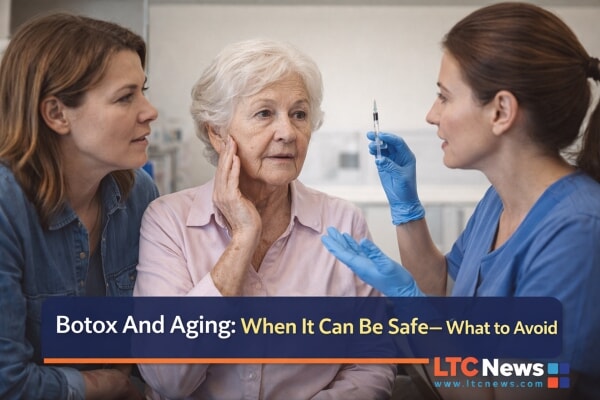
You may notice new lines in the mirror that make you look more tired than you feel. For adults over 40, Botox can be a safe, effective option when used thoughtfully and medically appropriately—but age, health, and provider skill matter more than ever.
Anna Marino
Anna Marino is a seasoned writer specializing in topics related to family, aging, and lifestyle in retirement. She shares advice on intergenerational relationships and strategies for enjoying retirement.
You are not trying to erase your age. You are trying to reflect on how you feel inside. You wake up feeling fine, but your reflection tells a different story. Deep forehead lines. Crow’s feet that seem permanent. A face that looks worn even when you feel energetic inside.
For many adults over 40, Botox becomes part of the conversation not just because you want to look younger, but because you want to look like yourself. That is the key: you want to see yourself in the mirror each and every day. The you that you remember and think of yourself as, rested, calm, and confident. When done correctly, Botox can help achieve that goal. When done poorly, it can have the opposite effect.
Whether you are considering Botox in Alamo, California, Alamo, Texas, Alamo, Indiana, or anywhere else, you want to feel good when you look in the mirror.
The question is not whether Botox can be used safely in older adults. It is how, when, and by whom.
How Botox Works—And Why Age Changes the Equation
Botox treatment is a purified form of botulinum toxin type A. In small, controlled doses, it temporarily blocks nerve signals to targeted muscles. That relaxation softens expression lines caused by repeated movements, such as frowning, squinting, or raising the eyebrows.
The process itself is brief. Injections typically take less than 30 minutes. Most people describe the sensation as a light pinch. No anesthesia is required, and normal activities usually resume the same day.
With aging, however, facial anatomy changes:
- Skin becomes thinner and less elastic
- Fat pads shift and shrink
- Muscle mass declines
- Bone structure subtly recedes
These changes mean Botox must be used more conservatively in older adults. What looks natural at 35 can look stiff or hollow at 65 if dosing is not adjusted.
Is Botox Safe for Older Adults?
The answer is yes—when used appropriately and under medical supervision. Age alone does not disqualify someone from Botox. Many healthy adults in their 60s, 70s, and even 80s receive Botox safely.
The key factors are overall health, medication use, skin integrity, muscle strength, and realistic goals.
According to the American Society of Plastic Surgeons, Botox has a long-established safety record when administered by trained medical professionals using FDA-approved products and dosing guidelines.
Complications are uncommon, but risk increases when treatments are rushed, poorly planned, or performed by underqualified providers.
When Botox May Not Be Appropriate
Botox is not for everyone. Older adults should proceed with caution or avoid treatment entirely if they have:
- Neuromuscular disorders such as myasthenia gravis or ALS
- Active skin infections at injection sites
- Significant swallowing or breathing disorders
- A history of severe reactions to botulinum toxin
- Unrealistic expectations about dramatic skin tightening
Certain medications can also increase bruising or complications. Blood thinners, muscle relaxants, and some antibiotics may require special consideration or timing adjustments.
A proper medical consultation is not optional. It is essential.
What To Look for in a Provider—Especially After 50
Experience matters more with age. Facial anatomy becomes more complex, and subtle mistakes show faster.
Look for a provider who:
- Is a licensed medical doctor, nurse practitioner, or physician assistant with aesthetic training
- Regularly treats adults over 45
- Uses conservative dosing strategies
- Discusses medical history and medications in detail
- Focuses on balance and movement, not frozen results
A good provider will say no when appropriate. Over-treatment is the most common problem seen in older adults, not under-treatment.
Common Treatment Areas—And How They Change with Age
Botox is most commonly used in the upper face:
- Forehead lines
- Lines between the eyebrows
- Crow’s feet around the eyes
In older adults, smaller doses are often used to preserve natural expression. Aggressive forehead treatment can cause brow drooping or heaviness if muscles are already weakened by age.
Some adults also explore Botox for:
- Neck bands
- Jaw tension or teeth grinding
- Facial asymmetry after injury or stroke
- Chronic migraines or muscle pain
Medical uses should always be evaluated separately from cosmetic goals.
When is Someone “Too Old” For Botox?
There is no specific age cutoff. The real question is functional skin health.
If skin has lost significant elasticity, Botox alone may not improve appearance and may even accentuate sagging. In those cases, other approaches—such as skin resurfacing, targeted fillers, or simply good skincare—may offer better results.
An ethical provider will explain limitations honestly. Botox should enhance quality of life, not create disappointment.
What To Expect After Treatment
Mild redness, swelling, or bruising can occur and usually resolves within hours to days. Most people begin seeing results within three to five days, with full effect at about two weeks.
Results typically last three to four months. With consistent, conservative treatment, some muscles may remain relaxed longer over time.
Avoid strenuous exercise, lying flat, or rubbing treated areas for the rest of the day. These precautions reduce the risk of unwanted spread.
Botox is Not Just Cosmetic—Confidence Matters
Feeling comfortable in your appearance affects how you show up in the world. Many older adults report feeling more confident, less self-conscious, and more socially engaged after treatment.
That emotional benefit matters. Confidence supports mental health, social connection, and overall well-being as we age.

Sponsored