Stress Recovery After 50: Why Nervous System Exercises Are Gaining Attention
About This Article
Adults over 50 are turning to breathing exercises and nervous system techniques to manage stress, improve sleep, and support healthy aging. Learn what experts say about vagus nerve exercises, caregiver stress, and long-term wellness.

Marcus Howard
Marcus Howard writes about alternative health topics for older adults such as CBD, acupuncture, and herbal medicine.
Table of Contents
- What the Vagus Nerve Actually Does
- Why Stress Often Feels Different After 50
- What Is Heart Rate Variability?
- What Research Says About Breathing Exercises
- Why Exhalation and Vocal Sounds May Help
- Connection Between Stress and Sleep
- Cold-Water Exposure Requires Caution
- Why Daily Habits Matter More Than Intensity
- Technology Is Reshaping Stress Management
- Stress, Aging, and Long-Term Care Planning
- What Medical Experts Want You to Remember
- Protecting Your Health and Independence as You Age
You may notice stress lingers longer than it once did. Sleep becomes lighter. Recovery takes more time. Even small daily pressures can feel heavier after 50, especially if you are caring for aging parents, supporting adult children, managing work demands, or facing health concerns of your own.
That growing strain is one reason more adults are exploring breathing exercises, relaxation routines, and nervous system practices often referred to online as a “vagus nerve reset.” While the phrase itself is more wellness terminology than medical diagnosis, experts say some breathing and relaxation techniques may help support the body’s natural stress-recovery system.
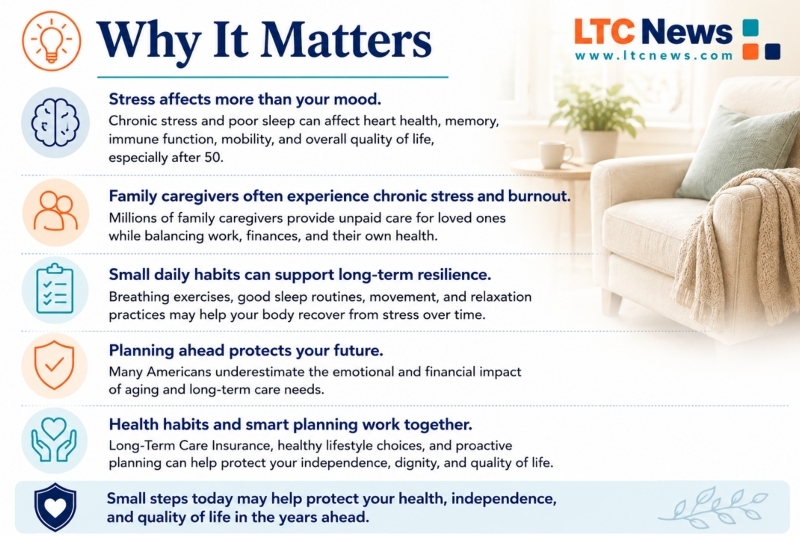
Chronic stress, poor sleep, caregiving pressure, and aging can affect both emotional and physical health, especially after age 50. Breathing exercises and nervous system practices linked to the vagus nerve may help support stress recovery, sleep, and resilience.
Research published in 2025 by Emory University underscores the cumulative toll these pressures take.
There are a lot of health impacts from things like stress, lack of sleep, and not having time for self-care. Physiologically, stress can have long-term effects — it can increase the burden on your cardiovascular system, disrupt your sleep, and decrease your immune response. — Dr. Brittany Butts, an assistant professor at Emory's Woodruff School of Nursing.
Interest in these practices reflects a larger shift in how Americans think about wellness and aging. Instead of chasing quick fixes, many people are seeking realistic daily habits that can improve sleep, emotional resilience, and overall quality of life.
For caregivers of older family members and anyone over 50, that goal has become increasingly important.
What the Vagus Nerve Actually Does
The vagus nerve is the longest cranial nerve in the body. It runs from the brainstem through the neck and into major organs, including the heart, lungs, and digestive system. It plays a major role in the parasympathetic nervous system, which helps the body recover after stress.
“The vagus nerve is involved in regulating internal organ systems, including heart rate, digestion and certain reflexes,” according to the Cleveland Clinic.
When functioning properly, the vagus nerve helps regulate:
- Heart rate
- Breathing
- Digestion
- Mood
- Sleep
- Stress recovery
- Inflammatory responses
After stressful situations, the parasympathetic nervous system helps the body return to a calmer baseline. Chronic stress, poor sleep, illness, caregiving strain, and aging may interfere with how efficiently the recovery process works.
Why Stress Often Feels Different After 50
Stress changes the body over time. Adults in midlife and older adulthood often juggle multiple emotional and physical responsibilities simultaneously:
- Caring for aging loved ones
- Financial pressure
- Career uncertainty
- Retirement planning
- Chronic health conditions
- Sleep disruption
- Loneliness and isolation
Research continues to show that chronic stress may contribute to:
- High blood pressure
- Increased inflammation
- Anxiety and depression
- Poor sleep quality
- Weakened immune response
- Cardiovascular disease risk
Caregiving stress can be especially intense. According to the AARP Public Policy Institute and the National Alliance for Caregiving, millions of Americans provide unpaid extended care for loved ones every year, often while balancing careers, finances, and their own health concerns.
Sleep researchers, including Matthew Walker, have extensively documented the relationship between chronic stress, sleep quality, cardiovascular health, and cognitive performance.
Over time, chronic stress does more than affect mood. It may influence sleep quality, inflammation, cardiovascular health, cognitive resilience, and overall physical recovery, all factors tied closely to healthy aging and future long-term care needs.
What Is Heart Rate Variability?
Many discussions of stress recovery include heart rate variability (HRV). HRV measures tiny differences in the timing between heartbeats. Contrary to what many people assume, a perfectly steady heartbeat is not necessarily ideal.
Higher HRV is generally associated with healthier autonomic nervous system flexibility and greater adaptability to stress. Lower HRV has been associated with:
- Chronic stress
- Burnout
- Poor sleep
- Anxiety
- Cardiovascular concerns
Researchers often use HRV to assess how breathing and relaxation techniques may influence stress recovery and autonomic nervous system function.
Medical experts caution that HRV should not be viewed as a standalone health score or diagnostic tool. Instead, it is one piece of a broader picture involving sleep, physical activity, stress, and overall health.
Tracking HRV isn't the only thing we should be doing for heart health, but it can be part of many lifestyle behaviors we take for cardiovascular health. You don't want tracking your HRV to be another thing that causes you stress, but it can serve as another tool for your overall mind and body well-being. — Dr. Sahar Naderi, MD, Cardiologist and Director of Women's Heart Health at Kaiser Permanente San Francisco, quoted in Stanford Lifestyle Medicine (February 17, 2026).
Dr. Naderi says there is no single “ideal” HRV number. Instead of trying to achieve a universally high HRV, it’s more helpful to establish your personal baseline and monitor changes over time to determine whether your heart is becoming more resilient.
What Research Says About Breathing Exercises
The strongest evidence involving vagus nerve exercises centers on slow breathing techniques. Studies published in journals including Hypertension and Circulation have found that controlled, slow breathing may support autonomic nervous system function and improve measures of cardiovascular regulation.
Research suggests that slow breathing decreases sympathetic and increases parasympathetic tone… slow breathing enhances respiratory sinus arrhythmia, a marker of vagal modulation, thereby improving autonomic balance. — Dr. Gurjeet Birdee and colleagues at Vanderbilt University Medical Center (Division of Clinical Pharmacology and the Osher Center for Integrative Health), published in Global Advances in Integrative Medicine and Health (September 2025).
Many researchers focus on breathing rates near six breaths per minute because they may help synchronize breathing and cardiovascular rhythms.
Simple breathing exercises may include:
- Inhaling slowly through the nose
- Exhaling gently and fully
- Making exhalations slightly longer than inhalations
- Practicing for five to 10 minutes daily
The goal is not deep or forceful breathing. Slow, gentle breathing tends to produce the most calming effects.
It is important to understand that “vagus nerve exercises” is not a formal medical treatment term. These are wellness and relaxation techniques that researchers believe may influence autonomic nervous system activity and stress recovery.
Why Exhalation and Vocal Sounds May Help
Longer exhalations may help activate parasympathetic nervous system responses.
Some people also practice:
- Gentle humming
- Chanting
- Singing
- Slow sighing
- Gargling
Research indicates that vocal practices such as chanting and humming can stimulate the vagus nerve, enhancing parasympathetic nervous system activity. — Researchers Michelle DeFrancesco, Liz Johnson, Gloriana Cruz, and Marita Stryker, writing for the National Center for Voice and Speech in their peer-reviewed publication NCVS Insights (May 30, 2025.
Small studies suggest vocal vibration may modestly influence parasympathetic activity because branches of the vagus nerve connect to muscles in the throat and vocal cords. Researchers say larger clinical studies are still needed before drawing firm conclusions.
Connection Between Stress and Sleep
Sleep problems become increasingly common with age. According to the National Institute on Aging, older adults often experience changes in sleep patterns, including lighter sleep and more nighttime waking.
Stress frequently worsens those problems. Elevated stress hormones may make it harder to:
- Fall asleep
- Stay asleep
- Reach deeper stages of restorative sleep
Poor sleep can then increase daytime anxiety and emotional strain, creating a cycle that becomes difficult to break. That is one reason many adults use breathing exercises before bed as part of a broader sleep-support routine.
Cold-Water Exposure Requires Caution
Some wellness discussions around nervous system regulation also include cold-water exposure practices.
CWI [cold-water immersion] is believed to elicit a range of physiological responses, including the activation of the autonomic nervous system, modulation of the immune system, and the release of various biochemical mediators… offering potential practical applications for health practitioners considering CWI for stress management and well-being support. — Tara Cain (lead researcher) and colleagues at the University of South Australia's Alliance for Research in Exercise, Nutrition and Activity (ARENA), published in PLOS ONE (January 2025)
However, older adults and individuals with:
- Heart disease
- Arrhythmias
- High blood pressure
- Cardiovascular concerns
- Autonomic disorders
These adults should approach cold-water exposure carefully and only with medical guidance. Cold plunges and prolonged breath-holding exercises may pose cardiovascular risks for some individuals.
Why Daily Habits Matter More Than Intensity
One of the biggest misconceptions about stress management is the idea that dramatic interventions are necessary. In reality, consistency usually matters more than intensity.
People who regularly practice stress-reduction techniques often describe:
- Feeling calmer in the morning
- Recovering faster after stressful situations
- Falling asleep more easily
- Feeling less physically tense
- Experiencing steadier moods
These changes typically develop gradually over weeks rather than days.
The body’s stress response can be reduced by regularly practicing relaxation techniques. - according to Harvard Health Publishing.
Technology Is Reshaping Stress Management
Many adults now use guided wellness apps, meditation platforms, breathing programs, and wearable devices to help maintain healthy routines.
Some tools offer:
- Guided breathing exercises
- Meditation sessions
- HRV tracking
- Sleep support
- Relaxation reminders
- Gentle stretching guidance
Smartphone-based meditation training has jumped onto the world stage, shifting how millions of people learn and practice meditation… the top 10 meditation apps have collectively reached over 300 million downloads. — Dr. J. David Creswell, Professor of Psychology at Carnegie Mellon University (and co-author Dr. Simon B. Goldberg, University of Wisconsin-Madison), writing in American Psychologist (2025).
For many people, the biggest benefit is structure. Short daily sessions may feel easier to maintain than complicated wellness regimens. But stress management is about more than daily comfort. Over time, chronic stress and poor sleep may affect physical health, resilience, and even future care needs.
Tools like the Leaply app are helping. The model is built around a 5-15 minute daily nervous system practice: one short, time-boxed session per day, opened with a brief physiology block that explains why the movement works, followed by a demonstration video with full playback controls.
A session might be:
- A short slow-breathing protocol
- A sequence using the voice for vibration
- A gentle release for the neck and jaw
- A paced exhalation drill
This kind of thing fits between coffee and the first email of the day. The vagus nerve reset plan in the app is organized week by week, with sessions unlocking as you complete previous ones. The app is built around the one number that really matters for vagal tone: the number of sessions you've completed.
Stress, Aging, and Long-Term Care Planning
Chronic stress affects more than emotional well-being. Over time, it may influence physical health, mobility, sleep quality, and cognitive resilience. As the body ages, supporting stress recovery becomes increasingly important for maintaining health, independence, and quality of life.
According to the U.S. Department of Health and Human Services Report on Long-Term Services and Supports, approximately 56% of adults turning 65 will require long-term services and supports at some point in their lives. The issue of long-term care is real, stressful, and impacts your family and finances.
Long-term care includes assistance with:
- Bathing
- Dressing
- Mobility
- Supervision due to memory loss
- Daily living activities
Many families wait until a crisis occurs before discussing care planning.
Long-Term Care Insurance helps many families:
- Protect retirement savings
- Reduce caregiving burdens
- Access quality care earlier
- Avoid relying entirely on adult children
- Receive care at home when possible
LTC News Long-Term Care Insurance Learning Center.
Health insurance and Medicare do not cover extended custodial long-term care services beyond short-term skilled-care situations. The financial impact is substantial, even for someone with substantial savings.
You can compare current extended care costs where you live by using the LTC News Cost of Care Calculator.
If your loved one needs help now, you can search for care providers through the LTC News Caregiver Directory.
What Medical Experts Want You to Remember
Breathing exercises and relaxation practices may help support stress recovery, but they are not cures or replacements for proper medical care.
Talk with your healthcare provider before trying breathing or cold-exposure exercises if you have:
- Heart disease
- COPD
- Severe asthma
- Arrhythmias
- Neurological disorders
- Blood pressure concerns
These techniques may complement healthy lifestyle habits and medical care, but they should not replace treatment for underlying medical or mental health conditions.
Protecting Your Health and Independence as You Age
You cannot remove stress from life entirely. But small, consistent habits may help your body recover from stress more effectively over time. As you age, supporting emotional resilience, sleep quality, physical health, and stress recovery becomes increasingly important for maintaining independence and quality of life.
Breathing exercises, relaxation techniques, mindfulness, movement, and healthy sleep routines may support overall well-being when practiced consistently alongside proper healthcare and healthy aging strategies.
The goal is not perfection. It is steadier recovery, better resilience, and improved quality of life as you age.
Ask yourself, “What small habit could help improve your health and resilience today — and have you taken steps to protect your future care choices and independence later in life?”
Frequently Asked Questions
How many older adults will eventually need long-term care?
According to the U.S. Department of Health and Human Services, approximately 56% of adults turning 65 will require long-term services and supports at some point in their lives.
Is cold-water therapy safe for older adults?
Not always. Older adults and people with heart disease, arrhythmias, high blood pressure, or autonomic disorders should approach cold-water exposure carefully and only with medical guidance. Cold plunges and prolonged breath-holding may create cardiovascular risks for some individuals.
Why does stress management matter for long-term care planning?
Chronic stress may affect physical health, mobility, sleep quality, and cognitive resilience over time. Supporting emotional and physical health becomes increasingly important as you age and prepare for future long-term care needs.
What is the vagus nerve and why is it important after 50?
The vagus nerve is the longest cranial nerve in the body and plays a major role in regulating heart rate, breathing, digestion, mood, sleep, and stress recovery. As you age, chronic stress, poor sleep, caregiving responsibilities, and health problems may affect how efficiently your nervous system recovers from stress.
Why are caregivers at higher risk for stress and burnout?
Millions of Americans provide unpaid care for loved ones while balancing jobs, finances, and family responsibilities. Caregiving stress is associated with exhaustion, sleep disruption, emotional strain, and physical health concerns.
What is heart rate variability (HRV)?
Heart rate variability, or HRV, measures small differences in the timing between heartbeats. Higher HRV is generally associated with healthier autonomic nervous system flexibility and better adaptability to stress.
Researchers often use HRV to study how breathing exercises and relaxation techniques may influence stress recovery.
Is there an ideal HRV score?
No. Cardiologist Dr. Sahar Naderi says there is no universal “ideal” HRV number. Instead, experts recommend identifying your personal baseline and tracking trends over time rather than trying to reach a specific score.
Can stress-management apps and wearables help?
Many people use wellness apps, meditation platforms, breathing programs, and wearable devices to support healthy routines. Some tools offer:
- Guided breathing exercises
- Meditation sessions
- HRV tracking
- Sleep support
- Relaxation reminders
Experts say the biggest advantage may be consistency and daily structure.
What are vagus nerve exercises?
Vagus nerve exercises are breathing and relaxation techniques designed to support parasympathetic nervous system activity and stress recovery. These may include:
- Slow breathing
- Gentle humming
- Chanting
- Singing
- Relaxation exercises
- Meditation
Medical experts note that “vagus nerve exercises” is a wellness term, not a formal medical treatment.
How long does it take for breathing exercises to help?
Most people do not experience overnight changes. Stress-management benefits from breathing exercises and relaxation routines usually develop gradually over time with consistency rather than intensity.
Does Medicare cover long-term care?
Medicare and traditional health insurance generally do not cover extended custodial long-term care, such as ongoing assistance with bathing, dressing, supervision, or daily living activities beyond limited skilled-care situations.
How can Long-Term Care Insurance help reduce family stress?
Long-Term Care Insurance can help families:
- Protect retirement savings
- Reduce caregiving burdens
- Access quality care earlier
- Receive care at home when possible
- Avoid relying entirely on adult children for care
Planning before a health crisis occurs may help preserve independence, dignity, and quality of life later in life.
Why does stress often feel worse after age 50?
Stress can affect the body differently with age due to:
- Sleep disruption
- Chronic health conditions
- Caregiving responsibilities
- Retirement concerns
- Loneliness or isolation
- Financial pressure
Over time, chronic stress may contribute to inflammation, cardiovascular disease, anxiety, poor sleep, and weakened immune response.
Can humming or chanting help calm the nervous system?
Some small studies suggest humming, chanting, singing, and extended exhalation exercises may modestly influence parasympathetic nervous system activity because the vagus nerve connects to muscles in the throat and vocal cords. Researchers say larger studies are still needed.
Can stress and poor sleep affect long-term health?
Yes. Chronic stress and sleep problems may affect:
- Heart health
- Blood pressure
- Memory
- Mood
- Immune function
- Cognitive resilience
- Overall quality of life
Over time, these issues may also influence healthy aging and future long-term care needs.
Can breathing exercises really reduce stress?
Research suggests controlled slow breathing may help support autonomic nervous system function and improve stress recovery. Studies published in journals including Hypertension and Circulation have linked slow breathing techniques to improved cardiovascular regulation and parasympathetic nervous system activity.

Sponsored