Millions of Americans Risk Outliving Their Retirement Savings. Long-Term Care Could Be the Biggest Missing Piece

About This Article
A new retirement analysis by CareScout Analytics suggests that retirees in most states could outlive their savings due to rising living expenses, healthcare costs, long-term care costs, and longer lifespans.

James Kelly
LTC News staff writer specializing in long-term care and aging.
Table of Contents
- What the CareScout Analysis Found
- States With the Largest Projected Retirement Funding Gaps
- States With the Strongest Retirement Outlook
- Why Retirement Costs Vary So Much
- Should You Consider Retiring in Another State?
- Understanding the CareScout Study
- Retirement Is Lasting Longer
- America Is Aging Faster Than Ever
- Alzheimer's Disease Illustrates Why Planning Matters
- Long-Term Care Is Often the Missing Piece
- Why Many Retirement Calculators Miss the Biggest Expense
- When a Health Event Changes Everything
- Local Care Costs Matter More Than National Averages
- Medicare Won't Pay for Most Long-Term Care
- Medicaid Is a Safety Net—Not a Retirement Strategy
- Family Caregiving Carries Financial Costs Too
- Women Face Greater Financial Risk
- Why Many Affluent Families Still Purchase Long-Term Care Insurance
- Planning While You're Healthy Gives You More Choices
- Retirement Planning Is Really About Managing Risk
- Long-Term Care Insurance Helps Protect More Than Your Savings
- Partnership Policies Add Another Layer of Protection
- Retirement Planning Should Include Conversations—Not Just Calculations
- Use Local Information—Not National Averages
- Finding Quality Care for Loved Ones
- Get Free Claims Support if a Loved One Has Long-Term Care Insurance
- Retirement Planning Means Preparing for the Life You Hope to Live
You may believe you've done everything right to prepare for retirement. You've saved consistently, invested wisely, reduced debt, and looked forward to the day work becomes optional. Yet a growing body of research suggests many Americans still face one financial risk they haven't fully planned for, the possibility of needing long-term care.
Americans are living longer. Healthcare costs continue to rise. Inflation has eroded purchasing power, and many retirees now spend 25 to 35 years relying on savings rather than a paycheck.
A recent analysis by CareScout Analytics found retirees in 41 states and the District of Columbia are projected to exhaust their retirement income and savings during retirement, leaving the average 65-year-old with an estimated $109,000 funding gap over a lifetime. Under the study's assumptions, only nine states were projected to have sufficient retirement resources to cover expected lifetime expenses.
The report generated headlines because it examined retirement through a broader lens than many traditional savings studies. Rather than focusing primarily on investment balances and withdrawal rates, the analysis incorporated projected housing expenses, taxes, healthcare spending, and long-term care costs to estimate whether retirement income would last throughout a person's lifetime.
Those findings deserve attention—but they also deserve context.
What the CareScout Analysis Found
The CareScout Analytics report examined whether today's typical retirees are likely to have enough lifetime income and savings to cover expected retirement expenses. Researchers modeled retirement income from Social Security, pensions, retirement accounts, and personal savings against projected spending that included housing, taxes, healthcare, and long-term care.
The findings were sobering.
Among the report's major conclusions:
- Retirees in 41 states and the District of Columbia are projected to outlive their retirement income and savings.
- The average projected retirement funding gap is approximately $109,000.
- Only nine states were projected to generate enough retirement resources to cover expected lifetime expenses.
- Geographic location significantly affects retirement security because taxes, housing costs, healthcare spending, and long-term care expenses vary widely across the country.
- Americans are living longer, increasing the number of years retirement savings must last.
Although every retirement is different, the report suggests that where you retire can influence financial security almost as much as how much you save.
States With the Largest Projected Retirement Funding Gaps
One of the most revealing findings in the CareScout Analytics report is that retirement security isn't determined solely by how much you've saved. Geography also plays a major role. Researchers found substantial differences in projected retirement outcomes across regions. Housing costs, state taxes, healthcare expenses, and the cost of long-term care all influence how long retirement income is likely to last.
The report identified several states where retirees face the greatest projected financial challenges because of higher living expenses and healthcare costs.
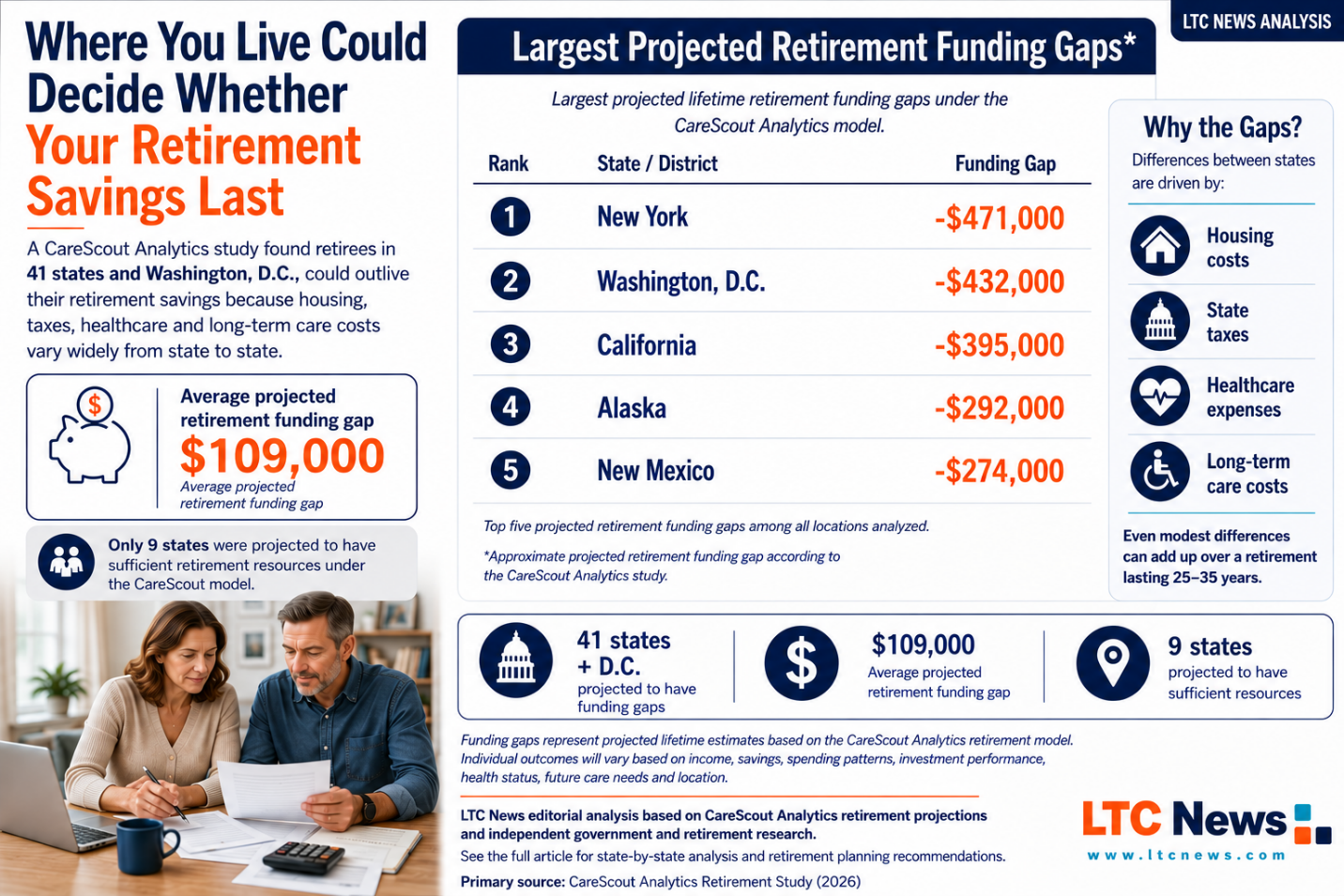
High housing costs, state and local taxes, healthcare expenses, and the cost of long-term care all contributed to larger projected shortfalls in these states.
States With the Strongest Retirement Outlook
While the CareScout Analytics study projected retirement funding shortfalls in 41 states and the District of Columbia, it found that nine states were projected to have sufficient retirement income and savings to cover expected lifetime expenses under the study's assumptions.
According to the analysis, those states are:
- Washington
- New Hampshire
- Colorado
- Nebraska
- Idaho
- Minnesota
- Utah
- Maryland
- Montana
Unlike states with the largest projected retirement funding gaps, these locations were projected to have retirement resources that exceeded expected lifetime expenses. The study considered multiple factors, including retirement income, personal savings, Social Security benefits, housing costs, taxes, healthcare expenses, and projected long-term care costs.
The findings illustrate that retirement security is determined by more than a state's cost of living. Some of the states with the strongest outlook, such as Washington and Colorado, are not among the nation's least expensive places to live. Instead, the CareScout model suggests that higher household wealth, stronger retirement income, and greater accumulated assets can offset higher living expenses, allowing retirement resources to last longer.
For retirees and those still planning for retirement, the message is clear: where you live matters, but so do the financial resources you bring into retirement. Building adequate savings, planning for healthcare and long-term care expenses, and understanding how local costs affect your retirement income are all essential components of a comprehensive retirement strategy.
One expense can dramatically change those projections. Long-term care remains one of the least predictable retirement costs because no one can know whether care will be needed, what type of care may be required, or how long services might last. Preparing for that possibility is one of the most important steps retirees can take to protect savings and independence.
Why Retirement Costs Vary So Much
The differences aren't driven by a single expense. Instead, several factors work together over a retirement that may last 25 years or longer. Among the biggest influences are:
- Housing prices and property taxes
- State income taxes and other local taxes
- Healthcare spending
- Long-term care costs
- Overall cost of living
- Life expectancy and healthcare utilization
Even modest annual differences can compound significantly over two or three decades of retirement.
Should You Consider Retiring in Another State?
The findings don't necessarily mean you should relocate. Many retirees choose to remain close to family, friends, physicians, and familiar communities despite higher living costs. However, for people who are still deciding where to retire, comparing future healthcare costs, taxes, housing expenses, and long-term care availability may be just as important as comparing weather or recreation opportunities.
Retirement isn't simply about choosing where you want to live today. It's also about choosing where your income and savings are most likely to support the lifestyle—and care—you may need throughout the decades ahead.
Understanding the CareScout Study
The retirement analysis was conducted by CareScout Analytics, part of CareScout, a Genworth Financial company. In addition to publishing retirement and long-term care research, CareScout provides care planning services and access to a nationwide network of care providers. The company also now offers a Long-Term Care Insurance policy issued by CareScout Insurance Company, a wholly owned subsidiary of Genworth Financial.
The study combines retirement income, longevity, taxes, healthcare spending, housing costs, and projected long-term care expenses into a comprehensive financial model. Like any industry-sponsored research, however, it should be viewed as one planning resource rather than a prediction of any individual's financial future.
LTC News is reporting on the findings because they reinforce an issue retirement professionals have discussed for years: many Americans underestimate the financial impact of living longer. Throughout this article, LTC News also relies on independent government research, nonprofit organizations, and other authoritative sources to provide broader context.
Retirement Is Lasting Longer
Living longer is one of modern medicine's greatest achievements. Longer lives provide more opportunities to travel, spend time with family, volunteer, or simply enjoy retirement. They also require retirement savings to last much longer than previous generations expected.
A retirement beginning at age 65 may extend 25 years or more. Every additional year means another year of housing expenses, food, utilities, insurance, transportation, taxes, and healthcare costs. The challenge isn't simply accumulating enough money to retire. It's about making sure those assets continue to support your lifestyle for decades.
America Is Aging Faster Than Ever
Demographics are accelerating that challenge. According to the Alliance for Lifetime Income, an average of 11,400 Americans turned 65 every day in 2025, adding more than 4 million people to retirement age in a single year, the highest on record. That pace continues through 2027 as part of what researchers call "America's Peak 65 Zone.
As the Baby Boom generation continues aging, demand for healthcare professionals, family caregivers, assisted living communities, memory care residences, nursing homes, and in-home care services is expected to grow substantially. That increased demand may also place additional pressure on care costs and retirement resources in many communities.
Alzheimer's Disease Illustrates Why Planning Matters
Retirement planning isn't simply about replacing employment income. It's also about preparing for changing health needs. According to the Alzheimer's Association's 2026 Alzheimer's Disease Facts and Figures report, approximately 7.4 million Americans age 65 and older are currently living with Alzheimer's disease.
By 2060, that number is expected to reach 13.8 million as the population continues aging. The report also says that long-term care costs for those living with Alzheimer's and other dementias are projected to reach $409 billion in 2026 — not including the value of unpaid caregiving.
Alzheimer's disease and other forms of dementia remain among the leading reasons older adults eventually require long-term care. Unlike many medical conditions that require weeks or months of treatment, cognitive impairment often necessitates years of supervision and assistance with everyday activities.
Dementia is not just a health care crisis but a financial crisis for individuals, families, and federal and state governments. Americans living with Alzheimer's and their caregivers rely heavily on Medicaid to help pay for critical care services as the fatal disease progresses." — Joanne Pike, DrPH, President and CEO, Alzheimer's Association.
Many people must rely on Medicaid since they did not have Long-Term Care Insurance or enough income and assets to pay for the high cost of long-term care services. Planning for retirement without considering that possibility may leave families financially vulnerable later in life.
Long-Term Care Is Often the Missing Piece
Federal researchers estimate that more than half of Americans who reach age 65—about 56%—will eventually need longterm care. For some, that support may last only a few months as they recover from an injury or illness. But for millions of others, the need stretches into years. Alzheimer’s, Parkinson’s, stroke, arthritis, and other chronic conditions can slowly steal independence, turning everyday tasks into overwhelming challenges and placing families under immense emotional and financial strain.
More families have no choice but to step in themselves, often providing care beyond what they realistically have the time, resources or capacity to handle." — Alan Weil, Senior Vice President, AARP Public Policy Institute, quote in TheStreet.
Long-term care is different from traditional medical care. Instead of treating an illness, long-term care helps people safely perform everyday activities such as bathing, dressing, eating, transferring, continence, and toileting—or provides supervision when cognitive impairment makes independent living unsafe.
Services may be provided:
- At home
- Through adult day care
- In assisted living
- In memory care
- In a nursing home
The setting depends on a person's health needs, family support system, and personal preferences.
Why Many Retirement Calculators Miss the Biggest Expense
Most retirement calculators do an excellent job of estimating routine living expenses. They project investment growth, Social Security income, inflation, taxes, housing expenses, and healthcare premiums. Few adequately account for long-term care.
Unlike replacing a roof or buying a new vehicle, long-term care cannot be scheduled or accurately predicted.
No one knows:
- Whether care will be needed
- When care might begin
- What type of care will be required
- How long services may be needed
One person may never require assistance. Another may need several years of home care followed by memory care or nursing home services. That uncertainty makes long-term care one of the most difficult retirement expenses to model—and one of the easiest to underestimate.
Longevity risk isn't simply about living longer. It's about making sure your financial resources last as long as you do. Extended healthcare and long-term care expenses can dramatically increase that challenge.
Longevity risk is worth mentioning first, and it's a good thing in a way. You don't know how long you're going to live, and you might live a very long time, which is wonderful, but just on the financial side, it's expensive to live a long time. You have to fund your retirement for more and more years." — Dr. Wade Pfau, PhD, CFA, RICP, Professor of Practice, American College of Financial Services; Founder, Retirement Researcher, speaking on RetirementWisdom.com podcast, 'The Key Decisions for Retirement Success'.
Retirement planning today requires more than estimating investment returns. It requires preparing for expenses that may never occur but could become the single largest financial obligation of retirement if they do.
When a Health Event Changes Everything
Most retirement plans are built around relatively predictable expenses.
- Housing
- Utilities
- Groceries
- Insurance
- Travel
- Healthcare premiums
Long-term care is different. A fall, stroke, cancer diagnosis, Parkinson's disease, Alzheimer's disease, or even frailty from aging can change daily life almost overnight. Care may begin with a few hours of assistance each week and gradually expand to full-time help at home, assisted living, memory care, or a nursing home.
Because no one can predict when care might be needed—or how long it may last—many retirement plans underestimate its financial impact. That doesn't mean retirement planning is flawed. It means retirement planning should account for both uncertainty and certainty.
Local Care Costs Matter More Than National Averages
Where you live can have as much influence on future care costs as your health. Labor shortages, housing costs, local wages, and the availability of professional caregivers all affect what families ultimately pay for long-term care. Costs can vary dramatically—even between neighboring communities.
Rather than relying on national averages or proprietary provider surveys, the LTC News Cost of Long-Term Care Services Calculator draws on current provider costs from across the United States and projects future costs. Families can compare local costs for home care, adult day care, assisted living, memory care, rehabilitation, and nursing homes based on where care is most likely to be needed. Understanding local costs creates a far more realistic retirement plan than relying solely on national estimates.
Medicare Won't Pay for Most Long-Term Care
That brings many retirees to another common misconception: that Medicare will pay for most long-term care needs. It will not. Medicare is primarily designed to pay for medical treatment, physician services, hospital care, and limited skilled nursing or rehabilitation following a qualifying hospitalization, provided strict eligibility requirements are met.
It does not pay for ongoing custodial care—the assistance many older adults eventually need with bathing, dressing, eating, mobility, or supervision because of dementia or other cognitive disorders.
Many families don't discover that limitation until care is already needed. Understanding Medicare's role before retirement can help avoid costly surprises later.
Medicaid Is a Safety Net—Not a Retirement Strategy
When savings are exhausted, many Americans eventually qualify for Medicaid assistance with long-term care. Medicaid serves an essential role, but Medicaid was never intended to be a retirement-income strategy.
Eligibility rules vary by state, and applicants often must spend down much of their countable income and assets before qualifying for benefits. Planning before an aging or health crisis gives families more financial flexibility and more choices regarding where and how care is received.
Family Caregiving Carries Financial Costs Too
Long-term care rarely affects only one person. It often changes the lives of spouses, adult children, siblings, and close friends. There are now approximately 63 million Americans who provide unpaid extended care to an adult family member or friend.
Many caregivers continue working while coordinating doctor visits, medications, transportation, meals, finances, and personal care. Others reduce work hours or leave the workforce entirely.
The financial consequences often include:
- Lost income
- Reduced retirement contributions
- Delayed career advancement
- Increased stress and burnout
- Higher out-of-pocket expenses
Long-term care planning isn't only about protecting your retirement. It can also help reduce future burdens on the people you love. Being a caregiver is physically and emotionally demanding and even more so when balancing a job and family at the same time.
Women Face Greater Financial Risk
Women often experience retirement differently from men. On average, women live longer, making them more likely to outlive a spouse and spend additional years living alone. Many women also step away from the workforce to care for children, aging parents, or spouses, reducing lifetime earnings and retirement savings.
Those factors combine to increase both the likelihood of eventually needing care and the financial importance of planning for it.
Why Many Affluent Families Still Purchase Long-Term Care Insurance
One of the biggest misconceptions about Long-Term Care Insurance is that only middle-income families need it. In reality, many affluent households purchase LTC Insurance coverage for a very different reason. Their goal isn't necessarily to avoid paying for care.
It's to preserve investment portfolios, retirement income, businesses, real estate, and estate plans. Selling appreciated investments during a market downturn—or liquidating income-producing assets to pay for several years of care—can permanently change a retirement plan. Plus, there are tax complications when self-funding long-term care.
LTC Insurance, in addition to easing family stress and burden, transfers much of that financial risk, allowing retirement assets to continue supporting a spouse, family members, charitable goals, or future generations. That's one reason physicians, attorneys, business owners, executives, and retirees with substantial assets frequently include Long-Term Care Insurance as part of a comprehensive retirement strategy.
"We see healthcare spending flare up later in life. Then that inflates the averages for everyone, even though it's a fairly small segment of our population that has that catastrophic long-term care spending need." — Christine Benz, Director of Personal Finance and Retirement Planning, Morningstar, quoted by the Globe and Mail.
Morningstar research finds that when long-term care costs are included, 41 percent of households are projected to run short of money in retirement, compared with just 26 percent when those costs are excluded. This point is perhaps one of the reasons why Benz is very focused on long-term care and makes a strong point on her podcast.
If you read my work regularly, you know that I'm a little bit obsessed with the topic of long-term care, not just how to pay for it, but also all of the other dimensions of it, like the impact on families." — Christine Benz, How to Retire podcast, October 30, 2024.
👉 Long-Term Care Insurance Tax Benefits
Planning While You're Healthy Gives You More Choices
LTC News research shows that most people who purchase Long-Term Care Insurance do so between the ages of 47 and 67. Applying for LTC Insurance while you're healthy generally offers the most options, as underwriting considers current health, prescription medications, and medical history.
👉 Compare Long-Term Care Insurance Companies and Products
Waiting until retirement, or after receiving a significant medical diagnosis, may limit available choices or increase premiums. Most experts say that planning early isn't about expecting the worst. It's about preserving the freedom to make decisions before those decisions become urgent.
Retirement Planning Is Really About Managing Risk
Investment performance matters. So do taxes. Social Security claiming strategies remain important. Preparing for retirement today also means recognizing that longevity, healthcare, and long-term care are financial risks that deserve the same attention as market volatility or inflation.
Ignoring those risks doesn't make them disappear. Planning for them can make retirement more secure.
Long-Term Care Insurance Helps Protect More Than Your Savings
Qualified Long-Term Care Insurance is designed to help protect more than your retirement account. It can help preserve your independence, expand your care choices, and reduce the financial burden on the people you love.
Unlike traditional health insurance, which primarily pays for medical treatment, qualified LTC Insurance helps pay for extended care when a policyholder meets the benefit eligibility requirements. An LTC policy will pay for ongoing skilled services, but most extended care involves needing assistance with at least two of the six Activities of Daily Living (ADLs) or experiencing a qualifying cognitive impairment, as defined by the policy.
Depending on the policy, benefits may help pay for care received:
- At home
- Through adult day care
- In assisted living
- In memory care
- In a nursing home
Many modern policies also include care coordination, caregiver support resources, and flexible care options that allow families to adapt as needs change.
For many households, the greatest value of Long-Term Care Insurance isn't simply paying for care. It's protecting retirement income, preserving investment portfolios, giving families the time to be family instead of caregivers, and giving families greater flexibility when important decisions must be made.
Partnership Policies Add Another Layer of Protection
Many consumers have never heard of Long-Term Care Partnership policies. Available in most states, these qualified LTC policies provide an important advantage for people who exhaust their LTC Insurance benefits and may eventually require Medicaid.
Under Partnership rules, policyholders generally may protect a corresponding amount of personal assets from Medicaid spend-down requirements, subject to state regulations. For many families, that means savings accumulated over decades can remain available for a healthy spouse or future generations instead of being consumed entirely by extended care costs.
Retirement Planning Should Include Conversations—Not Just Calculations
A successful retirement plan involves more than investment statements and withdrawal strategies. It should also include conversations with the people who matter most.
Consider discussing questions such as:
- Where would you prefer to receive care if you needed assistance?
- Would your retirement income comfortably support several years of long-term care?
- Have you explored long-term care insurance while you're still healthy enough to qualify?
- Are your estate planning documents, beneficiary designations, and healthcare directives up to date?
- Do your spouse or adult children understand your wishes?
Those conversations often prove just as valuable as financial planning itself.
Use Local Information—Not National Averages
Every community is different. The cost of home care in one city may differ dramatically from that in another city just 50 miles away. The availability of assisted living, memory care, rehabilitation, and nursing home services also varies significantly across the country.
The LTC News Cost of Care Calculator is the most comprehensive and accurate report on the current and projected costs of long-term care services nationwide. It helps you compare current local costs using provider-reported information from communities nationwide. Reviewing localized costs provides a more realistic picture of future expenses than relying solely on national averages or proprietary surveys.
Finding Quality Care for Loved Ones
Hopefully, you are planning for the future costs and burdens of aging so you are not a burden on those you love. However, you may have older parents who have declining health and need help now, or will need help soon. Knowing where to turn for quality care is equally important. The LTC News Caregiver Directory helps you locate licensed home care agencies, adult day care centers, assisted living communities, memory care residences, rehabilitation facilities, nursing homes, and other aging services throughout the United States.
Researching available resources by zip code allows you to narrow down options for a loved one.
Get Free Claims Support if a Loved One Has Long-Term Care Insurance
Millions of Americans already have Long-Term Care Insurance, and LTC policies have paid billions in benefits. Many policyholders, and their families, aren't sure how to begin the claims process when care becomes necessary.
LTC News offers free claims assistance, provided in partnership with Amada Senior Care, to help policyholders understand their benefits, complete paperwork, coordinate with care providers, and maximize the value of their coverage — File a Long-Term Care Insurance Claim.
Experienced guidance can reduce stress while allowing families to focus on receiving quality care rather than navigating complex insurance requirements.
Retirement Planning Means Preparing for the Life You Hope to Live
The CareScout Analytics study serves as an important reminder that retirement planning is no longer measured solely by the size of an investment portfolio.
The study also illustrates why retirement projections should be viewed as planning tools—not guarantees. Every family's financial situation, health history, retirement goals, and future care needs are different.
Living longer is one of life's greatest gifts. The financial challenge is making sure your savings last as long as your life does. Preparing for long-term care isn't planning for the worst. It's protecting the independence, dignity, and financial security you've spent decades building.
The purpose of retirement planning isn't simply to leave money behind. It's to preserve choices. Having the financial resources to remain at home longer, select the care setting you prefer, protect a spouse's financial future, or reduce the burden on your children can be every bit as valuable as the savings themselves.
Retirement should be measured by the freedom to live life on your own terms—not by the fear that a health event could erase decades of careful planning.
Frequently Asked Questions
Doesn't Medicare pay for long-term care?
No. Medicare generally pays for medical treatment and limited short-term skilled nursing or rehabilitation following a qualifying hospital stay. It does not pay for ongoing custodial care, such as assistance with bathing, dressing, eating, mobility, or supervision due to Alzheimer's disease or other forms of dementia.
Why does the CareScout study say many retirees could outlive their savings?
The CareScout Analytics study projects that retirees in 41 states and Washington, D.C., may not have enough retirement income and savings to cover expected lifetime expenses. Researchers considered Social Security benefits, retirement savings, housing, taxes, healthcare, and long-term care costs. The study estimated an average retirement funding gap of about $109,000, although the actual amount varies significantly by state and by individual financial circumstances.
Why does where I live affect retirement costs so much?
Your state can have a major impact on retirement expenses. Housing costs, property and state taxes, healthcare expenses, insurance, and the cost of long-term care vary widely across the country. Even relatively small annual differences can add up over a retirement that may last 25 years or longer.
Why is long-term care considered one of the biggest retirement risks?
Unlike most retirement expenses, long-term care is unpredictable. No one knows whether they'll need care, what type of care they'll require, or how long it may last. According to federal research, about 56% of Americans turning 65 will eventually need long-term services and supports that meet the federal definition. A prolonged need for home care, assisted living, memory care, or nursing home care can substantially affect retirement savings.


Sponsored