Lost in Translation: Why Language Access Is a Long-Term Care Safety Issue
About This Article
Language barriers in long-term care put older adults at risk of medication errors, missed symptoms, and poor care outcomes. With more than 25 million Americans having limited English proficiency, families evaluating care options should ask providers about bilingual staff, interpreter services, and multilingual care plans.

Linda Kople
Linda Kople is a freelance writer focused on caregiving, aging, health, wellness, long-term care, and retirement planning
Table of Contents
- America's Changing Language Landscape
- Why Communication Is Different in Long-Term Care
- The Growing Need for Multilingual Caregivers
- The Role of Family Caregivers
- Medical Records Translation and Continuity of Care
- Technology Helps — But Has Limits
- What Families Should Ask When Evaluating Care Providers
- Language Access Is Part of Long-Term Care Planning
Imagine you or an older family member trying to describe chest pain, explain a medication reaction, or communicate a fear about your care — in a language you don't fully understand. For millions of older Americans, that is not a hypothetical. It is a daily reality.
Language barriers have long been recognized as a challenge in hospitals and physician offices. But the stakes are even higher in long-term care, where communication is not a single interaction; it is continuous, deeply personal, and directly tied to safety. Whether care happens at home, in an assisted living community, a memory care unit, or a nursing home, the ability to understand and be understood shapes everything.
As America's population grows older and more diverse, addressing language access in long-term care is no longer optional. It is a matter of patient safety, care quality, and basic dignity.
America's Changing Language Landscape
The United States is one of the most linguistically diverse countries in the world. According to the U.S. Census Bureau's 2018–2022 American Community Survey, more than 22 percent of Americans speak a language other than English at home. Spanish is by far the most common non-English language, accounting for approximately 61 percent of non-English speakers. About 8.6 percent of all Americans report speaking English less than "very well."
Federal health officials estimate that roughly 68 percent of Hispanic and Latino Americans speak a language other than English at home, and approximately 28 percent report limited English proficiency.
Spanish-speaking Americans represent the largest group requiring language support in healthcare settings — but they are far from alone.
Growing populations of older adults speak Chinese, Vietnamese, Tagalog, Korean, Arabic, Russian, Polish, Haitian Creole, and dozens of other languages. As immigrant communities age and immigration patterns continue to evolve, multilingual care will only become more essential.
Why Communication Is Different in Long-Term Care
A physician visit typically lasts minutes. Long-term care often spans months or years. That distinction matters. Care recipients must communicate symptoms, pain levels, emotional concerns, dietary needs, medication reactions, and personal preferences — not once, but repeatedly, across shifts, facilities, and care transitions.
Providers must explain treatment plans, safety precautions, medications, exercises, and changes in health status, often to both the individual and their family. However, many of the caregivers' primary language is a language other than English.
Jake McDonald, Senior State Policy Advocacy Specialist at PHI, wrote in a May 2024 analysis that at least 27 percent of the country's direct care workers are immigrants — up from 21 percent in 2011 — and that investing in language access is "strategically necessary for states struggling to recruit and retain direct care workers as well as meeting the needs of individuals and communities needing linguistically diverse care."
When those exchanges break down, the risks are serious.
Research consistently shows that patients with limited English proficiency experience more communication challenges, more delays in care, more misunderstandings, and worse health outcomes than English-speaking patients. Professional interpretation services have been linked to improved access to care and better care continuity.
In long-term care specifically, language breakdowns can lead to:
- Medication errors
- Missed or misinterpreted symptoms
- Improper treatment
- Increased hospitalizations
- Confusion about care plans
- Incomplete informed consent
- Emotional distress and isolation
- Family misunderstandings about a loved one's status
For individuals living with Alzheimer's disease or another form of dementia, the challenge becomes more complex still. Families often report that a loved one with cognitive decline may revert to their native language as the disease progresses. A caregiver who does not understand that language may struggle to recognize pain, fear, confusion, or behavioral triggers, with consequences that can be difficult to undo.
"As clinical dementia progresses, then your ability to [switch between languages] declines," said Dr. Mario Mendez, Director of Neurobehavior at the VA Greater Los Angeles and Professor of Neurology and Psychiatry at UCLA's David Geffen School of Medicine. His research found that most bilingual Alzheimer's patients reverted to exclusive use of their native language as their dementia progressed.
The Growing Need for Multilingual Caregivers
America's caregiving workforce is becoming more diverse alongside the people it serves. Many home health aides, personal care aides, and direct care workers speak Spanish as a first language. Others speak Tagalog, Haitian Creole, Vietnamese, and numerous additional languages. When that diversity is matched appropriately with care recipients, it can be a meaningful asset. A Spanish-speaking caregiver working with a Spanish-speaking older adult often fosters greater trust, stronger engagement, and a higher quality of life.
But language mismatches create real challenges on both sides. An English-speaking family may have difficulty communicating with a caregiver who has limited English. A caregiver, in turn, may struggle to follow detailed care instructions, physician recommendations, or medication changes without translation support.
Some states have begun implementing programs to support long-term care workers with limited English proficiency while expanding multilingual workforce pipelines. Organizations serving older adults increasingly recognize that language access is not just a patient issue; it affects workforce development, training, safety, and retention as well.
The Role of Family Caregivers
The language challenge extends well beyond professional care settings.
Recent caregiving research estimates that approximately 63 million Americans provide unpaid care for a loved one. Many families are navigating care across multiple generations, cultures, and languages. Adult children may translate physician instructions for aging parents. Grandchildren may help grandparents navigate Medicare, Medicaid, or insurance paperwork. Family members often become de facto interpreters during medical appointments. In some cases, younger family members may only fully understand English.
The National Institute on Aging cautions that while some healthcare providers rely on family members or bilingual staff for interpretation, experts strongly discourage this practice. An informal interpreter "may be unable to convey medical terminology accurately, may inadvertently misinterpret information, or may be reluctant to share difficult news," according to the National Institute on Aging.
This is especially true when complex diagnoses, consent forms, medications, or legal documents are involved. Even a minor translation error can alter the meaning and affect a care decision in ways that are not immediately apparent.
Medical Records Translation and Continuity of Care
When an older adult moves between long-term care settings, seeks a specialist, transfers between health systems, or relocates, accurate medical record translation becomes essential to continuity of care.
Medical records contain specialized terminology, medication histories, diagnostic codes, laboratory values, and treatment recommendations. A translation error involving a dosage, diagnosis, or allergy can have serious downstream consequences. Professional medical records translation with medical translators with clinical expertise — such as those offered by Columbus Lang — understand the importance of preserving clinical meaning while meeting legal and regulatory standards. The need for English-to-Spanish medical translation, for example, is growing and will continue.
For older adults managing multiple chronic conditions across multiple providers, accurate translation is not administrative overhead. It can be the difference between proper treatment and a preventable mistake.
Technology Helps — But Has Limits
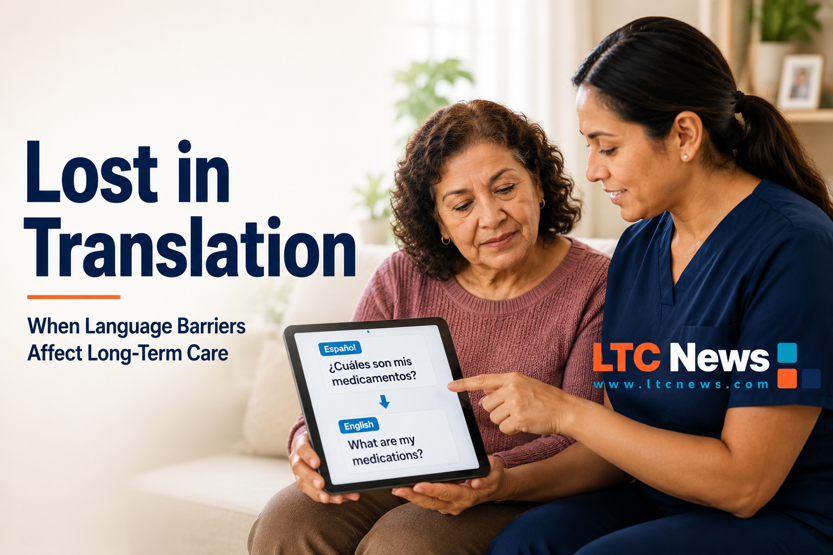
Advances in technology are improving language access in healthcare. Many providers now use video interpretation services, multilingual patient portals, and translation applications. Artificial intelligence tools are beginning to assist with real-time communication support as well.
However, healthcare experts consistently caution that automated translation should supplement, not replace, qualified medical interpreters and professional translators for high-stakes interactions. Human oversight remains essential when discussing diagnoses, medications, informed consent, and care planning. Automated tools are best suited for routine, lower-stakes communication.
What Families Should Ask When Evaluating Care Providers
When evaluating long-term care options, most families focus on cost, location, and quality ratings. Language access deserves a place in that conversation as well.
Some families hesitate to raise language concerns when evaluating extended care providers, worried that asking about a caregiver's English proficiency or requesting a bilingual staff member might come across as discriminatory. Experts say it is not. Asking whether a provider can communicate effectively with your loved one is a basic quality-of-care question — no different from asking about staffing ratios, safety records, or medication management protocols.
Effective communication is a clinical requirement, not a preference. When a caregiver cannot fully understand care instructions, or when a care recipient cannot clearly express pain or confusion, the result is a safety risk — regardless of anyone's intentions. Advocating for clear communication on behalf of a loved one is an act of care, not bias.
According to the AMA Journal of Ethics, long-term care organizations have both ethical and legal obligations to provide linguistically appropriate services. Title VI of the Civil Rights Act of 1964 prohibits discrimination based on national origin in any program receiving federal funds — and that obligation rests with the provider, not the patient or family.
When you narrow down long-term care options for a loved one in your search with the LTC News Caregiver Directory, be sure to include questions about language and communication.
Questions worth asking include:
- Are bilingual caregivers available, and in which languages?
- Are professional interpreter services offered for medical appointments and care conferences?
- Are care plans and written materials available in the preferred language?
- Can the care team — doctors, nurses, and care managers — communicate directly with the resident?
- Are family meetings conducted with interpretation support when needed?
These questions matter more as America's older population becomes more diverse. The U.S. Department of Health and Human Services continues to emphasize the importance of language access services for individuals with limited English proficiency, and federal estimates indicate that more than 25 million Americans have limited English proficiency. Minority older adult populations are projected to represent a growing share of the nation's aging population in the decades ahead.
Language Access Is Part of Long-Term Care Planning
Planning for long-term care is about more than paying for services. It is about ensuring care is delivered in a way that respects who a person is — including how they communicate, what makes them feel safe, and which language feels most natural when they are frightened or in pain.
Families who plan can make deliberate choices about providers who meet language and cultural needs. Long-Term Care Insurance, for example, gives families financial flexibility to choose providers based on fit rather than just availability or proximity. Medicare covers only short-term skilled care and does not pay for most ongoing long-term care services. Medicaid assists those with limited financial resources, but coverage and provider choice are often limited.
The LTC News Cost of Care Calculator can help you estimate current and future care costs of long-term care services in your area. Providers who provide language-specific services may cost more. For more on planning strategies, visit the LTC News Long-Term Care Insurance Learning Center.
Clear communication in long-term care is not a convenience or a preference. It is a core component of safety, informed consent, and human dignity.
Frequently Asked Questions
What problems can occur when language barriers exist?
Language barriers can contribute to:
- Medication errors
- Missed symptoms
- Delayed treatment
- Hospital readmissions
- Confusion about care plans
- Incomplete informed consent
- Social isolation
- Family misunderstandings
Even small communication errors can have significant consequences for older adults with complex health conditions.
Can artificial intelligence replace medical interpreters?
Not entirely. Translation technology and artificial intelligence can help with routine communication, but experts recommend human interpreters and professional translators for discussions involving diagnoses, medications, informed consent, treatment decisions, and care planning.
Why is Spanish especially important in healthcare and long-term care?
Spanish is the second most common language in the United States. Hispanic and Latino populations continue to grow, and many older adults either prefer Spanish or have limited English proficiency. At the same time, many caregivers and direct care workers also speak Spanish, making bilingual communication increasingly important in care settings.
What should families ask when evaluating long-term care providers?
Consider asking:
- Are bilingual caregivers available?
- What languages are spoken by staff?
- Are professional interpreter services offered?
- Are care plans available in multiple languages?
- Can physicians, nurses, and care managers communicate directly with my loved one?
- Are family meetings conducted with interpretation support when needed?
These questions can help ensure safer, more personalized care.
Why are accurate medical record translations important?
Medical records contain medication lists, diagnoses, laboratory results, treatment plans, and other critical information. Translation errors can lead to incorrect treatment decisions, insurance issues, delays in care, or legal problems. Accurate medical translation helps ensure continuity of care.
How many Americans speak a language other than English at home?
More than 22 percent of Americans speak a language other than English at home. Spanish is the most common non-English language, accounting for approximately 61 percent of non-English speakers. Millions of Americans also speak Chinese, Vietnamese, Tagalog, Korean, Arabic, Russian, Haitian Creole, and other languages.
Will the need for multilingual care increase in the future?
Yes. America's aging population is becoming more diverse. Minority older adults are expected to make up a larger share of the senior population in the coming decades, increasing demand for bilingual caregivers, interpreter services, multilingual care plans, and translated medical documents.
Why is language access important in long-term care?
Long-term care depends on ongoing communication between care recipients, family members, caregivers, nurses, and physicians. When language barriers exist, misunderstandings can affect medication management, symptom reporting, care planning, safety, and quality of life.
Why does language matter beyond safety?
Language is closely tied to culture, identity, trust, and dignity. Being able to communicate in a preferred language can reduce anxiety, improve emotional well-being, strengthen relationships with caregivers, and enhance overall quality of life during aging and long-term care.
Is asking about language abilities discriminatory?
No. Communication is a quality-of-care and safety issue. Families have every right to ask whether providers can effectively communicate with a loved one. Ensuring clear communication helps reduce risks and improves care outcomes.
Why can language barriers be especially challenging for people with dementia?
Many bilingual individuals with Alzheimer's disease or other dementias gradually revert to their first language as the disease progresses. If caregivers do not understand that language, it can become difficult to recognize pain, fear, anxiety, discomfort, or other needs.
Should family members serve as interpreters during medical appointments?
While family members often help, healthcare experts generally discourage relying solely on relatives to interpret medical information. Medical terminology can be complex, and important details may be misunderstood or omitted. Professional interpreters provide greater accuracy and help protect patient safety.
How does long-term care planning help address language needs?
Planning ahead gives families more options when selecting care providers. Long-term care insurance can provide greater flexibility to choose caregivers, home care agencies, assisted living communities, or nursing homes that better meet language and cultural preferences. Medicare generally covers only short-term skilled care, while Medicaid eligibility is based on financial need and may limit provider choice.


Sponsored