It’s 3 a.m. and Mom Needs Help. How After-Hours Support Helps Long-Term Care Families
About This Article
Afterhours nurse triage gives longterm care families a trained voice to call when symptoms, medication questions, or crises arise outside regular hours, even at 3 a.m. These services screen concerns, flag issues that may need emergency care, and can help reduce unnecessary ER visits. They’re a supplement, not a substitute, for a broader longterm care plan.

Linda Kople
Linda Kople is a freelance writer focused on caregiving, aging, health, wellness, long-term care, and retirement planning
Table of Contents
- Caregiving Has Become a Round-the-Clock Job for Millions
- What After-Hours Support Actually Offers
- What Research Actually Shows
- Many Families May Already Have This Benefit, at No Extra Cost
- Emotional Side of Caregiving Needs Attention Too
- After-Hours Help Doesn't Replace Long-Term Care Planning
- The Bigger Picture
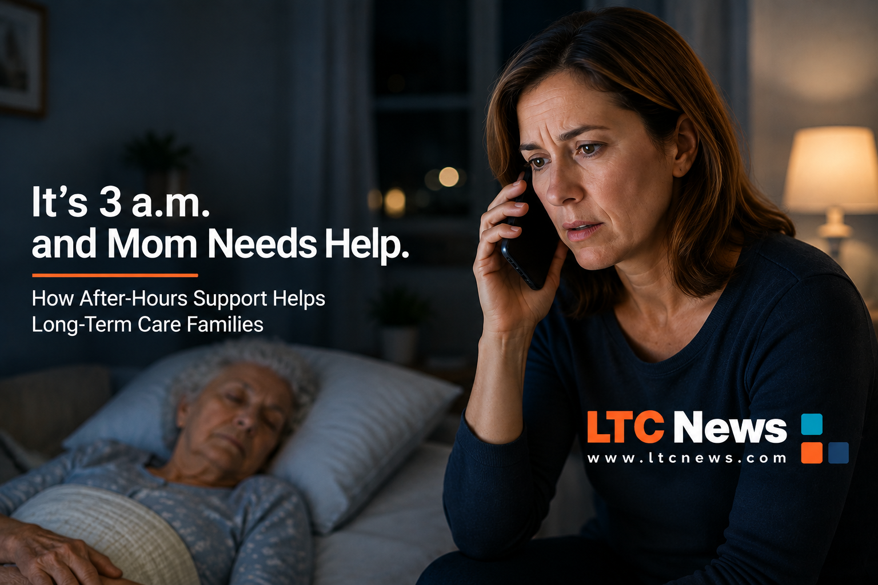
It's 3 a.m., and your mother's breathing sounds different than usual. It has already been a difficult adjustment since she moved in with your family, after you became uncomfortable with her living alone following your father's death. Her doctor's office closed ten hours ago. Wait until 9? Drive to the emergency room? Call a sibling who isn't a nurse and won't know either?
For the millions of Americans managing a parent's or spouse's long-term care needs, this scene repeats itself more often than anyone would like, and it rarely happens during business hours. What many families don't realize in that moment is that they may already have somewhere to turn.
If your mother is on a Medicare Advantage plan, covered by an employer health plan, or receiving home health or hospice care, a 24-hour nurse line may already be included at no extra cost, sitting unused on the back of an insurance card or in a folder of enrollment paperwork. The person who answers that phone at 3 a.m. can make a big difference.
Caregiving Has Become a Round-the-Clock Job for Millions
According to Caregiving in the US 2025, a joint report from AARP and the National Alliance for Caregiving (NAC), 63 million Americans, nearly one in four adults, now provide ongoing care for an older adult or a loved one. Family caregivers spend an average of 27 hours a week on caregiving duties, and 24 percent provide 40 or more hours a week, on top of jobs, households, and their own health needs.
The strain is well documented. A 2026 joint brief from the National Alliance for Caregiving and the National Alliance on Mental Illness, drawing on the same 2025 survey data, found that nearly two-thirds of caregivers (64 percent) report moderate to high emotional stress, and one in four feels alone, up from 21 percent in 2020. Financially, nearly half of family caregivers nationally report at least one negative financial impact from their caregiving responsibilities.
As NAC President and CEO Jason Resendez put it, family caregiving is "no longer a looming crisis; it's a daily reality" for millions of households, AARP reported on July 24, 2025.
Cognitive decline adds another layer. The Alzheimer's Association's 2026 Alzheimer's Disease Facts and Figures report puts the number of Americans age 65 and older living with Alzheimer's at 7.4 million in 2026, a figure projected to reach 13.8 million by 2060. Caring for a loved one with dementia often means symptoms and behavioral changes that don't wait for office hours, which is one reason reliable after-hours guidance matters.
What After-Hours Support Actually Offers
"Healthcare call center" covers a range of services, and not all are built the same way. Some are true nurse triage lines, staffed by licensed registered nurses who follow established clinical protocols, which may include widely used Schmitt-Thompson protocols. Others are broader call centers that use trained non-clinical staff to handle intake, scheduling, and routine questions, escalating to a nurse or on-call clinician only when needed. It matters which one a family is dealing with, since the scope of what each can safely advise varies.
Healthcare call center services support caregivers by providing a place to verify instructions, confirm appointment times, or ask whether a new symptom warrants a same-day visit, all without waiting on hold for an hour or driving to an office in person.
Depending on the program, after-hours support may include:
- Screening symptoms to help determine whether a same-day or emergency visit is warranted
- Helping route medication and prescription questions to the appropriate clinician or pharmacy
- Scheduling or rescheduling appointments across multiple providers
- Answering routine insurance and billing questions
- Identifying symptoms that may require emergency care and directing callers to 911 or the emergency department when appropriate
What Research Actually Shows
The evidence for nurse triage models is real, but it's worth being precise about what it covers. A peer-reviewed study of an after-hours nurse line, published in the National Library of Medicine's PubMed Central database, found the service resolved 70 percent of calls without physician involvement, with no patients triaged to home care later requiring an emergency room visit.
That study, however, was conducted in an academic pediatric endocrinology practice, a very different population from older adults managing multiple chronic conditions, dementia, or mobility limitations. It supports the broader point that nurse triage can resolve a large share of calls without a physician, but it should not be read as evidence of the same emergency-room outcomes for long-term care families specifically.
LTC News was unable to locate a comparably rigorous, independent study of after-hours triage outcomes in older or long-term care populations.
Yet, a 24-hour nurse line is a common feature of Medicare Advantage plans, offered at no extra cost by major insurers, and it typically appears alongside benefits like vision and dental rather than as a rare add-on.
Large employer-sponsored health plans frequently include the same kind of service. Original Medicare does not include a nurse line, and Medicare Supplement (Medigap) policies are standardized and generally don't either. However, some Medigap carriers add one as a free extra outside the standard benefit design.
Many Families May Already Have This Benefit, at No Extra Cost
A 24-hour nurse line isn't typically something a family buys on its own. It's built into the health coverage many people already have. Medicare Advantage plans often include one at no additional cost, and major insurers like Aetna, EmblemHealth, Providence, SCAN, and others usually offer it alongside benefits like vision and dental.
Large employer-sponsored health plans frequently include the same kind of service, and some home health and hospice agencies provide after-hours nurse access directly to their patients as part of care. Original Medicare does not include a nurse line, and Medicare Supplement (Medigap) policies are standardized and generally don't either, though some Medigap carriers add one as a free extra outside the standard benefit design.
For a family managing an older parent's or spouse's care, the practical step isn't shopping for this service; it's finding out whether it's already available. Check the back of the insurance card, the plan's Evidence of Coverage, the insurer's member portal, or a home health or hospice agency's welcome materials for a nurse line number.
If a loved one is on a Medicare Advantage plan or receiving home health or hospice care, the benefit may already exist and be available for you. Save the number somewhere easy to find, so it's ready before the night it's actually needed.
Emotional Side of Caregiving Needs Attention Too
Long-term care is rarely just physical. Isolation, grief, anxiety, and depression are common for both the person receiving care and the person providing it, and a symptom hotline alone won't address that.
Some care programs now pair nurse triage with a behavioral health virtual assistant, helping connect families to therapy or counseling rather than letting emotional needs get pushed aside while everyone focuses on physical symptoms.
Persistent caregiver stress can affect sleep, physical health, work, and relationships. Caregivers experiencing significant stress should consider talking with their doctor, a mental health professional, or a caregiver support organization rather than waiting until the strain becomes overwhelming.
After-Hours Help Doesn't Replace Long-Term Care Planning
After-hours support solves an immediate problem: what to do when a question or a crisis comes up outside office hours. It does not solve the larger problem every family eventually faces: who will provide extended care, where it will happen, and how it will be paid for. The emotional and physical burden of balancing caregiving with a career and family can be overwhelming. Without a long-term care plan. it often falls on an adult daughter or daughter-in-law.
Medicare generally pays for short-term skilled care under specific circumstances, not ongoing custodial long-term care. Medicaid can pay for long-term care for people who meet financial and functional eligibility requirements, which vary by state.
If your parent has Long-Term Care Insurance, it will provide tax-free benefits for qualified long-term care services, including care at home, adult day care, assisted living, memory care, and nursing home care, depending on the policy. That in-home care can give you and your family more time to be together instead of managing everything.
Keep in mind that you usually purchase Long-Term Care Insurance before you retire as part of an overall retirement plan. Because an LTC policy is subject to medical underwriting, you usually can't get one when a loved one needs care.
Many families wait longer than they need to before using an LTC policy that's already in place.
Since most Long-Term Care Insurance policies include in-home care and respite care, making a claim on an existing policy right away benefits everyone and ensures quality care." — Nick DeFrank, Vice President of LTC News.
DeFrank says families often contact LTC News for help finding caregivers and filing a Long-Term Care Insurance claim only after they've been managing caregiving entirely on their own for a while, having wanted to save the policy for "a rainy day."
LTC News partners with Amada Senior Care to provide free claim support with no cost or obligation — File a Long-Term Care Insurance Claim. The LTC News Caregiver Directory has over 80,000 caregivers and facilities that you can search for in your location to help you and your loved one.
Families weighing extended care options can use the LTC News Cost of Long-Term Care Services Calculator to see median costs for care services in their area.
The Bigger Picture
Caregiving is hard, even for the most capable, organized families. Nights like the one described above are common, and no one should feel they have to manage every part of it alone. Getting support, whether that's an after-hours nurse line, in-home help, or respite care to give a primary caregiver a break, is a reasonable and often necessary part of caring for an older loved one, not a sign of falling short.
After-hours call center support can be genuinely helpful for a family caregiver, but it's only one piece of a much larger plan, not a substitute for it. If a loved one has a Long-Term Care Insurance policy, the benefits are there to be used as soon as that person qualifies, not saved for some later, harder day.
Your experience as a caregiver should encourage you to prepare for aging now. Take an honest look at current and future long-term costs and available LTC Insurance coverage you can purchase affordably now, while you enjoy good health. Being prepared will give your adult children one less thing to face alone at 3 a.m. sometime in the future.
Frequently Asked Questions
How can I find out if my parent already has access to a nurse line?
Check the back of your parent's health insurance card, Evidence of Coverage, insurer's member portal, or enrollment materials. Families receiving home health or hospice services should also ask the provider whether after-hours nurse access is available. If you find a 24-hour number, save it in your phone and somewhere other family caregivers can easily find it before an urgent situation occurs.
What should families look for in an after-hours healthcare service?
Find out who answers medical questions, whether licensed nurses follow established clinical protocols, how urgent concerns are escalated, and how information is shared with the person's regular care team. Families should also understand how the service protects personal health information and what types of questions the service can and cannot address.
Can an after-hours nurse line solve the challenges of long-term care?
No. It addresses a specific problem: getting guidance when a health concern occurs outside normal office hours. Families still need to determine who will provide extended care, where that care will be provided, and how they will pay for it. Medicare generally covers short-term skilled care under specific circumstances rather than ongoing custodial long-term care, while Medicaid coverage depends on financial and functional eligibility requirements.
Can an after-hours nurse line help avoid unnecessary emergency room visits?
It may. Nurse triage can help families determine when symptoms may require emergency care and when another level of care may be appropriate. One peer-reviewed pediatric study found that an after-hours nurse line resolved 70 percent of calls without physician involvement. However, that research involved pediatric patients, not older adults with long-term care needs, so the same results should not be assumed for older populations.
Does Medicare provide a 24-hour nurse line?
Original Medicare does not include a 24-hour nurse line as a standard benefit. However, many Medicare Advantage plans offer nurse lines at no additional cost. Standardized Medicare Supplement (Medigap) coverage generally does not include this benefit, although some insurers may offer a nurse line as an additional service outside the standardized Medigap benefits.
Does an after-hours nurse line replace a doctor or emergency care?
No. After-hours support can help assess concerns and direct families toward an appropriate next step, but it does not replace a person's doctor or emergency medical services. Symptoms that may represent an emergency should be directed to 911 or an emergency department when appropriate.
What is an after-hours nurse triage line?
An after-hours nurse triage line gives patients and family caregivers access to a licensed nurse when a doctor's office is closed. Depending on the program, nurses can review symptoms, answer general health questions, help determine whether a concern can wait for regular office hours, or recommend seeking urgent or emergency care. Some healthcare call centers use non-clinical staff for initial calls and escalate medical concerns to a nurse or on-call clinician.


Sponsored