Is Manuka Honey Worth the Price? Health Benefits and Risks for Older Adults
About This Article
Manuka honey contains methylglyoxal (MGO), which gives it stronger antibacterial activity than ordinary honey. Sterile medical-grade honey dressings have a role in professional wound care. It has distinctive antibacterial properties and legitimate medical applications, but not every health claim justifies its premium price.

Marcus Howard
Marcus Howard writes about alternative health topics for older adults such as CBD, acupuncture, and herbal medicine.
Table of Contents
- What Is Manuka Honey?
- Can Manuka Honey Help Heal Wounds?
- What Family Caregivers Should Know About Bedsores
- Does Manuka Honey Offer Other Health Benefits?
- Is Manuka Honey Safe if You Have Diabetes?
- Other Safety Considerations for Older Adults
- Buying Authentic Manuka Honey
- Understanding Manuka Honey Labels
- Comparing Manuka Honey Ratings
- How Can You Tell if Manuka Honey Is Authentic?
- Is Manuka Honey Worth the Extra Money?
- When Your Loved One Needs More Than a Home Remedy
- Make Informed Choices About Your Health as You Age
You may have noticed jars of Manuka honey selling for several times the price of ordinary honey, accompanied by claims about immune health, digestion, skin repair, and wound healing. But is this premium honey worth the extra money, particularly as you get older?
As you age, managing your health may become more complicated. You may be living with diabetes, experiencing digestive problems, or noticing that cuts and scrapes take longer to heal. Natural products like Manuka honey may seem like an attractive addition to your wellness routine.
Manuka honey has distinctive antibacterial properties, and specially prepared medical-grade honey has legitimate applications in professional wound care. However, not every health claim associated with Manuka honey is supported by strong clinical evidence.
Understanding what Manuka honey can and cannot do can help you make better health decisions, avoid unnecessary expenses, and recognize when you or an older loved one needs professional medical attention.
What Is Manuka Honey?
Manuka honey is produced by bees that collect nectar from the Manuka plant (Leptospermum scoparium), which grows in New Zealand and Australia. Compared with ordinary honey, Manuka honey typically has a thicker consistency, darker color, and a richer, slightly earthy flavor.
What makes it different, however, is its concentration of a naturally occurring compound called methylglyoxal (MGO).
Most honey has some antibacterial properties. Manuka honey contains additional antibacterial activity associated with MGO, which develops from a compound naturally present in the plant's nectar. Dee Carter, a professor of microbiology at the University of Sydney who has studied honey's antibacterial properties for decades, points to MGO as the key difference.
The bacteria have all been killed very quickly by honey, despite any resistance [to other drugs] that they might have." — Dr. Dee Carter, quoted in The National.
Higher concentrations of MGO generally correspond with greater antibacterial activity under laboratory conditions. However, that doesn't necessarily mean consuming higher-strength honey will improve your health or help you recover from an illness.
Can Manuka Honey Help Heal Wounds?
One of the most promising medical applications of honey is wound care, an issue that becomes increasingly important as you get older. Aging skin becomes thinner and more vulnerable to injury. Diabetes, poor circulation, limited mobility, and inadequate nutrition can make wounds more difficult to heal.
Medical-grade honey is used in certain specialized wound dressings. Its properties can help maintain a moist wound environment and inhibit bacterial growth. A 2015 Cochrane review of honey as a treatment for acute and chronic wounds examined 26 studies involving more than 3,000 participants. Researchers found evidence that honey helped certain partial-thickness burns and infected surgical wounds heal faster than some conventional treatments.
However, the review examined different types of honey and did not establish whether honey was more effective than other treatments for diabetic foot ulcers, venous leg ulcers, and pressure injuries. Medical-grade honey is not the same as the Manuka honey you buy at the grocery store. The U.S. Food and Drug Administration (FDA) cleared Manuka honey wound dressings as early as 2007. FDA clearance applies to specific medical-grade dressings, not to honey sold as food.
Medical honey dressings are specially prepared and sterilized for wound management. Even the most expensive jar of Manuka honey is not a substitute for these medical products.
What Family Caregivers Should Know About Bedsores
If you're caring for an aging parent or spouse who spends much of the day in bed or a wheelchair, pressure injuries, commonly called bedsores, can become a serious concern. You may encounter online recommendations suggesting that Manuka honey can help heal these wounds. Although a wound care specialist may recommend medical-grade honey as part of a treatment plan, applying store-bought honey to your loved one's skin could introduce contaminants or delay appropriate treatment.
Pressure injuries often require a combination of treatments, including pressure relief, specialized dressings, nutritional support, and management of underlying health conditions.
Contact your loved one's healthcare provider if you notice:
- Persistent skin discoloration over a bony area
- Blisters, broken skin, or an open wound
- Increasing pain, swelling or warmth around a wound
- Pus, drainage, or an unpleasant odor
- A wound that isn't healing or is becoming larger
Fever, spreading redness, or sudden changes in your loved one's health may indicate a serious infection requiring urgent medical attention. Understanding how to prevent bedsores at home, including proper repositioning and skin care, can help you protect your loved one from painful and potentially serious complications.
Does Manuka Honey Offer Other Health Benefits?
Researchers continue to study Manuka honey for its antibacterial, antioxidant, and anti-inflammatory properties. Some findings are encouraging, but there's an important distinction between what happens in a laboratory and what happens when you consume a teaspoon of honey.
- Coughs and Sore Throats
A spoonful of honey may help soothe an irritated throat and temporarily reduce coughing. You may find it particularly comforting when added to warm tea. However, you don't necessarily need Manuka honey to experience these benefits. Ordinary honey may provide similar relief at a fraction of the cost.
If you have a persistent cough, fever or trouble swallowing, seek medical advice rather than relying on a home remedy. Difficulty breathing requires prompt medical attention.
- Digestive Health
Manuka honey is frequently marketed as a natural way to improve gut health, reduce acid reflux and support healthy intestinal bacteria. Laboratory research has examined its effects on several bacteria, including Helicobacter pylori, commonly known as H. pylori, which is associated with stomach ulcers.
However, there isn't sufficient human clinical evidence to recommend Manuka honey as a treatment for acid reflux, ulcers, bacterial infections or other digestive disorders. If you're experiencing frequent heartburn, persistent abdominal discomfort or unexplained changes in your digestive health, talk with your doctor. Digestive symptoms shouldn't automatically be dismissed as a normal part of aging.
- Immune Health and Inflammation
Many products marketed to adults over age 50 promise to strengthen the immune system or reduce inflammation. Although Manuka honey contains compounds with antioxidant and antibacterial properties, consuming it regularly has not been established as an effective way to prevent infections, strengthen immune function or manage chronic inflammatory conditions.
Getting adequate sleep, eating a balanced diet, staying physically active and receiving recommended vaccinations have stronger evidence supporting their role in maintaining your health as you age.
- Oral Health
Researchers have explored whether Manuka honey's antibacterial properties could help manage bacteria associated with gum disease and dental plaque. However, evidence supporting its routine use for oral health remains limited.
Honey also contains sugars that can contribute to tooth decay. If you experience dry mouth, a common problem among older adults taking certain medications, frequent exposure to sugary foods may increase your risk of dental problems.
Manuka honey shouldn't replace regular brushing, flossing, dental examinations or professionally recommended treatments for gum disease.
Is Manuka Honey Safe if You Have Diabetes?
Despite its reputation as a natural health product, Manuka honey is still a concentrated source of sugar. One tablespoon of honey contains approximately 64 calories and 17 grams of carbohydrates, primarily from sugar, according to the U.S. Department of Agriculture's FoodData Central nutritional database. Your blood sugar can increase after consuming honey, regardless of its antibacterial properties or MGO rating.
According to the Mayo Clinic, substituting honey for regular sugar generally offers no significant advantage for people with diabetes. In fact, honey contains slightly more carbohydrates and calories per teaspoon than granulated sugar.
If you enjoy Manuka honey, you may be able to incorporate small amounts into your diet. However, account for its carbohydrate content in your diabetes management plan. If you're caring for someone with diabetes, don't assume that a natural sweetener is healthier or safer simply because it has potential medicinal properties.
Other Safety Considerations for Older Adults
Most healthy adults can safely enjoy Manuka honey in moderation. However, certain health conditions may require additional precautions:
- Swallowing difficulties: If you or a loved one has dysphagia following a stroke, dementia or another neurological condition, follow the dietary recommendations of a speech-language pathologist. You may hear the term "honey-thick liquids," which describes a liquid's consistency, not the use of actual honey. Adding honey to a beverage doesn't necessarily make it safe to swallow. Follow the prescribed liquid thickness and preparation instructions to reduce the risk of choking or aspiration.
- Allergies: People with known allergies to honey or its components should avoid it.
- Weight management: Adding honey to your daily diet increases your calorie and sugar intake.
- Chronic health conditions: Don't substitute honey for prescribed medications or medically recommended treatments.
If you're a grandparent caring for young grandchildren, remember that honey of any kind should never be given to children under 12 months of age because of the risk of infant botulism.
Buying Authentic Manuka Honey
Experts say the ideal placeto buy authentic Manuka honey is directly from verified online storefronts of reputable New Zealand brands. There are several options, such as Bees & Trees Manuka Honey, or authorized retailers that clearly provide the honey’s New Zealand origin, MGO rating, and independent batch-testing information. Buying from a transparent producer makes it easier to verify authenticity, review current product details, and choose the right MGO strength before purchasing.
When deciding where to buy authentic Manuka honey, check for three things: a clear MGO rating on the label, a batch or lot code connected to an independent Certificate of Analysis, and confirmation that the honey complies with New Zealand Ministry for Primary Industries requirements.
Understanding Manuka Honey Labels
If you decide to purchase Manuka honey, you'll likely encounter several unfamiliar acronyms and numbers on the packaging. These ratings can help you understand what you're buying, but they shouldn't be interpreted as medical treatment recommendations.
- MGO—Methylglyoxal
The MGO rating indicates the concentration of methylglyoxal in the honey, measured in milligrams per kilogram. For example, a jar labeled MGO 350+ indicates a claimed minimum concentration of 350 milligrams of methylglyoxal per kilogram of honey. Higher MGO ratings generally command higher prices because they indicate a greater concentration of this antibacterial compound.
- UMF—Unique Manuka Factor
The Unique Manuka Factor (UMF) is a voluntary certification system administered by the UMF Honey Association. The certification evaluates several naturally occurring compounds:
- Methylglyoxal (MGO): Associated with antibacterial activity.
- Leptosperin: A marker used to help establish authenticity.
- Dihydroxyacetone (DHA): A precursor to MGO that helps assess the honey's potential to maintain its potency over time.
- Hydroxymethylfurfural (HMF): An indicator associated with freshness, storage, and heat exposure.
Not every legitimate Manuka honey producer participates in the UMF certification program. Some manufacturers use independent laboratory testing and other traceability measures to demonstrate product quality and authenticity.
- NPA—Non-Peroxide Activity
Non-peroxide activity, or NPA, is an older measurement system used to describe antibacterial activity that isn't attributable to hydrogen peroxide. Although you may still encounter NPA ratings, MGO and UMF ratings are commonly used to help consumers compare products.
Comparing Manuka Honey Ratings
The UMF Honey Association's four-factor quality assurance standards establish minimum MGO concentrations for each UMF rating.
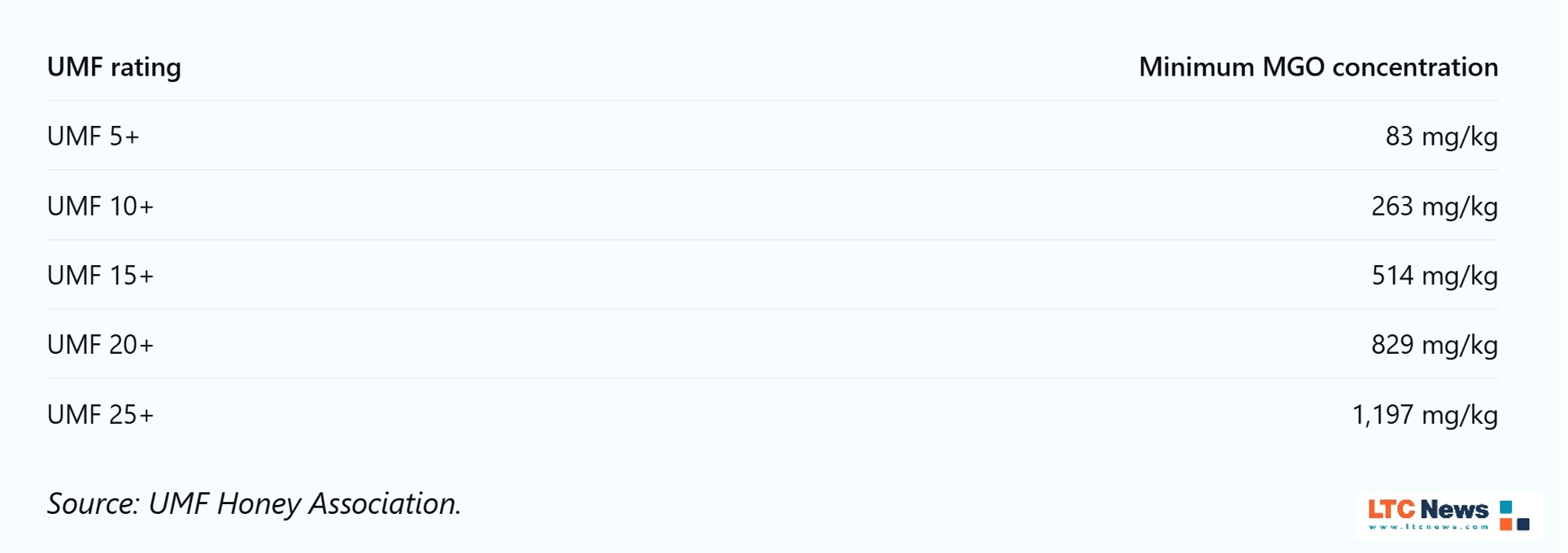
MGO concentration is only one component of UMF certification. A product that meets the minimum MGO concentration does not necessarily satisfy the association's other quality and authenticity requirements.
No established medical guidelines recommend specific MGO or UMF ratings for digestive health, immune support, inflammation, or other chronic health conditions.
Don't assume a jar with a higher rating will deliver greater health benefits simply because it costs more.
How Can You Tell if Manuka Honey Is Authentic?
The premium price of Manuka honey makes authenticity an important consideration. You don't want to spend considerably more money on a product that doesn't contain what the manufacturer claims. New Zealand's Ministry for Primary Industries (MPI) requires honey labeled as Manuka honey for export to undergo testing by recognized laboratories.
The testing examines four chemical markers and a DNA marker associated with Manuka pollen to establish authenticity. It also distinguishes monofloral Manuka honey, derived predominantly from Manuka flowers, from multifloral Manuka honey, which contains nectar from a wider variety of plants.
Australia also produces Manuka honey, although New Zealand's export testing requirements apply specifically to honey exported from New Zealand.
Be cautious of products that promise to cure infections, reverse chronic health conditions, or deliver guaranteed therapeutic results. Authenticity and medical effectiveness are two separate issues. Even genuine, high-quality Manuka honey may not deliver the health benefits advertised.
Is Manuka Honey Worth the Extra Money?
Your decision may ultimately depend on why you're buying it.
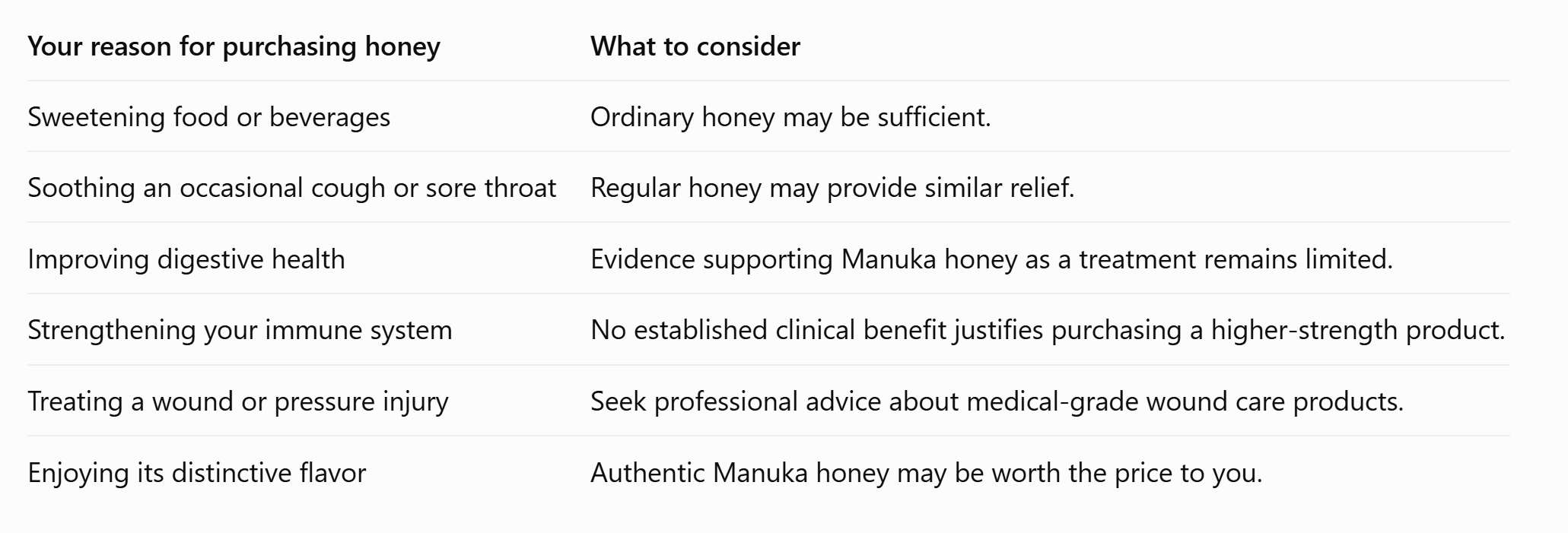
If you enjoy the taste of Manuka honey and can comfortably afford it, there's nothing inherently wrong with purchasing it. However, particularly if you're living on a fixed retirement income, spending substantially more on a higher MGO rating may not deliver meaningful additional health benefits.
When Your Loved One Needs More Than a Home Remedy
If you're helping an aging parent or spouse manage chronic health problems, you may find yourself looking for natural remedies that could improve their quality of life. However, changes in skin condition, appetite, mobility, digestion, or overall health may indicate a growing need for professional care rather than a new dietary product.
A home health nurse can help assess wounds, monitor certain health conditions, and provide medically necessary skilled services. Professional home caregivers can assist with personal hygiene, meal preparation, mobility, and other daily activities that become more difficult with age.
Medicare's home health benefit can cover medically necessary wound care provided by a nurse, including treatment for pressure injuries and surgical wounds. To qualify, you must generally be homebound, require part-time or intermittent skilled services, and have a doctor or other authorized healthcare provider certify your need for care. A Medicare-certified home health agency must provide the services.
However, Medicare and most traditional health insurance plans generally don't cover ongoing custodial long-term care when personal assistance is the only care you need. Medicare only pays for short-term skilled care. Although Medicare's skilled nursing facility benefit is time-limited, qualifying intermittent skilled home health services may continue as long as eligibility requirements are met.
Medicaid may provide long-term care benefits for individuals who meet state-specific financial and functional eligibility requirements. If you have tax-qualified Long-Term Care Insurance, your policy can help pay for covered long-term care services, generally providing tax-free benefits once you satisfy the policy's eligibility requirements.
If you're beginning to explore professional care options, the LTC News Caregiver Directory offers access to more than 80,000 long-term care providers nationwide, including in-home care agencies, assisted living communities, memory care facilities, and nursing homes.
Make Informed Choices About Your Health as You Age
Natural products can have a place in your daily life, but natural doesn't always mean more effective, safer, or medically necessary. As you get older, focus on what's well established to support your health and independence—good nutrition, regular physical activity, preventive healthcare, and appropriate management of chronic health conditions.
If you enjoy a teaspoon of Manuka honey in your morning tea, there's no reason to expect it to be a miracle remedy. Sometimes, enjoying the flavor is reason enough.
Frequently Asked Questions
Is Manuka honey approved by the FDA?
The FDA cleared specific Manuka honey wound dressings as early as 2007. However, that clearance applies to medical-grade wound care products, not honey sold as food. Manuka honey sold for consumption is not FDA-approved as a treatment for disease.
Is Manuka honey safe for people with diabetes?
Manuka honey can raise your blood sugar just like ordinary honey or other sweeteners. It contains slightly more carbohydrates and calories per teaspoon than granulated sugar. If you have diabetes, account for its carbohydrate content in your diabetes management plan.
What is Manuka honey, and how is it different from regular honey?
Manuka honey comes from bees that collect nectar from the Manuka plant, native to New Zealand and Australia. It contains higher concentrations of methylglyoxal (MGO), a naturally occurring compound associated with antibacterial activity. However, stronger antibacterial properties in laboratory studies don't necessarily translate into greater health benefits when consumed.
Can you eat Manuka honey every day?
Most healthy adults can consume small amounts of Manuka honey daily. However, one tablespoon of honey contains approximately 64 calories and 17 grams of carbohydrates. There is no established daily therapeutic dose or evidence that regular consumption prevents disease.
Can Manuka honey help heal bedsores and chronic wounds?
A wound care specialist may recommend sterile, medical-grade honey dressings as part of a treatment plan. However, evidence establishing their superiority over other treatments for pressure injuries remains limited. Never apply store-bought honey to bedsores, diabetic ulcers or other open wounds.
What are the proven health benefits of Manuka honey?
The strongest clinical evidence for honey's therapeutic use involves certain medical-grade wound dressings. Honey may also help soothe coughs and sore throats. However, evidence supporting Manuka honey for digestive health, immune function and chronic inflammation remains limited.
Is Manuka honey good for older adults?
Most older adults can safely enjoy Manuka honey in moderation, but there are no established health benefits specific to older adults. If you have diabetes, swallowing difficulties, dental problems or other chronic health conditions, consider your individual dietary and medical needs before consuming it regularly.


Sponsored