How Lab Accuracy Shapes Senior Care Decisions
About This Article
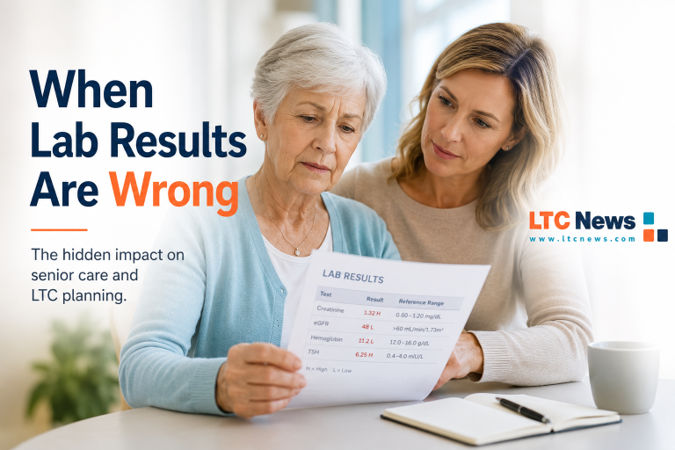
Laboratory test results drive a significant share of clinical decisions — including diagnoses, medication management, and discharge planning. For older adults, even small errors in lab results can trigger incorrect diagnoses, delay necessary care, disrupt long-term care planning, and affect eligibility for Long-Term Care Insurance.

Mallory Knee
Mallory Knee is a freelance writer for multiple online publications where she can showcase her affinity for all things beauty and fashion.
You trust lab results. Most families do. A number comes back on a blood panel, and a doctor acts on it. Medications change. Care plans shift. Decisions that can affect the rest of someone's life are made, all based on data assumed to be accurate.
But what happens when that data is wrong?
For older adults managing multiple chronic conditions, and for the adult children helping coordinate their care, laboratory accuracy is not an abstract technical issue. It has real consequences — medical, financial, and personal — that extend well beyond the clinic.
Why Lab Results Carry So Much Weight in Senior Care
The CDC reports that approximately 70 percent of medical decisions depend on laboratory test results, with more than 14 billion tests ordered annually in the United States. Hospitalization, medication prescriptions, and discharge timing — all routinely hinge on lab data.
For older adults, that dependence intensifies. Aging brings more chronic conditions, more medications to monitor, and more diagnostic complexity. Blood tests track kidney function, thyroid activity, blood glucose, cholesterol, cardiac markers, and dozens of other indicators that guide how doctors adjust care over time. Routine labs can catch early warning signs of conditions like anemia, diabetes, or kidney disease before symptoms become serious.
When those results are accurate, the system works as designed. When they are not, the downstream effects can be significant — and often go unnoticed until harm has already occurred.
The Scope of Diagnostic Error
Diagnostic errors — which include lab-driven misdiagnoses, delayed diagnoses, and missed diagnoses — are more common than most patients realize. Research published in JAMA Internal Medicine by Harvard-affiliated Brigham and Women's Hospital found that among nearly 2,500 hospitalized patients who had been transferred to an ICU or died, 23 percent experienced a diagnostic error, the majority of which were harmful.
A 2025 OECD report on diagnostic safety estimated that up to 15 percent of diagnoses are inaccurate, delayed, or wrong, with the direct financial burden of misdiagnosis estimated at 17.5 percent of total healthcare expenditure in a typical OECD country.
The American Society for Clinical Laboratory Science (ASCLS) has noted that failure to order or properly interpret diagnostic tests accounts for 55 percent of missed and delayed diagnoses in outpatient settings and 58 percent in emergency departments.
Diagnostic errors affect roughly 5 percent of U.S. adults each year. Among older adults — who present more atypically, carry more overlapping conditions, and take more medications — the risks are elevated.
Where Lab Errors Actually Happen
Not all laboratory errors occur in the testing itself. Research published in peer-reviewed literature consistently shows that most errors originate in the pre-analytical phase — before the test is even run. According to a study in Dove Medical Press's Practical Laboratory Medicine, pre-analytical errors account for 46 to 68 percent of total laboratory errors, while post-analytical errors account for another 18 to 47 percent. Errors in the analytical (testing) phase account for only 7 to 13 percent.
Even small lapses in proper lab instrument handlingcan introduce errors when teams fail to follow protocols carefully. In plain language: the biggest risks are in how samples are collected, labeled, transported, and handled — and in how results are communicated and interpreted after testing.
For older adults, several factors heighten vulnerability:
- Multiple medications can interfere with test results, producing readings that look abnormal when the underlying health status is stable
- Dehydration, common in older adults, can concentrate blood samples and skew results
- Atypical symptom presentation means doctors may be testing for the wrong conditions in the first place
- Fragmented care across multiple specialists increases the chance that no single provider sees the full picture
A systematic review published in The International Journal of General Medicine found that misdiagnosis rates exceeding 10 percent were documented for conditions prevalent in older adults, including dementia, heart failure, COPD, Parkinson's disease, and stroke. Both overdiagnosis and underdiagnosis are common and carry serious consequences.
What a Wrong Result Can Set in Motion
The effects of a single inaccurate lab result can cascade quickly — especially for older adults already managing complex health situations.
An abnormal kidney function result, for example, could lead to changes in medications that affect cognition or balance. A misread thyroid panel can result in months of incorrect treatment before the error is caught. A false positive or false negative in a cardiac marker test can trigger unnecessary procedures — or delay essential ones.
For caregivers of aging parents, these errors are particularly difficult to detect. You are relying on the same data the doctor is. If the result looks authoritative on a printout, it can take an advocate — someone asking questions and requesting second opinions — to identify that something is off.
The Long-Term Care Planning Dimension
What many families don't realize is that lab accuracy doesn't just affect today's medical decisions — it can shape long-term care planning and Long-Term Care Insurance outcomes for years.
Long-Term Care Insurance is medically underwritten. Insurers review an applicant's health history, current health status, and documented diagnoses to assess eligibility and set premiums. An inaccurate diagnosis in a medical record — even one that was never clinically confirmed — can affect an insurer's decision. As LTC News has previously reported, prescription data reports and electronic health records used by underwriters may contain errors that don't reflect a person's actual health. The result could be a decline for coverage.
According to research published in Health Affairs, approximately 40 percent of adults in the target age range for Long-Term Care Insurance — ages 50 to 71 — would be disqualified for coverage on medical grounds under standard underwriting criteria. For some, that disqualification stems from documented health conditions. For others, it may trace back to inaccurate data.
👉 Declined for Long-Term Care Insurance? Here’s What to Do Next
The 56 percent of Americans turning 65 who will need long-term care at some point — based on the federal definition of needing help with at least two activities of daily living, or supervision due to cognitive impairment — deserve to have accurate health records supporting their planning.
An erroneous diagnosis that suggests cognitive decline, for example, could make it harder or impossible to qualify for LTC Insurance. A correct diagnosis, accurately documented, supports better care coordination and better financial planning. The stakes are high, and they are not always obvious.
Questions Caregivers Should Be Asking
You don't need a medical degree to advocate effectively for an older family member. You need awareness — and a willingness to ask the questions that doctors and lab teams may not volunteer on their own.
Before the test:
- Has the person been told how to prepare? Fasting requirements, hydration status, and medication timing can all affect results.
- Is this the right test for what the doctor suspects? Lab professionals are an underutilized resource for education on proper test selection.
After the result comes back:
- Was the test repeated to confirm unexpected findings? For results that would significantly change a care plan, a single data point may not be sufficient.
- Does this result make sense given the full clinical picture? Advocate for an explanation if a result seems inconsistent with observed symptoms or recent history.
- Is a second opinion warranted? Particularly for diagnoses with major care implications — dementia, heart failure, kidney disease — a second review is reasonable and appropriate.
Regarding the medical record:
- Has an inaccurate diagnosis ever appeared in records that was later corrected? Request documentation that corrections were made and reflected in the electronic health record.
- If applying for LTC Insurance, work with a qualified Long-Term Care Insurance specialist to review the documentation before submitting an application. Errors discovered during underwriting are harder to address than errors corrected proactively.
Accuracy as a Long-Term Care Safeguard
Healthcare systems continue to improve testing protocols, automate analytical processes, and reduce sources of human error. Fully automated analytical systems have significantly reduced error rates during testing. But the pre-analytical and post-analytical phases — where most errors occur — remain heavily dependent on humans.
No system is error-free. That reality doesn't need to generate anxiety, but it does call for engagement. For families navigating the complexities of aging — managing multiple providers, balancing care decisions, planning for future needs — understanding that lab data is foundational to everything else is practical, not paranoid. Accurate testing supports accurate diagnoses, which support sound care decisions, which protect both health and financial security.
Health Disclaimer: This article is for informational purposes only and does not constitute medical advice. Always consult a qualified healthcare professional regarding medical conditions, diagnoses, and treatment decisions.
Sources:
- CDC, "About Laboratory Week 2019": https://www.cdc.gov/lab-week/about-archive.html
- OECD Health Working Papers No. 176, "The Economics of Diagnostic Safety" (2025): https://www.oecd.org/content/dam/oecd/en/publications/reports/2025/03/the-economics-of-diagnostic-safety_6e0ed50b/fc61057a-en.pdf
- American Society for Clinical Laboratory Science (ASCLS), "Do No Harm: Diagnostic Errors and the Laboratory" (Nov. 2025): https://ascls.org/do-no-harm-diagnostic-errors-laboratory/
- Harvard Gazette / Brigham and Women's Hospital, "Research assesses rates, causes of diagnostic errors" (Jan. 2024): https://news.harvard.edu/gazette/story/2024/01/research-assesses-rates-causes-of-diagnostic-errors/
- Dove Medical Press, Practical Laboratory Medicine, "Assessment of Types and Frequency of Errors in Diagnostic Laboratories" (March 2022): https://www.dovepress.com/assessment-of-types-and-frequency-of-errors-in-diagnostic-laboratories-peer-reviewed-fulltext-article-PLMI
- Dove Medical Press, International Journal of General Medicine, "Diagnostic errors in older patients: a systematic review" (2016): https://www.dovepress.com/diagnostic-errors-in-older-patients-a-systematic-review-of-incidence-a-peer-reviewed-fulltext-article-IJGM
- PMC / Health Affairs, "Medical Underwriting in Long-Term Care Insurance": https://pmc.ncbi.nlm.nih.gov/articles/PMC5127198/
- LTC News, "Prescription Data Reports Can Adversely Impact Long-Term Care Insurance Underwriting Decisions": https://www.ltcnews.com/articles/prescription-data-reports-adversely-impact-long-term-care-insurance-underwriting-decisions
- LTC News, "What Is Underwriting in Long-Term Care Insurance?": https://www.ltcnews.com/resources/faq/what-is-long-term-care-insurance-underwriting
Frequently Asked Questions
What should families do if they believe a diagnosis is incorrect?
Families should discuss concerns with the physician, request clarification, consider repeat testing when appropriate, and seek a second opinion for serious diagnoses. It is also important to ensure any corrected diagnosis is properly updated in the electronic health record.
Why are older adults more vulnerable to inaccurate test results?
Several factors can complicate testing in older adults, including multiple medications, dehydration, overlapping health conditions, and care from several different specialists. These factors can make results more difficult to interpret and increase the risk of diagnostic mistakes.
Should unusual laboratory results be repeated?
In many situations, yes. When a result would significantly alter treatment, medication use, or a diagnosis, physicians may recommend repeating the test to confirm the finding before making major care decisions.
How often do medical decisions depend on laboratory testing?
The Centers for Disease Control and Prevention (CDC) reports that about 70 percent of medical decisions rely on laboratory results. Hospital admissions, medication changes, treatment plans, and discharge decisions are frequently based on lab data.
Why does lab accuracy matter for long-term care planning?
Accurate laboratory testing supports accurate diagnoses, which helps families make informed decisions about care needs, financial planning, and Long-Term Care Insurance. Reliable medical records can protect both health outcomes and future planning options.
How can caregivers help reduce the risk of laboratory errors?
Caregivers can help ensure proper test preparation, provide complete medication information, ask questions about unexpected results, request explanations that fit the overall clinical picture, and maintain copies of important medical records. Active involvement can help identify potential problems before they affect care.
Why are laboratory test results so important for older adults?
Laboratory tests help physicians diagnose illnesses, monitor chronic conditions, adjust medications, and evaluate overall health. Because older adults often manage multiple health issues at the same time, accurate test results are critical to making appropriate care decisions.
Can laboratory errors lead to misdiagnosis?
Yes. Inaccurate test results can contribute to missed diagnoses, delayed diagnoses, or incorrect diagnoses. For older adults, these mistakes can affect treatment decisions, quality of life, and long-term health outcomes.
Can errors in medical records affect Long-Term Care Insurance eligibility?
Yes. Long-Term Care Insurance underwriting relies heavily on medical records and documented diagnoses. An inaccurate diagnosis that remains in a person's health record could negatively affect eligibility for coverage or result in higher premiums.
Where do most laboratory errors occur?
Most errors happen before or after the actual testing process. Problems can occur when samples are collected, labeled, transported, stored, reported, or interpreted. The testing itself is responsible for a relatively small percentage of laboratory errors.
How can an incorrect lab result affect treatment?
A single inaccurate result may lead to unnecessary medications, inappropriate procedures, delayed treatment, or changes in care plans that do not reflect the person's actual health condition. In some cases, it can take months before an error is discovered and corrected.

Sponsored