Finding the Right Long-Term Care in West Sussex: A Family's Guide to Care Homes and Aging Support in England

About This Article
Watching an aging parent struggle at home can leave families overwhelmed. Knowing England’s long-term care options, home care, residential or nursing care, dementia support, and funding, helps you plan before a crisis hits. Whether in West Sussex, elsewhere in the U.K., or abroad, early planning gives families more choice and loved ones a stronger voice.

Jacob Thomas
Jacob Thomas writes on health, wellness, and retirement topics, including aging, caregiving, insurance, and long-term care.
Table of Contents
- Why Planning Early Matters
- Recognising When More Support May Be Needed
- Understanding LongTerm Care Options in England
- Care Needs Often Change Over Time
- Understanding How England's Care System Differs
- NHS Continuing Healthcare
- NHS Funded Nursing Care
- Local Authority Social Care Assessments
- Care Needs Assessment
- Financial Assessment (Means Test)
- Attendance Allowance
- Deferred Payment Agreements
- Planning Ahead Makes Financial Decisions Easier
- How to Evaluate a Care Community
- Questions Worth Asking
- For Families Living Overseas
- Choosing the Right Care Community and Planning for the Future
- Finding the Right Care Community in West Sussex
- Look Beyond Beautiful Buildings
- Signs of a High-Quality Care Community
- One Provider Among Many
- Helpful Resources for Families
- Caring for the Family Carer
- For U.S. and Canadian Policyholders: Using LongTerm Care Insurance in the U.K.
- Bringing It All Together: Making Informed, Confident Care Decisions
You never imagine that an ordinary visit with an ageing parent will be the moment everything shifts. Yet there you are, noticing little things that don’t feel quite right. A pile of unopened post on the kitchen table. Meals that used to be second nature are now causing hesitation. Dad forgetting his tablets, or quietly giving up the social clubs that once brought him joy. Perhaps there’s been a fall, or a hospital stay, and suddenly the question of whether living alone is still safe hangs in the air.
For many families, it doesn’t happen all at once. It creeps in slowly. Small worries become regular patterns, and before long, you’re asking yourself things you never thought you’d need to consider.
“Is it time to get some help?” “Can Mum or Dad realistically stay at home?” “Where on earth do we start?”
If your loved one lives in West Sussex, you’re in a part of the country with a wide range of support—everything from home care and livein carers to residential, nursing, dementia, and respite care. The difficulty isn’t finding care; it’s working out which type is right and how England’s longterm care system actually works.
And if you’re reading this from outside the U.K.—many Americans and Canadians are supporting parents who’ve retired here—the terminology and structure can feel completely foreign. England’s health and social care system is very different from what you may be used to, which makes early planning even more important when you’re coordinating care from across the Atlantic.
The reassuring bit is this: you don’t have to figure it all out on your own. Understanding the options before a crisis hits can make an emotional, complicated transition far less overwhelming—for you and for the person you love.
The good news is that you don't have to make these decisions alone. Understanding the options before a crisis develops can make one of life's most difficult transitions considerably less stressful. Finding the right long-term care in West Sussex begins with understanding your loved one's changing needs, learning the differences between home care, residential care, nursing care, dementia care, and respite care, and researching providers through Care Quality Commission (CQC) inspections and independent reviews. Planning ahead can reduce stress, improve safety, and help families choose the right level of support before an emergency develops.
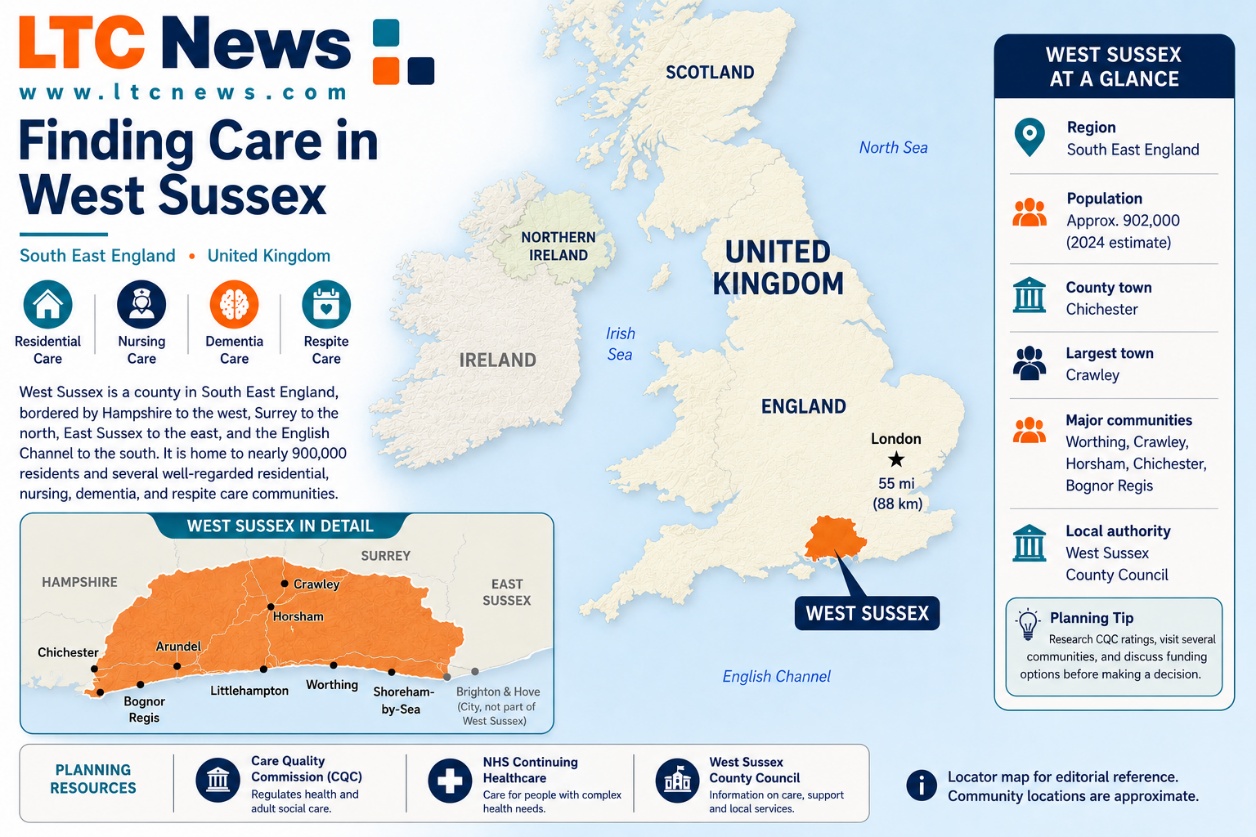
West Sussex is located along England's south coast in the South East region. The county is home to nearly 900,000 residents and offers a wide range of home care agencies, residential care homes, nursing homes, dementia communities, and respite care services. Families living elsewhere in the U.K.—or overseas—often begin their search by understanding where services are located within the county.
Why Planning Early Matters
Most families only start looking into longterm care when something urgent happens. A sudden hospital discharge, a worrying turn in dementia, repeated falls, or a wornout family carer can push everyone into making decisions that really deserve time, space, and calm heads. Planning early turns panic into choice.
When you start the conversation sooner, your loved one has a proper say in what comes next, where they’d like to live, what sort of support feels comfortable, and how much help they actually want. You can visit different care homes, compare services, understand how funding works, and ask the questions that matter, rather than scrambling during a crisis.
It also gives healthcare professionals, your GP (general practitioner), a hospital discharge team, or adult social care, a chance to assess changing needs before they become urgent.
And perhaps most importantly, early planning helps protect independence. Getting a bit of extra support doesn’t mean losing control. In fact, the right help often allows older adults to stay independent for longer by reducing risks and stepping in only where it’s genuinely needed.
If you’d like, I can also create a shorter version, a more emotional one, or a version tailored specifically for West Sussex families.
Recognising When More Support May Be Needed
The need for extra help rarely arrives in one dramatic moment. More often, it’s a slow realisation. You start spotting little changes, struggling with the shopping, meals becoming simpler or skipped altogether, difficulty dressing, or forgetting to take medications. A oncetidy home may look increasingly unkempt. Bills pile up. Friends mention they haven’t seen your loved one in a while.
Safety worries are often the tipping point. Perhaps there have been a few falls, appliances left switched on, trouble with the stairs, or moments of confusion when out and about. These signs can suggest that living alone is becoming more risky than reassuring.
Changes in mood matter just as much. Loneliness and isolation take a real toll. Someone who once loved gardening, volunteering, or meeting friends may slowly withdraw from the things that once brought them joy.
Memory changes should never be brushed aside. A bit of forgetfulness is normal with age, but increasing confusion, repeated questions, getting lost, difficulty managing money, or noticeable shifts in personality should be discussed with a GP. Some issues are treatable; others may point to the need for ongoing support or specialist dementia care.
And families must pay attention to themselves, too. Many spouses and adult children quietly take on more and more—what begins as helping with the shopping or lifts to appointments can gradually turn into managing medications, finances, meals, personal care, and constant supervision.
Supporting the family carer is part of supporting the older adult. No one should feel guilty for recognising when professional help is needed. It’s not a failure—it’s a step towards keeping everyone safe, supported, and able to breathe again.
If you’d like, I can also create a shorter version, a more emotional one, or a version tailored specifically for West Sussex families.

Understanding LongTerm Care Options in England
One of the biggest misunderstandings is the idea that a care home is the only path forward. In truth, England offers a whole spectrum of support, each designed to suit different health needs, lifestyles, and personal preferences.
Once you understand what’s available—home care, livein support, residential and nursing care, dementia services, respite options—you can make choices that genuinely fit your loved one’s life. And more often than not, the right support helps older adults stay independent for far longer than families expect.
- Home Care (Domiciliary Care)
Most people want to stay in their own homes for as long as they can, and home care makes that possible for many families. Care agencies can arrange for trained care workers to pop in and help with daytoday tasks—personal care, getting dressed, preparing meals, taking medications, light housekeeping, shopping, or simply offering a bit of company.
Visits can be as short as half an hour or last several hours, and they can be scheduled once a week or several times a day, depending on what’s needed.
For those whose needs are still fairly modest, home care offers a reassuring level of support while allowing them to remain in the comfort of familiar surroundings.
- Live-in Care
As needs grow, some families find that livein care strikes the right balance. A professional care worker moves into the home, offering daytoday support while still encouraging as much independence as possible.
For many older adults, it’s an ideal option, substantial help without giving up the comfort and familiarity of home. That said, livein care isn’t suitable for every situation. People with very complex nursing needs or advanced dementia may require a team of carers or specialist clinical support that can only be provided in a residential or nursing setting.
- Retirement Living and Sheltered Housing
Some older adults find that moving into accommodation designed specifically for later life offers just the right balance of independence and reassurance. Retirement communities and sheltered housing typically provide private flats alongside emergency call systems, shared spaces, organised activities, and optional support services.
For many people, these settings ease loneliness while still allowing them to live life very much on their own terms.
- Residential Care Homes
Residential care homes offer a safe and supportive place to live for people who can no longer manage on their own but don’t need roundtheclock nursing care. They provide comfortable accommodation, meals, housekeeping, personal care, and plenty of opportunities to socialise.
- Nursing Homes
Nursing homes offer everything you’d find in a residential care home, with the added reassurance of 24hour support from registered nurses. They’re designed for people with more complex medical needs—significant physical disabilities, advanced frailty, neurological conditions, or illnesses that require ongoing clinical oversight.
- Specialist Dementia Care
Living with dementia brings challenges that go far beyond memory loss. Specialist dementia communities are designed to offer secure, familiar surroundings where each person receives truly individualised support from teams trained specifically in dementia care.
Gentle routines, meaningful activities, and consistent, familiar staff help reduce anxiety while encouraging independence wherever it’s still possible.
- Respite Care
Not every stay in a care community is meant to be permanent. Respite care offers shortterm support—whether someone is recovering after a hospital stay, a family carer needs a wellearned break, or an older adult simply wants to try life in a care home before making a longerterm decision.
Many families find respite care incredibly reassuring. It gives everyone the chance to see whether a particular community feels like the right fit, without the pressure of committing straight away.
Care Needs Often Change Over Time
Choosing longterm care isn’t just about what someone needs today. Health and abilities can shift gradually over months or years. Someone managing well with home care now may eventually benefit from residential support. A resident who’s largely independent today may later need nursing care or specialist dementia services.
Where possible, it’s wise to look for providers who can offer several levels of care under one roof. Staying within the same organisation as needs change often reduces stress and helps preserve the relationships your loved one has built with staff, neighbours, and the wider community.
Understanding How Long-Term Care Is Funded and Choosing the Right Care Community
Finding the right care is only part of the journey. For many families, understanding how care is paid for can be even more confusing.
Unlike healthcare provided by the National Health Service (NHS), long-term social care in England is not automatically free. Depending on a person's medical needs, income, savings, and assets, care may be funded by the NHS, partially supported by the local authority, paid privately, or financed through a combination of these sources.
Families who begin planning before a crisis develops often have more financial options and more time to make informed decisions.
Understanding How England's Care System Differs
If you've helped a family member navigate long-term care in the United States or Canada, it's important not to assume the systems work the same way.
In England, healthcare is generally provided through the NHS, while long-term social care operates under a separate funding system. The amount someone contributes toward care depends on both their care needs and, in many cases, their financial circumstances.
By comparison, Medicare in the United States generally pays only for short-term skilled nursing or rehabilitation following a qualifying hospital stay. It does not typically cover ongoing assistance with everyday activities such as bathing, dressing, or supervision for dementia. Those services are usually paid through personal savings, Long-Term Care Insurance, or Medicaid for individuals who meet strict financial eligibility requirements.
Canada's healthcare system also differs. Provincial governments generally fund medically necessary healthcare, while long-term care funding varies by province. Residents often contribute toward accommodation costs, with provincial programs subsidizing nursing and personal care. Waiting lists, eligibility requirements, and costs differ throughout Canada.
For families coordinating care across borders, understanding these differences early can prevent confusion and unrealistic expectations.
NHS Continuing Healthcare
NHS Continuing Healthcare (CHC) is one of the most misunderstood parts of England’s carefunding system. CHC is a fully funded package of care provided by the NHS for people whose primary need is a health need rather than a social care one.
Unlike most other forms of support, eligibility has nothing to do with income, savings, or property. Instead, healthcare professionals look closely at the nature, intensity, complexity, and unpredictability of a person’s medical needs.
If someone is approved for CHC, their care can be funded in a range of settings:
- In their own home –
- In a residential care home –
- In a nursing home –
- Or in another appropriate environment
If you believe your loved one has complex medical needs, it’s worth speaking to their GP, the hospital discharge team, or an NHS care coordinator about requesting a Continuing Healthcare Checklist Assessment. It’s often the first step in determining whether CHC might be appropriate.
NHS Funded Nursing Care
Some people living in nursing homes need regular nursing support but don’t meet the criteria for full NHS Continuing Healthcare. In these situations, they may be eligible for NHS Funded Nursing Care (FNC).
Rather than covering the entire cost, the NHS contributes specifically towards the nursing element of the fees. Residents are still responsible for accommodation and personal care costs unless they qualify for other financial support.
Understanding how FNC differs from CHC helps families plan ahead and get a clearer picture of future care expenses.
Local Authority Social Care Assessments
If NHS funding isn’t the right fit, the next step is usually to contact West Sussex County Council Adult Social Care—or the local authority where your loved one lives. This is where social care assessments come into play, and two in particular matter most.
Local authorities begin by carrying out a Care Needs Assessment, which looks at the support a person requires with daily living—things like washing, dressing, mobility, preparing meals, managing medications, or staying safe at home. It’s a conversation-based assessment, designed to understand not just practical needs but also well-being, routines, and personal preferences.
If the assessment shows that support is needed, the council will then complete a Financial Assessment (often called a means test). This determines whether the local authority will contribute toward the cost of care or whether the individual will be expected to fund some or all of it themselves.
It’s worth knowing that these assessments are free, and anyone is entitled to request them, whether the person needs help at home, is considering a move into a care community, or is already receiving support. Starting this process early gives families a clearer picture of what help is available and what costs to expect, making future decisions far less daunting.
Care Needs Assessment
Anyone who appears to need care has the right to ask for a Care Needs Assessment. It’s the starting point for understanding what support a person genuinely requires day to day.
The assessment looks at how well someone manages ordinary activities—things like personal care, getting around safely, preparing meals, staying nourished, communicating, remembering important tasks, and keeping their home in a suitable condition.
Financial Assessment (Means Test)
If someone is found to need support, the local authority will then carry out a Financial Assessment—often called a means test. This looks at income, pensions, savings, investments, and, in some cases, property ownership to determine whether the council will contribute toward the cost of care.
Attendance Allowance
Many older adults who pay for their own care may still be entitled to Attendance Allowance. This benefit supports people over State Pension age who need help because of illness or disability.
It isn’t meanstested, so eligibility is based entirely on someone’s care needs—not their income, savings, or property. And once awarded, Attendance Allowance can also increase entitlement to certain other benefits, offering a little extra financial breathing room at a time when it’s often needed most.
Deferred Payment Agreements
Many families worry they’ll have to sell a loved one’s home straightaway to pay for residential care. In reality, that isn’t always necessary.
Some homeowners may be eligible for a Deferred Payment Agreement, which allows part of the care costs to be postponed until the property is eventually sold or the estate is settled. It’s essentially a way of using the value of the home later, rather than being forced to sell it immediately.
Planning Ahead Makes Financial Decisions Easier
The cost of longterm care can be significant, and starting conversations early makes a world of difference. When families plan before a crisis, there’s time to understand funding options, organise financial paperwork, discuss housing preferences, and put essential legal documents in place while an older relative can still be fully involved.
One of the most important steps is arranging a Lasting Power of Attorney (LPA). There are two types in England and Wales: –Property and Financial Affairs – Health and Welfare
Putting these documents in place early prevents lengthy legal complications if someone later loses mental capacity and ensures decisions can be made smoothly by trusted people.
It’s also wise for families to explore advance care planning. These conversations help ensure that future healthcare decisions reflect the older adult’s own wishes, values, and preferences—providing clarity and comfort for everyone as circumstances change.
How to Evaluate a Care Community
A polished website rarely tells the whole story. The most successful families combine research with personal visits.
- Review Care Quality Commission Reports
The Care Quality Commission (CQC) regulates care homes throughout England. Inspection reports evaluate whether services are:
- Safe
- Effective
- Caring
- Responsive
- Well-led
Reading several recent inspection reports provides valuable insight into how a care community performs beyond its own marketing materials.
- Read Independent Reviews
Verified reviews written by residents and family members can help reveal what everyday life is actually like. Rather than focusing on one review, look for consistent themes involving communication, staffing, cleanliness, activities, food quality, and how concerns are addressed.
Using independent reviews alongside CQC reports provides a much more balanced picture than relying on either source alone.
- Visit More Than Once
Nothing replaces seeing a community yourself. If possible, visit at different times of day. Observe whether residents appear relaxed and engaged. Notice how staff speak with residents.
Ask yourself:
- Do staff know residents by name?
- Does the atmosphere feel warm and welcoming?
- Are residents participating in activities?
- Are family members encouraged to visit?
- Are questions answered honestly and without pressure?
Sometimes your instincts provide as much guidance as inspection reports.
Questions Worth Asking
Every family has different priorities, but certain questions almost always offer valuable insight. It’s helpful to ask how the community creates personalised care plans and how often these are reviewed or updated.
Find out how families are kept informed, what happens if someone’s health changes, how frequently residents see their GP or other healthcare professionals, and what support is offered during those first few settlingin weeks.
It’s also worth asking about staff training, staff retention, and whether residents are usually cared for by familiar members of the team. Continuity makes a remarkable difference—not just to the quality of care, but to the comfort and confidence of the people living there.
For Families Living Overseas
Many older adults living in West Sussex have children or close relatives living elsewhere in the United Kingdom, the United States, Canada, Australia, or other countries. Fortunately, many care communities now offer virtual tours, scheduled video calls, secure family communication portals, and regular care updates, allowing relatives to remain actively involved regardless of distance.
Good communication becomes especially important when families cannot visit frequently.
Editorial Note: Funding rules, NHS eligibility criteria, local authority assessments, benefits, and financial thresholds can change over time and may vary depending on individual circumstances. This article is intended for general educational purposes and should not be taken as legal, financial, tax, or benefits advice.
Before making any significant care or financial decisions, families should seek guidance from West Sussex County Council, the NHS, a solicitor, or an independent financial adviser with experience in laterlife planning.
Choosing the Right Care Community and Planning for the Future
Once you’ve identified the level of care your loved one needs and have a clear sense of how that care may be funded, the next step is finding a community that truly feels right. That choice goes far beyond attractive buildings or modern facilities.
The best care communities create a place where older adults feel respected, valued, and genuinely connected. They encourage independence wherever possible, while offering professional support when it’s needed. Above all, they help residents continue living meaningful, fulfilling lives—surrounded by people who know them, understand them, and care about their well-being.
Finding the Right Care Community in West Sussex
West Sussex offers a wide variety of care providers, from longestablished independent homes to regional and national organisations running multiple communities across the county. Whether you’re looking in Worthing, Chichester, Horsham, Crawley, Bognor Regis, Littlehampton, East Grinstead, ShorehambySea, or another part of West Sussex, it helps to start by identifying providers that can meet your loved one’s needs today while also considering what they may require in the future.
Many organisations now offer several levels of support within the same group, including home care, residential care, nursing care, dementia care, and respite care. That continuity can make a real difference. If health needs change over time, residents may be able to remain within the same organisation, surrounded by familiar carers, routines, and friends—rather than facing the upheaval of moving to an entirely new environment.
Look Beyond Beautiful Buildings
Modern lounges, landscaped gardens, cafés, activity rooms, and comfortable bedrooms all add to the quality of life—but they shouldn’t be the deciding factor.
Pay close attention to how people interact. Do carers greet residents by name? Are conversations relaxed and genuine? Do residents seem engaged, comfortable, and content? Does the home feel calm and welcoming, rather than quiet because everyone is sitting alone?
Signs of a High-Quality Care Community
As you visit different providers, look for signs that residents are treated as individuals rather than simply recipients of care. Highquality communities tend to share a number of characteristics:
- Care plans reflect personal preferences as well as medical needs. – Residents are encouraged to make choices about their daily routines. – Activities cater to a range of interests and abilities. –
- Families are welcomed as partners in care.
- Staff turnover appears low, allowing residents to build familiar relationships.
- The atmosphere feels warm, respectful, and unhurried.
You don’t need to see perfection. What matters most is compassion, professionalism, and genuine respect—qualities that shape daily life far more than any single feature or facility.
One Provider Among Many
When searching for care homes in West Sussex, it is worth looking for communities that offer more than one type of care, providing your loved one and your family with greater continuity.
Families exploring care options in West Sussex will come across a wide mix of providers, including independent homes, charitable organisations, and national care groups. One example is Hallmark Luxury Care Homes, which operates several communities in the county offering residential, nursing, dementia, and respite care.
As with any provider, Hallmark—or any organisation you may be considering—should be evaluated using the same objective standards. Review recent Care Quality Commission (CQC) inspection reports, read independent family reviews, visit the community more than once if you can, and ask detailed questions about staffing, communication, activities, healthcare coordination, and how changing needs are supported.
The aim isn’t to identify the single “best” provider. It’s to find the community that feels right for your loved one’s unique needs, preferences, and personality.
Helpful Resources for Families
Several trusted organizations can help families better understand long-term care and available support.
- National Health Service (NHS)
The NHS provides information about:
- NHS Continuing Healthcare
- NHS Funded Nursing Care
- Hospital discharge planning
- Community healthcare services
- Long-term medical conditions
Families should also speak with their GP whenever health changes begin affecting everyday life.
- West Sussex County Council
West Sussex County Council Adult Social Care can arrange:
- Care Needs Assessments
- Financial Assessments
- Advice on home care
- Support for unpaid carers
- Safeguarding services
- Information about local providers
Even families expecting to pay privately often benefit from requesting an assessment because it helps identify appropriate services and future planning options.
- Care Quality Commission
The Care Quality Commission remains England's independent regulator of health and adult social care services. Inspection reports provide consistent national standards for comparing residential care homes, nursing homes, and other registered providers.
- Independent Review Websites
Independent review platforms can provide valuable insight into everyday life within a care community. When reading reviews, focus on recurring themes rather than isolated comments.
Consistent feedback about communication, staffing, responsiveness, cleanliness, or resident well-being often paints a more accurate picture than any single review.
Caring for the Family Carer
Searching for long-term care can be emotionally exhausting. Many family carers struggle with feelings of guilt. They worry they're somehow failing a parent by considering professional care. In reality, recognizing that someone needs more support is often one of the most compassionate decisions a family can make. Professional care doesn't replace family. It strengthens it.
When trained carers assume responsibility for medications, personal care, meals, mobility, and around-the-clock supervision, family members regain the opportunity to focus on spending meaningful time together. Instead of constantly worrying about daily tasks, you can once again enjoy conversations, celebrations, holidays, and simply being together.
That change often improves the quality of life for everyone involved.
For U.S. and Canadian Policyholders: Using LongTerm Care Insurance in the U.K.
If you’re a U.S. citizen or Canadian planning to relocate to the United Kingdom—either permanently or to be closer to family—you may be pleasantly surprised to learn that some LongTerm Care Insurance policies will pay benefits internationally, including for care received in the U.K.
Not every policy includes overseas coverage, and the rules vary widely depending on the insurer, the year the policy was issued, and the specific contract language. Some policies pay full benefits abroad, others pay a reduced amount as a cash indemnity, and a few limit international benefits to a set period of time.
Because of these differences, it’s essential to review your policy carefully or speak directly with a LongTerm Care Insurance specialist who can interpret the exact terms. They can confirm:
- Whether your policy pays benefits outside the U.S. or Canada
- What types of care are covered in the U.K. (home care, residential care, nursing care, etc)
- Any benefit reductions or time limits that apply internationally
- What documentation or care provider qualifications are required for reimbursement
- How to file claims once you’ve relocated
Understanding these details before you move ensures you can plan confidently, avoid unexpected gaps in coverage, and make informed decisions about care options in the U.K.
Bringing It All Together: Making Informed, Confident Care Decisions
Finding the right longterm care in West Sussex is rarely about making a quick choice. It’s about making an informed one. Start conversations early. Visit several communities. Learn how England’s funding system works. Read CQC inspection reports. Speak openly with healthcare professionals, financial advisers, and your family.
Most importantly, involve your loved one in every decision whenever they’re able to take part. The right care community doesn’t diminish independence. It provides the support that enables older adults to live safely, comfortably, and with dignity—while giving families confidence that the people they love are receiving compassionate, professional care.


Sponsored