Family Caregivers Spend $11,508 a Year as Spending Rises 59 Percent, AARP Finds

About This Article
New AARP research finds that family caregivers are spending more of their own money to help aging parents, spouses, and other loved ones. Dementia, complex care needs, and work disruptions are adding to the financial pressure, sometimes putting retirement savings at risk.

Linda Kople
Linda Kople is a freelance writer focused on caregiving, aging, health, wellness, long-term care, and retirement planning
Table of Contents
- What Is Driving Family Caregiving Costs?
- Why Does Caring for Someone With Dementia Cost More?
- How Is Family Caregiving Affecting Employment and Retirement?
- Why Are Lower-Income Caregivers Under Greater Financial Pressure?
- Are Parents the Only Family Members Creating Caregiving Expenses?
- Does Medicare Pay for Long-Term Care?
- Can Long-Term Care Insurance Reduce the Financial Burden on Families?
- How Can Families Prepare for Caregiving Expenses?
- What Does Rising Caregiving Spending Mean for Your Family?
Helping an aging parent with groceries, medications, or household bills may not seem like a major financial commitment at first. But those expenses can add up quickly, especially when care continues for months or years. The fact is family caregivers not only take the time away from their families and careers, but face costs themselves as well.
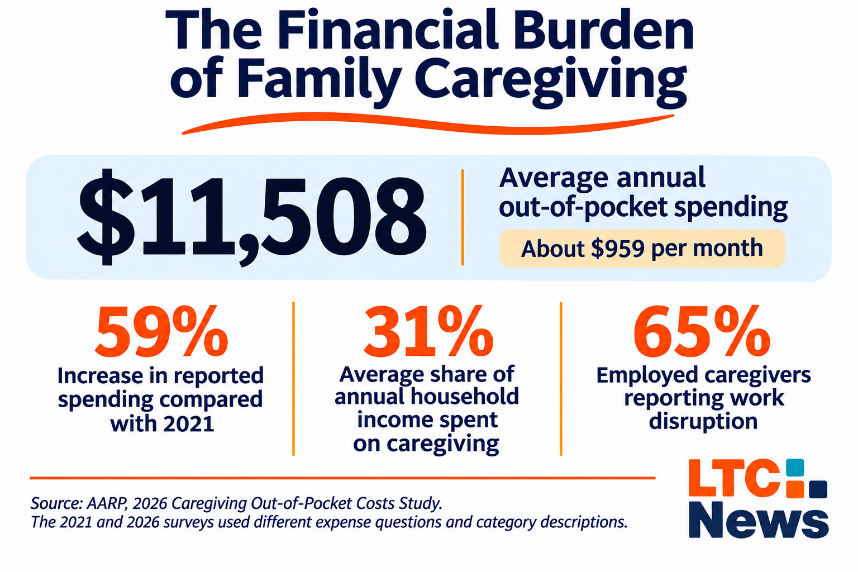
A new AARP study finds that family caregivers now spend an average of $11,508 annually out of pocket, or about $959 a month, helping relatives and friends who need care. Often, family members become caregivers because no other resources, like Long-Term Care Insurance, are in place to pay for professional in-home or facility care.
That's 59 percent more than the $7,242 reported in 2021, an increase of $4,266 a year in reported spending. The 2026 AARP Caregiving Out-of-Pocket Costs Study, released October 28, found that nearly nine in 10 caregivers incur expenses. On average, caregivers devote 31 percent of their annual household income to those costs.
For adults approaching retirement, the findings highlight a financial risk that may arrive earlier than expected. You could find yourself helping pay for a parent's care while still saving for your own retirement. The research comes during November's Long-Term Care Awareness Month, when attention turns to the growing need for extended care and how American families will pay for it.
What Is Driving Family Caregiving Costs?
Much of the financial burden comes from ordinary household necessities, not just medical bills or professional care. AARP found that housing and household expenses account for 42 percent of annual out-of-pocket caregiving spending, averaging $4,797. Medical expenses represent another 29 percent, averaging $3,313. Together, those categories account for 71 percent of what caregivers spend.
Housing-related expenses include groceries, rent, mortgage payments, utilities, and other household needs. Medical spending includes insurance premiums, copayments, prescription medications, equipment, and payments to health care providers. An adult daughter may help pay her mother's utility bills or buy groceries each week. A husband caring for his wife may need medical supplies, transportation to appointments, or occasional professional assistance at home. The purchases may seem modest individually, but they can become a substantial expense over time.
AARP's Megan O'Reilly, vice president of governmental affairs, captured the relationship between care needs and spending in comments reported by NPR: "The more care that's needed, the more it costs."
The increase since 2021 also requires context. AARP estimates that the $7,242 reported five years ago would equal approximately $9,100 in 2026 dollars. Using that inflation-adjusted figure, LTC News calculates an increase of approximately 26 percent in reported annual spending.
However, the surveys are not perfectly comparable. The 2021 research was conducted during the COVID-19 pandemic, when caregiving arrangements and access to services were disrupted. The 2026 survey also added expense questions and expanded descriptions of spending categories.
Those differences mean the reported increase should not be interpreted as a precise measure of how much the price of caregiving rose. The latest findings nevertheless show the substantial financial demands facing families today.
Why Does Caring for Someone With Dementia Cost More?
Families helping someone with Alzheimer's disease or another form of dementia face particularly high out-of-pocket expenses. AARP found that dementia caregivers spend an average of $15,846 annually, compared with $10,221 for those caring for someone without dementia. That's a difference of $5,625 a year.
Dementia can require more than help with bathing, dressing, or meals. Someone with significant cognitive impairment may need supervision to prevent wandering, assistance managing medications, or ongoing monitoring to remain safe. As the condition progresses, relatives may need professional in-home caregivers, adult day services or residential memory care.
Caregiving intensity also matters. AARP found that high-intensity caregivers spend an average of $15,084 annually, compared with $8,343 among those providing lower-intensity assistance. Caregivers performing three or more medical or nursing tasks spend an average of $15,648 annually, compared with $7,948 for those performing none.
Those tasks can include wound care, monitoring blood sugar, managing medical equipment, and other responsibilities that once were more commonly handled by health care professionals.
Rita B. Choula, senior director of caregiving at the AARP Public Policy Institute, described the growing responsibilities.
Family caregivers are taking on complex medical tasks at home while also shouldering the costs that come with that care." — Rita B. Choula.
The findings illustrate how families can become responsible for increasingly complicated care without necessarily having the financial resources or professional training to manage it.
How Is Family Caregiving Affecting Employment and Retirement?
The financial consequences of caregiving extend beyond the bills families pay. AARP found that 65 percent of employed caregivers experienced at least one work-related disruption because of their responsibilities. Some changed their work schedules or took time off. Others took on additional work to help cover expenses.
For adults in their 50s and early 60s, those decisions can be especially consequential. Reducing hours or leaving a job during peak earning years can affect retirement contributions, employer benefits, and future Social Security income.
Caregivers who retired earlier than planned because of caregiving reported average annual out-of-pocket expenses of $18,940. Other groups facing financial strain also reported spending above the national average:
- Caregivers who used retirement savings spent an average of $17,907 annually.
- Those who borrowed money or took out loans spent an average of $16,580.
- Caregivers who took an additional job spent an average of $16,851.
These averages don't prove that higher spending forced those decisions. They do show that caregivers making these sacrifices reported spending well above the $11,508 average. Some families may draw down retirement savings while also losing income because of caregiving responsibilities. For someone approaching retirement, the effects can continue long after caregiving responsibilities end.
Why Are Lower-Income Caregivers Under Greater Financial Pressure?
Caregiving expenses affect households across income levels, but the burden is especially severe for families with limited resources. AARP found that caregivers with household incomes below $40,000 spend an average of $11,448 annually on caregiving, nearly as much as the overall national average. Their reported expenses represent an average of 76 percent of annual household income.
The share of income devoted to caregiving varies considerably across income groups.
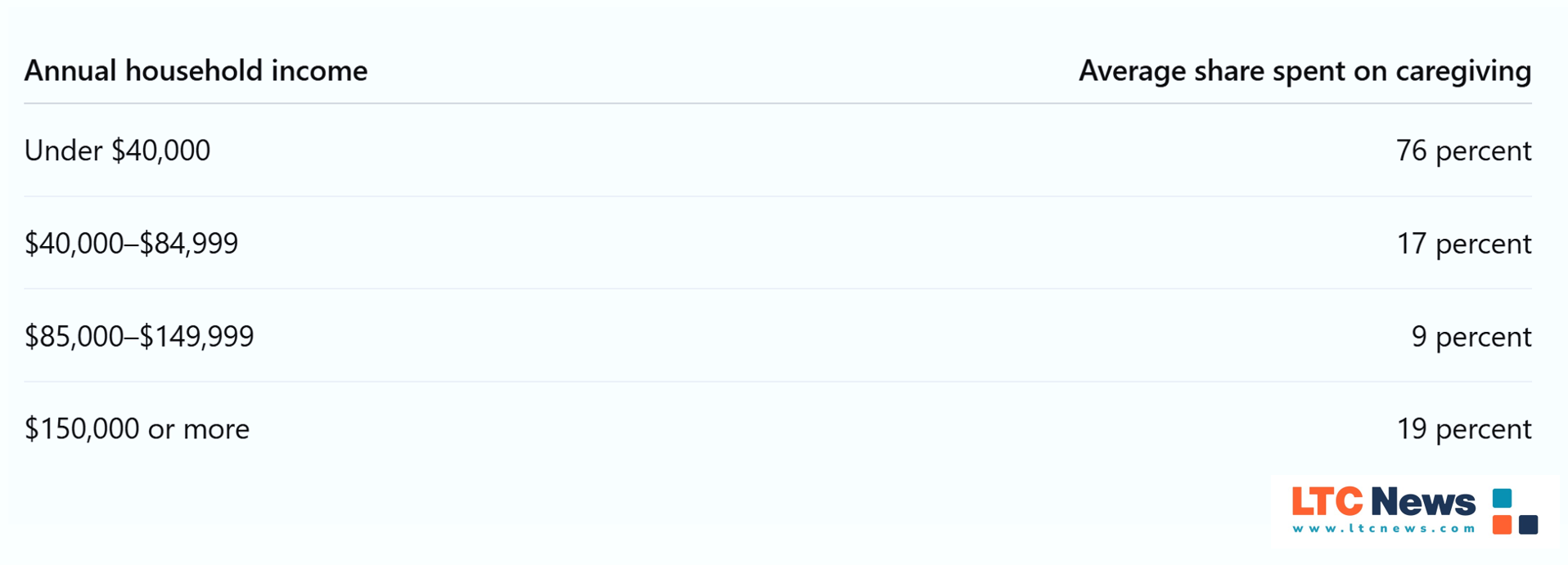
The percentages are averages within each income group, not the proportion of all families spending that amount. The findings also show that financial strain does not decline in a straight line as household income increases.
For lower-income households, however, even a relatively modest caregiving expense may compete with necessities such as housing, transportation, and food. The person receiving care may have limited savings, while the family member providing assistance may have little room in the budget to absorb additional costs.
Are Parents the Only Family Members Creating Caregiving Expenses?
Although much of the public discussion focuses on adult children caring for aging parents, caregiving responsibilities extend across generations. AARP found that caregivers supporting an adult child spend an average of $17,775 annually, among the highest amounts reported in the study. Those expenses represent an average of 50 percent of household income.
Caregivers helping someone between ages 18 and 39 reported average annual expenses of $16,217, representing 57 percent of household income. These findings reflect the needs of adults living with disabilities, chronic illnesses, or other conditions requiring ongoing assistance.
The financial challenges of long-term care are not limited to older Americans. Families may provide support to an adult child for decades, sometimes while also preparing for their own retirement.
Does Medicare Pay for Long-Term Care?
Many families assume Medicare will cover extended care when a parent or spouse can no longer manage everyday activities. Generally, it does not. Medicare does not pay for ongoing custodial care, including help with bathing, dressing, eating, and other activities of daily living, when that is the only care required. Original Medicare may cover up to 100 days of skilled nursing facility care per benefit period when specific requirements are met.
Generally, you or a loved one must first have a qualifying inpatient hospital stay of at least three consecutive days. The discharge day does not count, and time spent under observation does not count as inpatient care. Certain Medicare Advantage plans and qualifying programs may waive the three-day requirement.
Coverage under Medicare can end before day 100 if you no longer meet the skilled-care requirements. Medicare may also cover qualifying skilled home health services, but it does not generally pay for ongoing personal care when that is the only assistance needed. You can review the requirements through Medicare's skilled nursing facility coverage guidance.
Medicaid can help eligible individuals pay for long-term services and supports, including certain home and community-based services. Eligibility and available benefits depend on financial circumstances, medical needs, and state rules. Generally, for Medicaid eligibility, someone must require long-term care services because of a need with activities of daily living or supervision due to dementia, and have limited financial resources.
For families without Long-Term Care Insurance, which is typically purchased before retirement, or without sufficient personal resources, adult children and other relatives often step in to provide care directly or help cover the costs financially.
Can Long-Term Care Insurance Reduce the Financial Burden on Families?
Yes, LTC Insurance can help you reduce the physical, emotional, and financial burden that long-term care places on loved ones. Long-Term Care Insurance can help pay for covered extended care services and reduce the amount families must finance or provide themselves. Depending on the policy, benefits cover professional in-home care, adult day services, assisted living, memory care, or nursing home care.
Some policies offer cash benefits that provide greater flexibility, potentially allowing payments to eligible family caregivers when the contract permits. However, AARP's research identifies an important distinction between those expenses and the benefits typically provided by Long-Term Care Insurance.
Housing and household costs represent the largest category of caregiver spending. Traditional reimbursement policies generally do not directly reimburse family members for groceries, mortgage payments, utility bills, or other ordinary household expenses. Instead, LTC Insurance helps pay for care services, reducing the need for relatives to provide the care themselves.
Long-Term Care Insurance also generally must be purchased before someone develops a significant need for care. There are LTC policies that offer reduced underwriting, including some hybrid long-term care policies and short-term cash indemnity plans.
A parent who already requires substantial assistance or supervision because of cognitive impairment will usually be unable to qualify for new coverage. Insurers evaluate medical history, health conditions, and functional abilities during underwriting. Premiums vary based on age, health, benefit design, and insurer.
For adults still in good health, planning for their own future care may help prevent similar financial pressures from falling on their spouses or children. Those considering coverage can compare Long-Term Care Insurance options and request personalized LTC Insurance quotes from a specialist.
How Can Families Prepare for Caregiving Expenses?
The AARP findings make a strong case for discussing long-term care before a medical emergency forces difficult decisions. Families can begin by estimating what professional care might cost in the community where a loved one lives.
The LTC News Cost of Long-Term Care Services Calculator helps families compare current and projected expenses for in-home care, assisted living, memory care, and nursing home services. If a loved one already needs assistance, the LTC News Caregiver Directory helps you search a nationwide database of more than 80,000 care providers and services by ZIP code.
Those who already have Long-Term Care Insurance should understand the policy's benefit eligibility requirements and claims process before care becomes urgent. Amada Senior Care, an LTC News partner, offers long-term care insurance claims assistance at no cost or obligation, helping policyholders and families understand benefits and navigate the claims process — File a Long-Term Care Insurance Claim.
AARP is also advocating public policies intended to ease the burden on caregivers, including tax credits, more affordable respite care, paid family leave, and opportunities to compensate eligible relatives who provide care. Whether those proposals become available will depend on future federal and state policy decisions.
What Does Rising Caregiving Spending Mean for Your Family?
An estimated 63 million Americans provide unpaid care to an adult relative, friend or loved one, according to AARP and the National Alliance for Caregiving. For many, the responsibility begins gradually. A daughter starts by driving her father to medical appointments. A husband helps his wife with medications and household chores. An adult child begins paying a parent's utility bills when retirement income no longer covers every expense.
Over time, those responsibilities can become more demanding, both physically and financially. The latest AARP research puts a dollar figure on a burden that many families experience but rarely calculate. It also raises a question worth considering before someone needs extended care: Who will provide the help, and where will the money come from?
You may be willing to do whatever is necessary for someone you love. But having a plan can help preserve the choices, savings, and retirement security of everyone involved. Family caregiving will always require compassion and commitment. It shouldn't have to depend on a family's ability to absorb years of unexpected expenses.
Frequently Asked Questions
What are the biggest expenses for family caregivers?
Housing and household expenses account for 42 percent of out-of-pocket caregiving spending, while medical expenses represent another 29 percent. Common costs include groceries, utilities, medications, medical equipment, insurance-related expenses and transportation. Nearly nine in 10 caregivers report spending their own money to help someone they care for.
How does family caregiving affect employment and retirement?
AARP found that 65 percent of employed caregivers experienced at least one work-related disruption. Some reduce their hours, miss work or retire earlier than planned. Caregivers who retired early because of caregiving reported average annual out-of-pocket expenses of $18,940. Lost earnings and reduced retirement contributions can create additional financial consequences beyond direct caregiving expenses.
How much does the average family caregiver spend each year?
According to AARP's 2026 Caregiving Out-of-Pocket Costs Study, family caregivers spend an average of $11,508 annually, or approximately $959 per month. That's 59 percent more than the $7,242 reported in 2021. Adjusted for inflation, LTC News calculates an increase of approximately 26 percent, although changes in survey methods make direct comparisons imperfect.
Why is caring for someone with dementia more expensive?
People with Alzheimer's disease or other forms of dementia may require extensive supervision, assistance with daily activities and specialized care. AARP found that dementia caregivers spend an average of $15,846 annually, compared with $10,221 for caregivers helping someone without dementia.


Sponsored