America's Long-Term Care Workforce Crisis Is Growing—Why Your Family Should Prepare

About This Article
New research published in the New England Journal of Medicine warns the United States could face a shortage of more than 3 million long-term care workers by 2040. If you think finding quality long-term care will become easier as you grow older, the numbers suggest otherwise.

James Kelly
LTC News staff writer specializing in long-term care and aging.
Table of Contents
- Why America's Aging Population Is Creating a Caregiver Shortage
- Why America Could Be Short 3.3 Million Caregivers by 2040
- Caregiver Shortage Is Already Affecting Families
- Home Care Waiting Lists Continue to Grow
- Can Medical Innovation Reduce the Caregiver Shortage?
- Can Medical Innovation Reduce the Caregiver Shortage?
- Why Federal Aging Research Matters
- Immigration Has Become Part of America's Long-Term Care Workforce
- Lessons from Canada and Japan
- Higher Wages Alone Won't Solve the Workforce Crisis
- Why Medicaid Financing Matters
- Researchers Say All Three Solutions Must Work Together
- Why the Workforce Shortage Matters to Your Family
- Family Caregivers Are Carrying More of the Burden
- Long-Term Care Insurance Already Providing Substantial Benefits
- Long-Term Care Insurance Is About More Than Paying for Care
- Access to Care May Become Just as Important as Affordability
- What Medicare Covers—and What It Doesn't
- Medicaid Serves as a Financial Safety Net
- Partnership Programs Help Protect Retirement Assets
- LTC News Resources to Help You Prepare
- Why is America facing a long-term care workforce shortage?
- How many long-term care workers could America need by 2040?
- Why is the population age 85 and older so important?
- Which care settings will be most affected by the workforce shortage?
- How could the caregiver shortage affect my family?
- Why are so many family members becoming caregivers?
- What factors are contributing to the shortage of caregivers?
- Could technology solve the caregiver shortage?
- Why does immigration matter to the long-term care workforce?
- Why is Medicaid important to long-term care?
- Does Medicare pay for long-term care?
- What is the difference between Medicare and Medicaid?
- How can Long-Term Care Insurance help?
- When should someone consider purchasing Long-Term Care Insurance?
- What is a Long-Term Care Partnership Program?
As America enters its 250th year, it is entering one of the most significant demographic shifts in its history. People are living longer; the number of adults reaching advanced ages is climbing rapidly, and demand for long-term care is growing faster than the workforce needed to provide it.
Researchers writing in the New England Journal of Medicine warn that unless meaningful changes occur, the United States could face a shortage of more than three million professional long-term care workers by 2040. That shortage would affect nearly every aspect of aging, from receiving care at home to finding an assisted living community, memory care residence, or nursing home with enough qualified professionals to provide safe, high-quality care.
We have this level of need that's coming, that we do not have the workforce or the systems to meet. As a society, it’s the back-burner issue, but we’re running out of time." — Nicole Jorwic, Chief Program Officer, Caring Across Generations, quoted in UnDark.
For older adults and their families, the implications extend well beyond higher costs. A shrinking workforce can mean longer waiting lists, fewer provider choices, delayed services, and greater reliance on spouses and adult children who may already be balancing careers, raising children, and planning for their own retirement.
The findings reinforce something LTC News has reported on for years: planning for long-term care is no longer simply about paying for future care. Increasingly, it is about preserving access to quality care when you need it most.
Why America's Aging Population Is Creating a Caregiver Shortage
The demographic transformation now underway is unlike anything the United States has experienced before. According to projections from the U.S. Census Bureau, as cited by the researchers, the number of Americans age 85 and older will roughly double over the next 15 years, from approximately 6 million people in 2026 to more than 12 million by 2040. During that same period, the nation's working-age population is expected to grow very little.
That imbalance creates one of the defining questions facing the nation:
Who will provide care for millions of older adults when there are relatively few additional workers available to do the job? Plus, there is a related question: how will American families pay for that extended care?
Today, more than 61 million Americans are age 65 or older, and approximately 11,400 people celebrate their 65th birthday every day. Federal research from the U.S. Department of Health and Human Services estimates that 56 percent of people turning age 65 will eventually require long-term services and supports that meet the federal definition of long-term care. Demand for care is accelerating. The supply of caregivers is not.
Why America Could Be Short 3.3 Million Caregivers by 2040
The numbers behind the new research are striking. America's professional long-term care workforce—including registered nurses, licensed practical nurses, certified nursing assistants, home health aides, personal care aides, and other direct-care professionals working in both residential and home-based settings—currently numbers approximately three million workers.
Researchers Andrew R. Olenski, Ph.D., and David C. Grabowski, Ph.D., analyzed U.S. Census Bureau projections to estimate how many caregivers the country will need over the next 15 years. Using pre-pandemic staffing levels as a benchmark, they concluded the United States will require approximately 3.4 million additional long-term care workers by 2040 simply to maintain today's ratio of caregivers to adults age 85 and older.
Unfortunately, the projected supply paints a very different picture. Based on current employment patterns and projected immigration levels, researchers estimate that fewer than 100,000 additional workers are likely to enter the long-term care workforce during that same period. The result is a projected shortage of approximately 3.3 million caregivers.
Even under a more optimistic scenario, one assuming employment returns to pre-pandemic levels and immigration exceeds current projections, the nation would still face a shortage of approximately 2.9 million workers by 2040.
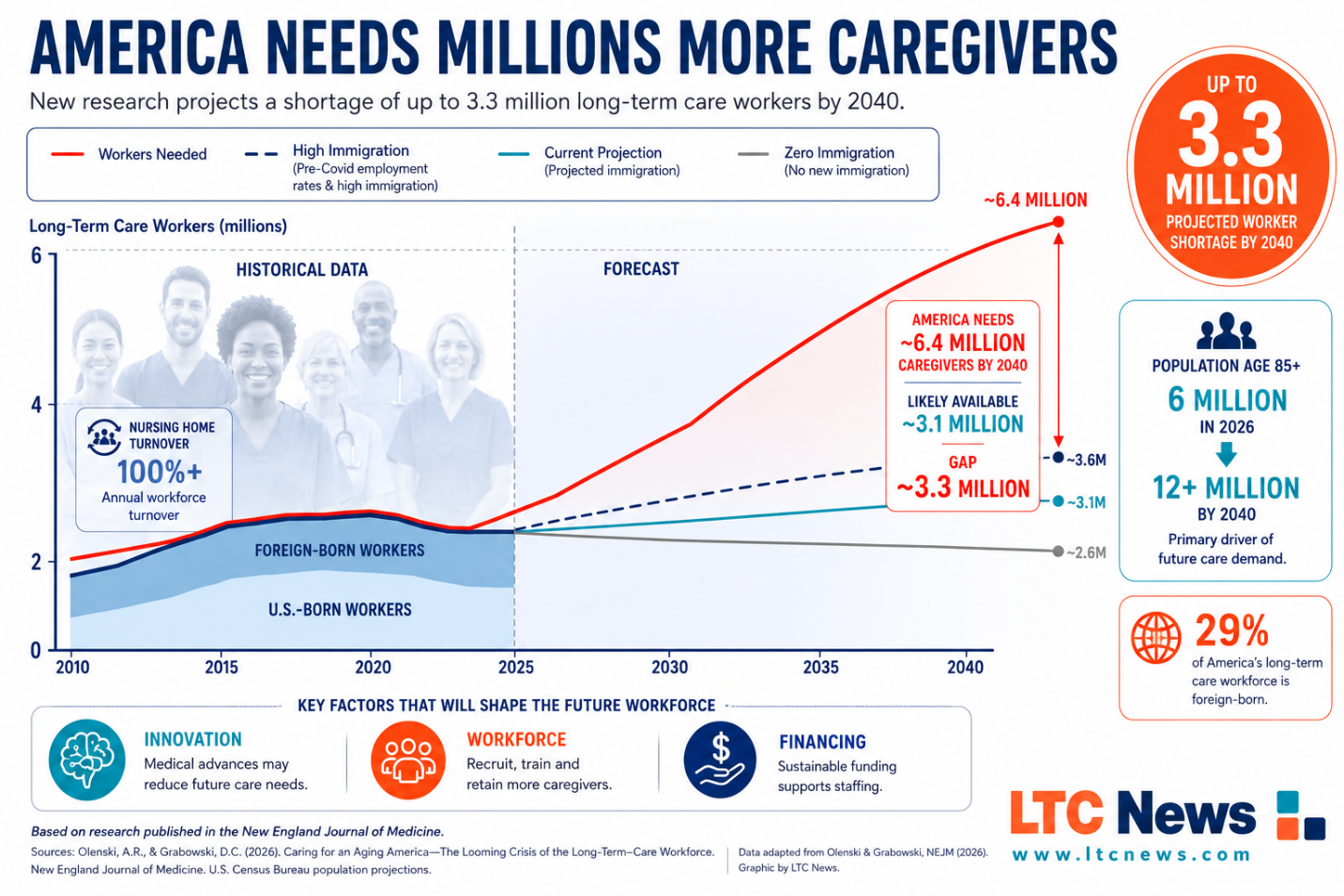
Think about what those projections mean. Even in the researchers' best-case scenario, America would still need a nearly entirely new long-term care workforce equal to today's entire workforce. That isn't simply a staffing challenge. It represents one of the largest workforce challenges facing the U.S. healthcare system over the next generation.
These aren't simply workforce projections. They represent millions of families who may one day struggle to find the professional care their loved ones need. We know that adult children cannot easily juggle the responsibilities of being caregivers with their careers and other family obligations. So, where will those caregivers come from and how will they get paid? — Matt McCann, CLTC.
Caregiver Shortage Is Already Affecting Families
The workforce shortage isn't a future problem. Families are already experiencing many of its effects. Across the country, nursing homes continue to struggle with recruiting and retaining qualified staff.
The new research notes that annual employee turnover in nursing homes exceeds 100 percent, meaning many facilities replace their entire direct-care workforce every year. High turnover has been associated with poorer resident outcomes, reduced continuity of care, and additional operational challenges for providers.
Source: Ashvin Gandhi, Huizi Yu, and David C. Grabowski, "High Nursing Staff Turnover in Nursing Homes Offers Important Quality Information," Health Affairs, Vol. 40, No. 3 (March 2021), pp. 384-391.
Several factors continue to make recruitment and retention difficult:
- Relatively low wages compared with competing industries
- Physically demanding work
- Emotional stress and burnout
- Limited opportunities for career advancement
- Persistent staffing shortages that increase workloads
The COVID-19 pandemic intensified each of those challenges. According to the researchers, many U.S.-born caregivers left the profession during the pandemic, and the industry has yet to recover fully.
Home Care Waiting Lists Continue to Grow
The shortage extends well beyond nursing homes. Across much of the country, Home- and Community-Based Services (HCBS) are already unable to meet existing demand. These Medicaid-supported programs help older adults remain in their homes by providing services such as personal care, homemaker assistance, respite care, adult day services, and other supports that can delay or prevent nursing home placement.
Demand has consistently exceeded available funding and staffing.
For those who pay with Long-Term Care Insurance or out of pocket, many home health agencies face the same challenges, though they can often pay higher wages. The reality is that those who pay for care with Long-Term Care Insurance and can show they can pay for the quality care that they deserve will usually get top priority ahead of everyone else.
As a result, many states have waiting lists that stretch for months—and in some cases, years—before Medicaid services become available. Only those with limited financial resources can qualify for Medicaid long-term care benefits. For families, those delays often create difficult choices.
NOTE: For families searching for long-term care services, including in-home care providers or long-term care facilities, use the LTC News Caregiver Directory. You can search from over 80,000 providers nationwide by zip code or city.
An aging parent may go without needed assistance. A spouse may become an unpaid full-time caregiver. An adult child may reduce work hours, postpone retirement, or leave the workforce entirely to provide care. The financial and emotional consequences can last for years. Understanding the magnitude of the shortage naturally raises another question: Can America afford the cost?
Researchers identify three broad areas where progress could help narrow the gap: reducing future demand through medical innovation, expanding the caregiving workforce, and strengthening long-term care financing. Each offers opportunities—but each also presents significant challenges.
Learn More: See current and project cost of long-term care services with LTC News Cost of Care Calculator
Can Medical Innovation Reduce the Caregiver Shortage?
Researchers identify three broad approaches to narrowing America's growing long-term care workforce gap. The first is reducing future demand for long-term care by helping older adults remain healthier and more independent for longer.
The second is expanding the caregiving workforce.
The third is improving recruitment and retention through better wages, training, and career opportunities.
None of these solutions alone is likely to eliminate the projected shortage. Instead, the authors conclude that meaningful progress will require action on all three fronts.
Can Medical Innovation Reduce the Caregiver Shortage?
One way to ease future workforce shortages is to reduce how much care older adults ultimately need. Researchers point to several promising developments that could improve healthy aging and help people remain independent longer, including:
- New therapies for Alzheimer's disease and related dementias
- Better prevention and treatment of chronic illnesses
- Assistive technologies that support independent living
- Remote patient monitoring
- Smart-home technologies
- Artificial intelligence that helps caregivers work more efficiently
If successful, these advances could reduce, as researchers describe, the intensity of care required for older adults. In practical terms, fewer caregivers might be needed for each person requiring assistance than under today's care models.
The authors caution, however, that the timing and impact of these innovations remain uncertain. Even major medical breakthroughs are unlikely to eliminate the need for millions of professional caregivers over the next two decades.
Technology can improve efficiency. It cannot replace compassion.
A person living with advanced dementia still needs reassurance, supervision, and hands-on assistance.
Someone recovering from a stroke still needs help transferring safely, bathing, dressing, preparing meals, taking medications, and performing other daily activities. Technology will almost certainly become an increasingly valuable tool. Professional caregivers will remain indispensable.
Why Federal Aging Research Matters
Medical innovation depends on sustained scientific research. The authors express concern that federal investment in aging research is moving in the opposite direction.
According to the paper, the National Institute on Aging awarded 322 new research grants in 2025, compared with 847 the previous year—a decline of approximately 62 percent and a reduction of more than $265 million in new research funding. The administration's proposed 2026 budget would further reduce support for aging research.
The researchers argue that slowing investment today could delay tomorrow's advances in dementia treatments, chronic disease prevention, rehabilitation, and assistive technologies. Those breakthroughs may ultimately help older adults remain healthier and independent longer, reducing demand for long-term care services over time.
For families, that research represents more than scientific progress. It could mean additional years of independence, improved quality of life, and fewer years requiring extensive caregiving.
Immigration Has Become Part of America's Long-Term Care Workforce
One of the least understood aspects of America's caregiving system is who provides much of the care. According to the researchers, approximately 29 percent of the nation's long-term care workforce is foreign-born. Previous studies by the authors found that communities with higher levels of immigration generally experienced:
- Better nursing home staffing ratios
- Improved resident outcomes
- Greater availability of caregiving services
The COVID-19 pandemic highlighted that contribution. While many U.S.-born workers left the long-term care profession during the pandemic, many foreign-born caregivers continued providing essential services throughout the public health emergency, helping stabilize a workforce already under extraordinary strain.
The researchers argue that future immigration policy will influence whether enough caregivers are available to meet growing demand. Nationally known immigration attorney, Beata Dejlitko McCann, says in her article on LTC News that immigrants are already a major part of the healthcare workforce.
Immigrants make up 28 percent of physicians and surgeons and 37.9 percent of home health aides, despite accounting for just 13.6 percent of the overall U.S. population. Data from the Migration Policy Institute show that immigrants play an especially important role in healthcare occupations and geographic areas where shortages are already severe.” — Beata Dejlitko McCann, immigration attorney.
Recent federal actions—including visa processing delays, reductions in refugee admissions, removal of protections from immigration enforcement at healthcare facilities, and increased immigration enforcement activity—could discourage both current and prospective caregivers.
Changes in federal immigration policy, including delayed or frozen visa processing, removal of protections from immigration raids for health care facilities, reductions in refugee resettlement, and intensified immigration-enforcement activities have produced chilling effects that extend beyond undocumented workers." — Andrew R. Olenski, Ph.D., and David C. Grabowski, Ph.D.
The paper notes that some nursing home administrators have reported that legally authorized employees occasionally miss work due to concerns about immigration enforcement. The authors also cite previous research showing that stricter immigration enforcement reduced the number of home care workers in affected communities while increasing nursing home placement among older adults.
The findings do not suggest immigration alone can solve the workforce shortage. Rather, they illustrate that immigration policy has become an important factor influencing the availability of professional caregivers.
Lessons from Canada and Japan
The United States is not alone in confronting rapid population aging. Several countries have already created immigration pathways specifically designed to strengthen their caregiving workforce.
Canada recently introduced its Home Care Worker Immigration Pilot, creating a pathway to permanent residency for qualified caregivers. Japan's Specified Skilled Worker visa program includes a dedicated category for long-term care professionals, reflecting the country's own demographic challenges.
In the United States, lawmakers have proposed the bipartisan Healthcare Workforce Resilience Act (H.R. 5283), which would recapture up to 40,000 unused employment-based visas for healthcare workers.
The researchers note that while such legislation could help, it is not focused specifically on long-term care and would address only a small portion of the projected workforce shortage.
Higher Wages Alone Won't Solve the Workforce Crisis
Higher wages are an important part of the solution. The researchers argue they are unlikely to be enough by themselves. Long-term care providers compete for workers with industries such as:
- Retail
- Warehousing
- Hospitality
- Food service
- Transportation
Recruiting millions of additional caregivers would require attracting workers away from those sectors. Economists describe this as an opportunity cost.
Every worker entering long-term care generally leaves another industry that also supports the nation's economy and tax base. The authors suggest that expanding the workforce will also require:
- Better training opportunities
- Clear career advancement pathways
- Improved workplace safety
- Greater professional recognition
- Stronger retention efforts
Without those improvements, recruitment alone is unlikely to keep pace with the nation's rapidly growing care needs.
Why Medicaid Financing Matters
Few Americans realize that Medicaid is the nation's largest payer of long-term care services, including nursing home care and many home- and community-based programs. Yet, to qualify for Medicaid, you must have very limited financial resources. That financial reality has direct implications for the workforce.
Providers depend heavily on Medicaid reimbursement to pay wages, invest in training, and recruit new employees. Higher reimbursement generally gives providers greater flexibility to improve compensation and expand staffing. Lower reimbursement can make those goals more difficult.
The researchers point to projected federal Medicaid spending reductions as another challenge facing the workforce. According to estimates cited in the paper, the One Big Beautiful Bill Act (OBBBA) is projected to reduce federal Medicaid spending by approximately $1 trillion over the next decade.
The authors conclude that lower reimbursement could translate into lower wages, fewer hires, and faster workforce attrition at precisely the time the nation needs millions of additional caregivers.
The White House and supporters of the OBBBA argue the law doesn't cut Medicaid but "strengthens" it by eliminating waste, fraud, and abuse, pointing to work requirements for able-bodied adults, more frequent eligibility redeterminations (every six months instead of annually), and removing ineligible recipients such as undocumented immigrants. The White House has cited CMS findings that Medicaid improper payments exceeded half a trillion dollars over the past decade and argues that, by CBO's own estimate, total Medicaid spending will still grow by roughly 47 percent over the next decade, so framing it as a "cut" is misleading.
As with other policy issues discussed in the paper, those conclusions represent the researchers' analysis of current federal policy and its potential implications. Actual outcomes will depend on future legislative decisions, implementation by federal and state governments, and how providers respond over time.
Researchers Say All Three Solutions Must Work Together
No single policy is likely to eliminate a projected shortage measured in millions of workers. Medical innovation may help older adults remain healthier longer. Immigration can supplement the caregiving workforce.
Better wages, improved training, and stronger career opportunities can help recruit and retain more caregivers. The researchers conclude that addressing America's long-term care workforce crisis will require meaningful progress across all three areas rather than relying on any single solution. For families, the policy debate is important. But an even more practical question remains:
How will this shortage affect your own retirement and the people you love?
That question shifts the conversation from public policy to personal planning, and it is where the workforce shortage becomes much more than a national issue.
Why the Workforce Shortage Matters to Your Family
Workforce projections and public policy debates may seem far removed from everyday life. In reality, they affect one question nearly every family eventually asks: Who will provide care when someone I love needs help?
The long-term care workforce shortage isn't simply an economic issue. It is becoming a family issue. Whether you're planning for your own retirement, helping an aging parent, or caring for a spouse, the availability of qualified caregivers may ultimately matter as much as your ability to pay for care.
A shortage of professional caregivers can affect nearly every aspect of the long-term care experience:
- Longer waits to begin home care services
- Fewer caregivers available in many communities, particularly rural areas
- Reduced staffing levels in assisted living communities and nursing homes
- More frequent caregiver turnover
- Increased pressure on spouses and adult children to provide unpaid care
For many families, the first sign of the workforce shortage isn't a government report. It's a phone call that begins with: "We're sorry, but we don't have staff available right now." That reality is already affecting families across the country.
Family Caregivers Are Carrying More of the Burden
When professional caregivers aren't available, families almost always become the backup plan. Approximately 63 million Americans now provide unpaid care for an adult family member or friend, according to recent research. That represents a 45 percent increase since 2015. Many family caregivers never expected to take on the role.
Some help aging parents with transportation, grocery shopping, medications, and finances. Others provide hands-on assistance with bathing, dressing, meals, mobility, or memory care. Many continue working while raising children of their own. Others reduce work hours, pass up promotions, retire early, or leave the workforce altogether.
The emotional toll can be overwhelming.
The financial consequences can last for decades. As the shortage of professional caregivers grows, more families may find themselves filling gaps in the long-term care system.
Long-Term Care Insurance Already Providing Substantial Benefits
While researchers tend to ignore it, Long-Term Care Insurance has already become a huge factor in how long-term care services are paid for in the United States. AHIP's latest data reported that $16,860,733,680 in traditional Long-Term Care Insurance benefits were paid in 2024. Since LTC Insurance came into existence, policies have paid $193,341,591,330 in long-term care benefits, helping many families afford in-home caregivers and quality long-term care facilities, including assisted living.
However, too many Americans assume they can start planning for long-term care after they retire, or worse, once they need care. Unfortunately, many experts say some of this is denial that they will ever need help with everyday living activities or suffer from dementia.
Unfortunately, waiting until after you retire is when options begin to narrow. Health changes can occur unexpectedly. Long-Term Care Insurance is medically underwritten. Waiting until a significant medical condition develops can make coverage substantially more expensive—or make qualifying impossible.
According to LTC News research, most people who do purchase Long-Term Care Insurance do so between ages 47 and 67, when they are generally healthier, and premiums are lower. Planning early also allows you to choose among a wider range of benefit options before health conditions limit those choices.
The workforce shortage creates another reason to plan ahead. When qualified caregivers are in short supply, having a plan already in place may help a policyholder begin receiving services more quickly when care becomes necessary.
Long-Term Care Insurance Is About More Than Paying for Care
Many consumers assume Long-Term Care Insurance exists solely to help pay nursing home bills. Today's policies are far more comprehensive. Qualified Long-Term Care Insurance policies under Section 7702(b) of the Internal Revenue Code generally pay benefits when a licensed healthcare practitioner certifies that an individual needs substantial assistance with at least two of the six Activities of Daily Living for at least 90 days or has a severe cognitive impairment, such as Alzheimer's disease or another form of dementia.
Benefits can typically be used in a variety of settings, including:
- Home care
- Adult day care
- Assisted living
- Memory care
- Skilled nursing facilities
- Hospice care, when appropriate
Most people prefer to remain at home for as long as it is safe and practical. Long-Term Care Insurance helps make that choice more realistic by providing financial resources to pay for professional caregivers before family members become overwhelmed.
Access to Care May Become Just as Important as Affordability
The research published in the New England Journal of Medicine highlights an important shift in long-term care planning. The conversation is no longer focused only on how families will pay for care. Increasingly, it is about whether qualified caregivers will be available when care is needed.
As workforce shortages continue, many home care agencies, assisted living communities, and other providers place significant value on clients who have an established payment source. Long-Term Care Insurance provides that financial certainty.
Instead of delaying services while families determine how care will be financed, providers know reimbursement has already been arranged through the policy. Many policies also include care coordination services that help families identify qualified providers, develop care plans, and navigate what can otherwise become a complicated process.
No insurance policy can guarantee immediate availability. However, having coverage may improve access to quality providers in increasingly competitive care markets.
What Medicare Covers—and What It Doesn't
One of the most common misconceptions about aging is that Medicare pays for long-term care. It does not. Medicare is designed primarily to pay for medical treatment. It will cover a limited period of skilled nursing or rehabilitation following a qualifying hospitalization when specific clinical requirements are met. It does not pay for ongoing custodial care—the assistance many older adults eventually need with:
- Bathing
- Dressing
- Eating
- Toileting
- Transferring
- Continence care
- Supervision because of Alzheimer's disease or other cognitive disorders
Those services make up the majority of long-term care. Understanding that distinction before a health crisis occurs allows families to make better financial decisions and avoid costly surprises.
Medicaid Serves as a Financial Safety Net
Unlike Medicare, Medicaid does pay for long-term care. It is the nation's largest payer of nursing home care and also finances many Home- and Community-Based Services that help people remain in their own homes.
Medicaid, however, is a means-tested public assistance program. Eligibility depends primarily on meeting financial requirements established by each state. Many individuals must spend down much of their savings before qualifying. For many middle-income families, that comes as an unpleasant surprise. Understanding Medicaid's role before care becomes necessary is an important part of comprehensive retirement planning.
Partnership Programs Help Protect Retirement Assets
One planning tool many Americans overlook is theLong-Term Care Partnership Program. Available in most states, Partnership-qualified Long-Term Care Insurance policies provide asset disregard protection.In simple terms, every dollar a qualifying Partnership policy pays in benefits allows the policyholder to protect a corresponding dollar of personal assets if Medicaid is eventually needed.
For many middle-income families, Partnership coverage offers additional financial security while encouraging earlier planning for future care needs. A qualified Long-Term Care Insurance specialist can explain whether Partnership policies are available in your state and how they fit into your retirement strategy.
LTC News Resources to Help You Prepare
LTC News has reported extensively on long-term care workforce shortages, caregiving trends, and aging policy for years. The findings published in the New England Journal of Medicine reinforce many of the trends our editorial team has documented as America's older population continues to grow and families face increasingly complex care decisions.
Preparation begins long before care is needed. LTC News offers several free resources designed to help families make informed decisions.
- LTC News Cost of Care Calculator
The LTC News Cost of Long-Term Care Services Calculator provides current monthly care costs nationwide and projected future costs, using ongoing surveys of long-term care providers, helping families estimate future care expenses where they live.
- LTC News Caregiver Directory
The LTC News Caregiver Directory includes more than 80,000 long-term care providers nationwide, helping families compare care options before a crisis occurs, including:
- Home care agencies
- Adult day care centers
- Assisted living communities
- Memory care communities
- Rehabilitation facilities
- Nursing homes
- Hospice providers
Researching providers before care becomes necessary can significantly reduce stress during a medical emergency.
- Long-Term Care Insurance Learning Center
The LTC News Long-Term Care Insurance Learning Center offers comprehensive unbiased information on all aspects of LTC Insurance.
- Free Long-Term Care Insurance Claims Assistance
Families with Long-Term Care Insurance policies can also access free claims assistance through LTC News in partnership with Amada Senior Care
Experienced specialists help families understand policy benefits, coordinate documentation, communicate with insurance companies, and navigate what can otherwise become a confusing claims process — File a Long-Term Care Insurance Claim.
For many LTC Insurance policyholders, that guidance proves nearly as valuable as the insurance benefits themselves.
The workforce shortage affects far more than healthcare providers. It affects retirement planning, family finances, caregiving responsibilities, and the ability of older adults to maintain independence. Understanding those realities before a crisis occurs allows your family to prepare while they still have choices.
Frequently Asked Questions
Why is America facing a long-term care workforce shortage?
The United States is experiencing a rapid increase in the number of older adults, particularly those age 85 and older, while the working-age population is growing much more slowly. Researchers writing in the New England Journal of Medicine project the country could face a shortage of approximately 3.3 million long-term care workers by 2040, making it increasingly difficult to meet future care needs.
How many long-term care workers could America need by 2040?
Researchers estimate the nation will need approximately 6.4 million long-term care workers by 2040 to maintain today's level of care. Under current workforce and immigration trends, only about 3.1 million workers are expected to be available, creating a projected shortage of approximately 3.3 million caregivers.
Why is the population age 85 and older so important?
Adults age 85 and older are the group most likely to require long-term care because of frailty, chronic illness, mobility limitations, or cognitive impairment. According to U.S. Census Bureau projections cited in the research, the number of Americans in this age group is expected to increase from approximately 6 million in 2026 to more than 12 million by 2040, significantly increasing demand for caregiving services.
Which care settings will be most affected by the workforce shortage?
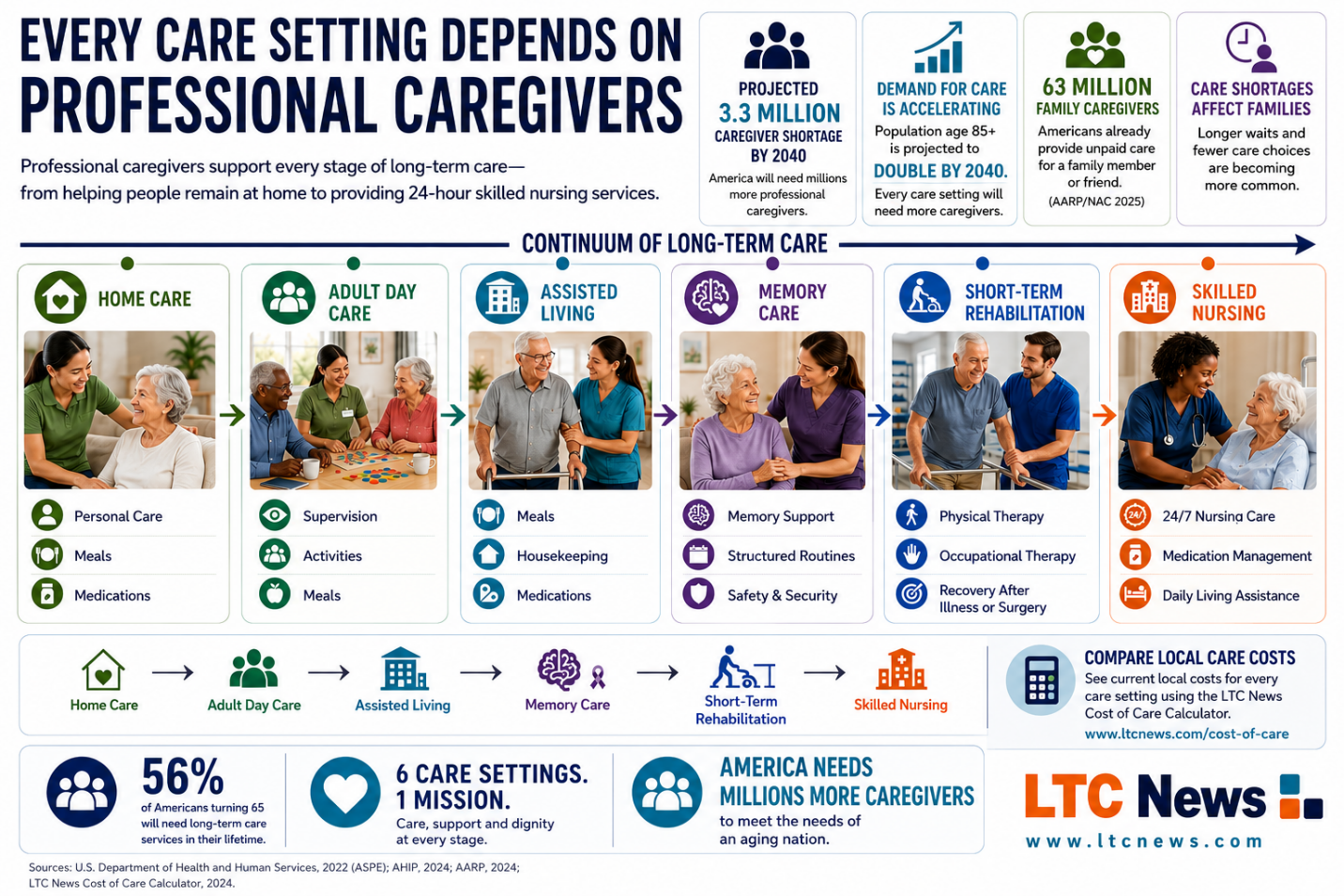
Professional caregivers are needed throughout the entire long-term care continuum, including:
- Home care
- Adult day care
- Assisted living
- Memory care
- Short-term rehabilitation
- Skilled nursing facilities
Staffing shortages in any of these settings can affect access to care, waiting times, and the availability of services for older adults and their families.
How could the caregiver shortage affect my family?
Families may experience:
- Longer waits for home care services
- Fewer provider choices in their communities
- Increased reliance on unpaid family caregivers
- Greater caregiver stress and burnout
- Delays in moving a loved one into assisted living or skilled nursing when needed
Planning before a crisis develops can help families better prepare for these challenges.
Why are so many family members becoming caregivers?
When professional caregivers are unavailable, spouses, adult children, relatives, and friends often step in to provide care.
According to the 2025 Caregiving in the U.S. report from the American Association of Retired Persons (AARP) and the National Alliance for Caregiving, approximately 63 million Americans now provide unpaid care for a family member or friend.
What factors are contributing to the shortage of caregivers?
Researchers identify several causes, including:
- An aging population that requires more care
- Slow growth in the working-age population
- High employee turnover
- Physically and emotionally demanding work
- Relatively low wages
- Reduced staffing following the COVID-19 pandemic
- Immigration policies that affect workforce availability
No single factor explains the shortage, which is why researchers believe multiple policy solutions will be needed.
Could technology solve the caregiver shortage?
Technology can help—but it cannot replace professional caregivers.
Artificial intelligence, remote monitoring, smart-home technology, and medical innovations may allow some older adults to remain independent longer. However, hands-on assistance, supervision, rehabilitation, companionship, and dementia care still require trained professionals.
Why does immigration matter to the long-term care workforce?
Approximately 29 percent of America's long-term care workforce is foreign-born.
Researchers conclude that immigration has become an important source of caregivers in both home-based and facility-based care. Future immigration policies could influence the availability of qualified caregivers as demand continues to grow.
Why is Medicaid important to long-term care?
Medicaid is the nation's largest payer of long-term care services, including nursing home care and many Home- and Community-Based Services.
Because providers rely heavily on Medicaid reimbursement, changes in funding can influence staffing levels, wages, recruitment, and workforce retention.
Does Medicare pay for long-term care?
Generally, no.
Medicare primarily covers medical treatment and limited skilled nursing or rehabilitation following a qualifying hospitalization when specific eligibility requirements are met.
It generally does not pay for ongoing custodial long-term care, including assistance with bathing, dressing, eating, supervision due to dementia, or extended home care.
What is the difference between Medicare and Medicaid?
Medicare is a federal health insurance program primarily for older adults and certain younger people with disabilities.
Medicaid is a joint federal-state program that provides healthcare and long-term care benefits for eligible individuals with limited financial resources. Medicaid is the primary public payer of long-term care in the United States.
How can Long-Term Care Insurance help?
Qualified Long-Term Care Insurance helps pay for covered long-term care services in a variety of settings, including home care, assisted living, memory care, and nursing homes.
Beyond helping pay for care, having coverage may make it easier to begin receiving services because providers often prefer clients who have an established payment source. Many policies also include care coordination services that help families navigate the care process.
When should someone consider purchasing Long-Term Care Insurance?
Most people who purchase traditional Long-Term Care Insurance do so between ages 47 and 67, when they are generally healthier, more likely to qualify medically, and premiums are typically lower than if they wait until retirement or after significant health changes.
Planning earlier provides more options and greater flexibility.
What is a Long-Term Care Partnership Program?
Available in 45 states, Partnership-qualified Long-Term Care Insurance policies allow policyholders to protect a portion of their assets if they later need Medicaid after exhausting their insurance benefits.
For many middle-income families, Partnership coverage provides additional financial security while encouraging earlier planning.

Sponsored