Aging in Rural America: Planning for Long-Term Care, Mobility, and Independence

About This Article
Independence in rural communities depends on more than good health. Long distances to care and essential services make mobility and preparation vital. Planning for transportation, home accessibility, emergencies, caregiving support, and LongTerm Care Insurance helps you stay independent, protect your family, and preserve the life you’ve built.

Mallory Knee
Mallory Knee is a freelance writer for multiple online publications where she can showcase her affinity for all things beauty and fashion.
Table of Contents
- Rural America Is Changing
- Why Mobility Becomes Healthcare
- Distance Changes Caregiving
- Rural America Is Choosing Home Care
- Independence Begins Before the Front Door
- Planning Before You Need Help
- Healthcare Access Begins With Transportation
- Public Transportation Often Isn't an Option
- The Vehicle Becomes Part of Your Healthcare Plan
- Rural Roads Bring Different Challenges
- Emergency Response May Take Longer
- Technology Is Helping Bridge the Distance
- When Professional Care Is Miles Away
- Choosing the Right Vehicle for Rural Independence
- Neighbor May Become Your First Caregiver
- Protecting Your Home, Your Family, and the Life You've Built
- Aging in Place Starts Years Before You Need Care
- The Family Farm Is More Than an Asset
- Long-Term Care Can Affect an Entire Operation
- Understanding the Cost of Care
- Understanding What Medicare Does—and Doesn't—Cover
- Medicaid Is an Important Safety Net
- Long-Term Care Insurance Can Help Preserve Choice
- Tax Benefits
- Planning Protects More Than Money
The nearest emergency department is nearly an hour away. A line of severe thunderstorms is approaching, and the snow has started to fall. Your spouse slips while walking to the barn. An ambulance is on the way—but it will take time.
If you live in rural America, situations like these aren't unusual. Distance influences nearly every healthcare decision you make. It affects how quickly emergency medical services reach your home, how often you can see specialists, whether professional caregivers are available, and how long you may be able to remain in the place you love. Aging makes it even more complicated.
You chose rural living for good reasons. Perhaps you wanted room to breathe after years of city traffic. Maybe your family has farmed the same land for generations. Your ranch, wooded property, lakeside home, or country acreage may represent decades of work, cherished memories, and a lifestyle built around self-reliance and independence.
Growing older doesn't mean giving up those values. It does mean recognizing that aging in a rural community presents challenges that differ from those in cities and suburbs. Planning before a health crisis develops can help you maintain your independence, reduce stress on your family, and preserve more choices about where and how you receive care.
Mobility becomes far more than driving.
- It becomes access to healthcare.
- It becomes access to professional caregivers.
- It becomes access to the independence you've worked so hard to achieve.
Rural America Is Changing
America's population continues to age, and many rural communities are growing older faster than metropolitan areas. Analyses from the U.S. Census Bureau and the Economic Research Service show that many rural counties have proportionately older populations, as younger adults often relocate for education and employment while older residents remain.
That demographic shift creates new challenges.
USDA's Economic Research Service, in its 2024 Rural America at a Glance report, identifies age structure and rural out-migration as defining drivers of demographic change in rural communities — the result of decades of young adults leaving for education and jobs while older residents remain in place.
The aging of the baby boom generation contributed to a rapid increase in the rural older population during the 2010s and early 2020s. This resulted in a large increase in the number of older age counties (those with 20 percent or more of their population age 65 or older), which nearly tripled since 2010." — Farrigan, T., Genetin, B., Sanders, A., Pender, J., Thomas, K. L., Winkler, R., Cromartie, J. (2024). Rural America at a glance (Report No. EIB-282). U.S. Department of Agriculture, Economic Research Service.
Many communities face shortages of physicians, nurses, therapists, direct-care workers, and other healthcare professionals. Rural hospitals have closed in some areas, forcing residents to travel farther for emergency and specialty care. Professional home care agencies may serve several counties, limiting availability and increasing travel time between clients.
According to the Health Resources and Services Administration, many rural communities continue to experience shortages of primary care providers, mental health professionals, and other healthcare specialists. For older adults, those shortages can make routine healthcare more difficult to access and increase the importance of advance planning.
Transportation is often one of the biggest obstacles.
Working-age populations in rural counties are shrinking, resulting in greater concentration in younger and older age groups. This was particularly evident in remote and rural adjacent counties, indicating that a relatively small working-age population must support both a significant child population and a relatively large older population." — Farrigan, T., Genetin, B., Sanders, A., Pender, J., Thomas, K. L., Winkler, R., Cromartie, J. (2024). Rural America at a glance (Report No. EIB-282). U.S. Department of Agriculture, Economic Research Service.
Unlike many metropolitan areas, rural communities may have little or no public transportation. Ride-share services can be limited or unavailable. Taxi service may not exist. Volunteer transportation programs help in some communities, but many operate with limited schedules and geographic coverage. Losing the ability to drive due to age or disability. even temporarily after surgery or illness, can dramatically change daily life.
The transition away from driving occurs over about a decade. It starts with not driving at night, in bad weather, on the interstate or in unfamiliar neighborhoods.” Katherine Freund, founder of the Independent Transportation Network, quoted in AgingCare.com.
Why Mobility Becomes Healthcare
Most people think about mobility in terms of getting from one place to another. In rural America, mobility often determines whether you receive healthcare at all.
A routine appointment with your primary care physician may require a 40-mile drive. Your cardiologist could be in another county. Physical therapy after surgery may involve traveling several times each week. A trip to the pharmacy could take an hour or more. What might be a brief errand in a city can become a half-day commitment in rural America.
Transportation remains one of the most significant barriers to healthcare access in rural communities.
When it comes to rural, geography plays a significant role. The geographic distance to providers, the distance that providers and patients have to travel to actually seek care, creates a barrier to care. Provider shortages create a barrier to access along with adequate insurance coverage... this impacts not only the health status of rural Americans but also directly impacts mortality in a rural context." — Alan Morgan, CEO, National Rural Health Association.
Distance affects preventive care as well. Older adults are more likely to postpone routine medical appointments when travel becomes difficult because of weather, health problems, fuel costs, or limited transportation options. Delaying preventive care may allow manageable conditions to become more serious before treatment begins.
The challenge becomes even greater after a major illness or injury. Recovering from a stroke, heart procedure, cancer treatment, or joint replacement often requires frequent follow-up appointments, rehabilitation, imaging, laboratory testing, and medication management.
- Each trip requires transportation.
- Each trip requires time.
- Each trip depends on maintaining the mobility needed to reach care.
Distance Changes Caregiving
Healthcare isn't the only service affected by geography. Distance changes caregiving, too. Many adult children want to help aging parents remain independent. In urban areas, that may mean stopping by after work to prepare dinner, drive to a doctor's appointment, or help with household chores. Rural families often face a different reality, and that is if that they didn't move to an urban area altogether.
A son may drive two hours just to mow the lawn. A daughter may spend an entire day traveling to accompany her mother to a medical appointment. Grandchildren who once visited every weekend may now live several states away because employment opportunities took them elsewhere.
According to the 2025 Caregiving in the U.S. report published by the AARP and the National Alliance for Caregiving, approximately 63 million Americans provide unpaid care to an older adult or another loved one with health needs.
For rural caregivers, distance often becomes an additional responsibility.
- Long drives.
- Lost work hours.
- Higher fuel costs.
- Weather delays.
- Unexpected overnight stays.
- The emotional burden of wondering whether a loved one is safe when help is miles away.
Professional caregivers face similar challenges. Home care nurses, therapists, and aides may spend hours each day traveling between patients scattered across multiple counties. Staffing shortages combined with long travel distances can limit appointment availability and reduce the number of visits agencies can provide. Families who understand those realities before a crisis occurs are better prepared to adapt when care becomes necessary.
Rural America Is Choosing Home Care
Like Americans everywhere, most rural families prefer to receive extended care at home for as long as possible, turning to assisted living only when home care is no longer enough. New data suggests rural communities are moving decisively in that direction.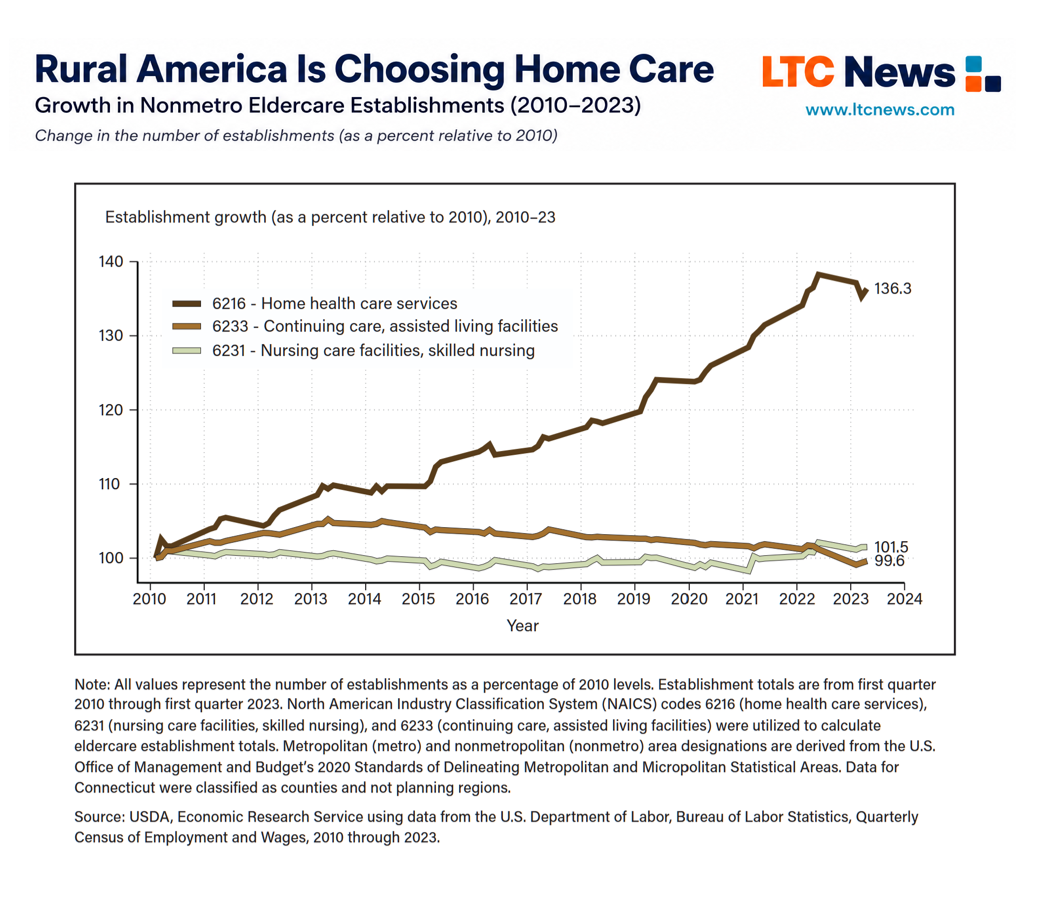
According to the U.S. Department of Agriculture's Economic Research Service, using Bureau of Labor Statistics employment data, the number of home health care establishments in nonmetro counties grew by more than 36 percent between 2010 and 2023. Continuing care and assisted living communities grew more modestly, increasing about 1.5 percent over the same period, while the number of nursing care and skilled nursing facilities in rural areas declined slightly, falling just under 1 percent.
The pattern mirrors what's happening across the country. Older adults consistently say they want to age at home, and rural families are no exception. As more home health care agencies open to meet that demand, rural residents are gaining more options to receive help with daily living activities or supervision for dementia without leaving the community, farm, or family property that matters most to them.
Growth hasn't been even across the country. Some rural counties saw a substantial rise in home health establishments between 2010 and 2023, while others saw little change or even a decline, often shaped by local population trends, workforce availability, and provider investment.
That last factor is critical. The same shortages driving up demand for home care, an aging rural population with fewer working-age residents to provide it, are also making it harder for agencies to keep up. Growth in the number of home care businesses doesn't necessarily mean growth in the number of caregivers available to staff them. Many rural home health agencies report ongoing difficulty recruiting and retaining direct-care workers, home health aides, and nurses, particularly in counties with declining populations and long driving distances between clients.
For rural families, that combination, more agencies opening but fewer workers to staff them, makes early planning even more important. Understanding what home care is actually available in your area, not just what should theoretically be available, is essential before a health crisis forces the question. 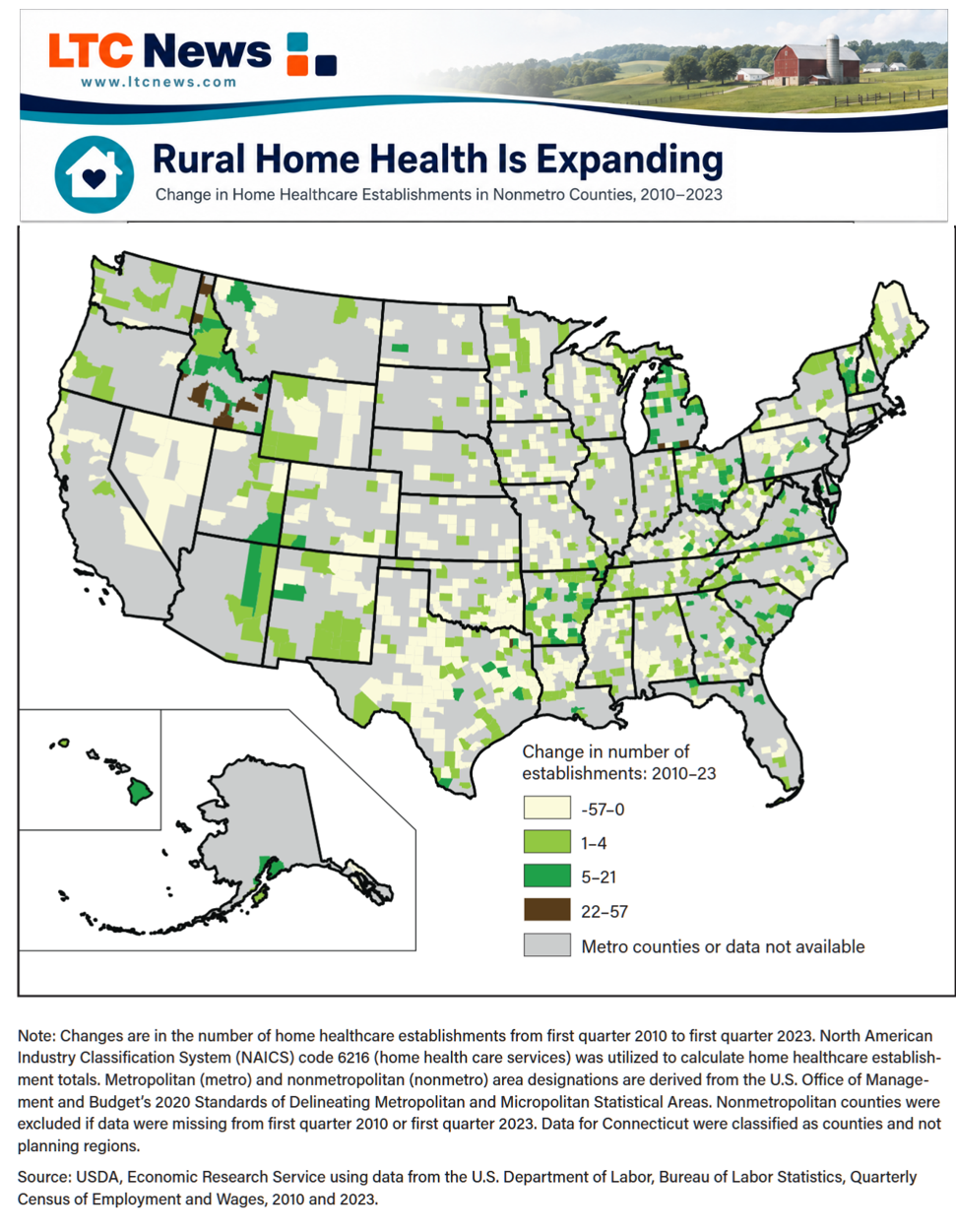
Independence Begins Before the Front Door
Aging in place starts long before someone needs a walker or wheelchair. It begins with evaluating the property itself. Many rural homes include features that younger homeowners barely notice, but that become increasingly important with age.
- Long gravel driveways.
- Steep grades.
- Uneven walking paths.
- Detached garages.
- Barns and workshops.
- Poor outdoor lighting.
- Narrow gates.
- Snow accumulation.
- Loose gravel.
Each can become a barrier after surgery, during recovery from illness, or as balance, vision, or strength changes over time. Walk around your property with fresh eyes. Ask yourself:
- Could an ambulance reach your home quickly in every season?
- Are house numbers clearly visible from the road, especially at night?
- Are walkways well lit and free of unnecessary hazards?
- Do steps have sturdy handrails?
- Could a wheelchair or walker safely navigate the entrance?
- Would a home health aide or nurse have difficulty reaching your front door during heavy rain or snow?
Addressing these concerns before mobility declines is almost always easier and less expensive than making emergency modifications after a fall or medical crisis.
Planning Before You Need Help
Successful aging in rural America begins with recognizing one important truth. Distance changes everything. It changes how quickly emergency services arrive. It changes how often family members visit. It changes how easily professional caregivers can provide assistance. It changes how you prepare your home, your transportation, and your finances for the future. Planning doesn't mean expecting the worst.
It means giving yourself the greatest number of choices if your health changes. The goal isn't simply to remain in your home. The goal is to remain connected—to healthcare, to your community, to your family, and to the independence that makes rural living so rewarding.
Healthcare Access Begins With Transportation
Transportation is often discussed separately from healthcare. In reality, the two are inseparable. Missing a physician appointment because roads are flooded or icy can delay diagnosis. Skipping physical therapy may prolong recovery. Postponing preventive screenings because the drive feels overwhelming can allow manageable health problems to become much more serious.
Transportation barriers remain one of the leading reasons many rural residents struggle to obtain timely healthcare.
Rural patients reported more problems with transportation and travel distance to health care providers and had a higher burden of travel for health care when measured by distance and time traveled." — Anay Shah, University of North Carolina at Chapel Hill.
That reality becomes even more significant with age. Vision changes may limit nighttime driving. Arthritis can make long trips uncomfortable. Medications sometimes affect alertness. Recovering from surgery, illness, or aging itself may temporarily prevent driving altogether. Unlike urban areas, there may be few—or no—alternative transportation options available.
Public Transportation Often Isn't an Option
Many Americans assume transportation alternatives exist everywhere. In much of rural America, they do not. Bus systems may never reach smaller communities. Taxi services may not operate outside larger towns.
Ride-share availability can be inconsistent or nonexistent. Volunteer driver programs provide valuable assistance in some communities but often depend on limited funding, volunteer availability, and advance scheduling.
That means many older adults depend almost entirely on:
- Their own vehicle
- A spouse
- Family members
- Friends
- Neighbors
- Faith communities
When none of those options are available, accessing healthcare becomes much more difficult. Transportation planning should therefore become part of every retirement discussion, not simply something families consider after someone stops driving.
The Vehicle Becomes Part of Your Healthcare Plan
For rural residents, choosing a vehicle isn't simply about comfort. It's about preserving independence.
Features worth considering include:
- Easy entry and exit
- Higher seating positions
- Good visibility
- Driver-assistance technology
- Reliable performance
- Four-wheel or all-wheel drive, where appropriate
- Space for walkers or wheelchairs
- Adaptive equipment if mobility changes
For people living on farms, ranches, or large rural properties, vehicles may also need sufficient ground clearance and traction to safely navigate gravel roads, muddy conditions, steep driveways, or snow-covered terrain. Understanding ground clearance in conversion trucks and other vehicles becomes important.
Reliability often matters more than luxury. The goal is to select transportation that supports both today's lifestyle and tomorrow's mobility needs, especially for older adults with limited mobility.
Rural Roads Bring Different Challenges
Driving conditions vary considerably from those found in metropolitan areas.
Older drivers may regularly encounter:
- Farm equipment traveling below highway speeds
- Wildlife crossings
- Narrow county roads
- Gravel surfaces
- Limited street lighting
- Flooded roadways
- Snow drifts
- Ice-covered bridges
- Long distances between fuel stations
Many of these conditions require greater concentration and longer reaction times. As vision, flexibility, or balance change with age, planning travel during daylight hours and allowing extra travel time can improve safety. Routine vehicle maintenance also becomes increasingly important when help may be many miles away.
Emergency Response May Take Longer
One of the greatest strengths of rural America is its willingness to help neighbors during emergencies. Volunteer firefighters, emergency medical technicians, and first responders provide extraordinary service across thousands of communities.
Distance, however, cannot be eliminated. An ambulance serving a large geographic area simply has farther to travel than one located a few blocks away. A 2017 study published in JAMA Surgery found that the national average response time from a 911 call to EMS arrival on scene was 7 minutes—in rural areas, that average climbs to more than 14 minutes, and nearly 1 in 10 rural calls have wait times close to 30 minutes.
Those extra minutes matter. In situations involving severe bleeding, cardiac arrest, or other time-sensitive emergencies, the person who happens to be nearby often becomes the first line of care.
Because of our response times just due to location, time to a hospital, the community's knowledge to start aid in a situation will aid us as an ambulance in helping make sure a good outcome is a possibility," says Tyler Weir, an emergency medical technician with Washington County Ambulance District, quoted in an article on the USC Annenberg School for Communication and Journalism website.
Knowing basic first aid—how to control bleeding, perform CPR, or recognize the signs of a stroke or heart attack—can make a meaningful difference in the minutes before help arrives. Many local hospitals, fire departments, and organizations such as the American Red Cross offer first aid and CPR courses, and free "Stop the Bleed" classes are increasingly available in rural communities to teach basic bleeding-control skills.
Taking one of these courses, and encouraging family members to do the same, is one of the simplest ways to prepare for a rural emergency. That's one reason prevention becomes so important.
- Reducing fall hazards.
- Maintaining smoke detectors.
- Installing handrails.
- Keeping driveways accessible.
- Clearly displaying house numbers.
- Preparing for severe weather.
Each small improvement may reduce the likelihood of an emergency occurring—or make it easier for responders to reach you quickly.
Families should also ask practical questions:
- Can emergency vehicles reach the home after heavy snowfall?
- Does GPS accurately locate the property?
- Are the gates locked?
- Is there enough room for larger emergency vehicles to turn around?
- If a medical helicopter is needed, where could it safely land nearby?
Those conversations rarely happen during emergencies. They should happen long before one occurs.
Technology Is Helping Bridge the Distance
Technology has transformed healthcare for many rural families. Telehealth appointments now allow physicians to evaluate many routine concerns without requiring lengthy travel.
Remote patient monitoring devices can transmit information such as blood pressure, blood glucose readings, heart rhythms, oxygen levels, and body weight directly to healthcare providers. Wearable devices increasingly detect falls, monitor activity, and alert family members when something appears unusual.
Artificial intelligence is beginning to assist physicians by identifying subtle changes in health data that may require additional evaluation. Broadband expansion has enabled many of these technologies.
Still, technology has limits. A virtual visit cannot replace emergency surgery. Remote monitoring cannot perform an MRI. Video appointments cannot substitute for chemotherapy, rehabilitation, dialysis, or many specialty services. Technology should complement healthcare—not replace access to it.
When Professional Care Is Miles Away
Healthcare workforce shortages affect many parts of the country. Distance makes those shortages even more noticeable in rural communities. Home healthcare agencies may cover multiple counties.
A physical therapist may spend more time driving than treating patients. Hospice nurses often travel long distances between visits. Some communities have waiting lists for home care because qualified caregivers are in short supply. Families should research local resources before they become necessary.
Questions worth asking include:
- Which home care agencies serve this area?
- How quickly can services begin?
- Are overnight caregivers available?
- Is specialized dementia care offered?
- How are visits affected during severe weather?
- What happens if staffing shortages delay care?
Those who have Long-Term Care Insurance have a leg up, since the provider knows they will be paid, and on time. The LTC News Caregiver Directory allows families to search for licensed home care agencies, assisted living communities, memory care providers, rehabilitation centers, and nursing homes throughout the United States, including in rural areas.
Knowing what resources exist, and how far away they are, is one of the first steps toward aging successfully in a rural community.
Choosing the Right Vehicle for Rural Independence
For rural families, a vehicle isn't just transportation. It's a lifeline to healthcare, groceries, church, and everyone you love. As mobility changes with age or health, the right vehicle can help you stay independent longer. The wrong one can quietly become a barrier.
No single vehicle works for every rural household, but a few categories tend to serve older adults and people with mobility limitations well. Crossover SUVs offer higher seating positions that reduce the strain of climbing in and out, along with better visibility over the road than a low sedan. Minivans provide wide-opening doors, low step-in height, and enough interior space for a walker or wheelchair without sacrificing all-weather capability. Midsize pickup trucks remain popular with rural families who need to haul equipment or feed, though the higher step-up height can become difficult over time and is worth testing before you buy.
Wheelchair-accessible vans, equipped with ramps or lifts, become essential for families managing more significant mobility changes. For anyone living on a farm, ranch, or property with gravel roads, steep driveways, or snow-covered terrain, all-wheel or four-wheel drive and adequate ground clearance aren't luxuries. They're often the difference between reaching the highway safely and getting stuck.
Features That Matter More Than Style: The AAA Foundation for Traffic Safety, working with the University of Florida's Institute for Mobility, Activity and Participation, developed a "Smart Features for Older Drivers" guide identifying vehicle features that improve safety and comfort as physical needs change. Recommended features include six-way power-adjustable seats for drivers with hip, knee, or leg pain; keyless entry and ignition for those with arthritis or reduced grip strength; a thick steering wheel for drivers with limited fine motor skills; and high-contrast displays for those with diminished vision.
"As a person ages, muscle strength, range of motion, and vision tend to diminish and can affect driving ability," says Dr. Sherrilene Classen, Professor and Chair, Department of Occupational Therapy, College of Public Health and Health Professions
Not only do these conditions affect a driver's comfort, their presence can also reduce the ability to safely execute the complex task of driving." — Dr. Sherrilene Classen.
According to the National Highway Traffic Safety Administration, physical and mental abilities, driving behaviors, and crash risks all change as drivers age, though age alone does not determine driving performance. Many roads, traffic signals, and vehicles weren't originally designed with older drivers in mind, which makes choosing the right vehicle and adapting it properly even more important.
Neighbor May Become Your First Caregiver
One characteristic distinguishes many rural communities. Neighbors often know one another. When storms arrive. When someone is hospitalized. When a spouse dies. When help is needed. That sense of community is one of rural America's greatest strengths.
It should also become part of your long-term care plan. Neighbors cannot replace professional healthcare. Nor can they become full-time caregivers for an older adult, especially someone with mobility challenges or memory loss.
But they may become the first people to notice that something is wrong, clear a snow-covered driveway, check on you after a power outage, or call family members during an emergency. Successful aging in rural America depends not only on preparing your home and finances.
It depends on strengthening the relationships that help communities care for one another.
Protecting Your Home, Your Family, and the Life You've Built
By the time most people retire, home means much more than an address. It represents decades of work. There are years of memories. A place where children were raised, careers ended, traditions began, and retirement finally slowed life's pace.
For many rural families, home also includes productive farmland, a working ranch, timber property, or acreage that has been passed from one generation to the next. Growing older isn't simply about remaining in a house. It's about preserving a way of life.
Aging in Place Starts Years Before You Need Care
Most people who say they want to age in place are really expressing something much larger. They want to remain independent. They want to continue making their own decisions. They want to wake up in familiar surroundings, maintain long-standing relationships, and stay connected to the communities they've helped build.
That goal rarely happens by accident. Successful aging in place begins long before someone needs assistance getting dressed or recovering from surgery. It begins while you're still healthy enough to prepare.
Small improvements often make the biggest difference.
- Better lighting.
- Safer walkways.
- Grab bars.
- Wider doorways.
- Lever-style door handles.
- A first-floor bedroom if stairs become difficult.
- Backup power for medical equipment or well pumps.
- Reliable internet access for telehealth.
Each improvement may seem minor today. Together, they can add years of safe, independent living.
The Family Farm Is More Than an Asset
Financial planning looks different in rural America. Many rural families own significant assets. For farmers, ranchers, and other business owners, the challenge is that much of their wealth isn't sitting in a savings account. It's in the land. The farm. The ranch. The family business. Timber. Equipment. Livestock. Or property that has appreciated over generations.
On paper, those families may have substantial net worth. In reality, much of that wealth isn't easily converted into cash without making difficult decisions. Selling acreage to pay for long-term care is rarely the goal, nor is it easy to do, especially when a crisis hits quickly, as it often does. Neither is borrowing heavily against property that supports retirement income or provides a living for future generations.
For many families, preserving the land means preserving the family legacy. Planning before care becomes necessary gives families more options than planning during a crisis.
Long-Term Care Can Affect an Entire Operation
When someone requires extended care, the effects often extend well beyond healthcare.
- Who feeds the livestock?
- Who plants or harvests the crops?
- Who manages employees?
- Who handles bookkeeping?
- Who drives equipment?
- Who cares for a spouse still living at home?
Those questions illustrate why long-term care planning is different for many rural families.
Many of the farm and ranch families I work with share these same concerns. Long-Term Care Insurance with cash benefits can be used for more than extended care. It can also help address these other issues that are often overlooked until a crisis hits." — Matt McCann, CLTC.
A health event involving one person can affect an entire household—or even an entire business. Adult children may suddenly find themselves balancing careers, caregiving responsibilities, and managing a family operation from hundreds of miles away. Early planning helps families make thoughtful decisions instead of emotional ones.
Understanding the Cost of Care
One misconception is that long-term care costs less in rural communities. Sometimes it does. Sometimes it doesn't. Limited provider availability can actually reduce competition and make certain services more difficult to obtain.
Families should understand the cost of long-term care where they live—not where someone else lives. Professional and semi-skilled home care. Adult day care. Assisted living. Memory care. Skilled nursing care. Each carries different costs that vary by community. The LTC News Cost of Long-Term Care Services Calculator allows you to compare current and projected future local extended care costs using ongoing surveys of care providers across the United States.
Knowing those costs years before care is needed helps families develop realistic Long-Term Care Insurance plans now, rather than making crisis decisions under pressure.
👉 Compare Long-Term Care Insurance Companies and Products
Understanding What Medicare Does—and Doesn't—Cover
One of the most common misconceptions about retirement is that Medicare will cover most long-term care. It won't. Centers for Medicare & Medicaid Services explains that Medicare is designed primarily to cover medically necessary healthcare. Under qualifying circumstances, it may pay for limited, short-term skilled nursing care or rehabilitation following a hospital stay when specific eligibility requirements are met.
However, Medicare does not pay for ongoing custodial care, including extended assistance with bathing, dressing, eating, personal hygiene, supervision because of dementia, or other long-term services and supports that many older adults eventually need. Learning that distinction during a healthcare crisis often comes as an expensive surprise. Understanding it before retirement allows families to explore other planning options while more choices remain available.
Medicaid Is an Important Safety Net
Medicaid plays an essential role in helping millions of Americans receive long-term care. Eligibility rules vary by state, but Medicaid generally serves people with limited financial resources or those who have spent down much of their assets paying for care.
Many rural families hope to preserve financial independence while passing property or businesses to future generations. That goal often leads to conversations with Long-Term Care Insurance specialists, elder law attorneys, accountants, and other advisors long before care becomes necessary. Planning doesn't eliminate uncertainty. It expands your options and places you in control.
Long-Term Care Insurance Can Help Preserve Choice
According to the Office of the Assistant Secretary for Planning and Evaluation, approximately 56 percent of people turning age 65 today are expected to require long-term services and supports that meet the federal definition during their lifetime.
For many rural residents, the first choice is remaining at home for as long as it is safe and practical. Qualified Long-Term Care Insurance policies, as defined under Section 7702(b) of the Internal Revenue Code, generally pay benefits when a licensed healthcare practitioner certifies that an individual is expected to need substantial assistance with at least two of the six activities of daily living for at least 90 days or has a severe cognitive impairment.
Depending on the policy and available providers, benefits may help pay for care received:
- At home
- In adult day care
- In assisted living
- In memory care
- In a nursing home
For people living in rural communities, those benefits may make it easier to bring professional caregivers into the home, reducing dependence on spouses or adult children while preserving greater flexibility in choosing where care is received.
Because premiums are based on age and health at the time coverage is purchased, many people obtain Long-Term Care Insurance between ages 47 and 67, before significant medical conditions develop. Coverage isn't appropriate for everyone. But for those who qualify, it can become the key part of a broader strategy to protect retirement savings, preserve family assets, and maintain greater control over future care decisions.
Tax Benefits
Premiums for Long-Term Care Insurance come with significant tax advantages. If you own a farm, ranch, or other business, the premium for LTC Insurance can become a tax-deductible business expense. If your business is a C Corporation, generally 100 percent of the premium is deductible. Otherwise, the IRS publishes a chart each year showing the maximum deductible amount based on your age.
For a rural family, a farm, ranch, or other business often represents more than income. It represents a legacy built over generations. Long-Term Care Insurance can help protect that legacy by covering the cost of care without forcing a family to sell land, liquidate equipment, or take on debt to pay for a spouse's or parent's care. Because premiums may qualify as a tax-deductible business expense, a farm or ranch family can protect both their operation and their future care needs while lowering their tax burden in the same year they purchase coverage.
Planning Protects More Than Money
Financial planning is often discussed in terms of dollars. For rural families, planning is equally about protecting relationships. Helping a spouse remain at home. Reducing stress on adult children. Keeping a family business operating. Avoiding rushed decisions. Preserving land intended for future generations.
Every family's circumstances are different. Smart estate planning, Long-Term Care Insurance, and preparing your home for aging, including transportation, can help you avoid a family crisis later in life. The important decision isn't choosing one strategy over another. It's beginning the conversation while time, health, and options remain on your side.
Frequently Asked Questions
Why do many rural families worry about paying for long-term care?
Many farm and ranch families have substantial wealth tied up in land, equipment, livestock, or family businesses rather than readily available cash. Selling property during a healthcare crisis is rarely the preferred solution. Planning in advance—including retirement planning, estate planning, and, when appropriate, Long-Term Care Insurance—can help families preserve assets and maintain more choices.
Are professional caregivers available in all rural communities?
Availability varies widely. Some rural communities have excellent home care resources, while others face significant workforce shortages and long travel distances for caregivers. Researching available providers before care is needed helps families prepare realistic plans. The LTC News Caregiver Directory can help locate licensed providers in communities across the country.
What home improvements should rural homeowners consider as they age?
Priorities often include improving exterior lighting, installing handrails, widening doorways where necessary, reducing trip hazards, improving driveway access, clearly marking house numbers, preparing backup power for essential equipment, and ensuring emergency vehicles can reach the property year-round.
How far should I live from a hospital or emergency department?
There is no ideal distance, but you should understand how long it takes emergency medical services to reach your home and how quickly you can reach emergency care during different weather conditions. If you live in a remote area, planning alternate routes, maintaining emergency supplies, and learning basic first aid become even more important.
Can I successfully age in place in a rural community?
Yes. Thousands of older adults successfully age in place on farms, ranches, and rural properties every year. Success depends on realistic planning, maintaining mobility, preparing your home, building a reliable support network, and understanding how healthcare and long-term care services are accessed in your community.
Why is mobility so important as you grow older in rural America?
Mobility is much more than the ability to drive. It provides access to healthcare, prescription medications, grocery stores, social activities, family, and emergency services. Losing mobility in a rural area can affect nearly every aspect of daily life because transportation alternatives are often limited or unavailable.
How can technology help older adults living in rural communities?
Telehealth, remote patient monitoring, wearable health devices, fall-detection systems, and medication reminders can improve access to healthcare while reducing unnecessary travel. Technology is a valuable tool, but it complements rather than replaces in-person medical care and professional caregiving.
What if my adult children live in another state?
Distance is common for many rural families. Discuss caregiving responsibilities before a crisis occurs. Prepare emergency contact lists, healthcare directives, financial powers of attorney, and communication plans. Local friends, neighbors, and faith communities may also become valuable members of your support network.
Why is aging in a rural community different from aging in a city?
Living in a rural community often means longer distances to hospitals, physicians, pharmacies, rehabilitation centers, and professional caregivers. Limited public transportation, healthcare workforce shortages, and greater travel times make planning for mobility and long-term care especially important to maintain independence.
How can Long-Term Care Insurance help someone living in a rural area?
Qualified Long-Term Care Insurance will help pay for care received at home, in assisted living, memory care, adult day care, or nursing homes, depending on the policy and available providers. For many rural families, benefits can help pay for professional caregivers, reducing the burden on spouses and adult children while helping preserve financial independence.
Does Medicare pay for long-term care if I need help at home?
Generally, no. Medicare primarily covers medically necessary healthcare and may pay for limited, short-term skilled nursing or rehabilitation services under qualifying circumstances. It generally does not pay for ongoing custodial care, including assistance with bathing, dressing, eating, supervision because of dementia, or other long-term services and supports.
How can I estimate the future cost of long-term care where I live?
Costs vary significantly by location and type of care. Reviewing local costs years before care is needed allows families to develop realistic financial strategies. The LTC News Cost of Care Calculator provides localized estimates for home care, assisted living, memory care, and nursing home services based on ongoing surveys of licensed providers.
Can I remain on my farm or ranch if I eventually need long-term care?
Many people do. Success depends on planning ahead. Home modifications, accessible transportation, caregiver support, emergency preparedness, and financial planning can make it possible to remain safely at home much longer. Every situation is different, so planning before health changes occur provides the greatest flexibility.
What is the biggest mistake rural families make when planning for aging?
The most common mistake is waiting until a health crisis occurs. Planning while you are healthy gives you more options for transportation, home modifications, caregiving, financial planning, and preserving your independence. Early preparation also reduces stress on spouses, adult children, and other family members.

Sponsored