The Home Safety Risks Your Aging-in-Place Checklist May Be Missing
About This Article
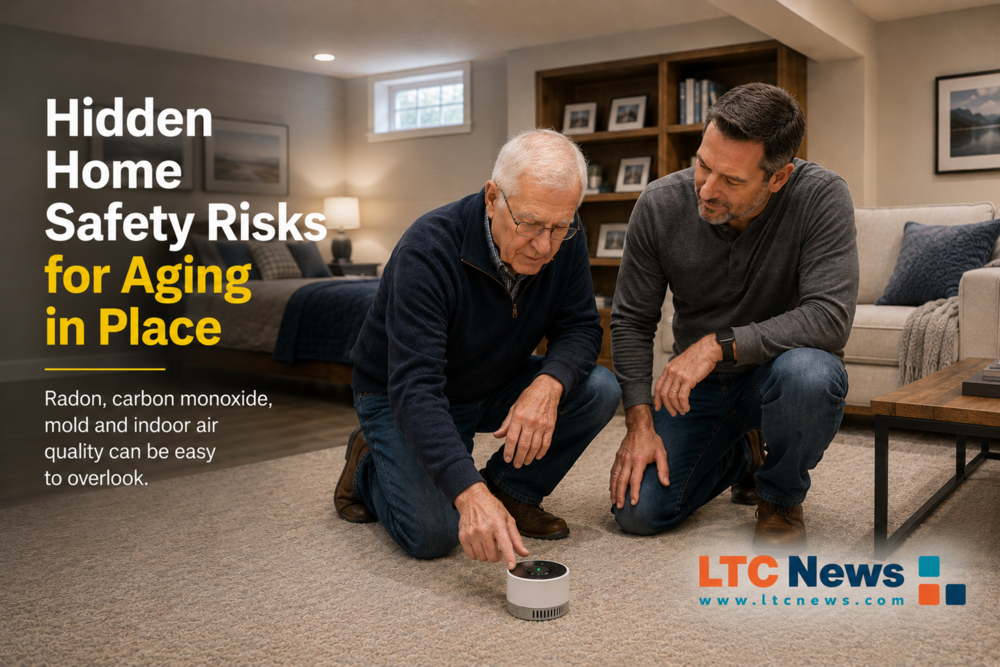
Grab bars, better lighting and removing trip hazards are a good start when you're preparing a home for an aging parent. But you may be overlooking risks you cannot see, including radon, carbon monoxide, excessive moisture, mold and indoor air pollution.

Marcus Howard
Marcus Howard writes about alternative health topics for older adults such as CBD, acupuncture, and herbal medicine.
Table of Contents
- Aging Can Mean Spending More Time at Home
- Radon Is One Invisible Risk Worth Checking
- Moving a Bedroom Downstairs? Consider Radon Testing
- Carbon Monoxide Can Pose a More Immediate Danger
- Moisture and Mold Shouldn't Be Ignored
- Cooking, Smoke and Tiny Particles Matter, Too
- Household Products Can Affect Your Indoor Air
- Add an Indoor Environment Check to Your Aging-in-Place Plan
- Think Beyond What You Can See
When you start preparing your home, or a parent's home, for aging, you probably begin with what you can see. You remove the loose rugs. You install grab bars in the bathroom. You brighten a dark hallway. You add handrails to the steps, and you may even move a bedroom to the first floor or a lower level so climbing stairs isn't part of daily life anymore.
Those changes matter. Falls remain one of the biggest threats to an older adult's independence. But there's another part of your home that deserves attention: the air inside it. Radon, carbon monoxide, particulate matter, excess humidity, mold, and pollutants from household products or combustion appliances can all be invisible. That does not make them unimportant.
According to the U.S. Environmental Protection Agency (EPA), Americans spend about 90 percent of their time indoors, and concentrations of some pollutants indoors are often two to five times higher than typical outdoor levels. Older adults and people with heart or respiratory conditions may be particularly vulnerable to some of these pollutants.
Jake Lusby, an NRPP-certified radon professional and owner of Air Sense Environmental, a St. Louis, Missouri area radon testing and mitigation company, told LTC News that someone who has retired, or who has reduced mobility, may spend the overwhelming majority of their hours inside. That poses several dangers.
Too many people forget about indoor air quality. It is easy to overlook because nothing about it is visible, and because the consequences are slow rather than sudden. But for someone who has chosen to stay in a home they have owned for thirty or forty years, indoor air is worth a place on the list, for a simple reason: they are breathing more of it than anyone else in the household ever did." — Jake Lusby, NRPP-certified radon professional.
If you're planning to stay in your home for years to come, checking your indoor environment is a practical part of aging safely in place.
Aging Can Mean Spending More Time at Home
Retirement often changes how you use your home. If you once left for work five days a week, you may now spend most of your day indoors. Mobility problems can increase that even more. If you're receiving home care or recovering from an illness or surgery, you might spend most of your time in just one or two rooms.
That matters because your exposure to indoor pollutants depends partly on how much of a pollutant is present and how long you're exposed to it.
The EPA points to numerous potential sources of indoor pollution, including fuel-burning appliances, building materials, furnishings, cleaning and maintenance products, excess moisture, heating and cooling systems, and outdoor sources that make their way inside.
That doesn't mean your home is necessarily unhealthy or that you should become alarmed about every possible contaminant. It means your aging-in-place assessment should look beyond accessibility.
Radon Is One Invisible Risk Worth Checking
Lusby tells LTC News that radon deserves particular attention because you cannot see it, smell it, or taste it.
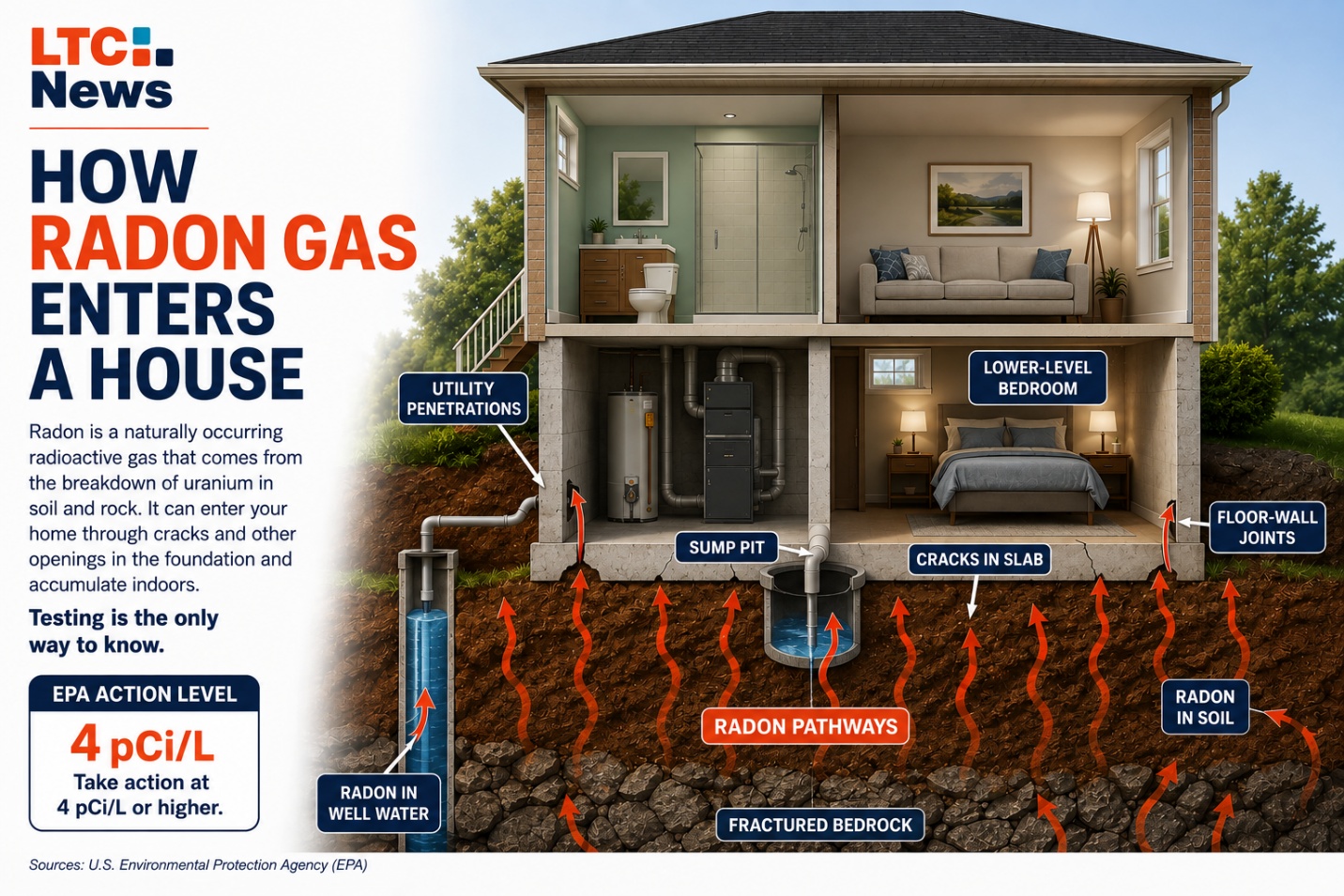
Radon is a naturally occurring radioactive gas produced by the breakdown of uranium in soil and rock. It can enter your home from the ground and accumulate indoors." — Jake Lusby, NRPP-certified radon professional.
Long-term exposure increases your risk of lung cancer. Radon is the leading cause of lung cancer among people who don't smoke and the second-leading cause overall, according to the EPA, which estimates radon contributes to roughly 21,000 lung cancer deaths in the United States each year — and smoking combined with radon exposure substantially raises that risk.
The EPA recommends taking action to reduce radon when a home's level reaches 4 picocuries per liter (pCi/L) or higher. The agency also recommends considering action between 2 and 4 pCi/L, because there is no known completely safe level of radon exposure.
Testing is the only way to know your home's radon level.
Moving a Bedroom Downstairs? Consider Radon Testing
One aging-in-place modification makes radon particularly relevant to you. You or your family may be considering moving a bedroom to a lower level or finishing a basement so an older parent or spouse can avoid stairs.
That can be a sensible accessibility decision. But it also turns the lowest level of your home into part of your everyday living space. The EPA recommends testing for radon on the lowest lived-in level of a home, and it specifically advises homeowners planning to finish a basement to test before remodeling begins. Even if you tested elsewhere in the house before, you may need another test once the basement becomes living space.
Indoor air quality testing typically involves a monitoring period of a day or two measuring humidity, particulates, VOCs, and carbon dioxide, followed by a written report. However, if you are considering making renovations to a parent's home, be sure to start testing before you start the work.
Testing before renovations can also catch a problem before walls, flooring, and other improvements make mitigation work more complicated.If you're planning a downstairs bedroom, caregiver suite, recreation room or other regularly occupied space, consider radon testing part of the renovation, not an afterthought." — Jake Lusby.
Carbon Monoxide Can Pose a More Immediate Danger
Unlike radon, which creates risk through long-term exposure, carbon monoxide can cause an immediate medical emergency. Carbon monoxide, or CO, is an odorless, colorless gas produced by fuel-burning equipment and devices. Furnaces, generators, and other combustion sources can produce it.
Symptoms of CO poisoning can include headache, dizziness, weakness, nausea and confusion. Severe exposure can cause you to lose consciousness, and it can be fatal.
Older adults and people with chronic heart disease, anemia or breathing problems can be more vulnerable to carbon monoxide poisoning, according to the Centers for Disease Control and Prevention (CDC). The agency reports that unintentional carbon monoxide poisoning unrelated to fires kills more than 400 Americans each year and results in thousands of hospitalizations. Make sure your home has working carbon monoxide alarms along with smoke alarms.
Check the age of your alarms rather than assuming they'll work indefinitely, and follow the manufacturer's replacement instructions and test them regularly. Fuel-burning furnaces, water heaters, fireplaces and other combustion appliances should be properly installed, vented and maintained.
Moisture and Mold Shouldn't Be Ignored
Water problems can become air-quality problems. A leaking basement, damp crawl space, plumbing leak or chronically humid room can create the conditions mold needs to grow.
The EPA recommends keeping indoor relative humidity below 60 percent, ideally between30 and 50 percent. A simple, inexpensive humidity meter from a hardware store can tell you where your home stands.
That makes basements and crawl spaces worth inspecting as you prepare a home for long-term aging. Look for:
- water stains or recurring leaks
- musty odors
- visible mold
- condensation
- persistently damp areas
- drainage problems around the foundation
Finding moisture doesn't automatically mean you're facing an expensive remediation project. The source could be as simple as a plumbing leak, a drainage issue, or a humidity problem.
That said, significant mold problems call for real precautions. The CDC advises people with weakened immune systems, chronic respiratory disease or certain underlying lung conditions not to participate in mold cleanup.
Cooking, Smoke and Tiny Particles Matter, Too
Indoor air pollution doesn't always come from the building itself. Cooking, fireplaces, candles, tobacco smoke, unvented heaters and some hobbies can all generate particulate matter inside your home.
Particulate matter is made up of tiny solid or liquid particles suspended in the air. Some are small enough to travel deep into your lungs, and the smallest particles may enter your bloodstream. If you have heart or lung disease, you can be more vulnerable to particle pollution, and exposure can aggravate existing respiratory and cardiovascular conditions.
Outdoor pollution can become an indoor problem, too. Wildfire smoke, traffic pollution and other outdoor particles can enter your home through windows, doors and ventilation systems. Good ventilation and appropriate filtration can help with some indoor pollutants, though no single air cleaner solves every indoor air-quality problem. The EPA specifically notes that conventional air cleaners do not remove radon gas.
Household Products Can Affect Your Indoor Air
Volatile organic compounds, commonly called VOCs, can be released from paints, cleaning supplies, furnishings, flooring and other household products. That becomes especially relevant if you're remodeling.
You may be renovating a home specifically to make it safer for an aging parent while simultaneously introducing new flooring, paint, cabinetry or furniture. The renovation can still be worthwhile; factor ventilation and indoor air quality into the project.
The EPA recommends three broad strategies for improving indoor air: controlling pollution at its source, improving ventilation and using filtration or air cleaning where appropriate.
Add an Indoor Environment Check to Your Aging-in-Place Plan
You don't need sophisticated monitoring equipment in every room to start thinking about indoor environmental safety. Begin with the basics.
Test your home for radon, particularly if it's never been tested or if a lower level is becoming living space. Make sure your smoke and carbon monoxide alarms are present and working. Check for water intrusion and excess humidity. Maintain your heating and cooling equipment and combustion appliances. Address visible mold or persistent moisture problems.
Pay particular attention if you're renovating. The EPA notes that remodeling can affect ventilation, moisture, and the way combustion equipment operates, and recommends considering indoor air quality before, during, and after any remodeling project rather than waiting for a problem to develop.
If you're helping a parent age in place, an occupational therapist or qualified aging-in-place professional can help identify accessibility and safety issues you might miss on a casual walkthrough.
A Safer House Can Support Independence — It Can't Eliminate the Need for Care
Aging in place is about more than staying inside the same house. The goal is an environment where you or your loved one can remain as safe, healthy, and independent as possible, and indoor environmental safety is one piece of that plan.
Fall prevention, accessible bathrooms, safe stairs, medication management, adequate nutrition, social engagement and appropriate help with daily activities all remain important, too.
Even a well-designed home can't prevent every change in health. You or a loved one may eventually need help with bathing, dressing, toileting, transferring, eating or other activities of daily living. Cognitive decline can create supervision needs even when someone remains physically mobile.
Medicare generally pays for short-term skilled care under specific circumstances, but it does not pay for most ongoing custodial long-term care. Medicaid can pay for long-term care if you or a loved one has limited financial resources.
Long-Term Care Insurance can provide benefits for qualifying care at home and, depending on the policy, adult day care, assisted living, memory care and nursing home care. In some cases, it may provide some funds or small modifications to the insured's home.
If a loved one has a Long-Term Care Insurance policy and you think they meet the benefit trigger requirements, get free expert help to process the insurance claim. LTC News partners with Amada Senior Care to provide free claim support with no cost or obligation — File a Long-Term Care Insurance Claim.
You can also search the LTC News Caregiver Directory to find qualified home care agencies and other care services near you.
Think Beyond What You Can See
Grab bars and better lighting belong on every aging-in-place checklist. So do the less visible parts of your home. Radon, carbon monoxide, moisture, mold, ventilation and indoor pollutants can all affect the health and safety of the people who spend the most time there, especially if they are older.
The best time to think about them is before there's a problem — particularly if you're renovating, moving a bedroom downstairs or preparing for a parent to receive care at home. Aging in place requires looking beyond what you can see. Checking for environmental risks can be another relatively simple step toward making a home safer for the years ahead.
This article is for general informational purposes. Consult qualified professionals for questions involving your home's environmental conditions.
Frequently Asked Questions
What is radon, and why is it dangerous?
Radon is a naturally occurring radioactive gas produced by the breakdown of uranium in soil and rock. You cannot see, smell or taste it. Long-term exposure increases lung cancer risk, and the EPA identifies radon as the leading cause of lung cancer among nonsmokers and the second-leading cause overall.
What humidity level is recommended inside a home?
The EPA recommends keeping indoor relative humidity below 60 percent and ideally between 30 and 50 percent. Controlling moisture can help reduce conditions that encourage mold growth.
What other indoor environmental risks should older adults consider?
Carbon monoxide, excessive humidity, mold, particulate matter, poor ventilation and pollutants from household products can also affect indoor air quality. Families should check smoke and carbon monoxide alarms, look for water intrusion and persistent moisture, maintain heating and combustion equipment, and address visible mold or other environmental problems.
Should you test for radon before moving a bedroom to the basement?
Yes, it is worth considering. The EPA recommends testing on the lowest lived-in level of a home and advises testing before finishing a basement. This can be particularly important when a basement or lower level is being converted into a bedroom, caregiver suite or other frequently occupied living space.
Does making a home safer eliminate the possibility of needing long-term care?
No. Home modifications and environmental improvements can support independence, but changes in health, mobility or cognition may eventually create a need for help with activities of daily living or supervision. Medicare generally covers short-term skilled care under specific circumstances but does not pay for most ongoing custodial long-term care; Medicaid may provide long-term care for people who meet its financial and eligibility requirements.
Can an air purifier remove radon?
Conventional air cleaners do not remove radon gas, according to the EPA. Radon testing is necessary to determine the level in a home, and elevated levels may require specific radon mitigation measures.
What radon level requires action?
The EPA recommends taking action to reduce radon when levels reach 4 picocuries per liter (pCi/L) or higher. The agency also recommends considering action when levels are between 2 and 4 pCi/L because there is no known completely safe level of radon exposure.
Why should indoor air quality be part of an aging-in-place plan?
Older adults may spend more time at home after retirement, because of mobility limitations or while receiving care. That can increase the amount of time they are exposed to radon, carbon monoxide, mold, particulate matter and other indoor pollutants. The EPA says Americans spend about 90 percent of their time indoors.


Sponsored