Peptides for Joint Health: What Research Shows About BPC-157, TB-500 and Connective Tissue

About This Article
Researchers are examining peptides tied to tendons, ligaments, collagen and tissue remodeling, but most evidence remains preclinical and several widely marketed compounds are not FDA approved treatments. Mobility challenges, often driven by tendon and joint issues, are a major concern for older adults and a common factor leading to long-term care needs.

Marcus Howard
Marcus Howard writes about alternative health topics for older adults such as CBD, acupuncture, and herbal medicine.
Table of Contents
- Understanding Joints and Connective Tissue
- Why Are Scientists Studying Peptides?
- BPC-157 and Musculoskeletal Research
- TB-500 Is Not the Same as Thymosin Beta-4
- GHK-Cu and the Extracellular Matrix
- Collagen Peptides Are a Different Category
- FDA Status and Safety Questions
- Laboratory, Animal and Human Studies Tell Us Different Things
- Peptides, Aging and Maintaining Mobility
- Is There a "Best Peptide" for Joint Pain?
- Why Online Peptide Claims Can Get Ahead of the Science
- What the Research Really Shows
Joint pain, tendon injuries, and declining mobility become more common concerns as we age. That has fueled interest in peptides, compounds being studied for their potential roles in tissue repair, collagen production, and other biological processes. It is hard to avoid conversations about peptides and the potential benefits they may offer, but understanding the science matters, and LTC News has been studying the potential benefits for some time.
BPC-157, TB-500, GHK-Cu and collagen peptides are among the names receiving attention. But they are not interchangeable, and the evidence supporting them varies considerably.
Much of the research involving experimental peptides remains limited to laboratory and animal studies. Promising biological findings should not be interpreted as proof that a peptide can safely repair joints, heal tendons, or improve mobility in people. That distinction matters, especially when evaluating claims from any research peptide supplier about emerging research peptides.
Understanding Joints and Connective Tissue
Your joints depend on more than bones. Tendons connect muscles to bones. Ligaments help stabilize joints. Cartilage provides a smooth surface between bones. Surrounding these structures is an extracellular matrix that supports cells and plays an active role in maintaining and remodeling tissue.
Collagen is a major structural component of many of these tissues. Connective-tissue studies often examine collagen production and organization, fibroblast activity, the growth of new blood vessels, inflammatory signaling, and extracellular-matrix turnover. These processes can change following an injury and as we age.
Tendons, ligaments, cartilage and other connective tissues undergo structural and biological changes over time. Understanding those changes is particularly relevant to older adults because limitations involving walking, transferring and other everyday movements can affect independence.
But identifying a biological pathway associated with aging or tissue repair doesn't mean scientists have found a treatment capable of reversing those changes.
Why Are Scientists Studying Peptides?
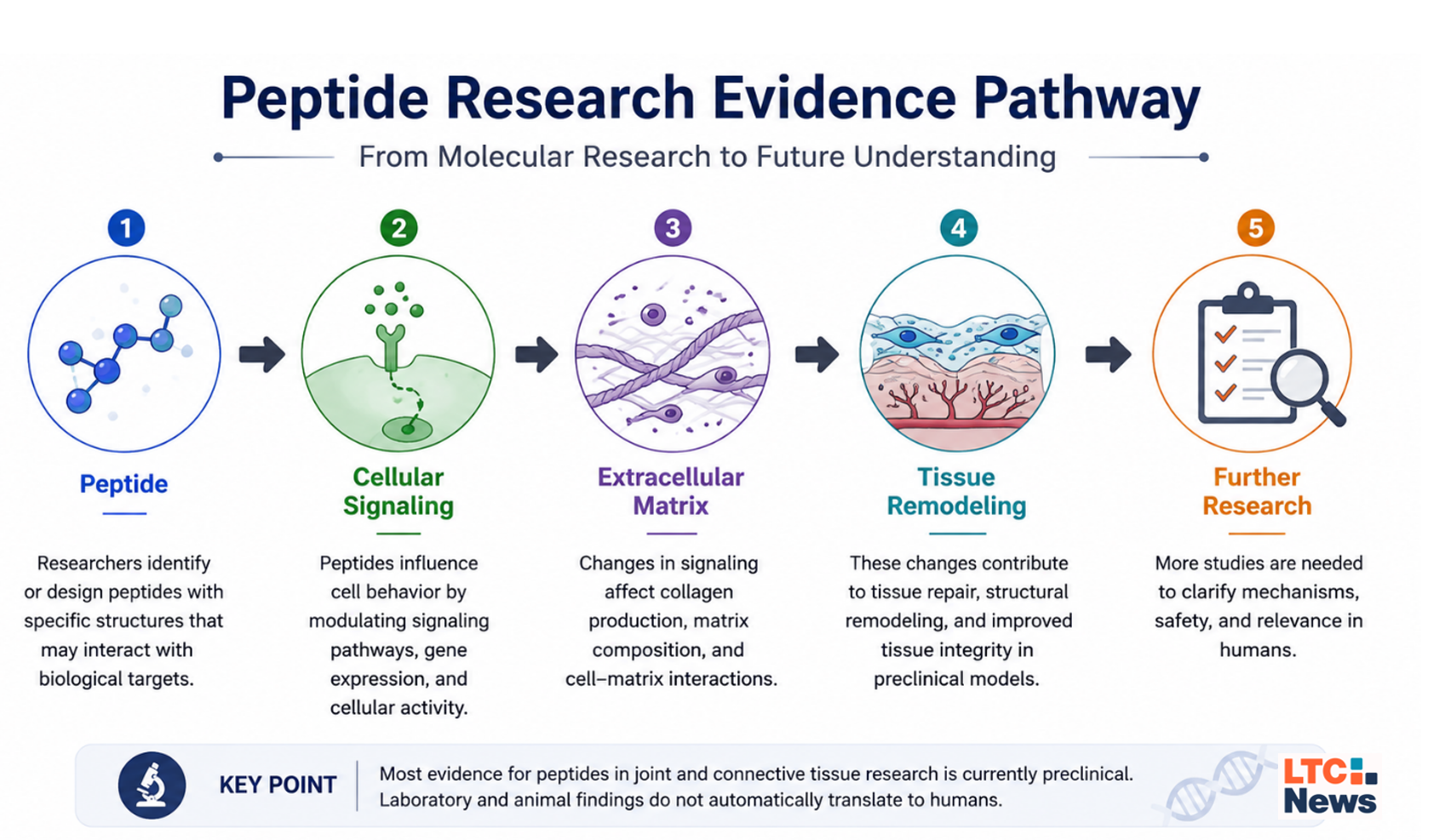
Peptides are short chains of amino acids. They occur naturally throughout the body and perform many biological functions. Different peptides can interact with different signaling pathways. Studies have examined their involvement in cellular migration, inflammatory signaling, the growth of new blood vessels, fibroblast activity, collagen-related processes and extracellular-matrix remodeling.
These processes interest scientists because tendon and ligament remodeling involves cells, collagen fibers, blood vessels, and other parts of the surrounding tissue. So asking whether a peptide can "repair a joint" skips several important steps.
Dr. Thomas Kremen, a sports medicine specialist and associate professor in the department of orthopedic surgery at the David Geffen School of Medicine at UCLA, says that so far, there is a lot of marketing, but very little substance that these peptides are effective.
We found they had some promising but variable effects on tendon, muscle, bone and ligament healing — but those effects may look very different among rodents compared to humans.” — Dr. Thomas Kremen.
The first question is whether a compound actually influences a biological pathway. The much harder question is whether that effect produces a meaningful benefit in people without unacceptable risks.
BPC-157 and Musculoskeletal Research
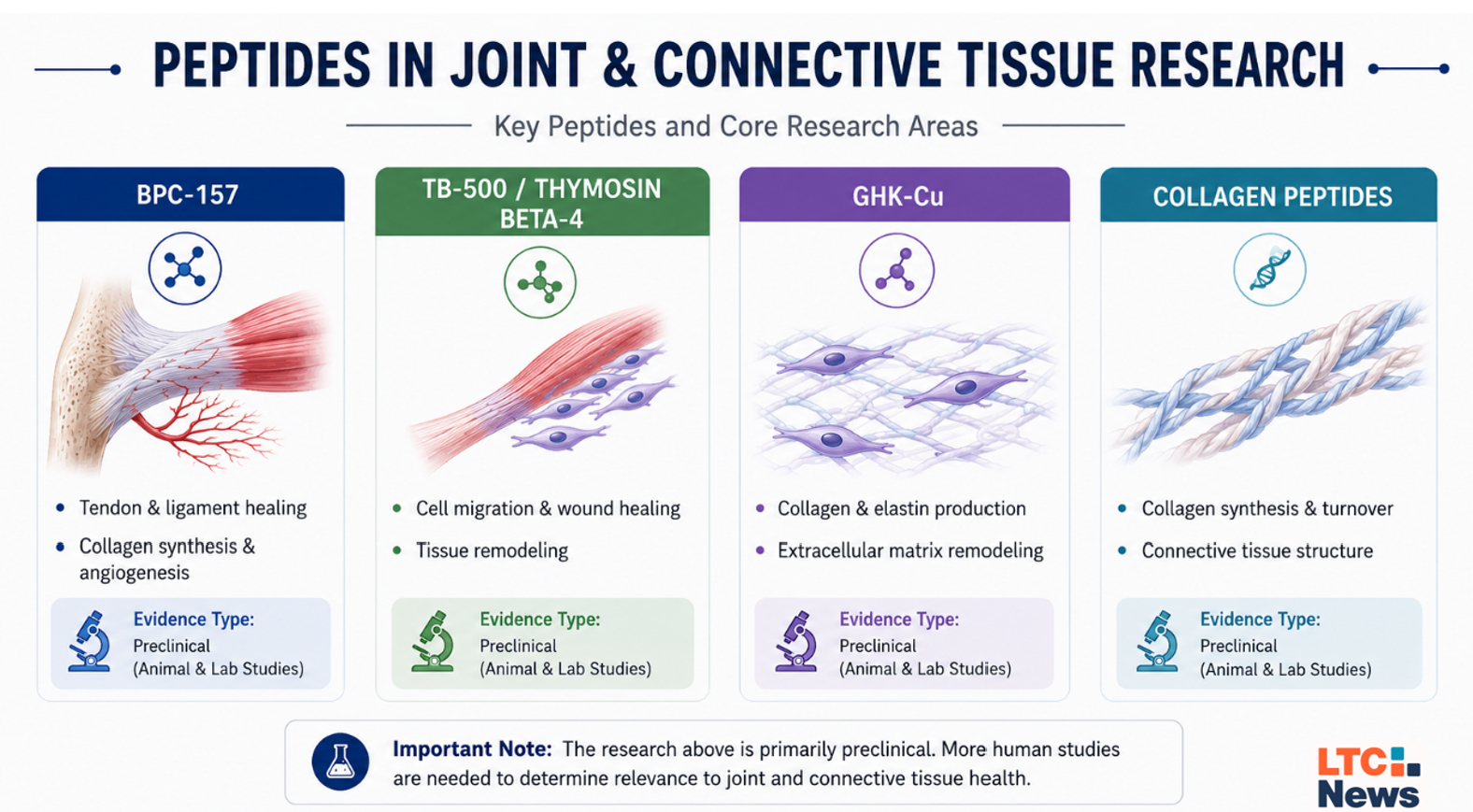
BPC-157 Peptide has become one of the most widely discussed experimental peptides in musculoskeletal research and online conversations about recovery. Laboratory and animal studies have examined BPC-157 in connection with tendon, ligament, muscle and bone injuries. Researchers have investigated potential effects on fibroblasts, vascular signaling, inflammatory pathways, and collagen organization.
Human evidence is far more limited. A 2025 systematic review of BPC-157 in orthopedic sports medicine identified 36 studies. Thirty-five were preclinical, and just one was a small retrospective study involving people. The review also found that clinical safety data remain lacking, leaving major questions about BPC-157's safety in people.
In other words, promising results in an animal tendon model cannot tell us whether BPC-157 will safely repair a human tendon, relieve joint pain, or improve mobility. BPC-157 remains an experimental research subject, not an established treatment for musculoskeletal problems.
TB-500 Is Not the Same as Thymosin Beta-4
TB-500 Peptide is frequently discussed alongside thymosin beta-4, but the two terms should not automatically be used interchangeably. Thymosin beta-4 is a naturally occurring peptide that has been studied in connection with cell migration, the growth of new blood vessels, wound biology, and tissue repair.
A 2026 scoping review examined scientific literature involving thymosin beta-4 and TB-500 in tissue healing, regeneration and musculoskeletal repair. The authors screened 1,772 records and included 80 studies.
Most involved thymosin beta-4 rather than TB-500. Human evidence was concentrated primarily in areas such as ocular and wound or soft-tissue research. Direct evidence involving TB-500 itself was limited to just one included study. Research directly involving tendons, ligaments, muscles, and cartilage was also relatively sparse.
That's important because online discussions can create the impression that a large body of research shows TB-500 repairs tendons or other musculoskeletal tissues. The scientific literature does not currently support such a broad conclusion.
GHK-Cu and the Extracellular Matrix
GHK-Cu Peptide is another peptide-related compound attracting scientific interest. GHK is a naturally occurring tripeptide that can bind copper, forming GHK-Cu. Laboratory studies have examined GHK-Cu in connection with collagen, elastin, glycosaminoglycans, fibroblast activity, and other processes associated with the extracellular matrix.
Those effects help explain interest in GHK-Cu and tissue remodeling. However, much of the research involves skin and wound biology rather than clinical treatment of human joint disease. Results involving one type of tissue cannot automatically be applied to another.
GHK-Cu is better understood as a research subject involving extracellular-matrix and tissue biology than as an established intervention for joint problems.
Collagen Peptides Are a Different Category
Collagen peptides are fundamentally different from experimental compounds such as BPC-157 and TB-500. They are fragments derived from collagen proteins rather than experimental signaling peptides. Collagen is a major structural protein in tendons, ligaments, cartilage, bone, and other connective tissues. Scientists have investigated whether consuming collagen peptides can influence collagen synthesis or adaptations associated with exercise and mechanical loading.
Unlike several experimental peptides discussed in this article, collagen peptides have been studied in human randomized trials. A systematic review published in 2026 evaluated randomized controlled trials involving collagen supplementation and tendon-related structural and performance outcomes. Eight trials involving 257 participants met the review criteria.
There are important limitations. Participants were aged 18 to 52; 246 of the 257 were men, and all studies incorporated resistance or plyometric training. That makes it difficult to know how broadly the findings apply, particularly to older adults.
Some studies found changes in tendon size or mechanical properties, but results varied depending on the study and outcome measured. Differences among the studies were also substantial enough that the authors could not combine the results into a single meta-analysis.
The takeaway is that evidence involving collagen-derived peptides should not be mixed with research on experimental peptides such as BPC-157 or TB-500 simply because all of them may be described as "peptides."
FDA Status and Safety Questions
A peptide can generate plenty of scientific interest without being an FDA-approved treatment. BPC-157 and TB-500 are not FDA-approved treatments for joint pain, tendon or ligament injuries, or age-related mobility problems.
The FDA has also identified potential safety concerns involving some peptide substances proposed for use in compounded drugs. The agency says compounded drugs containing BPC-157 may pose risks involving immunogenicity, an unwanted immune response, as well as challenges involving peptide-related impurities and characterization of the active pharmaceutical ingredient.
The FDA says it has identified no or only limited safety-related information for proposed routes of BPC-157 administration and lacks enough information to determine whether the drug would cause harm when administered to humans.
The agency has raised concerns about a thymosin beta-4 fragment associated with TB-500 as well, including the lack of identified human exposure data and important safety information.
In July 2026, the FDA's Pharmacy Compounding Advisory Committee reviewed BPC-157-related and TB-500-related substances as part of the process for determining whether certain bulk drug substances should be eligible for use in pharmacy compounding under federal law.
This was not an FDA drug-approval review.
Laboratory, Animal and Human Studies Tell Us Different Things
Not all research findings tell us the same thing.
- Laboratory Studies
Laboratory studies can reveal what happens to cells when they're exposed to a compound. Scientists can measure changes in gene expression, collagen production, cellular migration, and signaling pathways.
That's useful for understanding how something might work, but a collection of cells in a laboratory is a long way from a human knee, shoulder or tendon.
- Animal Studies
Animal studies take research a step further because scientists can observe tissue changes in a living system. They can examine collagen organization, blood-vessel changes, tissue structure, and even mechanical strength after an injury.
Dr. Rachel Frank, a professor of orthopedics at the University of Colorado Anschutz School of Medicine, says laboratory and animal research has produced some intriguing findings.
Animal and laboratory studies have suggested that some of these peptides can influence blood vessel formation — which from an injury perspective, can indicate healing — fibroblast activity, collagen production, reduce inflammation, and improve the healing response.” — Dr. Rachel Frank.
These processes interest scientists because tendon and ligament remodeling involves cells, collagen fibers, blood vessels, and other parts of the surrounding tissue. So asking whether a peptide can "repair a joint" skips several important steps.
The first question is whether a compound actually influences a biological pathway. The much harder question is whether that effect produces a meaningful benefit in people without unacceptable risks.
But animals and humans don't always respond the same way. Promising animal findings still need to be tested in people.
- Human Research
Human clinical studies are necessary to determine whether promising laboratory findings translate into meaningful health outcomes.
They also help answer questions that laboratory and animal studies cannot, including side effects, interactions, and short- and long-term safety.
For several experimental peptides discussed in this article, human evidence remains extremely limited. That's why preclinical findings should not be presented as proof that a treatment works.
Peptides, Aging and Maintaining Mobility
This research takes on added importance as we age. Tendons, ligaments and cartilage undergo changes in composition and structure over time. Changes in collagen organization, extracellular-matrix turnover, cellular activity and mechanical properties can all affect how our bodies move.
Mobility matters because it is closely connected with independence. Walking, getting out of a chair, climbing stairs and maintaining balance all depend on a combination of muscle strength, joint function, neurological control and healthy connective tissues.
When mobility becomes significantly impaired, everyday activities can become more difficult, and assistance may eventually be necessary. Maintaining strength, balance and mobility can therefore play an important role in healthy aging and remaining independent.
Research into the biology of aging may eventually provide new ways to prevent or treat some conditions affecting mobility. But finding an age-related biological pathway doesn't mean altering that pathway with an experimental peptide will preserve independence or prevent the need for long-term care.
Those conclusions require evidence from people.
Is There a "Best Peptide" for Joint Pain?
Internet searches for phrases such as "best peptide for joint pain," "peptides for tendon repair," and "peptides for mobility" can make a complicated area of research appear much simpler than it really is.
The evidence tells a different story. BPC-157 has a substantial preclinical literature involving musculoskeletal models, but very little human evidence. Thymosin beta-4 has been studied across several tissue-repair pathways, while direct evidence involving TB-500 remains extremely limited.
GHK-Cu has been investigated in extracellular-matrix and tissue biology, but much of that research does not involve human joint treatment. Collagen peptides belong to a different category and have been evaluated in human randomized trials, although the findings are not uniform.
There is no sound scientific basis for declaring one of these compounds the "best peptide for joint pain." A better question is what was actually studied. Was the research done in cells, animals, or people? How strong is the evidence? And what do we know about safety?
Why Online Peptide Claims Can Get Ahead of the Science
Interest in experimental peptides has grown faster than the human evidence supporting many of the claims made about them.
Statements that a peptide "heals tendons," "regenerates cartilage," "reverses aging," or "repairs joints" may take preliminary laboratory findings and present them as though researchers have demonstrated the same results in people.
That is not how medical evidence works. Consumers should also recognize the difference between a substance being discussed online, offered by a clinic, or sold as a "research" product, and a medication that has gone through the FDA approval process.
Anyone dealing with persistent joint pain, an injury, or declining mobility should discuss the problem with an appropriate health care professional rather than relying on an experimental product promoted online.
What the Research Really Shows
Peptide research may eventually help scientists better understand how tendons, ligaments, cartilage and other connective tissues respond to injury and aging. But the evidence isn't equally strong for every compound.
Human evidence remains particularly limited for experimental peptides such as BPC-157 and TB-500. GHK-Cu research has focused heavily on extracellular-matrix and tissue biology, while collagen peptides have a larger human research base but important limitations of their own.
Laboratory and animal studies can point scientists toward promising ideas. They cannot tell us by themselves whether a compound will safely relieve joint pain, repair a damaged tendon, or improve mobility in people.
For now, that's the most important distinction to remember: interesting science is not the same thing as a proven treatment.
Aging is complicated, and no single treatment is likely to address every challenge that can come with growing older. Peptide research may offer new possibilities in the decades ahead, potentially giving physicians better tools to address some age-related conditions. But even major medical advances won't eliminate every risk involving mobility, chronic illness, cognitive decline, or the need for help with everyday activities.
That's why planning for the consequences of aging remains an important part of retirement planning. Preparing for longer lives means thinking not only about retirement income, but also about future health, housing, caregiving and long-term care needs.
EDITORS NOTE: LTC News reports on emerging health and aging research for educational purposes. Experimental peptides discussed in this article should not be interpreted as recommended treatments. LTC News does not provide peptide dosing, treatment protocols, sourcing information, or personal-use recommendations.
Frequently Asked Questions
Is TB-500 the same thing as thymosin beta-4?
No. They should not automatically be treated as interchangeable. Thymosin beta-4 is a naturally occurring peptide with a broader research literature. A 2026 review found that most studies examined thymosin beta-4, while direct evidence involving TB-500 was very limited.
Should someone use an experimental peptide for joint pain or an injury?
LTC News does not recommend experimental peptide treatments or provide dosing, treatment protocols, or sourcing information. Anyone with persistent joint pain, an injury, or declining mobility should discuss appropriate evaluation and treatment options with a qualified health care professional.
Is BPC-157 FDA approved?
No. BPC-157 is not an FDA-approved treatment for joint pain, tendon or ligament injuries, or mobility problems. Most musculoskeletal research involving BPC-157 has been conducted in laboratory or animal models, and human safety data remain limited.
What is the best peptide for joint pain?
Current evidence does not support naming a "best peptide" for joint pain. The compounds commonly discussed online have very different research histories, and much of the evidence involving experimental peptides comes from laboratory or animal studies rather than human clinical trials.
Why don't animal studies prove that a peptide works in people?
Animal studies can help scientists understand biological mechanisms and observe how tissues respond in a living system. But animals and humans can respond differently to the same substance. Human clinical studies are needed to determine whether a treatment actually provides meaningful benefits and has an acceptable safety profile in people.
Are collagen peptides the same as BPC-157 or TB-500?
No. Collagen peptides are fragments derived from collagen proteins and are a different category from experimental peptides such as BPC-157 and TB-500. Collagen peptides also have a larger body of human research, although that does not mean every claimed benefit has been established.
Can peptides help older adults maintain mobility?
Scientists are studying biological pathways involved in connective tissue, aging, and mobility, but there is not enough evidence to conclude that experimental peptides such as BPC-157 or TB-500 preserve mobility or independence in older adults. Maintaining strength, balance, and overall physical function remains important for healthy aging.
What are peptides?
Peptides are short chains of amino acids. Many occur naturally in the body and help with biological functions and cellular signaling. The term covers a wide range of substances, so two compounds described as peptides may work differently and have very different levels of scientific evidence behind them.
Is TB-500 FDA approved for tendon or joint injuries?
No. TB-500 is not an FDA-approved treatment for tendon injuries, ligament injuries, joint pain or age-related mobility problems. The FDA has also identified important gaps in human exposure and safety information involving the thymosin beta-4 fragment associated with TB-500.
Do collagen peptides help tendons?
Some human studies have reported changes in tendon structure or mechanical properties when collagen supplementation was combined with exercise. However, a 2026 review found important limitations. Participants were ages 18 to 52, nearly all were men, and every study included resistance or plyometric training. More research is needed to determine how broadly the findings apply, especially to older adults.
Has BPC-157 been proven to repair tendons in people?
No. Animal studies have produced findings that have generated scientific interest, but those results do not prove that BPC-157 repairs injured tendons in people. Human clinical evidence remains extremely limited.

Sponsored