Mental Health and Aging: Why Emotional Health Belongs in Every Long-Term Care Plan

About This Article
Mental health conditions such as depression, anxiety, loneliness, and substance use become more common as you age, and they directly affect quality of life and the kind of long-term care you or a loved one will eventually need. An integrated care plan that screens for emotional health alongside physical health leads to safer, more effective outcomes.

Jacob Thomas
Jacob Thomas writes on health, wellness, and retirement topics, including aging, caregiving, insurance, and long-term care.
Table of Contents
- Why Aging and Mental Health Are So Closely Linked
- Loneliness Has Become a Public Health Crisis of Its Own
- Substance Use in Older Adults Is a Growing, Underrecognized Problem
- Caregiver Mental Health Belongs in This Conversation Too
- Depression and Dementia Often Overlap, and That Can Be Confusing
- Home Health and Integrated Care Work Best Together
- What Medicare Covers for Mental Health — and What It Doesn't
- Planning Now Protects More Than Your Finances
- Start the Conversation Early
You probably spend more time thinking about your physical health than your emotional health. You, hopefully, schedule annual physicals, monitor blood pressure, and worry about arthritis, diabetes, or heart disease. But depression, anxiety, grief, loneliness, and substance misuse can have just as much influence on whether you remain independent or eventually need long-term care, and for how long.
Too often, mental health gets treated as a separate issue from long-term care planning instead of a central part of it. Understanding how the two connect can help you and your family build a care plan that actually covers the full picture.
Why Aging and Mental Health Are So Closely Linked
According to the Centers for Disease Control and Prevention (CDC), depression is not a normal part of growing older, though roughly 4 percent of adults age 70 and older live with it. That may sound like a small share, but it still adds up to millions of older Americans, and the CDC notes the condition is frequently missed because symptoms get chalked up to "just getting old" or confused with a physical illness.
When depression goes unrecognized, it does not stay contained. Untreated depression often makes chronic disease harder to manage, increases hospitalization risk, and slows recovery after illness or surgery.
Loneliness Has Become a Public Health Crisis of Its Own
Loneliness deserves its own place in this conversation, not a passing mention. In 2023, U.S. Surgeon General Dr. Vivek Murthy issued a national advisory declaring loneliness and isolation an epidemic, warning that a lack of social connection carries health risks comparable to smoking daily.
The World Health Organization's (WHO) Commission on Social Connection built on that warning in its 2025 report, finding that up to one in three older adults experiences social isolation and that loneliness contributes to an estimated 871,000 deaths worldwide each year. Both reports point to the same conditions: social isolation and loneliness raise the risk of dementia, cardiovascular disease, depression, and premature death.
For older adults living alone, managing a chronic illness, or grieving a spouse, loneliness is not a minor discomfort. It is a measurable risk factor for the very outcomes long-term care planning tries to prevent.
Substance Use in Older Adults Is a Growing, Underrecognized Problem
Alcohol misuse and prescription dependency are both rising among adults over age 50, often tied to chronic pain, loneliness, grief, or depression that was never properly treated. Older adults are especially vulnerable because they are more likely to be managing multiple medications at once, which raises the risk of dangerous interactions between alcohol, opioids, and benzodiazepines.
Older adults also face real obstacles to getting help, including stigma, physical limitations, and a shortage of treatment programs designed with them in mind.
Expanded residential capacity allows us to serve more Idaho adults who need a structured environment for stabilization, clinical support, and long-term recovery planning." — Mallory Harris, executive director of Icarus Wellness and Recovery, an accredited treatment center in Idaho, in an interview with LTC News.
Waiting for a crisis before raising the issue with a doctor rarely leads to a better outcome. A straightforward, caring conversation, started early, is usually enough to open the door.
Caregiver Mental Health Belongs in This Conversation Too
Long-term care planning usually focuses on the person receiving care, but the people providing it are carrying a heavy load of their own. According to AARP and the National Alliance for Caregiving's Caregiving in the U.S. 2025 report, 63 million Americans now provide unpaid care to someone with a health condition or disability, a 45 percent increase over the past decade. The same report found that one in five caregivers rates their own health as fair or poor. Many also report anxiety, depression, interrupted sleep, and financial strain.
We have to stop thinking of family caregivers as an invisible workforce. They are trying to hold the entire long-term care system together, and they're doing it at great personal cost. With the oldest baby boomers turning 80 next year, the need for family caregiving will only intensify in the years ahead." — Rita B. Choula, Senior Director of Caregiving, AARP Public Policy Institute.
Many family caregivers experience anxiety, depression, sleep disruption, and burnout while helping a spouse or parent remain at home. A long-term care plan that only accounts for the care recipient and ignores the caregiver's well-being is an incomplete plan.
Depression and Dementia Often Overlap, and That Can Be Confusing
Depression and dementia are not the same condition, but they frequently show up together, and each can be mistaken for the other. Depression can produce memory and concentration problems that mimic early dementia. It can also develop alongside a dementia diagnosis, and behavioral changes, such as withdrawal, irritability, or agitation, may reflect depression, dementia, or both at once. Distinguishing between the two matters because depression is often treatable, while dementia requires long-term management.
Families and even health care providers sometimes assume mood or memory changes in an older adult are simply dementia progressing, when depression, a treatable condition, is also part of the picture. That is one more reason specialized behavioral health evaluation, not guesswork, should guide care decisions for someone showing cognitive or behavioral changes.
The Alzheimer's Association estimates 7.4 million Americans age 65 and older are living with Alzheimer's disease in 2026, a number projected to reach 13.8 million by 2060. As that population grows, so does the need for care teams who can tell the difference between depression, dementia, and the overlap between them.
Home Health and Integrated Care Work Best Together
Physical and mental health care stop being separate tracks at a certain point. An older adult living with dementia needs consistent medical supervision and emotional support at the same time, and no single provider covers both on their own.
Older adults often benefit from coordinated care involving physicians, skilled nurses, behavioral health professionals, therapists, and social workers. When those providers communicate with one another, problems are more likely to be recognized early and treated appropriately. For seniors who are not ready for a move to a residential facility, that kind of integrated, in-home approach can ease both the physical and emotional weight of the transition.
Questions to Ask Before Choosing Long-Term Care for Someone With Mental Health Needs
If you are evaluating a facility or home care agency for yourself or a loved one dealing with depression, anxiety, or a dementia-related behavioral condition, ask:
- How are depression and anxiety screened, and how often?
- Who manages psychiatric medications, and how closely are they monitored?
- How are behavioral changes communicated to families?
- Are counselors or social workers available on-site or by referral?
- Does the facility or agency have specific expertise in dementia-related behavioral symptoms?
- How are family caregivers included in care planning and updates?
You can compare providers and search for options with this level of expertise through the LTC News Caregiver Directory.
What Medicare Covers for Mental Health — and What It Doesn't
Medicare covers many medically necessary mental health and substance use disorder services (as does traditional health insurance), helping millions of older adults receive treatment for conditions such as depression, anxiety, and alcohol or prescription drug misuse. Medicare Part B generally pays for outpatient behavioral health services, including visits with psychiatrists, psychologists, clinical social workers, and other qualified mental health professionals.
Covered services also include depression screenings, diagnostic evaluations, medication management, individual and group therapy, and many substance use disorder treatments, including counseling and medication-assisted treatment when appropriate. Medicare Part A covers inpatient psychiatric and general hospital stays when medically necessary and program requirements are met. Many behavioral health services are also available through Medicare-approved telehealth programs, depending on current Medicare rules and provider participation.
Those benefits are important, but they should not be confused with Medicare's long-term care coverage. While Medicare helps pay for treatment of mental health and substance use disorders, it generally does not pay for ongoing custodial long-term care, or ongoing skills services beyond 100 days. Custodial care is extended assistance with everyday activities such as bathing, dressing, eating, using the toilet, transferring, or ongoing supervision because of severe cognitive impairment.
If an older adult eventually needs long-term support at home, in assisted living, memory care, or a nursing home, families often must rely on personal savings, Qualified Long-Term Care Insurance, or Medicaid for those who qualify due to limited financial resources. Planning gives families more choices and helps ensure both physical and emotional health needs can be addressed if long-term care becomes necessary.
Important: Mental health conditions alone generally do not qualify someone for Qualified Long-Term Care Insurance benefits. Eligibility is typically based on needing substantial assistance with at least two of the six activities of daily living or requiring substantial supervision because of severe cognitive impairment, regardless of the underlying medical diagnosis.
If a loved one is suffering from mental health challenges and has an LTC policy, you can get expert help in processing a Long-Term Care Insurance claim. LTC News partners with Amada Senior Care to provide free claim support with no cost or obligation. — File a Long-Term Care Insurance Claim.
Planning Now Protects More Than Your Finances
Long-term care planning is usually framed around cost, and the numbers matter. Federal data show that 56 percent of Americans turning 65 will need some level of long-term care, defined as needing help with at least two of six activities of daily living or supervision due to cognitive impairment. But cost is only part of the equation. A plan that ignores emotional health leaves real gaps, and in some cases, real safety risks at home.
Understanding your options for planning—from Long-Term Care Insurance to home care, assisted living, memory care, and skilled nursing—gives you and your family more control over future care decisions, including those for mental health. You can use the resources available on LTC News to help you and your family.
Start the Conversation Early
Mental health is a core part of healthy aging, and it belongs in every long-term care conversation, not a side note. Whether you are planning for yourself or a parent, understanding how emotional well-being, loneliness, and caregiver stress tie into physical health puts you in a stronger position to ask the right questions and get the right support.
Question: Have you talked with your family about how mental health fits into your life and long-term care plan? It is a conversation worth having before a crisis forces it.
This article is for informational purposes only and is not a substitute for medical advice. Speak with a qualified health care provider about your specific situation.
Frequently Asked Questions
Why is loneliness considered a health risk for older adults?
Loneliness is more than an emotional issue. Research has linked prolonged social isolation to an increased risk of depression, dementia, cardiovascular disease, and premature death. Older adults who live alone, have lost a spouse, or are managing chronic illness may be especially vulnerable, making social connection an important part of healthy aging and long-term care planning.
When should families start talking about mental health and long-term care?
The best time is before a health crisis occurs. Early conversations allow families to discuss care preferences, evaluate financial options, consider Long-Term Care Insurance, identify local care providers, and create a plan that addresses both physical and emotional health needs. Planning ahead provides more choices and reduces stress when care becomes necessary.
Are substance use disorders common among older adults?
They are becoming more common. Alcohol misuse and dependence on prescription medications, including opioids and benzodiazepines, can affect older adults dealing with chronic pain, grief, loneliness, or depression because aging changes how the body processes medications and alcohol; the risk of serious drug interactions and complications increases.
Is depression a normal part of aging?
No. While depression becomes more common among older adults, it is not a normal part of growing older. Depression is a treatable medical condition that can affect physical health, recovery from illness, and the ability to live independently. If symptoms such as persistent sadness, loss of interest, changes in sleep, or withdrawal from family and friends last more than a few weeks, they should be discussed with a physician or mental health professional.
Does Medicare pay for long-term care related to mental health?
Generally, no. Medicare pays for medically necessary treatment but does not cover ongoing custodial long-term care. If someone needs extended help with activities of daily living, supervision because of severe cognitive impairment, or long-term support at home, in assisted living, memory care, or a nursing home, those services are generally not covered by Medicare beyond limited skilled care benefits.
Does Medicare cover mental health care?
Yes. Medicare covers many medically necessary mental health and substance use disorder services, including outpatient visits with qualified behavioral health professionals, depression screenings, therapy, medication management, inpatient psychiatric care when medically necessary, and many substance use treatments. Many behavioral health services are also available through Medicare-approved telehealth programs, depending on current Medicare rules.
How does mental health affect long-term care needs?
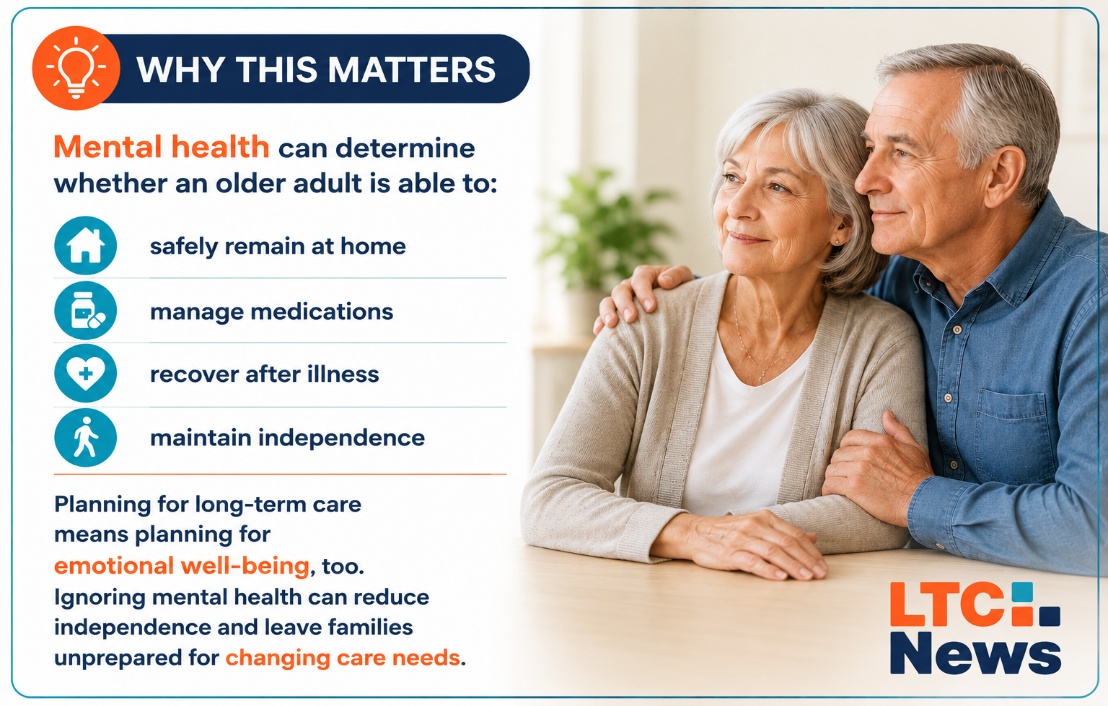
Mental health can influence whether an older adult is able to remain safely at home, manage medications, recover from illness, or maintain independence. Conditions such as depression, anxiety, dementia, loneliness, and substance misuse can increase the need for home care, assisted living, memory care, or nursing home services if they are left untreated.
Can depression and dementia look alike?
Yes. Depression can cause memory problems, poor concentration, confusion, and withdrawal that may resemble early dementia. It is also possible for someone to have both depression and dementia at the same time. Because depression is often treatable, a thorough medical and behavioral health evaluation is essential before assuming memory changes are caused only by dementia.
What should families ask when choosing a long-term care provider for someone with mental health needs?
Ask whether the provider routinely screens for depression and anxiety, how psychiatric medications are managed, whether counselors or behavioral health specialists are available, how behavioral changes are communicated to families, and whether the organization has experience caring for people with dementia-related behavioral symptoms. Coordinated care among physicians, nurses, therapists, social workers, and behavioral health professionals often leads to better outcomes.
Does Long-Term Care Insurance cover mental health conditions?
Mental health conditions by themselves generally do not trigger Qualified Long-Term Care Insurance benefits. Most policies pay benefits when the insured requires substantial assistance with at least two of the six activities of daily living or requires substantial supervision because of severe cognitive impairment. Once benefit eligibility is met, many policies can help pay for covered care provided at home, in assisted living, memory care, or in a nursing home, regardless of the medical condition that created the need for care.
Why should caregivers pay attention to their own mental health?
Family caregivers often experience stress, anxiety, depression, interrupted sleep, and financial strain while caring for a spouse, parent, or other loved one. Taking care of your own emotional and physical health helps you provide better care and reduces the risk of caregiver burnout. A comprehensive long-term care plan should consider the needs of both the care recipient and the caregiver.

Sponsored