Medical Flights for Older Adults: Air Ambulance Arranging, Costs, Medicare Rules and Planning

About This Article
An air ambulance, or medical flight, transports patients who cannot safely travel by commercial airline or car because of serious illness, injury, or medical instability. Older adults may require medical flights after strokes, surgeries, falls, or during transfers to specialized hospitals, rehabilitation centers, or long-term care facilities.

Jacob Thomas
Jacob Thomas writes on health, wellness, and retirement topics, including aging, caregiving, insurance, and long-term care.
Table of Contents
- Why Older Adults Increasingly Need Medical Flights
- What Is an Air Ambulance or Medical Flight?
- When Older Adults May Need Medical Air Transport
- Emotional and Financial Stress of Medical Flights
- How Air Ambulance and Medical Flight Services Work
- How Much Does an Air Ambulance Cost?
- Well-Known Medical Flight and Air Ambulance Providers
- What Families Should Compare Before Choosing a Provider
- How To Arrange a Medical Flight for a Loved One
- Does Medicare Cover Medical Flights?
- Can You Buy Insurance or Membership Coverage for Medical Flights?
- Medical Flights and Dementia Patients
- Why Long-Term Care Planning Still Matters
- How To Prepare for a Medical Flight Before a Crisis Happens
You may spend years helping an aging parent remain independent, only to discover during a medical crisis that the right hospital, rehabilitation center or specialist is hundreds of miles away. When that happens, it makes an already difficult situation into a bigger crisis.
Families often focus first on the diagnosis. Then comes another difficult realization: getting a medically fragile loved one safely from one place to another may require medical care during the journey itself.
For older adults recovering from strokes, heart problems, major surgery, or severe illness, commercial flights may not be safe. Long car rides can create additional health risks. Some patients require oxygen, cardiac monitoring or skilled medical supervision throughout travel.
That is where medical flights become part of the conversation. Air ambulances and patient transport flights help move older adults safely between hospitals, rehabilitation facilities, assisted living communities, and home settings. While many people associate air ambulances with dramatic emergencies, these services are increasingly used following hospitalization, illness, or relocation closer to family caregivers.
As America ages and healthcare becomes more specialized, families are confronting difficult questions about how to safely transport loved ones during medical crises.
Why Older Adults Increasingly Need Medical Flights
The healthcare system has changed dramatically over the past two decades. Many community hospitals no longer provide advanced neurological, trauma or cardiac care. Patients are often transferred to larger regional medical centers with specialized expertise, sometimes hundreds of miles away.
Older adults are also living longer with chronic illnesses, mobility limitations and cognitive decline that can make traditional travel unsafe after hospitalization.
According to the Alzheimer's Association's 2026 Alzheimer's Disease Facts and Figures report, an estimated 7.4 million Americans age 65 and older are living with Alzheimer's disease. The organization projects that the number could reach 13.8 million by 2060. As care needs increase, families often relocate loved ones with dementia closer to adult children or specialized memory care communities — sometimes across state lines — making medical air transport an increasingly common part of that transition.
Many air ambulance flights can be arranged after strokes, cardiac emergencies, serious falls, respiratory illness, or complications following surgery. Others involve older adults with dementia relocating closer to family caregivers or specialized rehabilitation facilities.
What Is an Air Ambulance or Medical Flight?
A medical flight is specialized air transportation for patients who cannot safely travel on a commercial airline or by long-distance ground transport. Aeromedical transportation includes any fixed-wing or rotor-wing aircraft used for patient treatment and transport, and typically serves acute cardiac, neurologic, or vascular emergencies, as well as patients requiring intensive care during transport.
Unlike standard flights, medical aircraft function as flying intensive care units, equipped with advanced healthcare equipment and staffed by trained medical professionals. Equipment can include ventilators, medications, electrocardiographs, cardiopulmonary resuscitation equipment, and stretchers, so that care may be rendered during the flight.
Staffing typically includes paramedics, emergency medical technicians, and, in some cases, physicians and nurses — the number and type of staff varying by patient condition.
Key Note: Medical transport aircraft aren't simply planes with a stretcher. They're configured to deliver the same level of monitoring and intervention a patient would receive in a hospital ICU, which is critical when time and distance stand between a patient and the care they need.
Some aircraft are equipped to provide critical-care monitoring and advanced medical support during transport. Others are designed for stable patients who still require medical oversight while traveling between healthcare facilities or returning home after treatment.
The level of care depends on the patient’s medical condition and the physician's recommendations.
When Older Adults May Need Medical Air Transport
For many families, the conversation begins unexpectedly.
A parent suffers a stroke while visiting another state. A spouse experiences complications after surgery far from home. An older adult spending the winter in Florida suddenly needs rehabilitation closer to family in the Midwest or Northeast.
Hospital discharge planners and physicians often help determine whether air medical transport is appropriate.
Patients may require medical flights when long-distance driving is unsafe, continuous oxygen or monitoring is necessary, or rapid transfer to a specialty medical center is required. Cognitive impairment, mobility limitations, and medical instability can also make commercial travel unsafe.
In some cases, families arrange medical transport to relocate aging parents closer to adult children after a serious health event.
That situation is becoming increasingly common as caregiving responsibilities grow nationwide.
According to AARP and the National Alliance for Caregiving’s Caregiving in the U.S. 2025 report, millions of Americans provide unpaid care for aging relatives while balancing careers, children and their own health concerns.
Caregiving experts say families often make transportation decisions during emotionally overwhelming situations with little time to research options or compare providers. Aging experts recommend discussing transportation preferences, hospital choices and long-term care plans before a medical emergency occurs.
Emotional and Financial Stress of Medical Flights
Medical transport decisions often happen during some of the most stressful moments a family will experience. Adult children may already be coordinating hospital updates, insurance questions, legal paperwork, and future care planning. Suddenly, they are also expected to evaluate air ambulance providers, understand medical risks and manage potentially significant expenses.
The pressure can intensify when relatives live in different states or disagree about care decisions. The CDC declared caregiving an “important public health issue” in a 2018 report detailing the prevalence of unpaid caregiving and the health issues facing caregivers, including stress, lack of sleep, and high rates of chronic illness.
One of the biggest issues is the lack of coordination that we see between medical care, long-term services and supports, and family caregivers, and it's usually the family caregiver that's tying all the knots together and making all the pieces fit together. — Dr. Chanee Fabius, Assistant Professor, Department of Health Policy and Management, Johns Hopkins Bloomberg School of Public Health, quoted in Caregivers: Health Care’s Hidden Workforce.
Families caring for loved ones with dementia face additional emotional strain. Watching a parent become frightened, confused, or disoriented during transport can be heartbreaking, especially during an already difficult medical crisis.
Experts recommend identifying one primary family contact to coordinate communication with hospitals, transport providers and receiving facilities. That can reduce confusion and help prevent conflicting information during fast-moving situations.
How Air Ambulance and Medical Flight Services Work
Most air medical transport companies coordinate the process from beginning to end.
That usually includes communication with:
- The sending hospital
- Physicians and nursing staff
- Ground ambulance providers
- The receiving healthcare facility
- Insurance providers, when applicable
The transport company also determines what level of medical support the patient requires during travel.
For example, a stable rehabilitation patient may require only oxygen support and nursing supervision, while a critically ill patient may need advanced cardiac monitoring or respiratory care throughout the flight. Weather conditions, airport access, and medical timing also influence scheduling.
Some providers can mobilize flights within hours during emergencies, while planned medical transfers may take longer to arrange.
How Much Does an Air Ambulance Cost?
Cost is one of the biggest concerns families face when considering medical transport.
Air ambulance pricing varies widely depending on:
- Distance traveled
- Aircraft type
- Medical staffing needs
- Ground ambulance coordination
- Specialized medical equipment
- Domestic versus international travel
Cross-country flights involving advanced medical support are typically far more expensive than shorter regional transfers. Interstate transfers and international medical repatriation flights are often among the most expensive transport situations families encounter.
Consumer advocacy groups and healthcare researchers have warned that air ambulance billing can expose families to major out-of-network costs because many providers operate outside traditional insurance networks.
The federal No Surprises Act now provides some protections against unexpected air ambulance billing for privately insured patients, although coverage limitations and disputes still occur. Families should request written cost estimates whenever possible and carefully review insurance policies before transport.
Well-Known Medical Flight and Air Ambulance Providers
Families researching air ambulance services may encounter dozens of regional and national providers. The right choice depends on the patient’s medical condition, travel distance, aircraft availability, and insurance considerations.
Experts recommend looking for companies with experienced medical crews, clear pricing policies, and accreditation through organizations such as the Commission on Accreditation of Medical Transport Systems (CAMTS).
Here are several well-known providers families often research when comparing air medical transport options.
AirCARE1
AirCARE1 operates medical transport aircraft for domestic and international patient transport. According to the company, its services include transportation coordination, ground transportation arrangements, and communication with healthcare facilities. AirCARE1 also states that it maintains CAMTS accreditation and offers 24/7 flight coordination services.
AeroCare Medical Transport System
AeroCare Medical Transport System provides domestic and international medical transportation services for patients requiring varying levels of medical support during travel. The provider says it assists families with transport coordination, insurance communication, and medical travel planning.
REVA Air Ambulance
REVA Air Ambulance is an international medical transport provider that coordinates both emergency and non-emergency patient flights. According to the company, its services include long-distance and international medical transport for patients requiring medical supervision during travel.
What Families Should Compare Before Choosing a Provider
Families should compare medical crew qualifications, accreditation status, aircraft capabilities, and pricing transparency before selecting a provider. It is also important to ask whether the company has experience transporting older adults with dementia, mobility limitations, or chronic illnesses.
Additional questions families should ask include:
- Does the company coordinate with insurance providers?
- Are ground transportation services included?
- Is international transport available if needed?
- How will the family receive updates during transport?
Experts say families should also be cautious about providers who demand large upfront payments before clearly explaining medical capabilities, insurance coordination, or transport details.
How To Arrange a Medical Flight for a Loved One
Arranging a medical flight can feel overwhelming, especially when you are already managing a health crisis. The good news is that reputable air ambulance companies handle most of the logistics — but families who understand the process move faster and make better decisions.
Here is what the process typically looks like from the moment a need is identified.
Start with the physician or hospital discharge planner
The process almost always begins at the bedside. Your loved one's attending physician or the hospital's case manager is the right first call. They can assess whether air transport is medically appropriate, prepare the clinical documentation the transport company will need, and in many cases recommend or directly coordinate with transport providers.
Do not try to arrange a flight independently before the medical team has weighed in. Transport companies require physician sign-off before any flight can be confirmed.
Contact air ambulance providers and request quotes
Once you have medical clearance, contact two or three CAMTS-accredited providers to compare services and pricing. Most operate 24 hours a day, seven days a week for both emergency and planned transfers.
When you call, be prepared to provide:
- The patient's current location and destination
- A summary of the medical condition and current medications
- The level of care required during flight (oxygen, ventilator support, cardiac monitoring, etc.)
- Insurance information
- Preferred timing if non-emergency
Reputable providers will conduct their own medical review before confirming the transport. Be cautious of any company that quotes a price without first reviewing the patient's clinical situation.
Verify insurance benefits before signing anything
Before authorizing transport, contact your insurance provider to determine what is covered and whether pre-authorization is required. Many policies require pre-authorization for non-emergency medical flights, and missing that step can result in a denied claim.
Ask the transport company directly whether they will coordinate with your insurer. Many established providers handle this on your behalf. Get all cost estimates in writing.
Gather the medical records
The transport team needs clinical documentation to prepare the aircraft, staff the crew appropriately and brief the receiving facility. Work with the sending hospital to have the following ready:
- Recent physician notes and hospital records
- Current medication list and dosing schedules
- Imaging results (X-rays, CT scans, MRI reports)
- Advance directives or power of attorney documents
- Contact information for both the sending and receiving medical teams
Having these organized in advance can shorten the time between approval and departure significantly.
Confirm the receiving facility is ready
The transport company will typically coordinate directly with the destination hospital or care facility, but families should verify independently that the receiving location has a bed confirmed, is aware of the patient's condition and has the appropriate specialty care available upon arrival. Do not assume that because transport is arranged, the destination is prepared.
Assign one family point of contact
With multiple providers, facilities and family members involved, confusion is common. Designate one person — ideally the individual with medical power of attorney — to serve as the primary communicator with the transport company, the sending hospital and the receiving facility. That person should be reachable by phone throughout the transport day.
Prepare for transport day
On the day of the flight, the medical crew will typically handle the physical transfer from the hospital room to the aircraft and from the aircraft to the receiving facility — what the industry refers to as bedside-to-bedside transport. A family member may be permitted to accompany the patient depending on the aircraft configuration and the patient's medical needs. Confirm this in advance.
Bring personal items the patient may need immediately upon arrival, including medications not being administered during flight, identification documents and insurance cards.
What to do if it is a true emergency
If your loved one is experiencing a life-threatening emergency, call 911 first. Emergency ground transport and local emergency departments stabilize the patient before any long-distance transfer is arranged. Air ambulance companies can mobilize quickly once a patient is stable enough for transport, some within a matter of hours, but emergency air transport is almost never the first step in a crisis.
Does Medicare Cover Medical Flights?
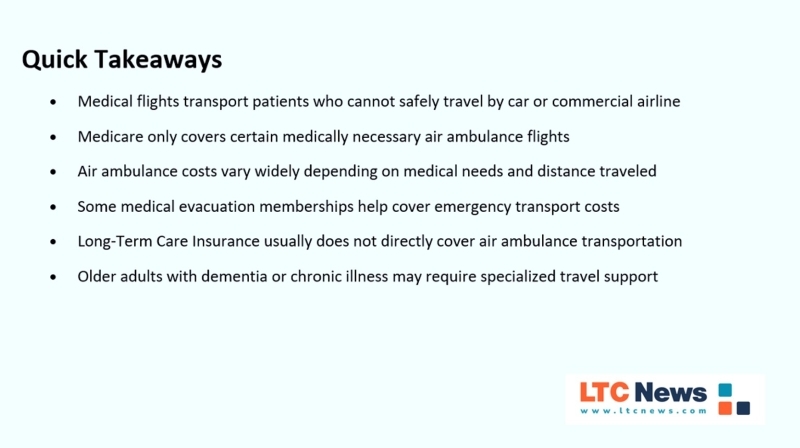
Medicare coverage for air ambulance transportation is limited. The Centers for Medicare & Medicaid Services (CMS) states that Medicare generally covers air ambulance transportation only when rapid transport is medically necessary, and ground transportation could endanger the patient’s health.
Coverage typically applies when a patient must quickly reach a hospital with appropriate medical facilities unavailable locally. Non-emergency flights, relocation transport and transportation arranged primarily for family convenience are often not covered.
Families can review current Medicare ambulance coverage rules directly through Medicare.gov Ambulance Services Coverage.
Can You Buy Insurance or Membership Coverage for Medical Flights?
Many older adults assume Medicare or standard health insurance automatically covers emergency medical flights. That is not always true, particularly for interstate transfers, non-emergency relocations or transportation back home after hospitalization. That has led to growing interest in medical evacuation memberships and supplemental transport programs.
These programs are not Long-Term Care Insurance policies, nor are they traditional health insurance. Instead, they function more like emergency transportation memberships designed to assist during medical travel emergencies.
Some programs help arrange and pay for:
- Emergency air evacuation
- Transportation to a hospital closer to home
- International medical repatriation
- Coordination with medical facilities
- Travel assistance services
Companies such as Medjet and Global Rescue offer these types of services.
Coverage limitations vary significantly. Some plans exclude pre-existing conditions, non-emergency relocations or long-term care transfers. Others only activate when travelers are a certain distance from home. Families should carefully review membership contracts before purchasing any program.
For retirees who travel frequently, maintain homes in multiple states or spend time abroad, these programs may provide additional peace of mind.
Medical Flights and Dementia Patients
Transporting someone with dementia requires additional planning and sensitivity. Unfamiliar environments, loud noises, disrupted routines, and medical stress can increase confusion, agitation, and anxiety.
Families should discuss behavioral concerns with the transport provider beforehand, including wandering risks, communication difficulties, medication schedules and mobility limitations.
Experienced medical crews often use calming communication techniques and structured routines to reduce distress during travel.
For some families, the medical flight itself becomes part of a larger transition into assisted living, memory care, or long-term care closer to family support systems.
Families dealing with dementia-related care transitions can also explore resources through the LTC News Caregiver Directory and Long-Term Care Learning Center.
Why Long-Term Care Planning Still Matters
Medical flights solve an immediate transportation problem, but they do not address the long-term realities many families face after a serious illness or injury. After hospitalization or medical transfer, older adults may require ongoing help with daily living activities, supervision, rehabilitation, or dementia support.
That is where long-term care planning becomes critical. Most Long-Term Care Insurance policies do not directly cover air ambulance transportation unless it is specifically included as a supplemental benefit. However, LTC Insurance may help pay for care services following a medical transfer, especially with cash plans that pay the full benefit in cash, allowing you to allocate the money as you see fit once you qualify for benefits.
Depending on the policy, benefits may help cover:
- Home healthcare
- Assisted living
- Memory care
- Skilled nursing care
How To Prepare for a Medical Flight Before a Crisis Happens
One of the most important things families can do is discuss healthcare and transportation preferences before an emergency occurs.
Important conversations should include:
- Preferred hospitals and specialists
- Insurance coverage details
- Emergency contacts
- Healthcare proxies and advance directives
- Relocation preferences
- Long-term care wishes
Families rarely have time to calmly research air medical transport during a stroke, fall, or sudden hospitalization. Planning ahead can help you make clearer decisions during a medical emergency while protecting both your loved one’s safety and your family’s financial stability.
Frequently Asked Questions
Can someone with dementia travel on a medical flight?
Yes. Medical transport providers frequently assist dementia patients during relocations, hospital transfers, and emergency situations. Families should discuss behavioral concerns, medication schedules, and mobility limitations with the provider before travel.
Are medical evacuation memberships worth it for retirees?
For retirees who travel frequently, maintain homes in multiple states or spend time abroad, medical evacuation memberships may provide added peace of mind. However, coverage limitations vary significantly, and families should carefully review contract details before purchasing a plan.
What is the difference between a medical escort and an air ambulance?
Medical escorts accompany stable patients on commercial flights. Air ambulances use specially equipped aircraft designed to provide medical monitoring and treatment during transport.
Are medical flights safe for older adults?
Medical flights are specifically designed for medically fragile patients. Aircraft are equipped with advanced medical equipment, and trained medical professionals monitor patients throughout transport.
Does Medicare pay for air ambulance transportation?
Medicare may cover emergency air ambulance transportation when rapid transport is medically necessary, and ground transportation could endanger the patient’s health. Coverage is generally limited to situations where a patient must quickly reach a hospital with appropriate medical facilities unavailable locally.
When should families begin planning for medical transport?
Experts recommend discussing transportation preferences, hospital choices, insurance coverage, and long-term care plans before a medical emergency occurs. Planning ahead can reduce stress and confusion during a crisis.
Can a family member accompany the patient?
Many air ambulance providers allow one companion onboard, depending on the aircraft size, medical equipment requirements, and patient condition.
Does Long-Term Care Insurance pay for medical flights?
Most Long-Term Care Insurance policies do not directly cover air ambulance transportation unless it is included through supplemental benefits. However, LTC Insurance may help pay for home healthcare, assisted living, memory care, or nursing care after a medical transfer.
What should families look for in an air ambulance provider?
Families should compare medical crew qualifications, accreditation status, pricing transparency, insurance coordination services, and experience transporting older adults with chronic illness or dementia.
How much does an air ambulance flight cost?
Air ambulance costs vary widely depending on distance traveled, aircraft type, medical staffing needs, and whether the transport is domestic or international. Interstate and international medical repatriation flights are often among the most expensive situations families encounter.

Sponsored
