Look Beyond Taxes Before You Move After Retirement

About This Article
A lower tax bill doesn’t guarantee a lowercost retirement. What you’ll actually spend depends far more on the community itself; its housing prices, insurance costs, and what you’ll pay for home care, assisted living, or nursing care if you ever need it. Taxes matter, but they’re only one small piece of the real cost of aging in a specific place.

Anna Marino
Anna Marino is a seasoned writer specializing in topics related to family, aging, and lifestyle in retirement. She shares advice on intergenerational relationships and strategies for enjoying retirement.
Table of Contents
- What Should You Compare Before Moving for Retirement?
- Compare Real Costs, Not Promotional Rankings
- Test the Location Against a Less Independent Future
- State Taxes Tell Only Part of the Story
- Where an Income-Tax Win Can Leak Back Out
- Availability of Quality Long-Term Care Matters
- Don't Forget Long-Term Care Insurance
- Consider the Real Cost of Family Support
- Your Estate Plan Follows State Law, Not You
- Have an Attorney in Your New State Read the Whole Package
- Update the People and Institutions That May Need the Documents
- Compare the Numbers Before You Move
You've picked a new town, maybe a smaller house, maybe a warmer winter. What you may not have planned yet is everything else that should change along with your address. Not to say that taxes don't matter; they absolutely do, but they're just one part of the equation when considering relocating for retirement.
A state with low or even no income tax may have higher property taxes, insurance costs, housing prices, or long-term care expenses that offset much of the savings. Likewise, a higher-tax state may provide better access to healthcare, transportation, family support, or other services that become increasingly important as you age.
The goal isn't to find the state with the lowest taxes. It's to find the community that gives you the best overall financial and quality-of-life outcome throughout retirement.

What Should You Compare Before Moving for Retirement?
Choosing where to retire involves much more than finding lower taxes or a warmer climate. The community you select can influence your healthcare options, long-term financial security, access to services, and quality of life for decades.
Before making a final decision, compare the overall cost of living, the availability of healthcare and long-term care services, and whether the area can continue to meet your needs if your health changes later in retirement.
Before relocating, compare:
- Housing costs
- State and local taxes
- Homeowners and auto insurance costs
- Access to physicians, hospitals, and specialists
- Long-term care costs
- Availability of home care providers
- Assisted living and memory care options
- Family support and proximity to loved ones
- Transportation and community services
- Estate planning requirements and state laws
- Long-Term Care Insurance policies (or options) and how existing coverage fits your relocation plans

Compare Real Costs, Not Promotional Rankings
Retirement rankings blend statewide averages into a single score, and you won't live in a statewide average. You'll live in one county and one ZIP code, where the property tax bill and the insurance premium can look nothing like the state figure the ranking used.
What matters is your annual after-tax cash flow plus the realistic price of buying support later. Run that comparison with the same household profile in every town you're considering. Hold your income and filing status steady, and withdraw the same amount from your retirement accounts in each scenario. One profile, several towns.
County-level and metro-level housing data from the Census Bureau's American Community Survey gives you a better starting number than a state median.
Test the Location Against a Less Independent Future
Score each candidate town twice. First under current conditions, while you drive and handle the house yourself. Then under a plausible later scenario in which you no longer drive, need paid help several days a week, and find that the specialist you depend on practices 90 minutes from your new front door.
A location stays workable only when the services you rely on remain reachable after your mobility or health changes. That doesn't mean planning for a nursing home. Plenty of people never need facility care and instead need a few hours of help at home each day plus a dependable ride to appointments.
Ask the county what public or volunteer transportation exists for adults who have stopped driving, and find out which hospital would take you. The Eldercare Locator, a public service of the Administration for Community Living, connects you with the Area Agency on Aging for that specific county, including local meal programs and transportation options. Talk with your doctors about current or anticipated extended care needs before you move away from the people who already know your history.
NOTE: The cost of long-term care services varies on several factors, including location. The LTC News Cost of Long-Term Care Services Calculator can show you the current and projected cost of extended care services based on your ZIP code. You can search for caregivers and long-term care facilities with the LTC Caregiver Directory.
State Taxes Tell Only Part of the Story
States don't tax retirement money as a single category. Look up each stream separately in the guidance published by your candidate state's own department of revenue or taxation:
- Social Security benefits
- Traditional pension income
- IRA and 401(k) withdrawals
- Employment or self-employment income
- Investment income, including capital gains
Tracking which states tax Social Security can be complicated. Bogart Wealth tracks it in their state-by-state accounting of what states tax Social Security.
Keep the federal question separate from the state one, because conflating the two is the most common mistake in this comparison. The IRS explains that Social Security benefits may be taxable once combined income clears base amounts written into federal law: $25,000 for single filers and $32,000 for married couples filing jointly. Combined income generally means your adjusted gross income plus nontaxable interest plus half of your Social Security benefits, and those base amounts are not indexed for inflation, so ordinary cost-of-living raises can pull a benefit into taxable territory that wasn't taxable a few years earlier.
REVIEW:"Must I Pay Taxes on Social Security Benefits?"
Where an Income-Tax Win Can Leak Back Out
A household can save on income tax and lose the savings elsewhere. Picture a hypothetical couple whose move trims their state income tax by $2,400 a year, then hands them a county assessor's bill $1,100 higher on a comparable house and an insurance quote $1,900 higher because of wind exposure. Their new neighborhood has no transit, so they keep the second car they had planned to sell. The move cost them money. Every figure in that example is hypothetical, meant only to show the arithmetic. Your real numbers come from the county assessor and from an insurance quote written for the specific address you're considering. Sales tax belongs in the same column, since counties and cities frequently stack their own rate on top of the state's.
A tax-friendly move works only when the recurring savings clear everything the new address adds, and only if getting there doesn't thin out the people who would show up for you.
Availability of Quality Long-Term Care Matters
A low median rate for extended care when you need it helps nobody if no agency or facility has enough staff. A state can look affordable while the county you like has three home care agencies and a six-week wait for a morning shift. Provider supply is local.
If you are already needing care, or think you might soon, factor in the availability of that care before you move. Search for providers on the LTC News Caregiver Directory and call two or three providers directly. Ask whether they serve that specific address and how long the wait runs for a weekday morning shift, and ask about weekends too, because that's where coverage quietly disappears. A licensed agency working 40 minutes outside its normal service radius may quote you a rate for care it can't reliably deliver.
Don't Forget Long-Term Care Insurance
If you already own a qualified Long-Term Care Insurance policy, review your coverage as part of your move. While policies provide benefits nationwide, relocating is a good time to confirm your family knows where your policy is stored, who to contact if you ever need to file a claim, and whether your coverage still aligns with the cost of care in your new community.
Review whether your benefit amount and inflation protection still reflect the cost of care where you're headed, since care costs vary by location and a benefit that looked generous in your old state can fall short in a higher-cost one.
Some states also have different Partnership Long-Term Care Insurance rules that may be worth discussing with your LTC Insurance specialist. In many states, Partnership-qualified Long-Term Care Insurance can help protect additional assets if you later need to qualify for Medicaid after your policy benefits are exhausted.
If you don't yet have coverage, relocating is often a natural point to evaluate your broader retirement strategy. Long-Term Care Insurance helps pay for qualified care at home, in assisted living, in memory care, or in a nursing home, and it's designed to protect your retirement income and assets from the cost of extended care.
Buying coverage before retirement also generally means you're more likely to qualify medically than if you wait until you're older or develop additional health conditions.
These policies see real use. LTC Insurance providers paid more than $16.8 billion in benefits in 2024 alone, and total claims paid since inception exceed $193 billion, according to AHIP's "Long-Term Care Insurance Coverage: State-to-State 2025."
Learn More: LTC News Long-Term Care Insurance Learning Center
Consider the Real Cost of Family Support
When comparing retirement destinations, don't overlook the value of nearby family. Many people move closer to adult children or other relatives for support, while others relocate farther away for a lower cost of living or a preferred lifestyle. Either decision can have a lasting impact if your health changes later in retirement.
Family caregiving isn't free simply because no one receives a paycheck. Unpaid caregivers often devote countless hours to transportation, meal preparation, personal care, medication management, medical appointments, and household tasks. Many also sacrifice work hours, career opportunities, or personal time to help a loved one remain independent.
Today, about 63 million Americansprovide unpaid care for a loved one, illustrating how often retirement planning becomes family caregiving planning. Distance matters. Adult children who live nearby may be able to respond during an emergency, coordinate healthcare, or help with regular errands.
Those who live several hours away may still provide emotional support but have far less ability to assist with day-to-day care. Even when family members live close, many have full-time jobs, children of their own, and other responsibilities that limit the amount of care they can realistically provide.
Before relocating, have an honest conversation with the people you expect might help in the future. Discuss what they can—and cannot—reasonably do, and don't assume they will be available when the need arises. If your move changes who can quickly respond in an emergency or serve as your healthcare agent, power of attorney, or executor, update your estate planning documents accordingly.
Family support may appear as just one item on your retirement planning checklist, but it can influence where you receive care, how quickly help arrives during a crisis, and how much of the caregiving burden falls on those you love.
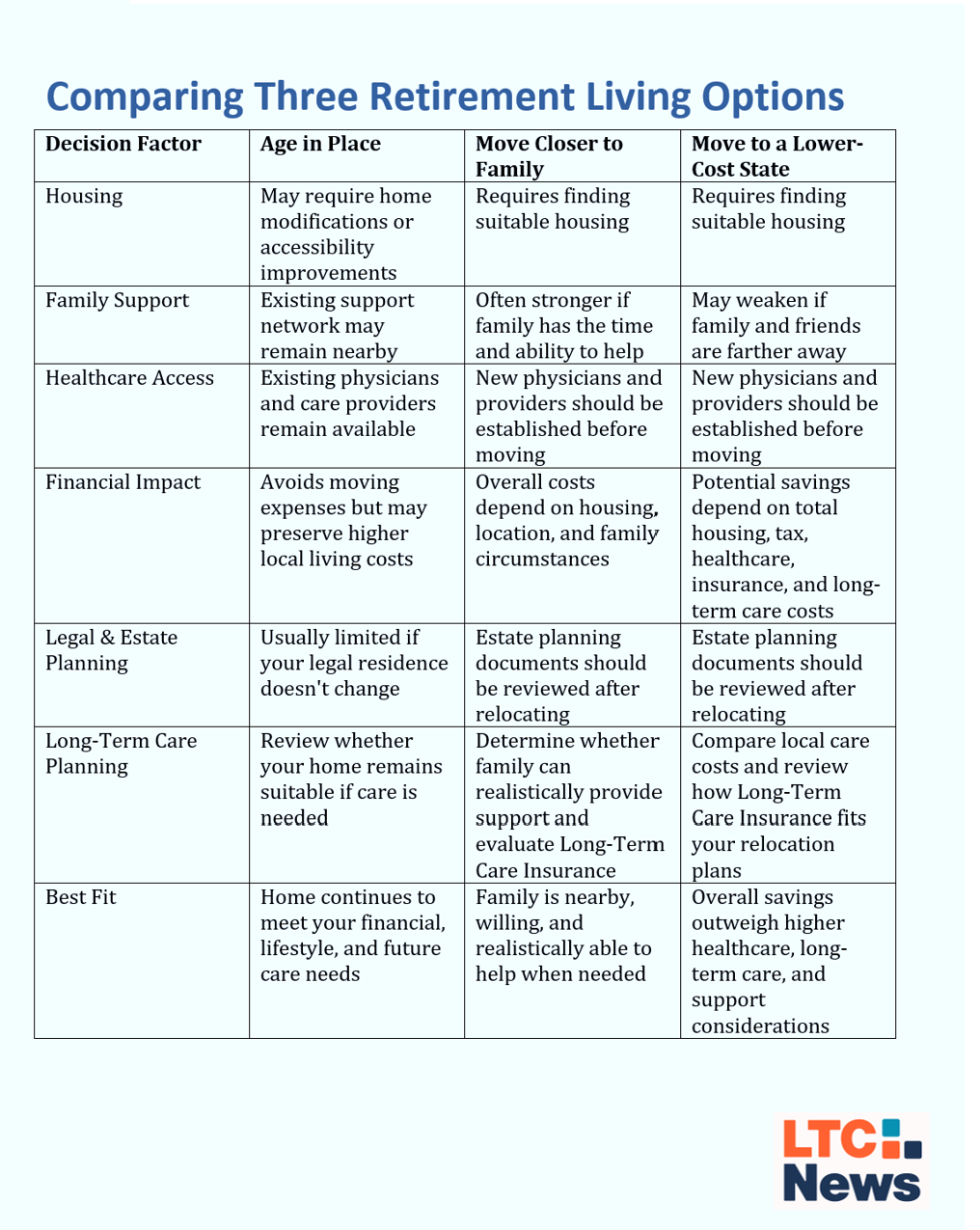
- When Aging in Place May Be the Stronger Option
Staying put often works when the house can be modified for single-floor living, and the mortgage or property tax burden stays manageable on retirement income. Familiar doctors are worth something real, and so is a neighbor with your spare key. Look hard at the risks you've stopped noticing, such as stairs, a roof approaching replacement, a yard someone else already mows and a social life that runs entirely on your driver's license. Price the accessibility work with two local contractor bids before you set it against the cost of moving.
- When Moving Closer to Family May Help
Proximity isn't the same as availability. Cover driving distance and work schedules honestly, and ask who answers the phone at 2 a.m. and who can't. Don't assume the family member who lives closest will be the one doing hands-on care.
- When Relocating to a Lower-Cost State May Work
Relocation holds up financially when the total expense picture is verifiably lower and licensed providers exist in adequate numbers. It holds up personally when the housing stock fits your mobility needs, and you have a credible plan for building a social life somewhere you know almost nobody, since rebuilding that takes longer than most people budget for. A new state also means new insurance carriers and new document rules, so the legal side needs its own pass.
Your Estate Plan Follows State Law, Not You
Domicile is the state you treat as your permanent legal home, and changing it moves both your tax filing and the law governing your estate documents. Your will and any revocable trust were drafted under one state's rules. Your financial power of attorney and health care directive were signed under that state's witnessing and notarization requirements. A power of attorney authorizes someone you name, called an agent, to act for you. A health care directive records your treatment wishes and names a medical decision-maker.
A move may not automatically invalidate those documents, but the answer depends on the states involved and the document itself. Terminology and execution formalities differ from state to state, and so does everyday acceptance at a bank or hospital counter. A document that worked for years can produce a delay on the afternoon you least want one. For a legal question tied to a particular state, consult that state's own statutes and official forms rather than another state's law or a general online summary.
Have an Attorney in Your New State Read the Whole Package
Ask an attorney licensed in your new state to review everything soon after your domicile changes. Start with the will and any trust. Move to the financial power of attorney and the health care directive next. Finish with how your real estate is titled and whether the people you named as decision-makers still make sense from a different state.
Update the People and Institutions That May Need the Documents
A plan only works if the right people can produce it. Confirm that your named agent is still willing to serve and can travel to your new city, and tell that person where the originals are stored. Give your new doctor's office a copy of the health care directive before you need it.
Check the beneficiary designations on your accounts too, because assets governed by a valid beneficiary designation generally pass under that designation rather than under the terms of your will, subject to applicable law and the account agreement.
Compare the Numbers Before You Move
State rankings are a useful starting point, but your decision should come down to the actual communities you're considering. Create a simple worksheet and compare each location side by side.
Include:
- Taxes
- Housing and insurance
- Home care and long-term care costs
- Healthcare access
- Family support
- Transportation
- Whether your estate plan needs to be updated
Give more weight to the factors that matter most to you. Someone with ongoing health needs may care more about access to specialists, while someone focused on keeping expenses low may place more weight on housing and care costs.
Then test your assumptions. Ask what happens if insurance costs rise, you need more paid help at home, or family members aren't as available as expected. A retirement location should still make sense when circumstances change.
The fact is some of this should have been done even before you retire and think of relocating. Longevity is a great thing, but being prepared for it is quite another.
Frequently Asked Questions
Does moving to another state affect my Long-Term Care Insurance?
Qualified Long-Term Care Insurance policies generally provide benefits nationwide. However, relocating is a good time to review your policy, confirm your benefit amount still reflects local care costs, verify your inflation protection remains appropriate, and discuss any state-specific Partnership program considerations with your insurance professional.
What costs should I compare before relocating for retirement?
Look beyond taxes. Compare housing costs, property taxes, insurance premiums, healthcare access, home care costs, assisted living and memory care costs, transportation, family support, and whether you'll need to update your estate planning documents after establishing residency in a new state.
Do I need to update my estate plan after moving to another state?
Often, yes. Estate planning documents such as wills, trusts, powers of attorney, and healthcare directives may still be valid, but state laws and execution requirements differ. After establishing residency, ask an attorney licensed in your new state to review your documents to ensure they continue to meet your wishes and comply with local law.
What is the biggest mistake people make when relocating for retirement?
Many people focus primarily on taxes while overlooking the factors that often have a greater impact on long-term financial security and quality of life, including healthcare access, the availability of quality long-term care providers, family support, insurance costs, and estate planning requirements. The best retirement location is the one that continues to meet your needs if your health, finances, or personal circumstances change over time.
How can I compare retirement locations objectively?
Create a simple worksheet listing each community you're considering. Compare housing, taxes, insurance, healthcare access, long-term care costs, transportation, family support, and legal considerations. Then test your assumptions by asking how the numbers change if insurance costs increase, you need more paid care, or family support becomes less available.
Is moving to a state with lower taxes always the best retirement decision?
No. While lower taxes can reduce some expenses, they don't automatically lower your overall cost of living. Housing prices, homeowners insurance, healthcare access, transportation, and the cost of long-term care often have a much greater impact on retirement expenses than state income taxes alone. Compare the total financial picture before deciding where to relocate.
Is aging in place always less expensive than relocating?
Not necessarily. Remaining in your current home may avoid moving expenses, but it could require accessibility modifications, higher property taxes, or increased maintenance costs. Compare those expenses with the total cost of relocating, including healthcare access, family support, and future long-term care needs.
Should I move closer to my adult children for retirement?
Moving closer to family can provide valuable support, but proximity doesn't always guarantee caregiving. Before relocating, have an honest conversation about what family members can realistically provide based on their work schedules, health, and other responsibilities.
Why should long-term care costs be part of a retirement relocation decision?
Many retirees focus on today's housing costs without considering future care needs. Home care, assisted living, memory care, and nursing home costs vary significantly by location. A community that appears affordable today may become far more expensive if you eventually require extended care.


Sponsored