It's 2 a.m., and Your Parent with Dementia Is Having a Medical Emergency. What Do You Do?

About This Article
A sudden illness can be frightening when your mother or father cannot explain what's wrong. Here's when to call 911, what to tell emergency room doctors, and what families should expect from assisted living, memory care, and nursing homes.

Linda Kople
Linda Kople is a freelance writer focused on caregiving, aging, health, wellness, long-term care, and retirement planning
Table of Contents
- When Should You Call 911 for Someone with Dementia?
- What If Your Parent’s Confusion Suddenly Deepens?
- How to Respond
- What Should You Tell Paramedics When They Arrive?
- At the Emergency Room, Your Parent Needs Someone Who Knows Them
- What Should You Say to the Emergency Room Doctor?
- What Should Doctors and Nurses Be Checking?
- 1. Breathing, circulation and vital signs
- 2. Stroke, delirium and neurological changes
- 3. Infection and other underlying illnesses
- 4. Medications and possible side effects
- 5. Pain and physical discomfort
- 6. Safety and prevention of worsening confusion
- What if Your Parent Becomes Agitated or Refuses Treatment?
- Your Parent Is Being Admitted. What Happens Next?
- How Should Care Facilities Respond When a Resident Has a Medical Emergency?
- Can a Facility Treat the Problem Without Sending Your Parent to the Hospital?
- What if Your Parent Has a DNR Order or Is Receiving Hospice Care?
- What Happens When Your Parent Is Ready to Leave the Hospital?
- How Can Families Prepare Before the Next Emergency?
- When Medical Emergencies Change the Long-Term Care Conversation
- The Most Important Person in the Emergency Room May Be You
Your mother is having trouble breathing. She's sweating, struggling to sit up, and suddenly doesn't recognize you. It's the middle of the night, and she has Alzheimer's disease. You're accustomed to confusion, but you've never seen her like this. What are you going to do? You never imagined you’d be trying to hold your own life together while suddenly carrying the weight of someone else’s.
What to do? Call 911. Severe breathing problems and sudden changes in awareness can signal a life-threatening emergency. Don't assume these symptoms are simply part of dementia or wait until morning to contact her doctor. When calling 911, immediately inform the dispatcher that your loved one has dementia, as it shapes how police or paramedics approach the situation, such as using slower movements, lower-toned voices, and minimizing flashing lights or blaring sirens
While you wait for paramedics, stay with your mother, follow the dispatcher's instructions, and gather her medication list if it's readily available.
You may have spent years helping her with meals, medications, and everyday routines. Yet nothing quite prepares you for the moment when something goes terribly wrong, and she cannot tell you what hurts. For millions of families, that responsibility is part of living with dementia.
The Alzheimer's Association estimates that 7.4 million Americans age 65 and older were living with Alzheimer's dementia in 2026, according to its 2026 Alzheimer's Disease Facts and Figures report.
Medical emergencies are a particular challenge for these families because dementia can interfere with recognizing symptoms, communicating pain, and understanding treatment. A paper by Hoque and colleagues, published March 25, 2026, in the Journal of the American Geriatrics Society, noted that more than half of people living with dementia and their care partners visit an emergency department each year. The authors also cited evidence suggesting that as many as 50 percent of people with dementia discharged from an emergency department return within 30 days.
Knowing what to do before an emergency happens can make a frightening situation more manageable.
When Should You Call 911 for Someone with Dementia?
Having dementia doesn't change the need for immediate treatment when a serious medical emergency occurs.
Call 911 if your parent experiences:
- Sudden facial drooping, arm weakness, difficulty speaking, or other stroke symptoms
- Severe difficulty breathing, choking, or blue or gray lips
- Chest pain or other symptoms suggesting a heart attack
- Unresponsiveness, loss of consciousness, or a seizure
- Serious bleeding or a major injury
- Sudden severe confusion accompanied by weakness, breathing problems, or difficulty waking up
If your parent might be having a stroke, tell paramedics when they were last known to be in their usual condition. Don't attempt to drive someone experiencing a potentially life-threatening emergency to the hospital yourself.
What If Your Parent’s Confusion Suddenly Deepens?
A sharp, sudden shift in thinking, awareness, or behavior is a critical warning sign that demands immediate medical evaluation, even if there was no fall or visible injury.
For example, your father, who usually recognizes you and walks with minimal assistance, might suddenly be unable to stand or seem entirely unaware of his surroundings. Or your mother, who is typically engaged and talkative at dinner, might become abruptly withdrawn, unresponsive, or difficult to awaken.
In individuals with dementia, these acute changes often signal delirium, which is frequently triggered by an underlying physical illness such as a urinary tract infection (UTI), pneumonia, severe dehydration, or a sudden adverse reaction to medication.
How to Respond
- Call your parent’s physician or after-hours service promptly if the mental shift is brand new and concerning, but not immediately life-threatening.
- Call 911 immediately if symptoms are severe, escalating rapidly, or clearly indicate a medical emergency (such as sudden weakness on one side, severe chest pain, or complete unresponsiveness).
What Should You Tell Paramedics When They Arrive?
The most important information you can provide is how your parent normally functions and what has changed.
You might say:
"My father has moderate dementia, but this isn't normal for him. Yesterday, he was walking with his cane and talking with us. Tonight, he can't stand and barely responds. I noticed the change around 1:30 a.m."
Paramedics also need to know about recent falls, medication changes, medical conditions, allergies, and whether your parent takes blood thinners. Tell them if your parent becomes frightened when strangers touch them, has difficulty hearing, or needs extra time to understand instructions.
If available, provide relevant advance directives, a health care power of attorney, or Physician Orders for Life-Sustaining Treatment (POLST). Some states use related forms called MOLST or POST.
Don't delay emergency care while looking for paperwork.
At the Emergency Room, Your Parent Needs Someone Who Knows Them
The emergency room can be overwhelming for someone with dementia. Bright lights, alarms, unfamiliar people, and repeated questions may leave your parent frightened or agitated. Your mother might repeatedly ask why she's there. Your father may pull at medical equipment because he doesn't understand what it does.
Family members can help by explaining the person's normal abilities, routines, and communication needs. As Dr. Scott Dresden, an associate professor of emergency medicine at Northwestern University Feinberg School of Medicine, points out, emergency departments present a uniquely difficult landscape for patients with cognitive impairment.
It is loud, bright and fast paced, and communication with patients and their families, friends or caregivers is not always as good as it should be." — Dr. Scott Dresden.
The National Institute on Aging's Taking a Person With Alzheimer's Disease to the Hospital offers specific guidance for emergency visits, including preparing medical information, explaining behavioral changes, and helping hospital staff recognize pain or distress.
What Should You Say to the Emergency Room Doctor?
The ER doctor will ask you questions, and when they do, be ready and specific about the changes you've observed. Here are two examples:
👉 "My mother has Alzheimer's disease. Normally, she recognizes me, walks with help and speaks in short sentences. Tonight, she suddenly stopped recognizing me and couldn't stand. I'm concerned something medical has changed."
👉 "My father has vascular dementia. Ordinarily, he is calm, eats independently, and can tell me if he is uncomfortable. Since this morning, he has become violently agitated, is crying out whenever he moves, and refuses to eat or drink. He cannot tell me where it hurts, but this level of distress is completely new for him."
Tell the doctor about symptoms your parent may be unable to describe. Share your observations. You should also explain what helps your parent remain calm and whether they have hearing, vision, or swallowing difficulties.
Doctors and nurses should continue addressing your parent directly whenever possible. A dementia diagnosis doesn't automatically mean someone lacks decision-making capacity. Capacity depends on the particular decision and the person's ability to understand, evaluate, and communicate a choice at that time.
Family members can support communication while respecting the person's remaining abilities and wishes. But what if your loved one isn't telling the truth to the emergency room doctor?
Your father tells the doctor he feels fine. He says he lives alone, still drives, and doesn’t take any medications. None of it is true. It can look like lying. It usually isn’t.
A person with dementia may not remember they live with you, or remember a fall, may not notice their own symptoms, or may try hard to seem capable in front of a stranger. Some have anosognosia, a brain-related lack of awareness of their own impairment. Caregivers often call it “showtiming,”which is when a parent who is struggling at home seems alert and charming for a few minutes with a doctor.
Since people with anosognosia don't recognize their cognitive disabilities, the typical self-reporting methods are not very reliable. Instead, diagnosis usually requires clinical assessments... and observations from caregivers." — Alzheimer's Association Official Guidelines on Anosognosia.
Try not to argue or correct your parent in front of the medical team. Being contradicted can embarrass or frighten them and worsen agitation.
Instead:
- Ask for a private word. Step outside the room or catch the nurse at the desk. “Before you finish, can I share a few things about his normal condition?”
- Hand over the facts in writing. A one-page sheet with the diagnosis, usual abilities, recent changes, and when symptoms began lets the team see the full picture without a debate at the bedside.
- Bring the medication list or the pill bottles. “I don’t take anything” is a common answer, and blood thinners, diabetes medicine, and recent prescription changes can change treatment.
- Fill in gently. “Dad, I think the doctor wants to hear about the fall on Tuesday” works better than “That’s not true.”
- Name the gap. “He seems sharp right now, but this isn’t how he’s been at home this week.”
Focus on the facts that affect care: falls, medications, when the change started, eating and drinking, and changes in walking or bathroom habits. Correcting medical information doesn’t mean overriding your parent. They still deserve to be heard, and their wishes still matter.
What Should Doctors and Nurses Be Checking?
You don't need medical training to understand the basic priorities of emergency care. Not every patient requires every test. The evaluation should reflect the symptoms, examination findings, medical history, and treatment preferences.
1. Breathing, circulation and vital signs
The team should assess oxygen levels, blood pressure, heart rate, temperature, breathing and consciousness. Severe symptoms may require immediate treatment before a detailed medical history can be obtained.
2. Stroke, delirium and neurological changes
When confusion begins suddenly, ask whether doctors are evaluating for delirium, stroke or another neurological problem. A neurological examination and structured delirium assessment may be appropriate.
3. Infection and other underlying illnesses
Depending on symptoms, doctors may order blood tests, glucose measurements, an electrocardiogram, imaging, or infection-related testing. Ask what each test is intended to identify and how the results may affect treatment.
4. Medications and possible side effects
Certain medications can worsen confusion, increase fall risks, or cause excessive sedation. Provide a complete medication list, including over-the-counter products and supplements. Mention recent changes or missed doses.
5. Pain and physical discomfort
People with advanced dementia may struggle to explain pain.
Facial expressions, guarding, moaning, restlessness, or changes in behavior can offer important clues. Doctors and nurses should also consider injuries, constipation, urinary retention and other sources of discomfort.
6. Safety and prevention of worsening confusion
Ask whether your parent needs assistance with walking, eating, drinking, or using the bathroom. Glasses, hearing aids, familiar objects and a family member's presence may reduce distress.
The Geriatric Emergency Department Guidelines provide a framework for improving emergency care for older adults, including screening, safety, and transitions of care.
What if Your Parent Becomes Agitated or Refuses Treatment?
Your father doesn't understand why a nurse is trying to insert an IV. He pulls his arm away and begins shouting. They refuse treatment. You know he isn't normally aggressive. He's frightened and confused.
Major research into hospital-based dementia care shows it is not uncommon for someone with dementia to refuse treatment in that situation.
High levels of resistance or refusal of care are common in people living with dementia within acute hospital wards. Every person living with dementia observed during the study resisted care at some stage of their hospital stay." — Dr. Katie Featherstone, Professor of Clinical Sociology and Director of the Cardiff Caring Research Center.
Ask the medical team to step back for a moment, lower their voices, dim overhead lights if possible, and allow you to approach your loved one first with a gentle touch or familiar reassurance.
Pain, fear, delirium, and unfamiliar surroundings may contribute to agitation. Sometimes medication is necessary to protect a patient or others from immediate harm. However, sedating medications and physical restraints carry risks for older adults with dementia.
Validate their feelings: Calmly touch their hand and say, "I know you're scared and want to go home, but the doctor just wants to make sure your heart is safe."
Translate for the medical team: Immediately look at the doctor or nurse and explain: "He is terrified because he doesn't understand what is happening. This isn't how he normally acts; he’s reacting out of pure confusion."
If your loved one lacks medical decision-making capacity due to advanced dementia or acute delirium, they cannot legally refuse life-saving emergency care if doing so would cause imminent, irreversible harm.
- Produce the Healthcare Power of Attorney (POA): If you hold the Healthcare Power of Attorney or are the designated surrogate decision-maker under an Advance Directive, present the document to the ER charge nurse or physician.
- Consult the Medical Team: While proxies cannot force non-emergency, elective procedures against a competent patient's wishes, emergency life-saving interventions required to stabilize an acute crisis fall under the medical team's duty of care and the proxy's authority to protect the patient's well-being.
Work closely with the emergency physician to determine whether a procedure is an immediate, life-saving necessity (such as stabilizing severe bleeding or a cardiac event) or a diagnostic test that can wait 20 minutes while your parent calms down. Giving the patient a brief window to decompress can often turn a flat refusal into cooperation.
If severe symptoms require medication, the lowest effective dose should be used. You can reasonably ask why sedation is needed, what alternatives were considered and how your parent will be monitored.
Your Parent Is Being Admitted. What Happens Next?
Hospitalization may solve the immediate medical problem while creating new challenges. Your mother may become more confused in an unfamiliar room. Your father may struggle to sleep, eat, or walk. Prolonged bed rest can contribute to weakness, and delirium may persist even after the underlying illness improves.
Ask whether the hospital has a geriatric care team or delirium-prevention program. Make sure staff understand whether your parent needs help with meals, medications, mobility, and toileting. The National Institute on Aging recommends involving familiar caregivers when possible, helping patients remain oriented and beginning discharge planning early.
A parent who walked independently before hospitalization may need rehabilitation or more assistance afterward. Medical stability doesn't necessarily mean someone can safely return to their previous routine.
How Are Medical Emergencies Handled in Assisted Living, Memory Care and Nursing Homes?
When your parent lives in a care community, you may not be present when an emergency begins. Instead, you're depending on staff to recognize the problem, respond appropriately, and communicate with the hospital and family.
The process differs depending on the type of facility. When looking for a long-term care facility for a loved one, ask about their emergency process so you understand what will happen.
NOTE: You can use the LTC News Caregiver Directory to search for caregivers and long-term care facilities nationwide.
- Assisted Living: Who Calls 911?
Assisted living communities generally provide assistance with everyday living activities, medication management, and supervision. They aren't necessarily staffed or equipped to provide continuous skilled nursing care.
When a resident experiences a serious emergency, staff should activate emergency services promptly and provide assistance within their training.
For less urgent changes, staff may contact an on-call nurse, doctor, or nurse practitioner. Families should ask whether a licensed nurse is physically present overnight, available by telephone, or not routinely available.
A life-threatening emergency should not be allowed to worsen while staff waits for a family member to answer the phone.
- Memory Care: Staff Must Recognize Changes Beyond Dementia
Memory care communities specialize in caring for people with cognitive impairment, although medical staffing and services vary. Caregivers may know that your mother sometimes becomes restless in the evening or that your father occasionally refuses meals. That familiarity is valuable. It helps staff recognize when something is different.
A resident who suddenly stops walking, becomes difficult to awaken, or experiences an abrupt change in behavior needs prompt assessment. Staff should communicate the resident's usual functioning, new symptoms, medication information, and treatment preferences to the emergency team.
A study published August 11, 2025, in JAMA Network Open examined a program intended to improve communication between assisted living communities and emergency rooms. Researchers interviewed 12 care managers. Participants reported improved communication and patient advocacy, particularly for residents with dementia.
Read: Emergency Department Care Coordination Program for Assisted Living Residents With Dementia: A Qualitative Study.
Because the study was qualitative, it did not establish that the program reduced hospitalizations.
👉The lesson for families is that a resident shouldn't arrive at the hospital with dementia listed in the chart but little explanation of what happened or how that person normally functions.
- Nursing Homes: More Medical Resources, but Emergencies Still Require Action
Nursing homes generally provide around-the-clock licensed nursing services and are better equipped for these medical emergencies. A nurse may assess vital signs, contact a doctor, and arrange certain treatments within the facility's capabilities. Some medical conditions can be managed without hospitalization. Others require immediate emergency transport.
Federal nursing home regulations establish specific responsibilities.
Under 42 CFR § 483.10(g)(14), Notification of Changes, nursing homes must immediately inform the resident, consult the resident's physician, and notify the authorized resident representative when specified significant changes, injuries, treatment changes, or transfer decisions occur.
Separate requirements under 42 CFR § 483.15(c)(2) address documentation and information provided to receiving health care providers.
These federal rules do not automatically apply in the same way to assisted living and memory care communities, which are primarily regulated under state licensing laws.
How Should Care Facilities Respond When a Resident Has a Medical Emergency?
What should you ask when the facility calls?If you receive a call saying your parent has fallen or is being transported to a hospital, ask what happened, when symptoms began, and whether a nurse or doctor has evaluated the situation. Find out which hospital is receiving your parent and whether the emergency team has their medications, medical history, and advance directives.
Ask who will update you and whether a staff member can explain your parent's normal condition to the hospital. Don't delay necessary emergency transport to complete the conversation.
Can a Facility Treat the Problem Without Sending Your Parent to the Hospital?
Sometimes. A nursing home may have the nursing staff, medical orders, and resources needed to treat certain illnesses without transferring the resident. Some facilities use INTERACT, short for Interventions to Reduce Acute Care Transfers, a program designed to improve recognition of changes in condition, communication, and decisions about hospital transfers.
Avoiding an unnecessary hospital visit can benefit someone with dementia. Hospitalization may increase confusion, disrupt sleep, and contribute to delirium or functional decline. However, avoiding hospitalization should never mean delaying treatment for a life-threatening emergency. The decision should reflect the medical condition, available care, and your parent's treatment preferences.
What if Your Parent Has a DNR Order or Is Receiving Hospice Care?
A do-not-resuscitate order (DNR) generally addresses whether cardiopulmonary resuscitation should be attempted when breathing or the heartbeat stops. It doesn't automatically mean your parent should receive no medical care or never be hospitalized.
Treatment for pain, breathing distress, infections, or injuries may still be appropriate, depending on the person's goals and medical orders. For someone receiving hospice care, families and facility staff should follow the established emergency plan and contact the hospice's 24-hour service when appropriate.
Hospice teams may be able to manage symptoms where the person lives, avoiding a distressing hospital transfer. Families should discuss these decisions before an emergency occurs, including who has legal authority to make medical decisions when the person cannot.
What Happens When Your Parent Is Ready to Leave the Hospital?
Your father has been treated for pneumonia. His breathing has improved, and the doctor says he can leave. But he's still confused and can no longer walk without assistance. Families sometimes discover that being medically stable doesn't mean someone can safely return to their previous living arrangement.
Before discharge, ask whether your parent can safely eat, swallow medications, walk, transfer from bed to chair, and use the bathroom. Find out whether delirium is still present and what changes might require another medical evaluation.
If you and your family are caregivers, you may need professional help, at least part-time. If your parent lives in assisted living or memory care, the community may need to reassess whether it can meet their increased needs.
For nursing home residents, federal rules establish requirements involving bed-hold notices and return rights following hospitalization. Families should understand these protections before assuming a hospital transfer means their parent has lost their place in the facility.
How Can Families Prepare Before the Next Emergency?
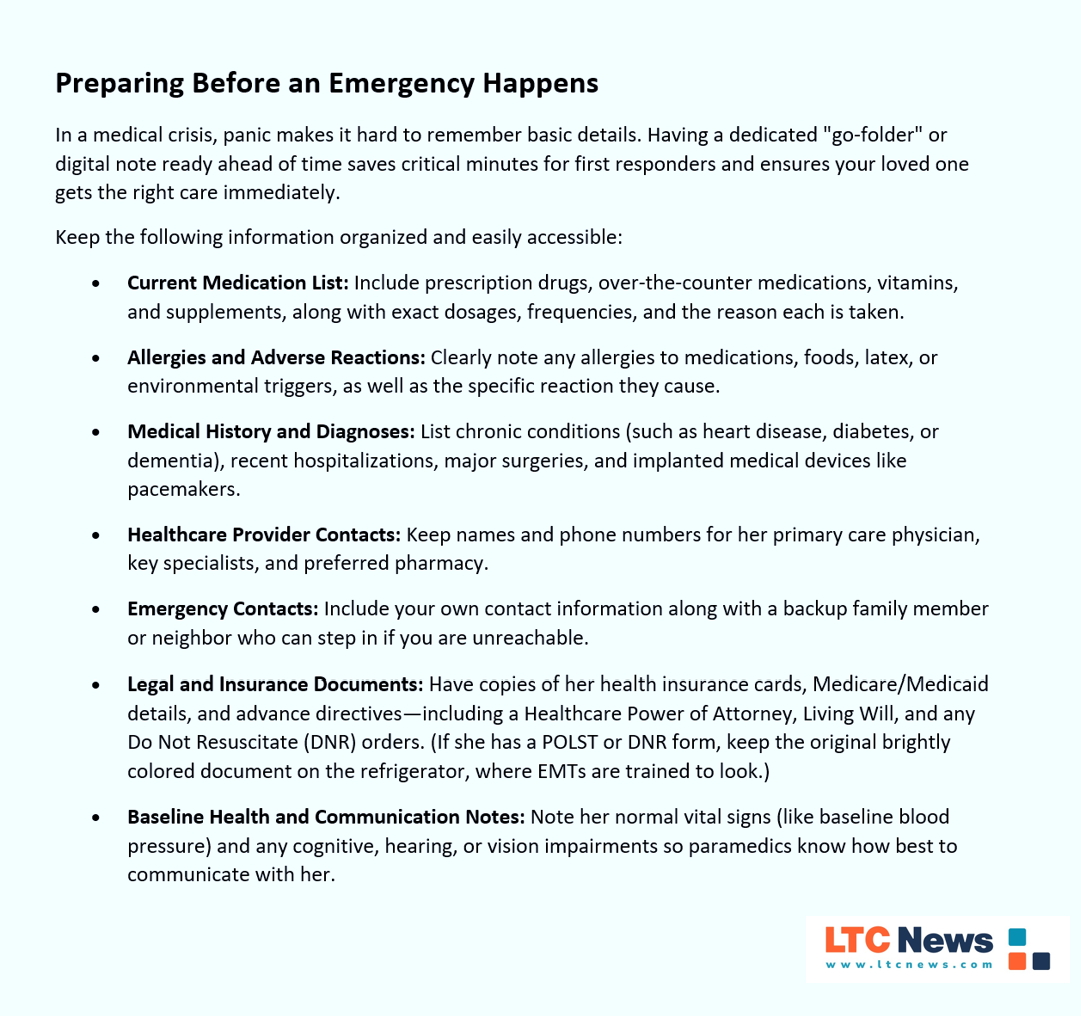
Keep an updated medical information sheet somewhere caregivers can find it quickly. Include medications, allergies, diagnoses, doctors, emergency contacts, insurance information, and advance directives.
Add a brief description of your parent's normal abilities. Does your mother recognize family members? Can your father walk independently? Does he need help swallowing? What makes him frightened or upset? The National Institute on Aging recommends keeping emergency information readily available and preparing a hospital bag with necessary documents and personal items.
Families should also understand who will call 911, who will notify relatives, and how medical information will reach the hospital.
When Medical Emergencies Change the Long-Term Care Conversation
The first emergency may seem like an isolated incident. Then another happens. Your mother falls while trying to reach the bathroom. Your father develops pneumonia. A medication change leaves him unusually confused.
Each time, you miss work, spend hours at the hospital, and wonder whether it's still safe for your parent to live at home. Eventually, the question may change from whether your parent can recover from the latest illness to whether the current caregiving arrangement can meet their needs.
Moving someone into assisted living or memory care doesn't mean the family has stopped caring. Sometimes it means recognizing that one person cannot safely provide every level of supervision, personal assistance, and medical support.
Professional care also comes with substantial expenses. Families can use the LTC News Cost of Care Calculator to research current and future care costs and the LTC News Caregiver Directory to explore professional care options.
If your parent already has Long-Term Care Insurance, a decline in daily functioning or the need for substantial supervision because of cognitive impairment may warrant reviewing claim eligibility. Tax-qualified LTC policies provide benefits when an insured person meets applicable requirements, such as assistance with at least two activities of daily living or substantial supervision due to severe cognitive impairment.
Don't delay using the benefits from your loved one's LTC policy; that is why they bought it in the first place. LTC News partners with Amada Senior Care to provide free claim support with no cost or obligation. Their trained experts will help you through the entire process so your loved one can access benefits quickly — File a Long-Term Care Insurance Claim.
For you, you see what is happening, and you must ask yourself the question: do you want your children to go through this aging crisis without help? The best time to plan is when you are still healthy; planning now will help ease family stress and burden and protect your income and savings from the rising cost of extended care. It also provides you with more choices. LTC News research indicates that most people apply for Long-Term Care Insurance between ages 47 and 67.
👉 Remember, health insurance and Medicare will only pay for short-term skilled care, not ongoing help with daily living activities or supervision due to dementia.
Learn More: How to apply for Long-Term Care Insurance.
The Most Important Person in the Emergency Room May Be You
Your mother is finally resting in a hospital bed. The doctor has explained what happened, and treatment has begun. A nurse enters to check her vital signs. Your mother opens her eyes and looks frightened. She doesn't recognize the room or understand why she's connected to monitors.
Then she sees you. You take her hand and tell her she's safe. She may not remember the ambulance ride, the tests, or the conversations with the doctors. But your presence can still bring comfort.
Caring for someone with dementia often means speaking up when they cannot explain what's wrong, noticing changes others might miss, and helping medical professionals understand the person beyond the diagnosis. You don't need to know every medical answer. You need to recognize when something is wrong, seek appropriate help, and make sure the people caring for your parent understand what has changed and what matters to them.
That responsibility remains important whether your parent lives down the hall or in a memory care community miles away.
Frequently Asked Questions
Does a DNR order prevent someone with dementia from receiving emergency treatment?
No. A DNR generally concerns resuscitation when breathing or the heartbeat stops. Other medical treatments may remain appropriate, depending on the person's wishes and medical orders.
Should a memory care facility call the family before sending a resident to the hospital?
Facilities should follow applicable emergency protocols, resident directives, and state requirements. Necessary emergency treatment should not be delayed while waiting for family authorization when immediate action is required.
Can a hospital make dementia worse?
Hospitalization doesn't necessarily accelerate the underlying dementia, but illness, disrupted sleep, unfamiliar surroundings, and certain medications can contribute to delirium and declines in functioning. Some changes may persist after discharge.
What should you tell an emergency room doctor about a parent with dementia?
Explain your parent's normal mental and physical abilities, when the new symptoms began, and exactly what changed. Provide medication information, medical history, allergies, and relevant advance directives.
Should you call 911 if someone with dementia suddenly becomes confused?
Sudden confusion requires prompt medical assessment. Call 911 if it is accompanied by stroke symptoms, severe breathing problems, unresponsiveness, or other signs of a life-threatening emergency. For less severe changes, seek prompt medical guidance.

Sponsored