How Years of Coal Mining Can Shape Long-Term Care Needs Later in Life
About This Article
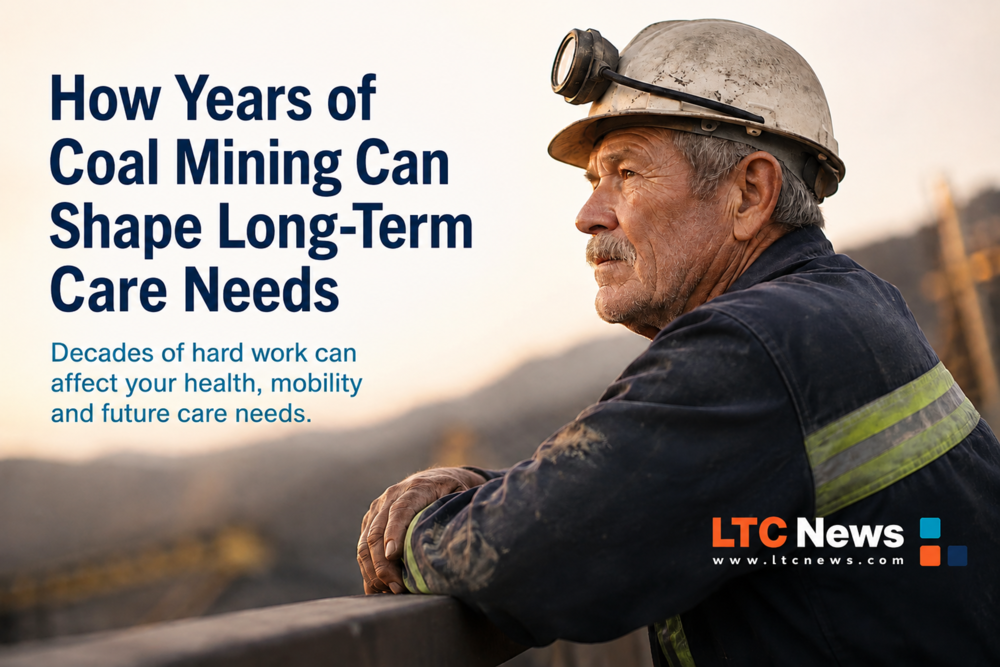
Decades of coal mining or other heavy manual labor can lead to workman’s compensation. Long-term care needs later in life can result even without a single reportable injury. Cumulative strain on joints, muscles, and the lungs builds slowly over a career, and it often surfaces as difficulty with daily tasks decades after a miner leaves the industry.

James Kelly
LTC News staff writer specializing in long-term care and aging.
Table of Contents
- Coal Country Spans More Ground Than Most People Realize
- Lung Disease Is Still a Major Factor for Former Miners
- Benefits, Claims, and the Legal Side of Care Planning
- How Families Become the First Long-Term Care Providers
- What a Long-Term Care Assessment Actually Looks At
- Not Every Former Miner Faces the Same Outcome
- Matching Long-Term Care to the Person
- Coal Miners - What to Know Before Applying for Long-Term Care Insurance
- Seek Help and Get Professional Advice
- Sources
Roof falls, explosions, and equipment accidents left many miners with permanent, identifiable damage — a crushed limb, lost fingers, a damaged spine. But a large share of former coal miners never had a single dramatic accident. They just worked hard, for decades, in a job that asks more of the body than almost any other occupation.
If you or someone in your family spent years underground or on a surface crew, you already know the job leaves a mark. Some injuries were obvious the day they happened. Others built up quietly, one shift at a time, until the body simply wore down. Either way, coal country is now home to a generation of aging former miners whose working years are starting to shape the kind of help they need today. Understanding how decades of physical labor affect aging can help families recognize care needs earlier and make better long-term care decisions before a crisis develops.
Research backs up what miners have long known from experience. A systematic review of studies on physically demanding work found that heavy manual occupations roughly double the risk of hip osteoarthritis compared with less physical jobs, with repetitive lifting, awkward postures, and prolonged kneeling or squatting among the biggest contributors.
A separate study tracking knee joints over time found that people in the most physically intensive jobs developed knee osteoarthritis at a significantly higher rate than people in sedentary work, even after accounting for old injuries and body weight. Research out of Finland found manual trades such as construction carried a sharply elevated risk of disability retirement tied to hip osteoarthritis alone.
None of that requires an accident report. It's the accumulated cost of thousands of shifts spent lifting, crouching, and working in cramped, physically demanding conditions. Add in the natural muscle loss that comes with age, known as sarcopenia, and a body that remained strong at 50 can start needing assistance at 70 or 75, with no single clear cause a family can point to.
Osteoarthritis is one of the leading causes of premature retirement and identifying occupational factors that could have some activity modification to reduce this risk, is critically important." — Professor David Hunter, Florance and Cope Chair of Rheumatology, Institute of Bone and Joint Research, University of Sydney.
These gradual physical changes often make everyday activities like bathing, dressing, climbing stairs, or safely getting in and out of bed increasingly difficult, creating the need for long-term care services.
Coal Country Spans More Ground Than Most People Realize
Appalachia gets most of the attention, but coal mining shaped daily life across a much wider stretch of the country, and each region still carries an aging population of former miners today.
Southern West Virginia has long been the heart of American coal. The state currently mines coal in 21 of its 55 counties. It remains the country's largest producer of bituminous coal and ranks second nationally in overall coal production. Counties like McDowell, Mercer, Mingo, and Logan, part of the historic Pocahontas coalfield, built entire communities and generations of family employment around the mines. Many of those communities have shrunk sharply as mining employment declined, but the former miners who stayed behind are aging in the same towns where they once worked.
Eastern Kentucky and southern Virginia, part of Central Appalachia, followed a similar pattern. Coal remained central to local economies well into the 21st century even as production and employment fell.
Northeastern Pennsylvania's anthracite region, centered on Scranton and Wilkes-Barre, saw underground mining largely end after the 1959 Knox Mine Disaster flooded much of the northern coalfield, though deep mining continued into the early 1970s in pockets north of Scranton and south of Wilkes-Barre. The miners from that era are now in their 80s and 90s.
Southwestern Pennsylvania tells a different story from the anthracite region. Bituminous coal is still mined today in 21 Pennsylvania counties, concentrated in the state's southwest, including Greene, Washington, Somerset, Armstrong, Indiana, Fayette, and Westmoreland counties. According to the Pennsylvania Department of Conservation and Natural Resources, some of the largest and most productive underground coal mines in the country operate in this region's Main Bituminous coalfield. Pennsylvania remains among the top five coal-producing states nationally, and its mining workforce today includes both current miners and recent retirees, a very different age profile from the anthracite region's miners in their 80s and 90s.
Southern Illinois is a region many people forget produced coal at all. Sitting atop the Illinois Basin, a coal-rich formation running roughly 400 miles, the region's mines employed close to 100,000 workers and produced around 100 million tons of coal a year at their peak in the 1920s. Counties like Williamson, Saline, and Franklin were built around towns like West Frankfort, Herrin, and Harrisburg, and many families there trace three or four generations of mining work. Southern Illinois had dozens of active coal mines in the 1980s, but today the region operates only a handful, roughly 10–12 mines, due to declining demand for high-sulfur coal. However, researchers at Southern Illinois University, Carbondale are returning to abandoned coal mines to explore mining rare earth elements.
Wyoming, home to the Powder River Basin, is now the nation's single largest coal-producing state. Campbell County as a whole contains more coal than any other county in the country and has historically produced the bulk of Wyoming's output; 13 of the state's top 20 coal producers in 2011 operated there. Gillette, the region's hub, is sometimes called the "Energy Capital of the Nation, and is home base for most of the coal companies operating in the basin.
Its mining relies primarily on surface operations rather than underground work. Although the physical demands differ from deep mining, decades of heavy equipment operation, climbing, lifting, and repetitive work can still contribute to joint problems and mobility limitations later in life.
Wherever the mine was, the pattern for long-term care planning is similar: a career of hard physical labor, followed decades later by a body that needs more support than it used to.
While coal mining is among the most physically demanding occupations, many of the same long-term health challenges affect people who spent decades in construction, steel mills, manufacturing, farming, logging, and other physically demanding careers. The lessons about planning for future care apply well beyond coal country.
Lung Disease Is Still a Major Factor for Former Miners
Musculoskeletal wear isn't the only long-term consequence of the job. Coal workers' pneumoconiosis, commonly known as black lung disease, along with chronic obstructive pulmonary disease and other respiratory illness, remains one of the most serious health risks tied to underground mining.
New federal research shows the problem hasn't gone away. Nearly one in three experienced underground coal miners with at least 25 years on the job in Central Appalachia showed evidence of black lung disease in X-rays taken over the past five years, according to research from the National Institute for Occupational Safety and Health, or NIOSH. That's the highest rate seen since 1978, and a fourfold increase since the disease hit a low point in 1999. The disease is incurable and progressive, meaning it can continue to worsen even decades after a miner leaves the industry.
For long-term care purposes, advanced lung disease often means more than an oxygen tank. Reduced lung capacity limits stamina for basic tasks, increases fall risk from breathlessness and fatigue, and frequently requires the kind of home care or skilled nursing support that goes beyond what a spouse or adult child can safely provide alone.
Benefits, Claims, and the Legal Side of Care Planning
Many former miners may still receive workers' compensation, Social Security Disability, or federal black lung benefits that help offset medical expenses and replace lost income tied to an old injury or occupational illness. While these programs rarely pay for extended custodial care, such as help with bathing, dressing, or supervision at home, they can become an important part of a family's broader financial planning for aging.
Reaching that point isn't always straightforward.
Many workers spent years managing the long-term effects of workplace injuries or occupational illnesses. Caroline Munley, a Pennsylvania Bar-certified workers' compensation specialist at Munley Law, told LTC News that some are seeking legal assistance to claim workers' compensation benefits or pursuing claims related to unsafe working conditions and exposure to harmful substances. Their occupational histories remained relevant long after active mining declined.
Federal data show that roughly 7,700 coal miners were receiving Black Lung workers’ compensation benefits in 2024, according to a Government Accountability Office report published in May 2026. This figure reflects only miners who qualify for the federal Black Lung Benefits Program, which covers disability and medical costs related to pneumoconiosis; it does not include miners receiving state workers’ compensation for other coalrelated injuries, illnesses, or fatalities. As a result, the total number of coal workers receiving any form of workers’ compensation in the United States is much higher, but only the black lung portion is publicly reported at the national level.
The most common problem I see in workers' compensation cases is injured workers who wait too long to report the injury or who don't realize they can push back when a claim is denied." — Caroline Munley.
Several legal experts told LTC News that an insurance company is not on the worker's side. Seeking legal advice will help you get every benefit the law says you're entitled to.
That advice matters for older adults navigating long-term care today, too. Some former miners are still owed benefits tied to old claims. Others just carry the physical result of an injury that was never formally reported at all, a common outcome in an era when miners were expected to keep working through pain.
How Families Become the First Long-Term Care Providers
Family members are usually the first to notice when independence starts to slip. An adult child may notice a father gripping the stair rail more tightly or taking longer to leave the house. A spouse may realize bathing or dressing now takes real effort.
Family caregiving of this kind has become the backbone of long-term care in the United States. More than 63 million Americans now provide unpaid or informal care for a family member with a chronic illness or disability, according to the 2025 Caregiving in the U.S. report from AARP and the National Alliance for Caregiving. Many caregivers report significant financial strain, and nearly one in four provides 40 or more hours of care a week, on top of their own jobs and households.
Caregiving tends to build gradually rather than begin all at once.
Someone takes over the driving, then the shopping, then medication management. A relative starts checking in every day because leaving the person alone no longer feels safe. No single change looks significant on its own; together, they add up to an informal long-term care arrangement built entirely around family effort.
Many caregivers don't recognize the shift as it happens. 'They don't think of themselves as caregivers even after they've taken over the driving, the shopping, and the medication management." — Susan Reinhard, senior vice president at AARP and director of its Public Policy Institute.
That family support can also mask how much independence has already been lost. A household may keep functioning smoothly only because a spouse or adult child has quietly absorbed the hardest tasks. Recognizing the full scope of care already being provided helps a family judge whether the current arrangement is sustainable, or whether it's time to bring in outside help.
What a Long-Term Care Assessment Actually Looks At
A long-term care assessment focuses on what someone can safely and consistently do right now. A mining injury, an old diagnosis, or decades of physical labor provide useful background, but present-day function determines the level of support a person actually needs.
Assessments typically look at bathing, dressing, eating, using the bathroom, walking, and moving between a bed and a chair, the basic activities of daily living, or ADLs. They also weigh meal preparation, medication management, transportation, household responsibilities, and whether someone can safely be left alone.
Long-term care assessments also evaluate memory, judgment, and cognitive function, because these abilities affect whether someone can safely live independently.
Being able to complete a task once doesn't mean someone can manage it independently day after day. A former miner might still climb stairs or get dressed, but only with significant pain, frequent rest breaks, or a real risk of falling. A thorough assessment identifies not just whether help is needed, but how much and how often, the difference between occasional reminders and hands-on support every time someone stands or bathes.
Family observations fill in gaps that a single appointment often misses. Relatives usually know which routines have changed, which tasks they've quietly taken over, and whether their loved one tends to downplay difficulties in front of a doctor or assessor.
Not Every Former Miner Faces the Same Outcome
None of this means disability is inevitable. Many former miners enjoy active, independent retirements well into their 80s and beyond. Genetics, smoking history, workplace safety conditions at the specific mine, overall health, and access to medical care all influence how someone ages after decades of physical labor.
The goal of this article isn't to assume every former miner will need long-term care. It's to help families recognize the risk factors early enough to plan for them, rather than being caught off guard.
Matching Long-Term Care to the Person
Some former miners and manual laborers can stay at home with the right support in place. Grab bars, handrails, better lighting, mobility equipment, and bathroom modifications can meaningfully reduce fall risk, and physical or occupational therapy can help someone move more safely through a daily routine.
Home care can add assistance with personal tasks, meals, medication, and transportation, while respite care gives family caregivers planned relief when they're carrying most of the load. Assisted living tends to fit someone who needs regular personal help and supervision but not continuous medical care. Skilled nursing becomes appropriate when ongoing medical monitoring or extensive physical assistance is required.
Families who planned ahead with Long-Term Care Insurance often have more flexibility in choosing home care, assisted living, or skilled nursing without relying entirely on personal savings or family caregivers. It's worth noting that Medicare generally pays only for limited, short-term skilled care after a hospital stay and does not cover ongoing custodial long-term care, even when that care lasts for years.
Get Help: If you or a lovedone needs extended care, for whatever reason, and has an LTC Insurance policy, get free no obligation help to process the claim — File a Long-Term Care Insurance Claim.
Medicaid becomes the nation's largest payer of long-term care for people who meet strict medical and financial eligibility requirements, but planning ahead of a health crisis gives families far more options than reacting after one.
Costs vary dramatically by state and by community, so understanding local numbers matters. Our Cost of Long-Term Care Services Calculator can help you estimate the cost of extended care in your area. Our Caregiver Directory can help you find local home care agencies, assisted living communities, skilled nursing facilities, nurses, therapists, and rehabilitation services. Our Long-Term Care Learning Center has more on planning for long-term care needs before a crisis forces the decision.
Coal Miners - What to Know Before Applying for Long-Term Care Insurance
Applying for Long-Term Care Insurance isn't always straightforward for former miners, and eligibility often comes down to timing and current health status rather than mining history itself, according to Long-Term Care Insurance experts interviewed by LTC News.
Someone already receiving workers' compensation for an occupational injury will typically have very limited coverage options, since insurers view an open claim as an unresolved health issue. Someone already receiving paid or family care for daily activities generally isn't eligible at all; Long-Term Care Insurance is built to help pay for care before it starts, not after.
Chronic obstructive pulmonary disease, black lung disease, and other breathing conditions don't automatically disqualify an applicant. Someone who is active and independent may still qualify, depending on the specific treatment plan and severity. Oxygen use, however, is one of the more common reasons for a denial, since it typically signals a level of respiratory impairment that most carriers won't underwrite.
Multiple joint replacements and severe arthritis could also be a concern. Because eligibility depends heavily on the specifics of a person's health history and current treatment, it's worth speaking with a qualified Long-Term Care Insurance specialist before applying, rather than a general life or health insurance agent. A specialist can help identify which carriers may be a fit or whether other planning tools make more sense.
Timing matters, too. According to LTC News research, most people who apply for Long-Term Care Insurance do so between the ages of 47 and 67. Waiting longer narrows the field of available carriers and increases the odds that a new health condition, even a minor one, closes the door on coverage altogether.
Seek Help and Get Professional Advice
Whether someone spent decades underground in Appalachia, southern Illinois, Wyoming, or anywhere where mining exists, the lesson is the same: long-term care needs often develop gradually after a lifetime of physical work. Recognizing those risks early gives families time to plan, understand costs, explore care options, and protect retirement savings before a crisis forces difficult decisions.
Seek experienced legal assistance if you're seeking workers' compensation for a workplace injury at a mine. Physical labor is hard on your body, and an old workplace injury or simply the wear of decades on the job can change your quality of life and increase your already high risk of needing help with daily living activities.
This article is for general informational purposes and isn't a substitute for individualized medical, legal, or financial advice. Consult a qualified professional about your specific situation.
Sources
- Friedman, L.S., et al. "The Association Between Employment in Coal Mining and History of Injury, Current Pain, and Prescription Opioid Use." American Journal of Industrial Medicine, Wiley Online Library, 2025. https://onlinelibrary.wiley.com/doi/10.1002/ajim.23679
- "Influence of physically demanding occupations on the development of osteoarthritis of the hip: a systematic review." National Library of Medicine, PMC, 2022. https://www.ncbi.nlm.nih.gov/pmc/articles/PMC9400208/
- "Occupations Involving Manual Labor Increase the Risk for Incident Knee Osteoarthritis." American College of Rheumatology Meeting Abstracts, 2015. https://acrabstracts.org/abstract/occupations-involving-manual-labor-increase-the-risk-for-incident-knee-osteoarthritis/
- "Occupation, Physical Workload Factors, and Disability Retirement as a Result of Hip Osteoarthritis in Finland, 2005–2013." The Journal of Rheumatology, 2018. https://www.jrheum.org/content/45/4/555
- "Appalachia's black lung rates highest in nearly 50 years as miners' protections stall." NPR, August 2026. https://www.npr.org/2026/08/05/nx-s1-5894884/appalachia-black-lung-coal-miners-silica-dust
- "Caregiving in the U.S. 2025." AARP and the National Alliance for Caregiving, July 2025. https://www.aarp.org/pri/topics/ltss/family-caregiving/caregiving-in-the-us-2025/
- West Virginia Office of Energy, coal profile. https://energywv.org/wv-energy-profile/coal/
- "A Look Inside the Coal Communities in the Illinois Basin." Pacific Standard, 2017. https://psmag.com/magazine/a-look-inside-the-coal-communities-in-the-illinois-basin/
- "Death Underground: The Knox Mine Disaster." Pennsylvania Center for the Book. https://pabook.libraries.psu.edu/literary-cultural-heritage-map-pa/feature-articles/death-underground-knox-mine-disaster
- Caroline Munley, Munley Law — interview with LTC News.
Frequently Asked Questions
Does black lung disease increase long-term care needs?
It can. Black lung disease (coal workers' pneumoconiosis) is a progressive and incurable lung disease caused by inhaling coal dust over many years. Advanced disease can reduce stamina, increase shortness of breath, limit mobility, and make daily activities difficult, increasing the need for home care, assisted living, or skilled nursing care.
Are coal miners the only workers at higher risk for future long-term care needs?
No. Many of the same age-related challenges affect people who spent decades in other physically demanding occupations, including construction, manufacturing, farming, logging, steel production, transportation, and heavy equipment operation. Years of repetitive physical work can increase the likelihood of mobility limitations and the future need for long-term care.
Are former coal miners automatically eligible for Long-Term Care Insurance?
No. Working in the mining industry alone does not automatically prevent someone from qualifying for Long-Term Care Insurance. Eligibility depends on current health, medical history, medications, functional ability, and underwriting guidelines. Many former miners who remain healthy and independent can still qualify if they apply before significant health problems develop.
Can years of coal mining lead to long-term care needs?
Yes. Decades of coal mining place repeated stress on the joints, spine, muscles, and lungs. Even miners who never experienced a major workplace accident may develop arthritis, reduced mobility, chronic pain, or respiratory disease that makes everyday activities like bathing, dressing, or walking difficult later in life. These gradual changes can increase the need for long-term care services.
Why do many former coal miners need help later in life even without a serious injury?
The physical demands of mining accumulate over time. Years of lifting, climbing, kneeling, working in confined spaces, and operating heavy equipment can gradually wear down the body. As people age and naturally lose muscle strength, those decades of physical strain often become more noticeable and can limit independence.
Can someone receiving workers' compensation still buy Long-Term Care Insurance?
Usually no. An active workers' compensation claim or ongoing disability related to a workplace injury eliminates most coverage options. Because underwriting varies among insurance companies, it's best to work with an experienced Long-Term Care Insurance specialist who understands carrier guidelines.
What signs indicate a former miner may need long-term care?
Early warning signs include difficulty climbing stairs, frequent falls, trouble bathing or dressing, increasing shortness of breath during routine activities, memory problems, or relying more on family members for transportation, shopping, meal preparation, or medication management. Recognizing these changes early allows families to plan before a crisis occurs.

Sponsored