How to Choose Men's Wellness Supplements After 50: What the Evidence Shows
About This Article
Men's wellness supplements may support healthy aging, but they work best alongside exercise, nutrition, quality sleep, and regular medical care. Before buying a supplement, look for transparent dosing, third-party testing, and realistic claims supported by research. Talk with your physician before starting any new supplement.

Marcus Howard
Marcus Howard writes about alternative health topics for older adults such as CBD, acupuncture, and herbal medicine.
Table of Contents
- Why Men Turn to Wellness Supplements as They Age
- Sarcopenia: The Muscle Loss That Often Goes Unnoticed
- What the Evidence Actually Shows
- What Supplements Can and Cannot Do
- The Placebo Effect: Why Feeling Better Isn't Proof
- How Dietary Supplements Are Regulated, and How They Aren't
- Choose Products That Prioritize Independent Testing
- Pay Attention to Dosages
- Consider Practical Daily Use
- Understand "Clean Label" Claims
- Watch for Marketing That Sounds Too Good to Be True
- When "Low Testosterone" Is Really Something Else
- Talk to Your Doctor Before You Start
- What Actually Preserves Muscle and Independence
- Remember the Basics of Healthy Aging
- Why This Matters for Long-Term Care Planning
- What's the Goal?
Losing muscle, strength, and stamina isn't inevitable, but it becomes far more common after age 50. Many men respond by looking for ways to hold onto their vitality through exercise, better sleep, improved nutrition, or a dietary supplement purchased online or at a local retailer. The challenge is telling the products backed by real evidence apart from those built mostly on marketing.
Healthy aging isn't defined by a single birthday. After age 50, the body gradually changes how it builds muscle, regulates hormones, recovers from illness, and responds to physical stress. Supplements may support that process for some men, but only when combined with healthy habits and appropriate medical care. Before buying premium men's wellness supplements, you should understand what they can do and the possible benefits you may achieve.
Why Men Turn to Wellness Supplements as They Age
Male wellness involves more than one hormone level. Beginning in middle age, many men notice declining muscle mass, slower recovery after physical activity, lower energy, and changes in sexual health. It's easy to chalk all of this up to getting older. While these changes are often associated with aging, they can also reflect an underlying medical condition, from sleep disorders to hormonal or metabolic issues, that deserves evaluation rather than a supplement bottle.
That distinction matters. A supplement might ease a symptom at the margins. It won't diagnose or treat whatever is actually driving it.
Sarcopenia: The Muscle Loss That Often Goes Unnoticed
One of the most important, and most overlooked, aspects of aging is sarcopenia, the progressive loss of skeletal muscle mass and strength. Adults begin gradually losing muscle mass as early as their thirties, well before most men think to worry about it, with losses accelerating after age 60.
Sarcopenia isn't just a cosmetic concern. It's closely linked to frailty, falls, fractures, hospitalization, loss of independence, and an increased likelihood of eventually needing long-term care. Muscle is what keeps you steady on your feet, able to rise from a chair without help, and able to bounce back after a fall, surgery, or illness.
Starting as early as age 30, we all begin to lose muscle mass gradually, says Dr. Jack M. Guralnik, MD, MPH, PhD, professor of epidemiology and public health at the University of Maryland School of Medicine.
But for many older adults, this loss happens more quickly and can be more debilitating, leading to increases in falls, hospitalization, reliance on long term care, and even death. And it doesn’t have to be this way.” — Dr. Jack M. Guralnik, M.D., MPH, PhD.
Learn: What is long-term care?
This is precisely why maintaining muscle matters so much for long-term independence. Strength and muscle mass help preserve:
- Balance and stability
- Walking speed and mobility
- The ability to live independently at home
- Recovery capacity after an illness, injury, or hospital stay
No supplement reverses sarcopenia on its own. Resistance exercise, adequate protein, and consistent physical activity are the interventions with the strongest evidence behind them, a point we'll return to below.
What the Evidence Actually Shows
A quality supplement should explain why each ingredient is included and point you toward real research behind it. Here's what the evidence shows for ingredients commonly found on men's wellness labels:
- Zinc supports immune function and reproductive health, and a deficiency can affect both. Most men who eat a varied diet already get enough zinc from food sources like meat, shellfish, and fortified cereal, according to the National Institutes of Health Office of Dietary Supplements.
- Vitamin D matters for bone health and immune function. Its connection to testosterone is murkier than marketing suggests. A 2020 review in Clinical Therapeutics found that while observational studies link low vitamin D to low testosterone, most controlled trials that gave men vitamin D supplements found no meaningful effect on testosterone levels. If you aren't deficient, supplementing likely won't move the needle on your hormones.
- Magnesium plays a role in muscle function, nerve signaling, and energy production, and many Americans consume less magnesium than recommended, per the NIH Office of Dietary Supplements.
- Fenugreek has shown mixed but sometimes promising results for testosterone and exercise performance in small clinical trials. A 2024 randomized trial of 95 men aged 40 to 80 found a fenugreek extract modestly raised total testosterone compared with baseline, though the difference from placebo didn't reach statistical significance. The National Center for Complementary and Integrative Health notes that evidence for fenugreek's hormonal effects remains limited overall.
- Tongkat Ali (Eurycoma longifolia) has the most encouraging research of the group. A 2022 systematic review and meta-analysis of clinical trials in Medicina concluded the herb modestly improved total testosterone, particularly in men with lower baseline levels. However, the researchers cautioned that study sizes remain small and quality is inconsistent.
- Shilajit, a mineral-rich substance used in Ayurvedic medicine, was evaluated in a 90-day randomized, placebo-controlled trial of healthy men aged 45 to 55, which found significant increases in total and free testosterone compared with placebo. It's one of the more researched botanical ingredients in this category, but the evidence base is still thin, a handful of trials, not dozens. Product purity is particularly important here, since contamination has been reported in some imported preparations.
One ingredient outside the typical "men's wellness" formula deserves mention on its own merits: creatine monohydrate. It's one of the most extensively studied supplements available, and a 2021 meta-analysis of older adults found that creatine combined with resistance training produced meaningfully greater gains in lean tissue mass and strength than resistance training alone.
Of everything covered in this article, creatine has stronger evidence behind it than nearly any herbal ingredient marketed for men's wellness, though it still works only alongside resistance training, not in place of it. No single ingredient has been proven to restore youthful hormone levels or dramatically increase testosterone in otherwise healthy men. Be skeptical of any product promising fast or guaranteed results.
If you're not familiar with the term, resistance training means any exercise that makes your muscles work against a force, whether that's a dumbbell, a resistance band, a weight machine, or just your own body weight in a push-up or squat. The goal is to challenge your muscles enough that they adapt by getting stronger, not just moving through the motion. It's different from cardio like walking or cycling, which trains your heart and lungs more than it builds muscle.
You don't need a gym membership or a barbell to start. Bodyweight squats, wall push-ups, or a set of resistance bands used consistently two or three times a week meet the definition and produce real results, especially compared to no strength work at all.
What Supplements Can and Cannot Do
Healthy aging depends on several systems working together: your heart, muscles, hormones, sleep, nutrition, and mental well-being. A supplement might support one piece of that picture, but it can't replace medical treatment or a healthy lifestyle.
As the ingredient evidence above shows, research into testosterone, libido, muscle recovery, and cognitive supplements is genuinely mixed. Some studies show modest benefit in specific groups, like men who are already deficient. Others show little to no effect in healthy men. A responsible manufacturer says so plainly instead of overselling the science.
The Placebo Effect: Why Feeling Better Isn't Proof
It's worth naming something rarely discussed on supplement packaging: expectation and marketing shape how we feel, independent of what's actually in the capsule. Many men report feeling more energetic or motivated shortly after starting a new supplement, in part because they expect to.
That's a real experience, but it isn't evidence that the product changed a hormone level or reversed a physical decline. Feeling better is worth something. It just isn't proof a supplement caused it.
How Dietary Supplements Are Regulated, and How They Aren't
Many men assume that anything sold in a bottle on a store shelf has been reviewed for safety the way a prescription drug has. It hasn't. Unlike medications, dietary supplements generally do not undergo FDA review for safety or effectiveness before they reach store shelves.
Manufacturers are responsible for ensuring product quality and truthful labeling, but the FDA typically acts only after a product is already on the market and a problem, such as an adverse event report, surfaces.
Learn More: FDA 101: Dietary Supplements
In practice, that means a company can launch a new supplement without ever notifying federal regulators. This is precisely why the quality signals like independent testing, transparent dosing, and honest labeling matter so much when you're the one deciding what to put in your body.
Choose Products That Prioritize Independent Testing
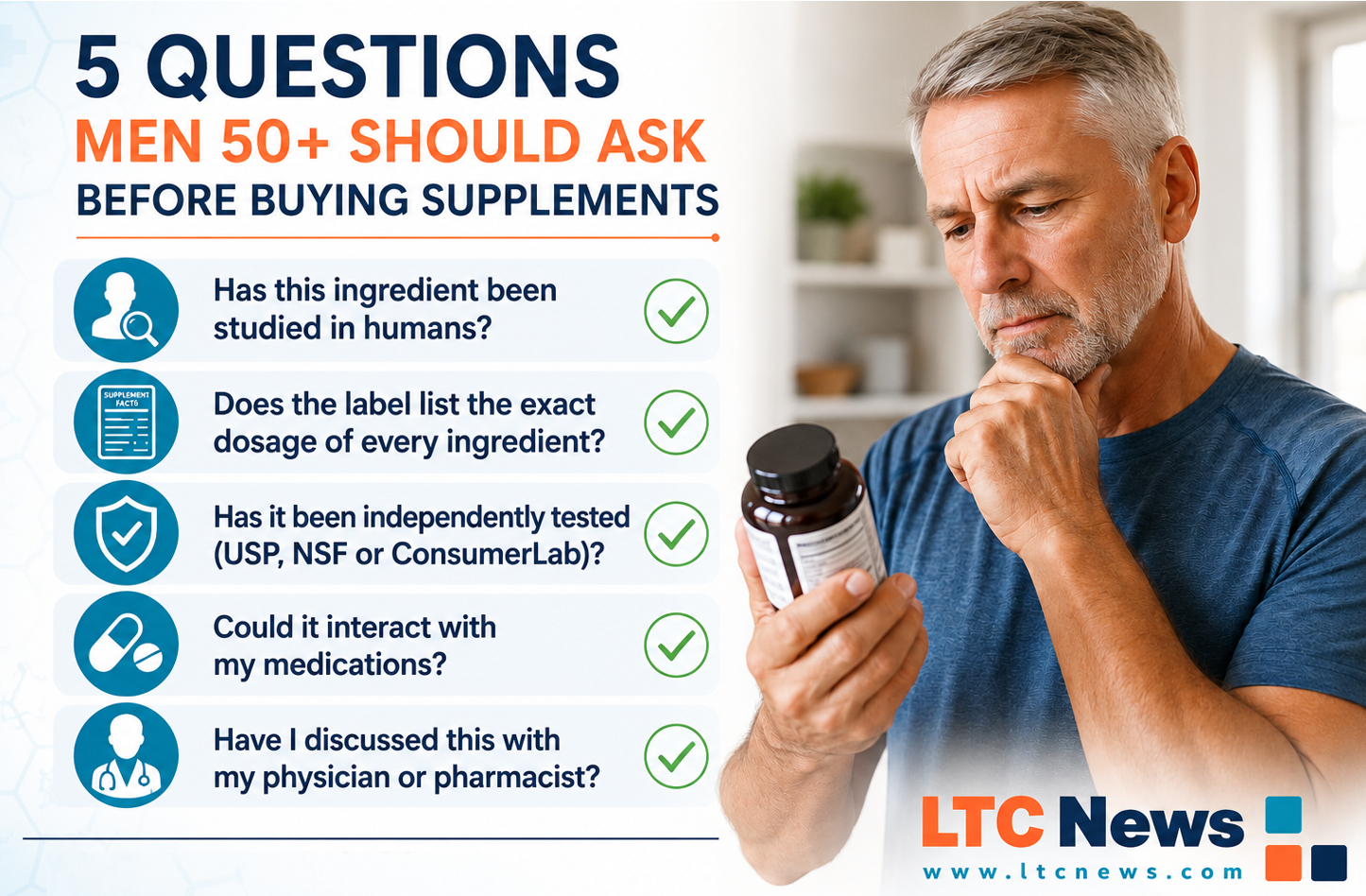
Because the FDA doesn't verify supplements before they reach shelves, look for products independently tested by a recognized third party. The most credible marks include:
- USP Verified, which confirms a product's identity, potency, and purity through annual facility audits and ongoing testing
- NSF Certified for Sport, which screens each certified lot for hundreds of substances banned in competitive sports, in addition to confirming label accuracy
- ConsumerLab, an independent lab that buys products off retail shelves, tests them, and publishes the results, including for products that fail
It's worth being clear about what these seals do and don't mean. They confirm a product contains what the label says and is free of common contaminants. They don't confirm the product will actually work for you. Quality and effectiveness are two different questions, and a certification only answers the first one.
Pay Attention to Dosages
An ingredient only works at the dose used in the research behind it. Some products list a dozen vitamins, minerals, and botanical extracts, but include amounts well below what clinical trials actually used.
A transparent label should state:
- The exact amount of each ingredient
- Serving size
- Recommended daily intake
- Duration of use, if applicable
That information also lets your physician or pharmacist check for interactions with any medications you take, a step we'll come back to below.
Consider Practical Daily Use
Even a well-researched supplement won't help if you don't take it consistently. Look for products with clear directions, a reasonable number of daily doses, easy-to-understand labels, a transparent subscription policy if there is one, and responsive customer service with a fair return policy.
A simple routine is a lot easier to stick with than a complicated schedule of pills spread across the day.
Understand "Clean Label" Claims
Many premium supplements market themselves as hormone-free, vegan, non-GMO, gluten-free, or soy-free. These features may matter to you based on dietary needs or preferences, but they say nothing about whether a product is effective. Weigh them alongside ingredient transparency, manufacturing standards, and the actual research, not in place of it.
Watch for Marketing That Sounds Too Good to Be True
Be skeptical of any product claiming to dramatically increase testosterone, reverse aging, cure erectile dysfunction, build muscle without exercise, or replace prescription medications.
By federal law, dietary supplements cannot claim to diagnose, treat, cure, or prevent disease, and any structure/function claim on a label must carry a disclaimer stating the FDA hasn't evaluated it. If a label or advertisement crosses that line, treat it as a red flag.
When "Low Testosterone" Is Really Something Else
Many men who suspect low testosterone actually have a different, treatable condition driving their symptoms: sleep apnea, obesity, type 2 diabetes, depression, a medication side effect, thyroid disease, or anemia can each produce fatigue, low libido, and reduced strength that look a lot like low testosterone on the surface. In many of these cases, treating the underlying condition, not raising testosterone, resolves the symptoms.
Testosterone naturally declines with age, in part because the testes produce fewer hormonemaking cells over time. Obesity, especially excess abdominal fat, and diabetes can further suppress testosterone, says Dr. Shalender Bhasin, an endocrinologist at Harvardaffiliated Brigham and Women’s Hospital.
A supplement won't diagnose sleep apnea or catch undiagnosed diabetes. Only a doctor and the right lab work can do that.
Talk to Your Doctor Before You Start
If you're managing heart disease, diabetes, liver or kidney disease, elevated PSA levels, benign prostatic hyperplasia (BPH), a history of prostate cancer, or a hormonal disorder, talk to your doctor before adding any new supplement.
This isn't a hypothetical concern. Some supplement ingredients interact with common medications, including blood thinners such as warfarin (Coumadin), apixaban (Eliquis), and rivaroxaban (Xarelto), as well as diabetes medications, blood pressure medications, and thyroid medication. An interaction can weaken a medication's effect, intensify it, or skew lab results your doctor relies on. Your physician or pharmacist is the right person to check.
What Actually Preserves Muscle and Independence
If your goal is genuinely to protect strength, mobility, and independence as you age, the most effective interventions available aren't in a supplement bottle. Resistance training has been shown to increase muscle protein synthesis and is considered the most effective intervention for preventing muscle loss in healthy older adults, and combining it with adequate dietary protein produces meaningfully better results than either alone.
Put simply: for physically active older adults, resistance training and adequate daily protein intake have substantially stronger evidence for maintaining muscle than any supplement currently on the market. Most experts recommend older adults consume more protein than younger adults to help preserve muscle, with individual needs depending on health status and activity level, so this is worth discussing with your doctor or a registered dietitian rather than guessing at a number.
Remember the Basics of Healthy Aging
No supplement replaces healthy daily habits. The biggest long-term gains still come from the fundamentals:
- Regular resistance and aerobic exercise
- Adequate dietary protein
- Quality sleep
- Maintaining a healthy weight
- Avoiding tobacco
- Limiting alcohol
- Managing chronic conditions
- Staying socially and mentally engaged
A supplement can play a supporting role for some men, but it works best layered on top of these habits, not in place of them.
Why This Matters for Long-Term Care Planning
Maintaining strength, balance, endurance, and overall health becomes increasingly important with age because these factors influence whether someone can continue living independently. Muscle loss, poor balance, and slow recovery after illness are among the most common reasons families begin exploring caregiving support or long-term care options.
While supplements may have a supporting role for some men, no capsule replaces the benefits of regular physical activity, proper nutrition, preventive healthcare, and early management of chronic disease.
If you or someone you love is starting to think about healthy aging and retirement planning, experts say being proactive is always the best approach. In the end, aging always wins, and being prepared for the consequences of aging, including long-term care, is essential to a comprehensive retirement plan.
Use the resources available on LTC News, like the Cost of Long-Term Care Services Calculator, which can help you understand what extended care will cost in your area when you need it; the LTC News Learning Center covers healthy aging and long-term care planning in more depth, and if an older family member needs care now, the Caregiver Directory can help you find local services.
What's the Goal?
The goal isn't simply to raise testosterone or find the next supplement. It's to remain active, independent, and healthy for as many years as possible. Thoughtful lifestyle choices, regular medical care, and informed decisions about supplements can all play a role in helping you get there.
Before you buy your next supplement, ask yourself: does the evidence behind this product match its promises, and have you talked to your doctor about what's really driving how you feel? Healthy aging begins with understanding what your body needs, not simply what a label promises.
Medical Disclaimer: This article is for educational purposes only and should not be considered medical advice. Always consult your physician or another qualified healthcare professional before beginning any dietary supplement, particularly if you have chronic health conditions or take prescription medications.
Frequently Asked Questions
What is the most effective way to preserve muscle as I age?
Research consistently shows that resistance training combined with adequate dietary protein is the most effective strategy for maintaining muscle mass and strength as you grow older. Regular physical activity, quality sleep, maintaining a healthy weight, and managing chronic medical conditions are also essential for preserving mobility and independence. Supplements may provide additional support for some individuals, but they cannot replace these healthy habits.
Do men's wellness supplements really work?
Some do, depending on the ingredient and the individual. Vitamins and minerals can correct nutritional deficiencies, while certain supplements such as creatine have strong clinical evidence for improving muscle strength when combined with resistance training. However, many herbal products marketed for testosterone or vitality have only limited or mixed scientific support. Supplements should complement a healthy lifestyle, not replace exercise, proper nutrition, or medical care.
Are dietary supplements approved by the FDA?
No. Unlike prescription medications, dietary supplements generally are not reviewed by the U.S. Food and Drug Administration (FDA) for safety or effectiveness before they reach the marketplace. Manufacturers are responsible for ensuring product quality and truthful labeling. That's why it's important to choose products that provide transparent ingredient lists, clinically meaningful dosages, and independent third-party testing.
What is sarcopenia, and why should men over 50 care?
Sarcopenia is the age-related loss of muscle mass and strength. It begins gradually as early as your 30s and often accelerates after age 60. Sarcopenia increases the risk of falls, fractures, frailty, hospitalization, and eventually the need for long-term care. Fortunately, regular resistance exercise, adequate dietary protein, and staying physically active can help slow its progression.
Can dietary supplements increase testosterone naturally?
Some ingredients have shown modest effects in small clinical studies, particularly among men with nutritional deficiencies or lower testosterone levels. However, no dietary supplement has been proven to dramatically restore youthful testosterone levels in otherwise healthy men. If you're experiencing symptoms of low testosterone, consult your physician for a proper evaluation instead of relying on supplements alone.
Which men's wellness supplement has the strongest scientific evidence?
Among the supplements discussed in this article, creatine monohydrate has one of the strongest bodies of clinical evidence. Research shows it can improve muscle strength and lean muscle mass when paired with resistance training. By comparison, herbal ingredients such as Tongkat Ali, fenugreek, and shilajit have shown promising but less consistent results and require more high-quality research.
Why is maintaining muscle so important for healthy aging?
Muscle strength affects far more than appearance. Maintaining muscle helps preserve balance, walking ability, endurance, and recovery after illness or injury. Strong muscles also reduce the risk of falls and may help older adults remain independent longer, delaying or even preventing the need for assistance with daily activities or long-term care services.
Could my symptoms be caused by something other than low testosterone?
Absolutely. Fatigue, reduced muscle strength, low libido, and decreased energy can also result from sleep apnea, obesity, diabetes, thyroid disorders, depression, anemia, medication side effects, or other medical conditions. A healthcare professional can determine the underlying cause through a medical history, physical examination, and appropriate laboratory testing.
How can I tell if a supplement is high quality?
Look for products that clearly list the dosage of every ingredient and have been independently tested by organizations such as USP Verified, NSF Certified, or ConsumerLab. While these certifications don't guarantee a supplement will work, they do help verify that it contains the ingredients listed on the label and is free of many common contaminants.
Can supplements interact with prescription medications?
Yes. Some dietary supplements can interact with blood thinners, diabetes medications, blood pressure medications, thyroid medications, and other prescription drugs. Certain herbal ingredients may also affect laboratory test results or increase the risk of side effects. Always discuss any new supplement with your physician or pharmacist before adding it to your daily routine.