How Much Exercise Do You Need After 60? A Simple Weekly Plan for Healthy Aging

About This Article
Walking, strength training, and balance exercises can help you stay healthy, prevent falls, and maintain your independence as you age. Here's how to build a weekly exercise routine that works for you without a gym membership.

Linda Kople
Linda Kople is a freelance writer focused on caregiving, aging, health, wellness, long-term care, and retirement planning
Table of Contents
- How Much Exercise Do You Need After Age 60?
- What Does a Good Weekly Exercise Routine Look Like?
- What if You're Just Starting to Exercise?
- Which Strength Exercises Are Best for Older Adults?
- How Many Repetitions Should You Do?
- Why Are Balance Exercises So Important After 65?
- How Does Exercise Help You Stay Independent Longer?
- Can Exercise Reduce Your Need for Long-Term Care?
- How Can You Exercise Safely With Health Problems?
- Staying Active Is About Enjoying Your Life
You probably do not give much thought to the quiet strength woven into your daily life. It is there every time you carry a heavy bag of groceries from the car, climb a flight of stairs to reach a favorite picture, or rise easily from your chair to greet a loved one. Yet as the years pass, preserving simple moments of independence becomes vital to staying independent as you get older.
The good news is that staying strong after 60 doesn't require running marathons, lifting heavy barbells, or spending your golden years in a noisy gym. Instead, small and consistent steps can make a profound difference.
Health experts recommend that adults should strive for at least 150 minutes of moderate physical activity each week, complemented by strength exercises on two days. For those 65 and older, the Centers for Disease Control and Prevention also highlights the importance of balance exercises—a key to staying confident on your feet. Broken down, that translates to a comfortable 30-minute brisk walk five days a week, paired with light strength work and balance movements.
Even if you have not exercised in years, your body is remarkably resilient. Abby King, Ph.D., a Stanford Medicine professor of epidemiology and population health and a faculty member at the Stanford Prevention Research Center, says it is never too late to start getting active.
We have a number of studies showing that even people who were very inactive were able to gain fitness and wellbeing benefits by increasing their regular physical activity levels in ways that fit their abilities.” — Dr. Abby King.
You can begin with brief five- or 10-minute sessions today and gently build your strength as your energy and confidence grow. Even if you have been relatively inactive for most of your life, integrating small bits of movement into our day can make a difference at any age, said Silvia Tee, M.D., a clinical associate professor of medicine and a geriatrician at the Stanford Senior Care clinic.
Just a few days of inactivity, she pointed out, can trigger long-term mobility challenges. On the flip side, a regular exercise routine can also help people stay healthy and independent." — Silvia Tee, M.D.
How Much Exercise Do You Need After Age 60?
According to Jessica Daily, Senior Lifestyle's National Director of Programming, the best exercises for seniors are easier to put into a weekly routine when the movements suit a person’s interests, mobility, and surroundings. Senior Lifestyle offers residential options for older adults, including independent living, assisted living, memory care, skilled nursing, and shortterm stays.
Daily says that walking may be convenient for one person; another may prefer an appropriate seated activity or time in a pool. What matters for planning is the kind of movement an activity provides and whether it can be done comfortably and consistently.
Strength work, for example, doesn't have to start in a gym. Depending on a person’s abilities, it may involve controlled sit-to-stand movements, resistance bands, or other suitable movements that challenge major muscle groups. Balance practice might include standing near a sturdy counter while shifting weight slowly or trying another movement suited to the individual. The CDC’s examples of activities that count can help distinguish aerobic, strength, and balance work when choosing what to include.
Enjoyment matters, too. A preferred walking route or a class that feels welcoming is easier to return to than a plan built entirely around exercises someone dislikes. The goal is not to find a single perfect movement. It is to choose a workable mix that covers different needs over time.
The CDC recommends that adults ages 18 to 64 get at least 150 minutes of moderate-intensity aerobic activity weekly, or 75 minutes of vigorous activity, or an equivalent combination. Adults 65 and older have the same aerobic target, with an added emphasis on balance.
According to the CDC's Older Adult Activity: An Overview, your weekly activities should include:
- Aerobic exercise: Brisk walking, swimming, cycling, or other activities that raise your heart rate.
- Strength training: Exercises that work the major muscle groups at least twice weekly.
- Balance exercises: Activities that improve steadiness and coordination, particularly for adults 65 and older.
You can tell whether you're exercising at a moderate intensity by using the talk test. Your breathing should be faster than usual, but you should still be able to hold a conversation. Walking is an easy choice for many people, although swimming, dancing, water aerobics, and cycling can provide similar cardiovascular benefits.
The CDC also recommends being as active as your abilities allow, even when you cannot meet the full weekly targets.
What Does a Good Weekly Exercise Routine Look Like?
You don't need to exercise for hours every day. A regular schedule can help you fit different activities into your week. Here's an example for someone who can comfortably walk at a moderate intensity.
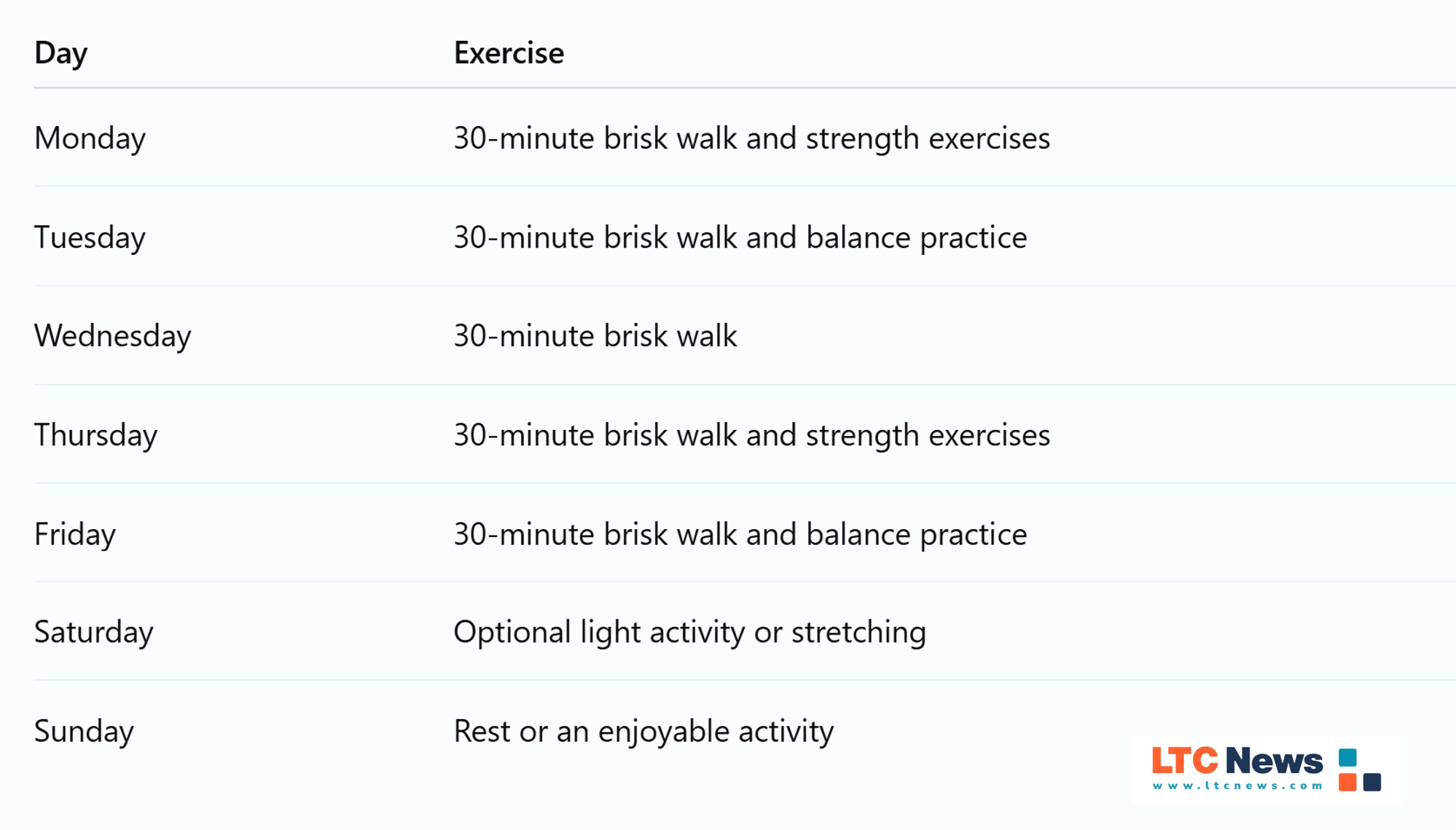
Five 30-minute walks provide the recommended 150 minutes of moderate aerobic activity. The strength sessions should cover all major muscle groups. You can divide walking into shorter periods if that works better. A 15-minute walk in the morning and another after dinner can be just as useful as one 30-minute session at the same intensity.
Weather doesn't have to interfere, either. Indoor walking, a stationary bicycle, or an appropriate fitness class can provide alternatives when outdoor conditions are poor. If you walk outdoors, watch for uneven sidewalks and other fall hazards.
What if You're Just Starting to Exercise?
If you've been inactive, don't try to follow the full schedule immediately. Start with something manageable.
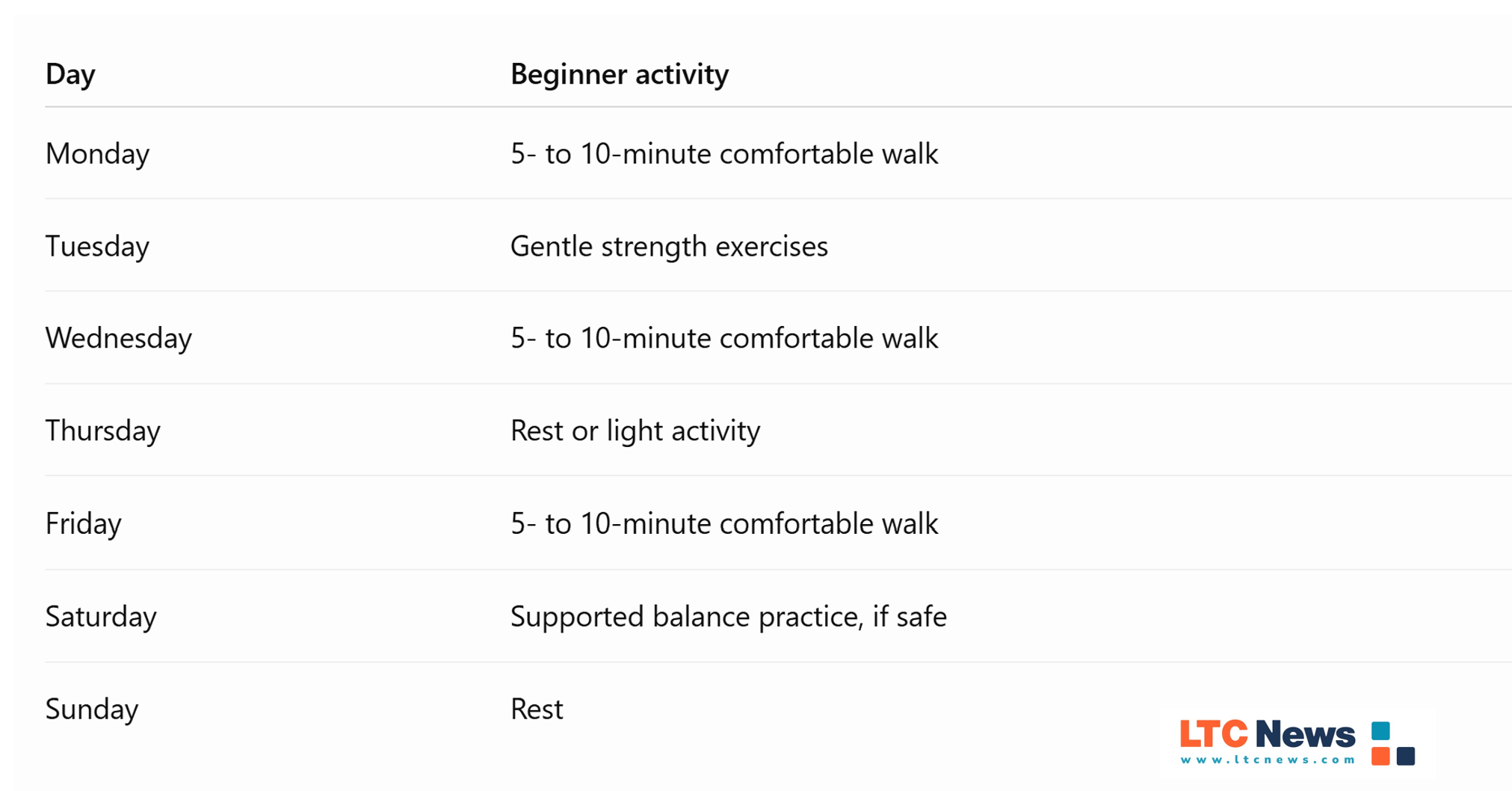
This beginner schedule is a starting point, not a substitute for the full CDC recommendations. Your initial walks may be slower than moderate intensity. As your endurance improves, gradually add time or increase the pace. The National Institute on Aging's Tips for Getting and Staying Active as You Age recommends building activity gradually and choosing movements you enjoy.
Which Strength Exercises Are Best for Older Adults?
Muscle strength plays an important role in staying independent. Think about how often you use your legs to stand, your arms to carry something, or your core muscles to keep yourself steady. Strength training helps maintain those abilities.
You can begin with simple exercises at home:
- Sit-to-stand: Sit in a sturdy chair, stand up slowly, and sit back down with control. Use your hands for support if needed.
- Wall push-ups: Place your hands against a wall, bend your elbows, and gently push yourself away.
- Resistance-band rows: Pull a resistance band toward your body to strengthen your back and arms.
- Supported heel raises: Hold a sturdy counter and slowly lift and lower your heels.
- Light weights: Use comfortable hand weights for appropriate arm and shoulder exercises.
These are examples rather than a complete program. Your routine should work the legs, hips, back, abdomen, chest, shoulders, and arms.
How Many Repetitions Should You Do?
The CDC's What Counts as Physical Activity for Older Adultssuggests eight to 12 repetitions of a strengthening exercise. If you're new to strength training, start with one set. Add sets as you get stronger. The final repetition should feel challenging enough that doing another without help would be difficult.
You shouldn't have to strain excessively or push through pain. If you're unsure which movements are safe, a doctor or physical therapist can help you select appropriate exercises. Strength training can also support bone health as you age.
Why Are Balance Exercises So Important After 65?
Losing your balance can have serious consequences as you grow older. The CDC reports that more than 14 million Americans ages 65 and older, about one in four, report falling each year. Falls are the leading cause of injury among older adults, according to the CDC's Older Adult Falls Data. A serious fall can lead to a broken hip, head injury, hospitalization, or a lasting loss of mobility. Fortunately, balance and strength exercises can reduce the risk of falling.
Depending on your abilities, you might try:
- Heel-to-toe walking: Walk slowly with one foot directly in front of the other, keeping secure support within reach.
- Supported weight shifting: Hold a sturdy counter while gradually shifting your weight from one leg to the other.
- Sit-to-stand exercises: Practice rising from a chair and sitting down with control.
- Tai chi: Join an appropriate class that uses slow movements to improve balance and coordination.
Never attempt a challenging balance exercise without adequate support. If you've recently fallen or have trouble staying steady, ask your doctor or physical therapist which activities are safe.
How Does Exercise Help You Stay Independent Longer?
Regular physical activity offers benefits that extend beyond fitness. The CDC links exercise in older adults to improved brain health, lower fall risk, and better management of chronic conditions, including heart disease and type 2 diabetes.
Physical activity can also help people maintain independence longer. That independence often comes down to ordinary activities. Getting out of bed, stepping into the shower, dressing, and walking around your home may seem simple until an injury or medical condition makes them difficult.
These tasks are closely related to the activities of daily living used to evaluate long-term care needs. Six commonly recognized activities are bathing, dressing, eating, toileting, continence, and transferring, such as moving from a bed to a chair, known as "activities of daily living." Under federal tax-qualified Long-Term Care Insurance standards, benefits may become available when someone is expected to need substantial assistance with at least two of these activities for at least 90 days. Severe cognitive impairment requiring substantial supervision is another qualifying trigger. Policy conditions and certification requirements also apply.
Exercise may help preserve some of the physical abilities needed for daily activities, but it cannot prevent every illness, injury, disability, or even frailty due to aging.
Can Exercise Reduce Your Need for Long-Term Care?
Staying physically active can reduce certain risks that contribute to disability, particularly falls and loss of strength. However, even someone who has exercised throughout adulthood may eventually need help because of dementia, arthritis, a stroke, or another health condition.
56 percent of Americans turning 65 will eventually need help with daily living activities or supervision due to memory loss. Being proactive with your health and wellness, staying physically and mentally active, and getting regular check-ups with your doctor can help delay the need for long-term care. However, doing these things won't prevent it.
Family members often provide that assistance, sometimes at considerable personal and financial expense, when no other plan is in place. Planning now, before you retire, will give you more choices when you do need help.
Medicare does not pay for ongoing custodial long-term care, although it may cover up to 100 days of qualifying skilled nursing facility care per benefit period. Medicaid helps eligible people with limited financial resources and qualifying care needs.
Long-Term Care Insurance can provide tax-free benefits under applicable rules to help pay for care at home or in a facility, depending on the policy.
Exploring coverage while you're younger and healthier offers more options. However, eligibility depends on your medical history and the insurer's underwriting requirements. Exercise alone does not guarantee approval. You can review Long-Term Care Insurance options and work with a qualified Long-Term Care Insurance specialist to get personalized LTC Insurance quotes from top brands offering Long-Term Care Insurance plans.
Taking care of your health can help preserve your independence for a longer period of time. Preparing for future extended care costs will help protect your income and assets and reduce the burden on loved ones.
How Can You Exercise Safely With Health Problems?
You may need to modify your routine if you have arthritis, heart disease, breathing problems, or difficulty walking. For example, someone with knee pain may find swimming or a stationary bicycle more comfortable than walking long distances. If you have trouble standing for long periods, seated exercises or movements recommended by a physical therapist may be appropriate.
Warm up with easier movement before exercising and cool down afterward. Wear supportive shoes and keep exercise areas free of obstacles. Remember to drink water before, during, and after activity, even when you don't feel thirsty. Older adults may not always recognize thirst as readily as younger people. If your doctor has placed you on fluid restrictions, follow those instructions. Pay attention to how you feel while exercising.
Stop if you become dizzy, nauseated, or unusually short of breath. Call 911 if you have chest pain, faint, or have severe trouble breathing. People with chronic medical conditions, recent surgery, or significant mobility limitations should ask their doctor about appropriate activities before making major changes to their routine.
Staying Active Is About Enjoying Your Life
You don't have to become an athlete to benefit from exercise. A walk with your spouse, an afternoon in the pool, or a few strength exercises at home can help you stay active while doing something you enjoy. Some days you'll feel energetic. Other days, a shorter walk or lighter activity may be more appropriate.
As you grow older, maintaining your strength and mobility can help you continue doing the things that make life enjoyable, like traveling, spending time with grandchildren, working in the garden, or simply moving around your home without assistance. You can't prevent every health problem that comes with aging. But staying active and planning for the possibility of future long-term care needs can help you and your family face those changes with more confidence.
Quality Extended Care Matters: If you're looking for professional caregivers or long-term care communities for a loved one with a proven track record of helping residents stay active, healthy, and engaged, use the LTC News Caregiver Directory. You can search more than 80,000 care providers nationwide to find quality care options that meet your loved one's needs. Just type in a ZIP code, city, or town name, and find the best providers near you or your loved one.
If you manage a provider, claim your free listing on the LTC News Caregiver Directory and/or upgrade it to boost visibility and highlight your staff and services through the LTC News Directory Business Portal.
Frequently Asked Questions
Do you need a gym membership to stay healthy after 60?
No. Walking, resistance bands, chair exercises, light weights and supported balance activities can provide meaningful health benefits at home. Choose activities that match your abilities and work toward the CDC's weekly exercise recommendations.
Can you start exercising after 70 if you've been inactive for years?
Yes. It's never too late to benefit from physical activity. Start with manageable activities, such as five- or 10-minute walks, and gradually increase your activity as your strength and endurance improve. Ask your doctor for advice if you have health concerns or mobility limitations.
What exercises help older adults prevent falls?
Strength and balance exercises can reduce fall risk. Activities such as tai chi, supported heel-to-toe walking, sit-to-stand exercises and resistance training can improve steadiness and muscle strength. People with significant balance problems should seek advice from a doctor or physical therapist.
Can regular exercise help you avoid needing long-term care?
Regular exercise can help maintain strength, mobility and independence while reducing some risks associated with disability. However, it cannot prevent every illness, injury or age-related condition. Federal research estimates that 56 percent of Americans turning 65 will eventually need long-term services and supports, making advance planning important even for healthy adults.
How much exercise should you get each week after age 60?
The CDC recommends at least 150 minutes of moderate-intensity aerobic activity weekly, such as brisk walking, along with muscle-strengthening exercises on two days. Adults 65 and older should also include balance exercises to help reduce their risk of falling.


Sponsored