How Mobile Health Apps Can Help Older Adults Age Safely at Home
About This Article
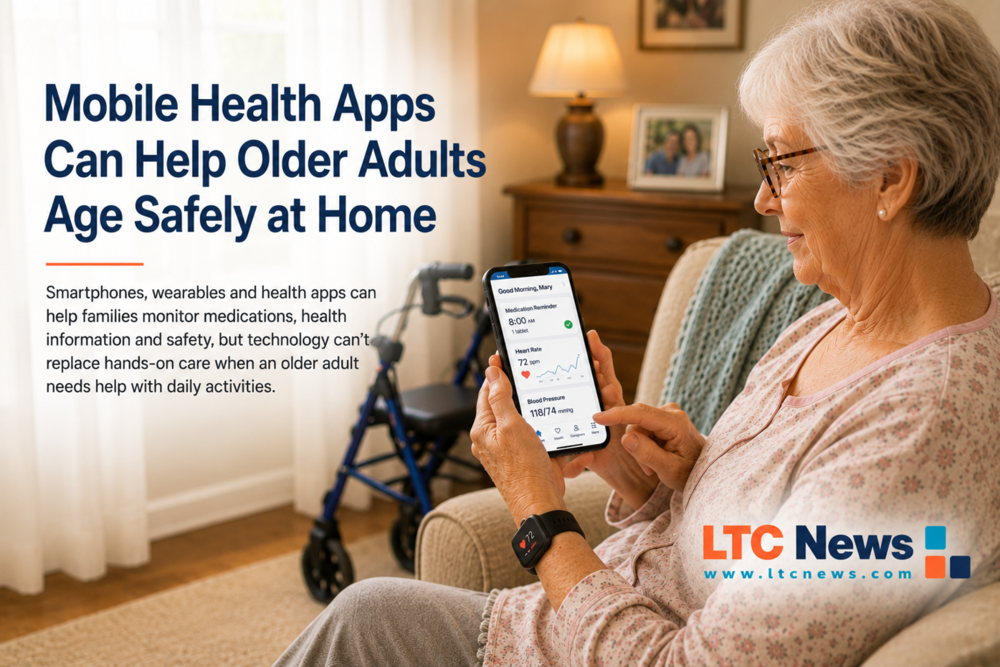
Aging at home is important for many older adults. Mobile health apps and connected devices can help older adults age at home by supporting medication reminders, storing health information, enabling remote doctor visits and, with a compatible wearable or device, sending a fall alert to family.

Jacob Thomas
Jacob Thomas writes on health, wellness, and retirement topics, including aging, caregiving, insurance, and long-term care.
If you're helping an aging parent stay in their own home, you've probably looked into a health app or two. You're not alone. Adults age 50 and older now own smartphones at nearly the same rate as younger adults. About 90 percent own one, according to AARP's 2026 Tech Trends report.
The interest in these tools reflects a larger goal. About 75 percent of adults 50 and older say they want to remain in their homes for the long term, according to AARP's Home and Community Preferences Survey. That shift is changing what aging in place can look like. It's worth understanding what these tools actually do, and don't do, before building a care plan around one.
As more older adults need mobile health apps and other technology devices at home, this rising demand is pushing companies to rely on healthcare mobile app development services because building technology that is both useful and easy to use for older adults takes more than clean code. The good news is there are more and more available options to help your loved one age in place safely.
Technology can be a very beneficial tool for older adults who want to remain at home, especially when it’s paired with the helping hand of a family member or professional caregiver. People who contact LTC News often ask whether technology can help a loved one stay at home longer and whether Long-Term Care Insurance will pay for that technology. The answer depends on the technology and the policy, but these tools can be an important part of a broader plan that combines technology with human care and support.” — Nick DeFrank, Vice President, LTC News.
What Mobile Health Apps and Connected Technology Do
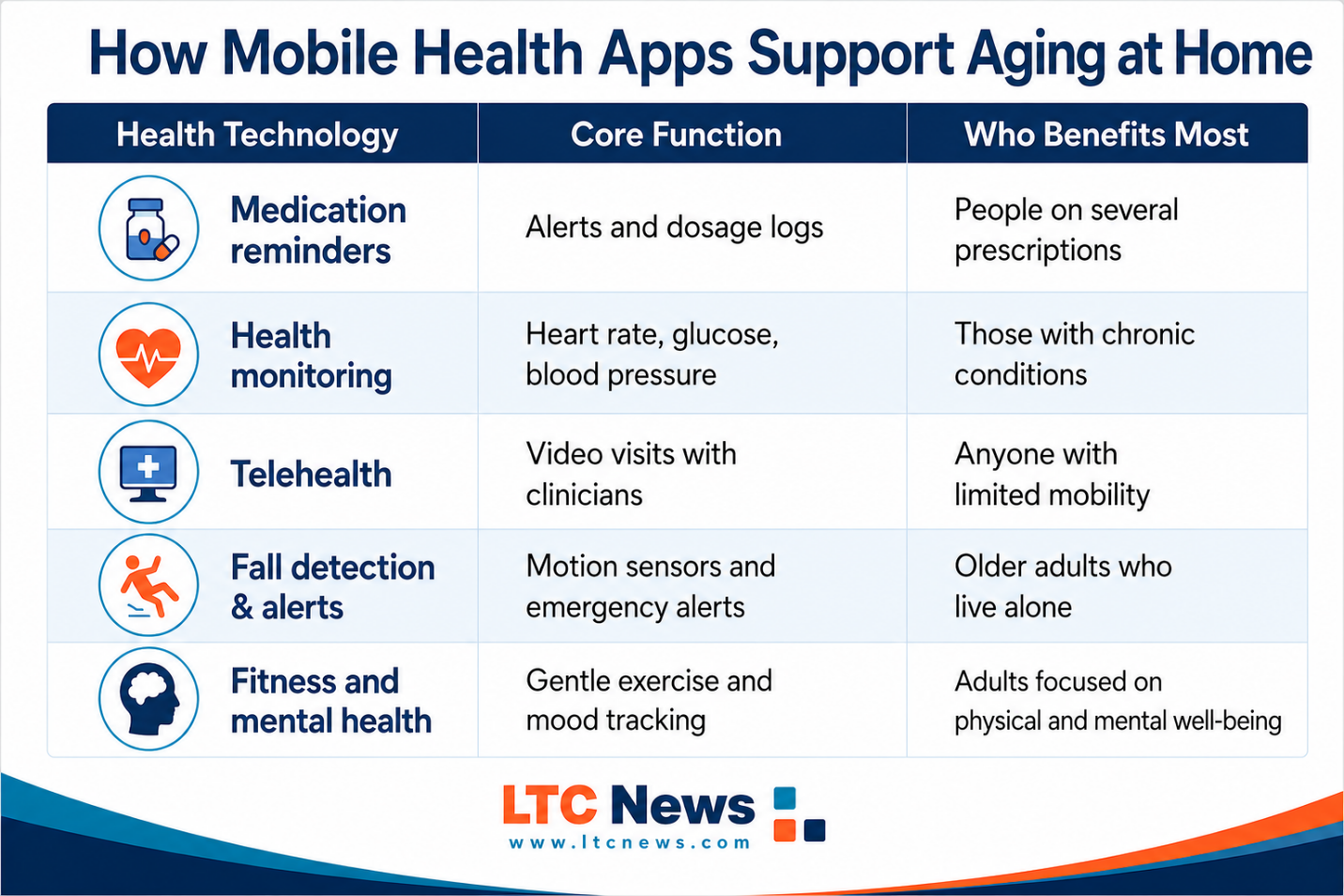
The term "health app" covers a wide range of tools, and many depend on a paired wearable, smartwatch or Bluetooth medical device rather than the phone alone:
- Medication reminders that alert a person when it's time for a dose and log what was taken
- Health monitoring that records or displays information such as blood pressure, glucose or heart rate, often using data from a connected medical device or wearable
- Telehealth apps that connect a person to a doctor or nurse by video
- Fall-detection features on some smartphones, watches and monitoring devices
- Health record apps that keep test results and visit notes in one place
Interest in these tools is real. Nearly half of adults 50 and older say technology can help them live a healthier life, and more than a third already use wearable devices, per AARP's survey.
Fall Detection: What It Can and Can't Do
Falls are the leading cause of injury among older adults. Every year, more than 14 million adults 65 and older report a fall, or about one in four, according to the Centers for Disease Control and Prevention.
Fall-detection features on some smartphones, watches and monitoring devices can provide another layer of protection by alerting a family member, caregiver or emergency service after a suspected fall. They don't prevent every fall or guarantee that an emergency will be detected, but they may shorten the time someone waits for help.
Technology Can Monitor. It Can't Provide Care.
A smartphone, wearable or monitoring system can provide useful information, reminders and alerts. But technology can't help someone get dressed, bathe safely, use the toilet, prepare meals or physically get out of bed.
Family caregivers often step in to fill those gaps. AARP and the National Alliance for Caregiving reported that 63 million Americans provided unpaid or paid care to an adult or child in 2025, underscoring how central families remain to care even as technology becomes more advanced.
For people who eventually need help with activities of daily living or supervision because of cognitive impairment, technology can support the care plan, but it generally cannot replace handson assistance from family members or paid caregivers.
Federal research estimates that 56 percent of people turning 65 will develop a need for long-term services and supports during their remaining lifetime. Technology may make aging at home easier, but families should still plan for the possibility that hands-on help will eventually be necessary.
What to Weigh Before You Rely on One
No app or device replaces a full long-term care plan, and not every tool fits every person. Before you or a parent relies on one:
- Match the technology to the actual health need, not just what's popular
- Check that the text and buttons are large and easy to read
- Find out who receives an alert and what happens next; a fall notification or abnormal reading has limited value if nobody is monitoring it or knows how to respond
- Check whether the technology requires Wi-Fi, cellular service, Bluetooth, or a paid subscription, and understand what happens during a power or internet outage
- If appropriate, determine whether a family caregiver or other trusted person can securely access important readings or alerts
- Test it together for a few weeks before depending on it fully
Privacy deserves extra scrutiny. AARP's 2026 research found that data privacy remains the top barrier to technology adoption among older adults considering new technology. Before using a health app, check what information it collects, where the information is stored, and whether it can be shared with third parties.
How Technology Is Enhancing Life Inside LongTerm Care Communities
Longterm care facilities are increasingly adopting technology to strengthen quality of life for residents, not just streamline operations. Many communities now use smart sensors and unobtrusive monitoring systems to track sleep patterns, mobility and environmental comfort, allowing staff to respond quickly when a resident needs assistance. Digital care platforms also help teams coordinate routines, medication schedules and therapy plans, reducing delays and improving consistency in daytoday support.
Facilities are pairing these tools with technologies that enhance engagement and independence. Voiceactivated devices, adaptive tablets and virtual reality programs give residents new ways to communicate, participate in activities and stay mentally stimulated. Even small additions—like automated lighting, personalized music systems or digital reminders—can make daily life safer and more enjoyable. The goal isn’t to replace human interaction, but to use technology to reinforce dignity, connection and a sense of control for every resident.
Technology companies are also accelerating innovation for an aging population, developing tools that support safety, independence and connection whether someone lives at home or in a longterm care facility. From AIdriven falldetection systems to more intuitive telehealth platforms, developers are refining products to meet the complex needs of older adults and the caregivers who support them. Emerging solutions—like personalized digital companions, adaptive mobility devices and smarter medicationmanagement tools—reflect a growing commitment across the tech sector to help older Americans maintain quality of life in every care setting.
Planning Beyond the App
Technology may help someone remain independent longer, but increasing health or mobility problems can eventually create a need for hands-on help. Long-Term Care Insurance can help pay for eligible care at home or in other settings when a person meets the policy's benefit requirements, generally because they need help with activities of daily living or have qualifying cognitive impairment.
If you're building that plan, LTC News's Cost of Long-Term Care Services Calculator can show what home care costs in your area, and the LTC News Learning Center walks through how Long-Term Care Insurance works.
NOTE: If you're further along and need to find paid or family caregiving help for a loved one, the Caregiver Directory is a good next stop. You can search from over 80,000 in-home caregivers, senior communities, and long-term care facilities nationwide.
The best technology is the technology an older adult will actually use and that family caregivers understand. Mobile health apps and connected devices can provide another layer of information, safety, and connection, but they should complement, not replace, a realistic plan for future care needs.
Frequently Asked Questions
Can mobile health apps help older adults remain at home longer?
Yes. Mobile health apps and connected devices can support aging at home by providing medication reminders, organizing health information, supporting telehealth visits, and monitoring certain health and safety information. However, technology works best as part of a broader plan that includes family involvement or professional caregiving when needed.
What should families look for when choosing a health app or connected device?
Choose technology based on the older adult's actual needs and ability to use it. Consider ease of use, accessibility, privacy protections, caregiver access, subscription costs, internet or cellular requirements, and what happens if the device loses power or connectivity. Families should also understand who receives an alert and what happens after one is triggered.
Are mobile health apps safe for personal health information?
Privacy protections vary by app and device. Before using one, review what information it collects, how and where the data is stored, whether information is shared with third parties, and what controls the user has over access. Health information entered into every consumer health app is not necessarily protected in the same way as information maintained by a health care provider.
Can technology replace a family or professional caregiver?
No. Technology can monitor, remind and alert, but it cannot provide most forms of hands-on assistance. Someone who needs help bathing, dressing, toileting, eating, transferring or performing other daily activities will generally still need assistance from a family member or professional caregiver.
Will Long-Term Care Insurance pay for health apps, wearables or monitoring technology?
It depends on the policy and the technology. Long-Term Care Insurance primarily helps pay for eligible long-term care services once the insured meets the policy's benefit requirements. Some policies may cover certain equipment, technology, home modifications, or alternative-care services when they are part of an approved plan of care. Families should review the specific policy and contact the insurance company before assuming a device or service is covered.
Can a smartphone or smartwatch detect a fall?
Some smartphones, smartwatches and monitoring devices can detect a suspected fall and send an alert to a family member, caregiver or emergency service. These features can provide an additional layer of protection, but they cannot detect every fall, prevent falls or guarantee that help will arrive immediately.
What types of health technology are most useful for older adults?
Common tools include medication reminder apps, telehealth platforms, health record apps, fall-detection technology and devices that track information such as heart rate, blood pressure or glucose. Some functions require a smartwatch, wearable or connected medical device rather than a smartphone alone.


Sponsored