How AI Is Changing Dementia Care and Long-Term Care Services
About This Article
Artificial intelligence is transforming dementia care, caregiving, home care, assisted living, and aging in place. Learn what AI can and cannot do for older adults and families. Will Long-Term Care Insurance pay for AI tools to help provide safety and quality extended care?

Jacob Thomas
Jacob Thomas writes on health, wellness, and retirement topics, including aging, caregiving, insurance, and long-term care.
Table of Contents
- Artificial Intelligence Is Expanding Across Long-Term Care
- What Artificial Intelligence Actually Is
- Limits of AI in Extended Care and Memory Care Settings
- Why Voice-Based AI Works Well for Early Memory Loss
- What AI Voice Assistants Can Do Day to Day
- AI and Aging in Place
- How AI Is Being Used Across Long-Term Care Services
- AI Scams and Privacy Risks Families Should Understand
- Will Long-Term Care Insurance Cover AI Tools and Smart Care Technology?
- AI in Memory Care and Assisted Living Does Not Replace Quality Care
- Financial Reality of Dementia Care Has Not Changed
- Human Care Still Matters Most
- AI — a Tool to Help Older Loved Ones
By: Jacob Thomas
If you're caring for a parent with early Alzheimer's disease, you know how quickly memory loss can reshape everyday life. The same question was asked four times before breakfast. Medication was left untouched on the kitchen counter. An appointment forgotten by noon.
For loved ones and caregivers, those moments are exhausting. For the person living with memory loss, they often create anxiety, embarrassment, and a growing fear of losing independence.
Artificial intelligence is not a cure for dementia. But AI-powered tools, including voice assistants, smart home sensors, medication reminders, predictive monitoring systems, and fall detection technology, are beginning to change how older adults receive support at home and in long-term care settings.
For some families, these technologies may help older adults remain safer and more independent longer. They may also reduce some of the daily stress that contributes to caregiver burnout.
Artificial Intelligence Is Expanding Across Long-Term Care
Artificial intelligence is increasingly being used in dementia care, home care, assisted living, memory care, rehabilitation, and caregiving support. AI-powered tools can help monitor routines, organize reminders, identify possible health changes, and improve communication between older adults, caregivers, and healthcare providers.
However, experts caution that AI cannot replace human supervision, emotional support, medical judgment, or long-term care planning.
According to the Alzheimer’s Association, an estimated 7.4 million Americans age 65 and older are living with Alzheimer’s disease in 2026. About 1 in 9 Americans age 65 and older has Alzheimer’s, and experts project the number could rise to nearly 13.8 million by 2060, barring major medical breakthroughs. Nearly three-quarters of those living with Alzheimer’s are age 75 or older.
At the same time, an LTC News analysis of the 2025 Caregiving in the U.S. report from AARP shows that 63 million Americans now provide unpaid caregiving support for aging or disabled loved ones, reflecting a dramatic increase in family caregiving responsibilities nationwide.
Those realities are accelerating interest in technologies designed to help older adults age in place while supporting overwhelmed caregivers.
What Artificial Intelligence Actually Is
Artificial intelligence refers to computer systems designed to perform tasks that normally require human intelligence. These systems analyze data, recognize patterns, learn from information, and respond based on probabilities and algorithms.
Many people already use AI daily without realizing it. Voice assistants, fraud alerts from banks, navigation apps, smart watches, and even customer service chatbots all rely on forms of artificial intelligence.
AI systems can recognize speech, identify patterns, organize schedules, monitor behaviors, and rapidly process large amounts of information. Some healthcare systems now use AI to help identify possible medical problems earlier or reduce administrative burdens on doctors and nurses.
But AI is not human thinking. It does not possess emotions, judgment, empathy, or human understanding.
Limits of AI in Extended Care and Memory Care Settings
Families need the most clarity here. Artificial intelligence can support caregiving, but it cannot replace human care. Research from the University of Washington found that people living with mild Alzheimer's disease most valued human connection over what technology could offer.
In a study led by gerontologist Clara Berridge, PhD, participants said they preferred visits and phone calls from family and friends over what any robot or AI system could provide. (Source: Nature, April 25, 2024; BBC Radio 4, May 29, 2024)
AI is not:
- Human consciousness
- A doctor or nurse
- A substitute for caregivers
- A replacement for emotional connection
- Guaranteed to be accurate
- A cure for Alzheimer’s disease
- A replacement for long-term care planning
AI systems can make mistakes, misunderstand emergencies, provide inaccurate information, or fail during internet or power outages. Some systems also generate false information, sometimes called “hallucinations,” where incorrect responses are presented confidently as fact.
Most importantly, AI cannot replace human compassion, physical caregiving, or emotional support. Most people living with dementia eventually require direct help with daily living activities like bathing, dressing, eating, toileting, supervision, mobility, and medication management. Technology may improve safety and organization for some individuals, but it does not eliminate the reality of long-term care needs.
Why Voice-Based AI Works Well for Early Memory Loss
One reason voice technology works particularly well for people with early-stage cognitive decline is what it does not require. No typing. No swiping. No passwords. No complicated menus.
A person can simply ask:
- “What day is it?”
- “Did I take my medicine?”
- “When is my doctor’s appointment?”
- “Call my daughter.”
The response comes back instantly and consistently. That consistency matters more than many people realize. Family caregivers — even loving and patient ones — may become emotionally exhausted answering the same question repeatedly throughout the day.
Voice assistants respond calmly every time, which may reduce anxiety and embarrassment for someone aware of their own memory struggles. For many people with early-stage dementia, preserving dignity matters just as much as preserving memory.
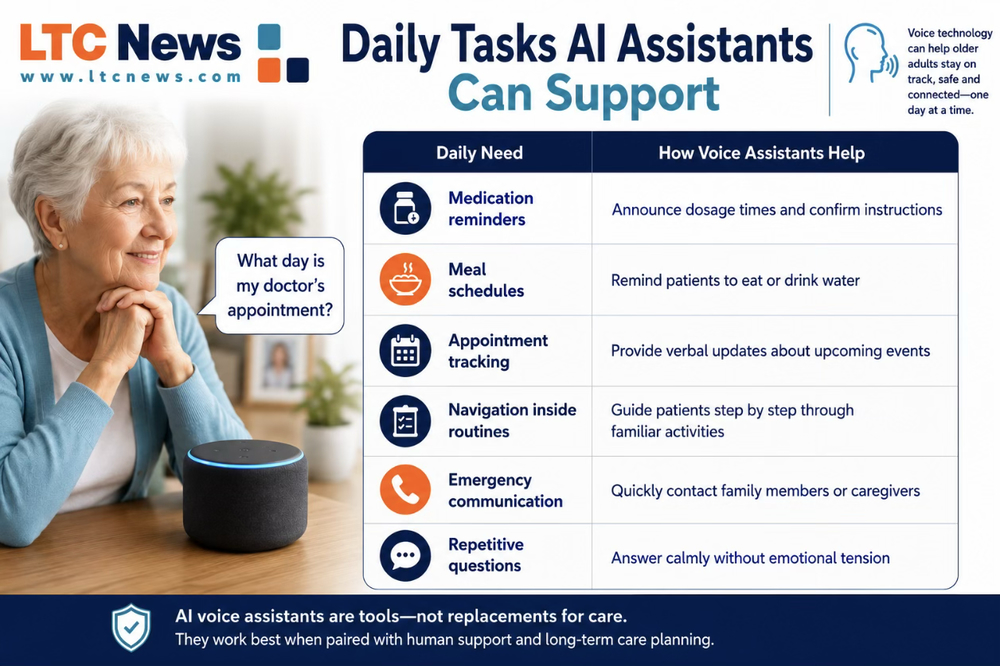
What AI Voice Assistants Can Do Day to Day
Voice-based systems work best when they reduce friction from ordinary daily tasks. For someone with early cognitive decline, even small disruptions can create confusion that lasts for hours.
AI-powered voice systems may help with:
- Medication reminders
- Hydration and meal reminders
- Appointment tracking
- Step-by-step routine guidance
- Emergency contact support
- Calendar reminders
- Repetitive question responses
- Simple communication with caregivers
Some families also use digital note-taking and transcription tools to help capture important thoughts and reminders before they are forgotten. That can be especially helpful for people in the early stages of memory loss who may remember something important for only a brief moment before it fades.
The National Institutes of Health specifically recommends that people with mild cognitive impairment use memory aids, including to-do lists, notes, and calendars, as practical strategies for managing daily cognitive challenges. Voice-based tools that can instantly capture and store a spoken thought extend that same strategy into the digital age, making it easier for both patients and caregivers to preserve important information and review it later.
AI notes maker, from Edubrain AI, is an example of a tool that has become a powerful memory aid. For example, a person might verbally record a reminder about an upcoming appointment, medication change, or family event using a voice-enabled app or digital assistant. The system can then organize the information into written notes that caregivers and family members can review later.
Instead of relying entirely on handwritten reminders that can be misplaced or forgotten, these tools may help families maintain clearer records, improve communication, and reduce some of the confusion that often accompanies cognitive decline.
These tools can reduce the mental effort required to remember small but important details. For some families, that changes the emotional dynamic inside the home. Interactions become less about correction and more about connection.
AI and Aging in Place
Voice assistants are only one part of a broader category of technology helping older adults remain at home longer. AI-driven home support systems now include motion sensors that detect unusual inactivity, smart stoves that automatically shut off, fall detection systems, wandering alerts for dementia patients, medication dispensers, sleep monitoring systems, and emergency response technology.
For adult children managing care from another city or state, these systems may reduce constant worry and enable earlier intervention if something changes at home. Even for professional caregivers in the home, it provides additional "eyes" to support safety and a better quality of life.
👉Find quality in-home caregivers and long-term care facilities, including memory care, by searching with the LTC News Caregiver Directory.
"This is just the tip of the iceberg, from navigation apps that learn your routines to chatbots that offer appointment reminders or medication support, AI is woven into nearly every aspect of the technology we rely on nowadays. For caregivers, that means there are already powerful tools at their fingertips that can make daily care tasks easier, safer, and more efficient." — Keren Etkin, Gerontologist, Author of The AgeTech Revolution, in AARP.
Still, experts caution that these systems are not foolproof. False alarms occur. Sensors fail. Internet outages interrupt coverage. Some older adults may become confused or frustrated by the technology.
Technology works best as a support layer — not a substitute for human oversight.
How AI Is Being Used Across Long-Term Care Services
Artificial intelligence is rapidly expanding beyond home use into nearly every area of long-term care and healthcare. In many cases, families may not even realize the technology is already being used behind the scenes.
- Home Care
Home care agencies increasingly use AI-driven scheduling systems to coordinate caregiver visits more efficiently and reduce delays caused by staffing shortages. Some providers also use monitoring systems that help track medication adherence, identify unusual activity patterns, or alert family members when something appears wrong inside the home.
Building these systems is rarely about the model itself. Yuri Musienko, Chief Business Development Officer at Merehead, tells LTC News that building these systems is usually less about the AI itself and more about making it work with the tools an agency already uses. As the engineering team at Merehead explains in its guide to AI integration, the real challenge is connecting AI with existing scheduling, recordkeeping, and alert systems.
The most important safeguard in AI systems is not model accuracy, but traceability. Each decision is logged with a rationale, so a person can review the reason for the alert and cancel it. Care technologies require the same discipline: Treat an AI alert as a prompt to review, not a decision already made." — Yuri Musienko, Chief Business Development Officer at Merehead.
For families trying to support an aging parent remotely, these systems may provide reassurance without requiring constant phone calls throughout the day.
- Assisted Living Communities
Some assisted living communities now use predictive monitoring systems designed to identify possible fall risks, sleep disruption, or sudden behavior changes that could signal a health decline.
Operators hope the technology may allow staff to intervene earlier before a small problem becomes a medical emergency. Experts caution that technology should support caregivers, not replace personal interaction or direct observation.
- Memory Care Programs
Memory care communities are increasingly experimenting with AI-supported engagement tools, including personalized music therapy, reminiscence prompts, wandering prevention systems, and interactive conversation programs designed to stimulate cognitive engagement. Reminiscence work depends on what the family can actually put in front of someone, and decades-old prints are often too faded to prompt much. An AI Image Editor, like Higgsfield, repairs the originals, sharpening a damaged photograph enough for a resident to recognize the face in it.
Some providers believe these technologies may help reduce agitation or improve routine consistency for certain residents with dementia.
- Nursing Homes
Some nursing homes now use AI-assisted systems for pressure ulcer monitoring, infection surveillance, staffing coordination, emergency alerts, and electronic charting support.
Facilities continue searching for ways to improve resident safety while coping with nationwide staffing shortages and rising care demands.
- Hospitals and Rehabilitation Centers
Hospitals increasingly use AI for imaging analysis, rehabilitation tracking, patient monitoring, and predicting possible hospital readmissions.
Healthcare systems hope these technologies may help reduce paperwork burdens on doctors and nurses while identifying medical concerns earlier.
- Caregiver Support
Family caregivers are also turning to AI-based organizational tools to help coordinate appointments, medication schedules, caregiving tasks, and communication between relatives.
For caregivers already balancing jobs, children, and caregiving responsibilities, even small reductions in stress can make a meaningful difference.
AI Scams and Privacy Risks Families Should Understand
As AI technology advances, experts warn that older adults are increasingly targeted by sophisticated scams that use cloned voices, fake emergency calls, and AI-generated fraud schemes.
Remind your loved one never to share passwords through voice systems or provide financial information to unknown callers. Families should also carefully review privacy settings on smart devices used in the home.
Many connected devices collect voice recordings, behavioral patterns, health-related information, and location data. Privacy protections and cybersecurity have become increasingly important for aging families using connected technology.
Will Long-Term Care Insurance Cover AI Tools and Smart Care Technology?
Some Long-Term Care Insurance policies may help cover certain AI-assisted tools or monitoring systems when the policy includes “Alternate Plan of Care” language or flexible benefit provisions. These provisions allow the insurance company, policyholder, and healthcare providers to agree on services, equipment, or technologies not specifically listed in the original policy if they help maintain safety, improve quality of care, or delay more expensive institutional care.
For example, AI-supported fall detection systems, remote monitoring technology, medication reminder platforms, wandering prevention tools, smart home safety devices, or digital caregiver communication systems may qualify under some policies when they are part of a broader care plan designed to help someone remain safely at home.
Cash indemnity Long-Term Care Insurance policies may offer even greater flexibility because benefits are paid directly to the policyholder, allowing families to decide how best to use the funds. In those situations, families could choose to spend part of their monthly benefits on technology that supports caregiving, supervision, or aging in place.
Many hybrid Long-Term Care Insurance products are designed with cash benefits so they with greater flexibility in mind as technology becomes more integrated into home care and dementia support.
Still, coverage varies widely by policy language, carrier guidelines, and the specific circumstances of the claim. Families should carefully review policy provisions related to:
- Alternate Plan of Care benefits
- Care coordination services
- Home modification coverage
- Assistive technology
- Cash indemnity flexibility
Before purchasing expensive AI-assisted systems or monitoring devices, it is important to speak directly with the Long-Term Care Insurance company, claims department, or a licensed LTC Insurance specialist to determine whether the technology may qualify under the policy.
AI in Memory Care and Assisted Living Does Not Replace Quality Care
Technology alone does not determine the quality of a care community — and families who focus too heavily on a facility's tech features risk missing the factors that matter most.
The evidence on this is clear. Of the nearly one million people who reside in assisted living communities across the United States, up to 70 percent have some form of cognitive impairment, and 40 percent carry a diagnosis of Alzheimer's disease or a related dementia.
For families placing a loved one in memory care, the stakes of choosing the wrong community are enormous. No monitoring system changes that calculus.
Research examining memory care units across multiple states found significant variation in regulations, staffing ratios, and direct care hours — all of which may affect health outcomes and quality of life for people living with dementia. That variation means families cannot assume that a community's technology investments reflect the quality of its human care.
When touring or evaluating any assisted living or memory care provider, the questions that matter most are still human ones. High staff turnover is a red flag that can signal management problems or employee dissatisfaction. Low caregiver-to-resident ratios often indicate better attention to individual needs.
Families should ask about ongoing training programs, emergency response protocols, and how care plans are updated as a resident's needs change.
👉 How to Evaluate the Quality of Care in Assisted Living Facilities
High turnover can hurt relationships between residents, make consistent care harder to deliver, and signal deeper staffing problems. Some facilities rely on part-time contractors or on-call workers to fill gaps, which ensures coverage but makes it harder for residents and caregivers to build the lasting connections that matter in dementia care.
Ask direct questions on a tour. What is the staff-to-resident ratio on overnight shifts, not just days? How many of the caregivers working with dementia residents have completed specialized dementia training? What is the average tenure of the direct care staff? How does the community communicate with families when something changes?
No technology system answers those questions. And no fall sensor, behavioral monitor, or AI scheduling tool can compensate for a community with high staff turnover, inconsistent training, or residents who spend most of their time without meaningful human interaction.
The LTC News Caregiver Directory can help your family locate and compare memory care communities and assisted living providers nationwide for a loved one.
Financial Reality of Dementia Care Has Not Changed
One of the biggest misconceptions families have is that technology will somehow eliminate the financial burden of aging and dementia.
It will not.
Long-term care costs continue rising nationwide across home care, assisted living, memory care, adult day care, and nursing homes. Costs vary widely depending on location, level of care, and services required.
The LTC News Cost of Long-Term Care Services Calculator helps your family compare current and projected long-term care costs nationwide. Understand that Medicare does not cover extended custodial long-term care, including ongoing supervision for dementia, long-term home care assistance, or assisted living.
It is one reason why many people have added Long-Term Care Insurance to their retirement plan. Be sure to ask an older family member if they had purchased a policy when they were younger. For you, adding an LTC policy before you retire is a key part of retirement planning.
Long-Term Care Insurance will help cover:
- Home care
- Assisted living
- Memory care
- Adult day services
- Nursing home care
- Care coordination
Planning before a health crisis develops remains far easier and more affordable. Consult a licensed Long-Term Care Insurance specialist regarding your individual situation.
Human Care Still Matters Most
As advanced as AI may become, aging remains deeply human. Older adults still need compassion, physical presence, emotional support, human judgment, family connection, patience, and trust.
Technology may help preserve independence and reduce stress. It may improve communication and support safer routines. But no algorithm replaces the comfort of a trusted caregiver, a spouse holding your hand, or an adult child sitting beside a parent during a difficult moment.
AI — a Tool to Help Older Loved Ones
AI is becoming an increasingly useful support tool in dementia care, caregiving, and long-term care services. For many older adults with early-stage memory decline, voice assistants, monitoring systems, and smart home technology may improve safety, reduce confusion, and help preserve independence longer.
For caregivers, these tools may reduce some of the emotional exhaustion that often comes with repeated reminders, constant monitoring, and long-distance caregiving responsibilities.
But AI is a support layer — not a care plan.
If someone you love began showing signs of memory loss tomorrow, would your family be prepared emotionally, financially, and practically to respond?
Families who combine thoughtful use of technology with early long-term care planning, caregiving support, legal preparation, and Long-Term Care Insurance will likely be far better prepared when aging, frailty, or dementia eventually changes daily life.
If your loved one has declining health and memory and has a Long-Term Care Insurance policy, use the benefits to pay for the quality extended care services they deserve, improving their quality of life and easing the stress on the rest of the family. LTC News partners with Amada Senior Care to provide free claim support with no cost or obligation. Their trained experts can walk you through the entire process and help you access benefits quickly and correctly — File a Long-Term Care Insurance Claim.
If your loved one does not have an LTC policy but does have Life Insurance, don't drop the policy to save money; use it to pay for extended care, including memory care, now. Consider selling the life insurance policy to cover the costs of long-term care.
The LTC News Long-Term Care Learning Center offers additional guidance on aging, caregiving, Long-Term Care Insurance, dementia care, and planning resources for families navigating these difficult decisions.
Remember, avoid a family crisis when you get older by being prepared for the future costs and burdens of aging, including dementia, by considering Long-Term Care Insurance as part of your retirement plan. Get multiple LTC Insurance quotes from a specialist representing all the top-rated insurance companies offering long-term care solutions.
Frequently Asked Questions
How can families prepare for dementia and future long-term care needs?
Experts recommend:
- Discussing care preferences early
- Reviewing legal and financial plans
- Exploring Long-Term Care Insurance options
- Understanding Medicare limitations
- Researching home care and memory care providers
- Using trusted caregiving resources and support networks
Does Medicare pay for AI caregiving technology?
Generally, no. Medicare does not typically cover most smart home systems, voice assistants, or AI-based caregiving technologies used for long-term support or supervision. Coverage varies depending on medical necessity and the device involved.
Can artificial intelligence really help someone with early Alzheimer’s disease?
In some cases, yes. AI-powered tools such as voice assistants, medication reminders, smart home monitoring systems, and digital calendars may help people with early-stage memory loss remain more organized, safer, and independent. These tools work best during the earlier stages of cognitive decline when a person can still interact with technology consistently.
Can Long-Term Care Insurance help pay for AI tools or smart home technology?
Some Long-Term Care Insurance policies may help cover AI-assisted monitoring systems, fall detection devices, medication reminder technology, wandering prevention tools, or other smart home safety systems when they are part of an approved care plan. Policies that include Alternate Plan of Care provisions or cash indemnity benefits may offer families greater flexibility to use benefits for technology that supports aging in place, supervision, and quality care at home. Coverage varies by insurer and policy language, so families should review their policy carefully and speak directly with the insurance company or a licensed LTC Insurance specialist before purchasing technology or filing a claim.
What is the biggest misconception about AI and aging?
One of the biggest misconceptions is that technology will somehow replace the need for caregiving or long-term care planning. AI can support safety and organization, but aging, dementia, and frailty remain deeply human challenges that still require compassion, planning, and personal care.
Is AI being used inside assisted living and memory care communities?
Yes. Some assisted living and memory care providers use AI systems to monitor fall risks, sleep disruption, behavior changes, staffing coordination, infection surveillance, and emergency alerts. However, technology should support caregiving staff — not replace meaningful human interaction.
Can AI replace caregivers or memory care staff?
No. Artificial intelligence can support caregiving tasks, but it cannot replace human compassion, supervision, emotional support, or hands-on care. Most people living with dementia eventually need direct assistance with bathing, dressing, eating, mobility, medication management, and supervision.
Are AI voice assistants safe for seniors?
They can improve organization and safety, but families should understand privacy risks and potential scams. Smart devices may collect voice recordings, behavioral patterns, and location data. Families should carefully review privacy settings and cybersecurity protections.
How are scammers using AI to target older adults?
Criminals increasingly use AI-generated scams that may include cloned voices, fake emergency calls, fraudulent text messages, and realistic phishing schemes. Families should remind older loved ones never to share passwords, financial information, or account details with unknown callers or voice systems.
Are AI systems always accurate?
No. AI systems can make mistakes, provide inaccurate information, misunderstand emergencies, or fail during internet or power outages. Human oversight remains essential, especially for someone with advancing dementia or complex medical conditions.
Will AI reduce the cost of long-term care?
Not significantly. Technology may improve efficiency or delay higher levels of care for some individuals, but long-term care costs continue rising nationwide. Families should still prepare financially for future care needs.
What types of AI tools are being used in dementia care?
Current AI-related tools used in dementia and long-term care may include:
- Voice assistants
- Medication reminder systems
- Fall detection devices
- Smart home monitoring
- Wandering prevention alerts
- Sleep monitoring systems
- Digital note-taking and transcription tools
- Predictive health monitoring systems
Why do voice assistants work well for people with memory loss?
Voice technology removes many barriers older adults struggle with, including typing, passwords, menus, and small screens. A person can simply ask questions out loud and receive immediate answers or reminders, which may reduce confusion and anxiety.
Can AI help older adults remain at home longer?
For some people, yes. Smart home systems and voice-based reminders may help reduce certain risks and support aging in place. However, technology alone does not eliminate the eventual need for human caregiving or long-term care services.
Can AI reduce caregiver stress?
In many situations, yes. Caregivers often experience emotional exhaustion from repeated reminders, constant monitoring, and coordination of appointments or medications. AI tools may help reduce some of those daily pressures and improve communication within families.

Sponsored