Health Net Ending Medi-Cal Assisted Living Benefit: What Families Need to Know
About This Article
Health Net plans to discontinue an optional Medi-Cal assisted living benefit at the end of 2026, affecting roughly 3,500 Californians who rely on the program for care. Many are older adults with dementia or other cognitive impairments.

James Kelly
LTC News staff writer specializing in long-term care and aging.
Table of Contents
- What's Happening
- Why This Benefit Existed
- Families Caught in the Middle
- What Protections Exist, and What's Missing
- Health Net Responds to LTC News
- Medi-Cal Asset Rules Are Also Changing in 2026 and 2027
- Medi-Cal vs. Long-Term Care Insurance, Explained
- What Long-Term Care Costs in California
- What Affected Families Can Do
Before you read further, here's something worth clearing up: this story is about Medi-Cal, California's Medicaid program, not about Long-Term Care Insurance. If you or a family member owns a Long-Term Care Insurance policy, this news doesn't affect that coverage.
LTC Insurance policies are contracts regulated by state insurance departments per federal guidelines. The policy spells out covered benefits and conditions, and an insurer can't simply remove them because it decides it no longer wants to offer them. Individual LTC Insurance policies that meet federal guidelines are guaranteed renewable as long as required premiums are paid. However, premiums on traditional policies can increase for an approved class of policyholders, subject to state rules that make it difficult to get approved increases for policies being sold today.
Medi-Cal managed care operates under different rules. Plans can choose whether to offer certain optional Community Supports and can discontinue them subject to state requirements. That's what's happening here, and it shows why Medi-Cal and Long-Term Care Insurance aren't interchangeable when you're planning for long-term care.
What's Happening
Health Net, one of the largest Medi-Cal insurers in the country, plans to discontinue the optional CalAIM Community Support known as Nursing Facility Transition/Diversion to Assisted Living Facilities at the end of 2026, according to reporting by CalMatters based on documents the outlet obtained and interviews with providers. For readability, this article refers to it as the assisted living benefit or assisted living support after this first reference.
Roughly 3,500 Medi-Cal enrollees rely on Health Net to pay for assisted living costs, and most are older adults, many with dementia or other cognitive issues, according to senior advocates cited by CalMatters. Two other plans that contract with Health Net, CalViva Health and Community Health Plan of Imperial Valley, have also told the state they intend to drop the benefit.
Health Net operates Medi-Cal plans across 10 California counties: Amador, Calaveras, Fresno, Inyo, Los Angeles, Mono, Sacramento, San Joaquin, Stanislaus, and Tulare.
CalMatters reports that members remain entitled to medically appropriate services through Dec. 31, 2026, and Health Net says affected members will receive care through their individual authorization dates and could transition to nursing homes, in-home supportive services, or other programs.
Editor's Update — Sept. 4, 2026: Following publication of this story, Health Net provided LTC News with an additional statement clarifying that it is extending contracts with providers offering the affected assisted living and personal care Community Supports through Dec. 31, 2026. The company says its previously announced plan to discontinue those optional Community Supports effective Jan. 1, 2027, has not changed.
Why This Benefit Existed
DHCS describes Community Support as helping eligible Medi-Cal members transition from nursing facilities to assisted living settings or, when appropriate, diverting people living in the community from entering a nursing facility in the first place. It's one of the optional Community Supports available under CalAIM, California's initiative to modernize Medi-Cal and reduce costs by keeping high-need patients out of emergency rooms and hospitals.
Each Medi-Cal managed care plan chooses whether to offer it and can revisit that decision annually. When active, it covers most of the 24-hour care costs at board-and-care homes, memory care facilities, and similar settings, while residents pay room and board separately.
The program was also designed to ease pressure on a separate, state-run Assisted Living Waiver for low-income Californians that has an 18,000-person cap and a three-to-four-year waitlist, according to CalMatters' earlier reporting.
Families Caught in the Middle
When paid long-term care services disappear, the need for care doesn't disappear with them. It often shifts to adult children, spouses, and other family members who suddenly must provide more hands-on help, supervision, or financial support.
That concern extends well beyond the families affected by this Health Net decision. Federal research suggests more than half of people reaching age 65 will eventually need some form of long-term services. AARP and the National Alliance for Caregiving reported in 2025 that 63 million Americans were providing unpaid care to a loved one with a complex medical condition or disability.
CalMatters' reporting features Matt Johnstone, whose 89-year-old father has dementia and lives in a board-and-care facility in North Hollywood. Johnstone told the outlet he learned the benefit had ended from the facility, not from Health Net, and that customer service representatives he called didn't recognize the program. A second family CalMatters interviewed, the Horcasitas-Glenns, described a similar runaround trying to get information about a mother-in-law's memory care coverage, and later received a letter revoking her authorization a month early "at the request of the provider," a claim the provider disputed, and CalMatters independently confirmed was inaccurate.
Pauline Shatara, deputy director of California Advocates for Nursing Home Reform, told CalMatters that some assisted living facilities have already reported residents being dropped off at emergency rooms. Hagar Dickman, director of long-term services and supports for Justice in Aging, said Health Net's calculus appears to be that offering no services costs less than offering some.
In a statement to CalMatters, a Health Net spokesperson disputed the idea that members would be left without care and said its internal data showed the benefit hadn't reduced emergency room visits or hospital stays.
What Protections Exist, and What's Missing
State regulators told CalMatters that Health Net members are entitled to services through Dec. 31, 2026, as long as continued care is clinically appropriate, and that members can request an extension if their authorization expires early. The Department of Health Care Services said Medi-Cal members have the right to appeal, file a grievance, and access continuity-of-care protections.
Advocates counter that beyond a required 30-day notice, the state has few tools to guarantee patients stay housed once a plan drops a benefit like this. Shatara previously told CalMatters that Health Net had not provided transition plans for affected members, while differing provider contract end dates had created uncertainty about when services would stop.
In a statement provided to LTC News following publication of this story, Health Net said that, after discussions with DHCS, it is extending its contracts with ALFT and PCHS Community Supports providers through Dec. 31, 2026. The company said its plan to discontinue the optional supports effective Jan. 1, 2027, remains unchanged.
Health Net Responds to LTC News
Following publication of this story, Health Net provided LTC News with the following statement, attributed to a company spokesperson. The company says it has extended contracts with ALFT and PCHS Community Supports providers through Dec. 31, 2026, while its decision to discontinue the optional supports beginning Jan. 1, 2027, remains unchanged.
Health Net and DHCS share a commitment to advancing the health and well-being of Medi-Cal members while ensuring public resources are used appropriately and in ways that deliver meaningful value. Our approach is guided by the goals of CalAIM, our contractual responsibilities, and the shared commitment to program integrity, including the prevention of fraud, waste, and abuse.
Given changing market conditions and after discussions with DHCS, Health Net is extending its contracts with ALFT and PCHS Community Supports providers through Dec. 31, 2026.
Health Net remains a strong supporter of CalAIM and Community Supports. As Community Supports mature, we will continue evaluating our experience and available data to prioritize services that produce better health outcomes and are consistent with the program’s objectives.
Health Net’s plan to sunset the optional ALFT and PCHS Community Supports effective Jan. 1, 2027 remains unchanged. We will continue working closely with members, providers and care management teams throughout the transition.”
— Health Net spokesperson
Medi-Cal Asset Rules Are Also Changing in 2026 and 2027
The timing of Health Net's decision overlaps with a separate, unrelated shift in Medi-Cal financial eligibility that long-term care families should know about.
Effective Jan. 1, 2026, California reinstated an asset limit for Medi-Cal programs that had been eliminated in 2024, including the categories that cover older adults, people with disabilities, and people needing long-term care. Through June 30, 2027, an individual can have up to $130,000 in countable assets and remain eligible, plus $65,000 for each additional household member, according to the Department of Health Care Services.
Starting July 1, 2027, that limit falls sharply, to $21,000 for one person and $31,000 for two people, plus $1,550 for each additional household member, under the state's enacted 2026-27 budget. Families with a member on Medi-Cal long-term care benefits, or planning to apply, have a window to understand how the coming reduction could affect eligibility.
Medi-Cal vs. Long-Term Care Insurance, Explained
The Health Net situation is a useful illustration of how Medicaid-funded long-term care differs from Long-Term Care Insurance:
- Who controls the benefit: A Medi-Cal managed care plan can add or eliminate an optional Community Support like this one annually. A Long-Term Care Insurance policy's covered benefits are set out in the contract you signed and can't be unilaterally stripped away by the insurer.
- Regulatory structure: Medi-Cal is California's Medicaid program and operates under federal and state Medicaid requirements, with managed care plans administering covered services under state contracts. Long-Term Care Insurance is private insurance regulated by state insurance departments in addition to federal guidelines. In California, individual LTC policies must be guaranteed renewable, meaning the insurer cannot cancel coverage over age or declining health, although insurers may seek regulatory approval for certain premium increases.
- Eligibility: Medi-Cal is a means-tested public program. Income rules apply, and California reinstated asset limits in 2026 for certain eligibility groups, including many older adults, people with disabilities, and those needing long-term care, with a much lower limit scheduled for 2027. Long-Term Care Insurance is private coverage purchased before extended care is needed and is medically underwritten at the time of application. Once coverage is in force, receiving benefits depends on meeting the policy's benefit triggers, not on how much income or savings you have.
- Choice of care setting: Medi-Cal coverage for a given setting depends on the particular program, plan, and eligibility requirements. Most comprehensive Long-Term Care Insurance policies provide benefits for covered care in multiple settings, which can include care at home, adult day care, assisted living, memory care, and nursing homes, subject to the policy's terms and benefit triggers.
- What triggers benefits: Most federally tax-qualified Long-Term Care Insurance policies pay benefits when a licensed health care practitioner certifies that the insured is chronically ill, generally because the person needs substantial assistance with at least two of six activities of daily living for an expected period of at least 90 days, or requires substantial supervision because of severe cognitive impairment. Financial need is not a benefit trigger. That distinction matters here, since many of the people affected by Health Net's decision have dementia.
Learn More: LTC Insurance Benefit Triggers
The larger lesson for families is that Medicaid and Long-Term Care Insurance serve different purposes. Medi-Cal provides an essential safety net for people who qualify under the program's financial and medical rules. Private Long-Term Care Insurance is designed to provide a contractual source of tax-free benefits for qualifying long-term care, usually before someone must rely primarily on Medicaid. Neither eliminates every long-term care challenge, but the Health Net situation illustrates an important difference: optional Medicaid services can change as government programs, budgets, and managed-care arrangements change. An existing individual Long-Term Care Insurance policy cannot simply remove covered benefits because an insurer decides it no longer wants to provide them.
Medicare should not be confused with either option. Medicare health insurance generally does not pay for ongoing custodial long-term care. It may cover qualifying short-term skilled care under specific circumstances, but it isn't designed to pay indefinitely for assisted living, memory care, or help with everyday activities.
What Long-Term Care Costs in California
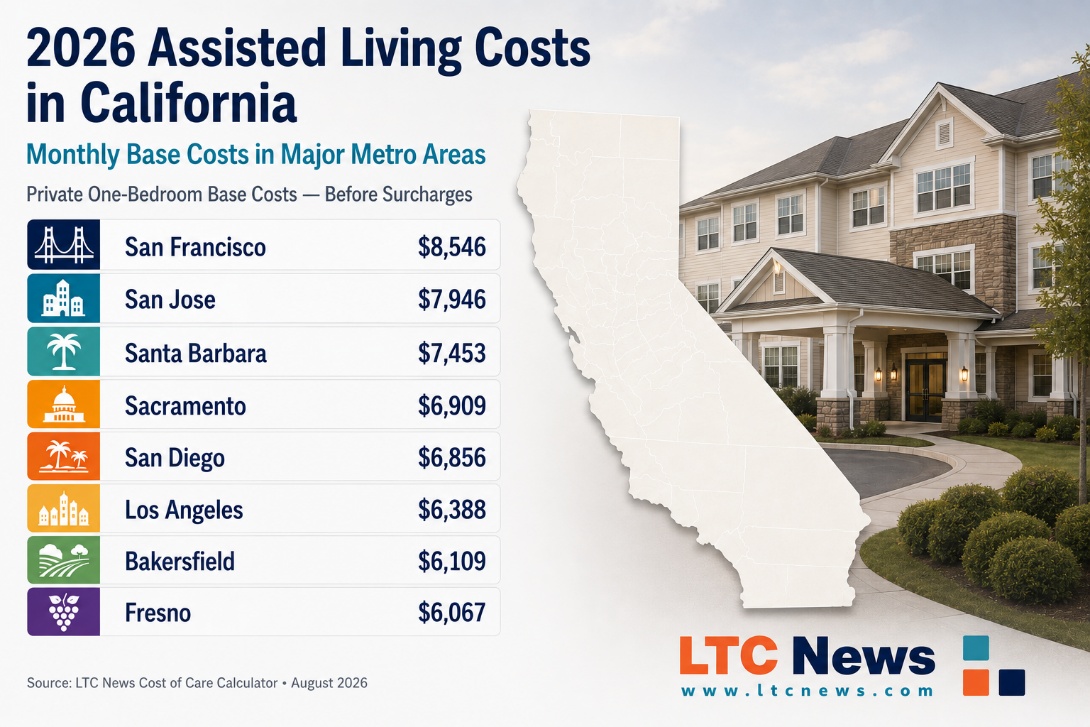
The financial stakes are significant. Assisted living, memory care, home care, and nursing home costs can quickly reach thousands of dollars each month, with costs varying substantially throughout California. Families can use the LTC News Cost of Long-Term Care Services Calculator to see current costs for their city and compare home care, assisted living, memory care, and nursing home expenses.
In California, long-term care services are expensive, but costs still vary depending on where you live according to LTC News. The 2026 monthly base costs for assisted living, before surcharges, in major metro areas vary:
What Affected Families Can Do
Families currently receiving the benefit should consider taking several steps now:
- Confirming your authorization date and requesting an extension before it expires, if needed.
- Asking Health Net directly, in writing, for a transition plan.
- Filing an appeal or grievance with the plan if you believe you're being denied care you're entitled to.
- Asking whether another Medi-Cal managed care plan available in your county still offers the Nursing Facility Transition/Diversion to Assisted Living Facilities Community Support, and what changing plans could mean for existing providers and authorizations before making a switch. CalMatters reports some families have been told other plans are reluctant to authorize these services for new members, so switching is not a guaranteed fix.
- Contacting a local Area Agency on Aging or legal aid organization, such as Justice in Aging, for help navigating the process.
This story is based on original reporting by CalMatters, a nonprofit, nonpartisan newsroom, with additional context from the California Department of Health Care Services and the California Department of Insurance.
The Health Net decision is an immediate problem for thousands of California families, but it also carries a broader lesson. Long-term care needs can last for years, while the programs used to pay for that care don't all operate under the same rules. Understanding what Medicare covers, what Medi-Cal provides, and what private Long-Term Care Insurance guarantees under its contract can help families avoid discovering those differences in the middle of a care crisis.
Frequently Asked Questions
Is Health Net ending Long-Term Care Insurance coverage in California?
No. The Health Net decision involves an optional benefit offered through Medi-Cal, California's Medicaid program. It does not affect private Long-Term Care Insurance policies. Existing Long-Term Care Insurance benefits are established by the insurance contract and cannot simply be eliminated because an insurer decides it no longer wants to provide them.
How many Californians could be affected?
About 3,500 Medi-Cal enrollees rely on Health Net for this assisted living support, according to advocates cited by CalMatters. Many are older adults with dementia or other cognitive impairments.
Can families switch to another Medi-Cal plan that still offers the benefit?
Possibly, depending on what Medi-Cal managed care plans are available in the member's county. Families should determine whether another plan offers the Nursing Facility Transition/Diversion Community Support and whether their existing providers would participate. Changing plans does not guarantee that the service will be authorized.
Will affected Health Net members immediately lose their care?
Not necessarily. State regulators told CalMatters that members are entitled to medically appropriate services through Dec. 31, 2026, and members may be able to request extensions when authorizations expire earlier. Families should confirm their individual authorization dates directly with their plan.
What Medi-Cal assisted living benefit is Health Net ending?
Health Net plans to discontinue the optional CalAIM Community Support known as Nursing Facility Transition/Diversion to Assisted Living Facilities at the end of 2026. The program helps eligible Medi-Cal members transition from nursing facilities into assisted living settings or, when appropriate, avoid entering a nursing facility in the first place.
How is Medi-Cal different from Long-Term Care Insurance?
Medi-Cal is a means-tested government health program with financial and medical eligibility requirements. Long-Term Care Insurance is private insurance generally purchased before extended care is needed and is medically underwritten when someone applies.
Once a Long-Term Care Insurance policy is in force, eligibility for benefits is based on the policy's contractual benefit triggers rather than the insured's income or savings.

Sponsored