FDA Fast-Tracks Psychedelic-Based Mental Health Treatments as Aging America Faces Rising Long-Term Care Risk
About This Article
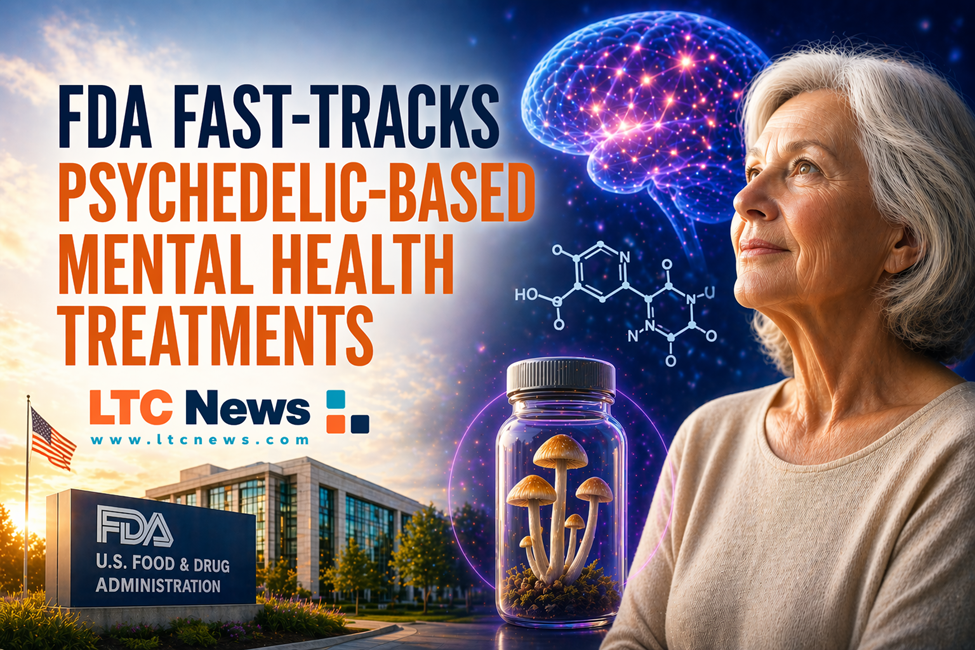
Federal regulators are accelerating psychedelic-based mental health treatments for serious conditions. Many veterans, researchers, and patient advocates applauded the move as a long-overdue, bipartisan step to address the mental health crisis, including major depressive disorder in older adults.
The U.S. Food and Drug Administration (FDA), following a directive from the U.S. Department of Health and Human Services (HHS), announced on April 24, 2026, a series of actions to accelerate development of treatments for serious mental illness, including psychedelic-based therapies.
The FDA announced major steps to support the development of serotonin-2A agonists & related products—a class of medications historically referred to as "psychedelic" drugs. Veterans, researchers, and patient advocates are welcoming the move as a long-overdue, bipartisan effort to confront the nation’s mental health crisis, including major depressive disorder among older adults.
The move follows an April 18 Executive Order from President Donald Trump directing faster access to therapies for complex and treatment-resistant conditions.

President Trump speaking before signing the executive order in the Oval Office
Under President Trump’s leadership, we are accelerating the research, approval, and responsible access to promising mental health treatments—including psychedelic therapies like ibogaine—to confront our nation’s mental health crisis head-on, especially for our veterans,” — HHS Secretary Robert F. Kennedy Jr.
FDA Commissioner Marty Makary, M.D., M.P.H., stressed both urgency and scientific rigor.
These medications have the potential to address the nation’s mental health crisis, including conditions like treatment-resistant depression, alcoholism and other serious mental health and substance abuse conditions.” — Marty Makary, M.D., M.P.H.
Makary says that as this field moves forward, its development must be grounded in sound science and rigorous clinical evidence.
What the FDA Is Fast-Tracking
The agency is prioritizing research into serotonin-2A agonists, a class of drugs that includes psychedelic compounds.
Key actions include:
- Priority vouchers for companies studying:
- Psilocybin for treatment-resistant depression
- Psilocybin for major depressive disorder
- Methylone for post-traumatic stress disorder (PTSD)
- Authorization of a Phase I clinical trial for noribogaine hydrochloride, a derivative of ibogaine, targeting alcohol use disorder
- Planned final guidance for designing clinical trials, including patient monitoring and data standards
“This is the first instance in which the FDA has allowed a clinical study in the U.S. of a derivative of ibogaine,” the agency said.
The FDA emphasized that these therapies are not approved and must still demonstrate safety and effectiveness through clinical trials.
Why This Is Also a Story About Aging
At first glance, this may sound like a policy story about drug development. In reality, it is also a story about aging in America—and what happens when mental health needs go untreated later in life. Public health data consistently show that most adults age 65 and older live with at least one chronic condition, and many manage multiple conditions that complicate mental health treatment.
As you age, mental health challenges often become more complex:
- Depression is frequently underdiagnosed
- Anxiety increases with health decline and isolation
- Alcohol misuse is rising among adults over 50
- Cognitive decline and depression often overlap
Dr. Tracy Beth Hoeg, acting director of the FDA’s Center for Drug Evaluation and Research, highlighted the growing need for new approaches.
There is a growing recognition of the potential of psychedelic medications to address multiple different psychiatric conditions that are notoriously difficult to treat.” — Dr. Tracy Beth Hoeg.
Hidden Link to Long-Term Care
Mental health is one of the most overlooked drivers of long-term care.
Untreated or poorly managed conditions can lead to:
- Loss of independence
- Medication mismanagement
- Increased fall risk
- Social withdrawal
- Substance misuse
These issues often accelerate the transition from independent living to assisted living or memory care. Experts say that mental health is a key component of successful aging, affecting physical health, longevity, and quality of life.
Depression is not a normal part of aging. It’s a serious condition that can and should be treated.” — National Institute on Aging.
The urgency is growing. More than 63 million Americans now provide unpaid care, a 45% increase since 2015. Much of that care is driven not only by physical decline, but also by cognitive and mental health challenges.
Alcohol Use Disorder After 50: A Rising Concern
One of the most significant elements of the FDA’s announcement is the focus on alcohol use disorder. This condition is often overlooked in older adults, but is a major contributor to:
- Falls and injuries
- Hospitalizations
- Dangerous medication interactions
- Earlier need for long-term care
Dr. George Koob, director of the National Institute on Alcohol Abuse and Alcoholism, has repeatedly warned that alcohol misuse among older adults is underrecognized and undertreated in the United States.
Of concern is the rapidly growing number of drinkers aged 65 and older.” — George F. Koob, director of the National Institute on Alcohol Abuse and Alcoholism.
A Different Approach to Mental Health Treatment
Researchers say psychedelic-assisted therapies may work differently from traditional medications. Psychedelic-assisted therapy appears to produce rapid and sustained improvements in some patients with depression, potentially by increasing psychological flexibility and emotional processing.
Psilocybin appears to facilitate a kind of ‘reset’ of brain activity in depressed patients.
Psilocybin works differently from conventional antidepressants—making the brain more flexible and fluid, and less entrenched in negative thinking patterns.” — David Nutt, MD, head of the Center for Psychedelic Research at Imperial College London.
Unlike daily medications, some therapies under study aim to deliver longer-lasting benefits after a limited number of supervised sessions. Experts stress these treatments must be administered in controlled clinical environments with trained professionals.
What This Means for You and Your Family
If you are in your 50s, 60s, or beyond—or caring for an aging parent—this shift could have real implications.
Ask yourself:
- Are mental health issues being overlooked in your family?
- Could untreated depression or alcohol use affect independence?
- Are you prepared if mental health decline leads to care needs?
Longer lifespans increase exposure to:
- Depression
- Cognitive decline
- Social isolation
Healthy aging is not merely the absence of disease or disability but requires physical and mental health and ongoing social engagement.” — Centers for Disease Control and Prevention.
Experts stress that mental health is one of the biggest and most overlooked drivers of aging, independence, and long-term care. The FDA’s accelerated push into next-generation mental health treatments is a major development.

Sponsored