Don't Wait for a Crisis: Why Finding an Elder Law Attorney Now Can Protect Your Family

About This Article
Getting ready for aging is a core part of retirement planning, and an elder law attorney can help protect your wishes, prepare for future long-term care needs and prevent costly legal mistakes. Without advance planning, an elder law attorney can guide you through those challenges as well to ease a crisis.

James Kelly
LTC News staff writer specializing in long-term care and aging.
Table of Contents
- What Does an Elder Law Attorney Do?
- Estate Planning Isn't Just for Wealthy Families
- How Elder Law Attorneys Fit Into Long-Term Care Planning
- Understanding Medicaid and Asset Protection
- Long-Term Care Insurance and Legal Planning Should Work Together
- Seven Questions to Ask Before Hiring an Elder Law Attorney
- 1. Are You Licensed to Practice in the State Where I Need Help?
- 2. How Much Experience Do You Have With Cases Like Mine?
- 3. What Services Are Included?
- 4. What Will the Services Cost?
- 5. Who Will the Attorney Represent?
- 6. How Will We Communicate and Share Information?
- 7. Will You Help Keep the Plan Updated?
- Warning Signs When Choosing an Elder Law Attorney
- How to Compare Elder Law Attorneys
- Family Caregiving Makes Advance Planning Even More Important
- Start Planning While You Still Have Choices
It can start with something small, like a stack of unopened mail on your mother’s kitchen counter or your father repeating the same story three times during dinner. Then comes the phone call you’ve been dreading, or the doctor softly uttering a diagnosis like dementia.
Suddenly, you’re not just a son or daughter anymore; you're the one stepping up to guide your parents through their hardest chapter. Or maybe, as you look toward your own retirement, you find yourself staring out the window and wondering: Who will step up for me when I need it most?
If you’ve felt that quiet knot of anxiety in your stomach, you aren't alone. These are the tender, vulnerable moments families navigate every single day. Yet so many of us wait until crisis strikes, a sudden fall, a late-night ER visit, or a sharp decline in health, before seeking guidance. When life unravels quickly, families scramble for answers, searching through old filing cabinets for legal documents that are outdated, misplaced, or never written.
The problem is more common than many realize. According to the 2026 Trust & Will Estate Planning Report, 56 percent of American adults surveyed had none of the five estate planning documents tracked by the survey. Just 26 percent had a will, down from 31 percent in 2025. The national survey of 5,000 adults found that many people delay planning because they believe they lack sufficient assets, don't know where to begin, or they just keep putting it off.
But estate planning isn't just about what happens after someone dies. It also helps determine who can make decisions during a person's lifetime when illness, injury, or cognitive decline makes those decisions difficult or impossible.
Bobbi L. Thury, a board-certified elder law attorney and co-founder and co-CEO of Legacy Law Firm, P.C., tells LTC News that families often wait too long to seek legal guidance. Her firm serves clients in South Dakota, Iowa, Minnesota, Nebraska, and North Dakota.
Start looking while everyone is healthy. Ask whether the attorney is board-certified in elder law, whether they handle Medicaid and nursing home planning every day or just now and then, and whether they take time to understand your family, not just your paperwork. The right attorney should leave you feeling more prepared and less afraid." — Bobbi L. Thury.
Thury says an elder law attorney's job is to help families protect the people they love and what they've worked so hard for, long before a crisis forces their hand. Finding the right attorney before a crisis gives you time to understand your options, compare legal services, and make decisions without the pressure of an approaching hospital discharge or nursing home admission.
What Does an Elder Law Attorney Do?
An elder law attorney helps older adults, people with disabilities, and their families navigate legal issues related to aging, health care, financial decisions, and long-term care.
Unlike attorneys who primarily prepare wills or handle probate, elder law attorneys may address legal concerns that arise while a person is still living. Depending on their experience and state laws, their services may include:
- Estate planning: Preparing wills, trusts, and other documents to manage assets and carry out a person's wishes.
- Powers of attorney: Establishing who can make financial or legal decisions and under what circumstances.
- Health care directives: Documenting medical treatment preferences and identifying someone authorized to make health care decisions.
- Medicaid planning: Explaining eligibility requirements, allowable asset protections, and how benefits may help pay for qualifying long-term care.
- Guardianship and conservatorship: Addressing situations in which someone may no longer have the legal capacity to make certain decisions.
- Nursing home and assisted living issues: Reviewing contracts, resident rights, and disputes involving care facilities.
- Special needs planning: Helping families provide financial support for a person with a disability while considering eligibility for government benefits.
- Veterans benefits: Assisting eligible veterans and surviving spouses with certain Department of Veterans Affairs benefits, including pension benefits with Aid and Attendance, when the attorney has the appropriate VA accreditation.
Not every elder law attorney handles all these matters. Some focus on estate planning, while others regularly handle Medicaid applications, nursing home issues, or contested guardianship cases. The distinction matters when choosing someone to represent you or a family member.
Estate Planning Isn't Just for Wealthy Families
You don't need a large estate to benefit from legal planning. Consider a married couple who owns a modest home, has retirement savings, and receives Social Security. If one spouse develops dementia or experiences a serious stroke, the other may discover that marriage alone doesn't provide unrestricted authority to handle every financial transaction or legal matter.
A properly prepared durable financial power of attorney can authorize a trusted person to act, either immediately or when specified conditions are met, depending on the document and state law. Without a valid power of attorney or another appropriate legal arrangement, families may have to seek guardianship or conservatorship through the courts when someone loses the ability to make decisions. The process can be expensive, time-consuming, and involve public court proceedings. Planning ahead may help families avoid unnecessary court intervention.
Healthcare documents serve a different purpose. A healthcare proxy or medical power of attorney generally appoints someone to make medical decisions when authorized under state law. A living will typically records preferences about certain treatments and end-of-life care. An attorney can help coordinate these documents with wills, trusts, property ownership, and beneficiary designations. Reviewing these documents is especially important after a marriage, divorce, death of a spouse, relocation, or major health diagnosis.
How Elder Law Attorneys Fit Into Long-Term Care Planning
Legal planning becomes especially important when someone needs ongoing help with daily activities or supervision because of cognitive impairment. According to the U.S. Department of Health and Human Services, about 56 percent of Americans turning 65 will need some form of long-term services and supports during their remaining years.
Families often assume Medicare will cover these expenses. Generally, it won't. Medicare may pay for qualifying short-term skilled nursing or home health services, subject to coverage requirements. It does not pay for ongoing custodial long-term care simply because someone needs help bathing, dressing, eating or remaining safe at home.
Medicaid can pay for qualifying long-term care for people who meet the program's financial, medical, and other eligibility requirements. Those rules vary by state and by the type of care, but Medicaid is geared for those with limited financial resources.
Married couples may have additional protections. Medicaid's spousal impoverishment rules generally allow a spouse who remains at home to retain certain income and assets when the other spouse qualifies for covered long-term care. The amounts and applicable rules vary, making professional guidance especially important.
An elder law attorney can help families understand these requirements and determine whether advance legal planning is appropriate.
Understanding Medicaid and Asset Protection
Medicaid planning is one of the most misunderstood areas of elder law. Families sometimes believe they can transfer a home to an adult child, give away savings, or establish a trust shortly before entering a nursing home and automatically qualify for benefits. That assumption can be costly.
For many Medicaid long-term care applications, transfers made for less than fair market value during a five-year look-back period may trigger a period of ineligibility. Exceptions and state-specific rules can apply. An attorney experienced in Medicaid planning can review assets, income, previous transfers, marital circumstances, and potential eligibility before recommending a strategy.
For example, a trust does not automatically protect assets from Medicaid eligibility rules. Its legal structure, timing, funding, and the person's retained rights all matter. Families should also understand Medicaid estate recovery. Federal law requires states to seek repayment of certain Medicaid expenses paid for recipients age 55 or older, including nursing home care and qualifying home and community-based services.
Estate recovery is generally deferred or prohibited while certain protected survivors are living. Federal rules prohibit recovery when the deceased Medicaid recipient has a surviving spouse, a child younger than 21, or a child of any age who is blind or disabled. States must also provide procedures for hardship waivers.
Depending on state law and individual circumstances, estate recovery can affect a family home or other assets left behind. An elder law attorney can explain how these rules apply and whether additional protections are available. The objective should be lawful planning that protects the older adult's interests, not hiding assets or withholding information from government agencies.
Long-Term Care Insurance and Legal Planning Should Work Together
An elder law attorney is only one part of a broader long-term care planning strategy. Long-Term Care Insurance can help pay for covered services at home, in adult day care, assisted living, memory care, and nursing homes, depending on the policy. Qualified Long-Term Care Insurance policies pay benefits when the insured meets specified requirements, such as the inability to perform at least two activities of daily living or severe cognitive impairment, along with applicable certification and policy conditions.
Most states also participate in the Long-Term Care Insurance Partnership Programs. Qualifying LTC Insurance Partnership policies can provide dollar-for-dollar Medicaid asset disregard protections, subject to state rules, if a policyholder later applies for Medicaid, often after exhausting policy benefits.
An attorney can explain the legal implications of Medicaid eligibility and asset protection. An experienced LTC Insurance specialist can help evaluate insurance options, benefits, and underwriting requirements. These are different professional roles, and neither replaces the other.
Before making financial decisions, families can use the LTC News Cost of Long-Term Care Services Calculator to explore the current and projected costs of home care, adult day care, assisted living, memory care, and nursing homes in their area. Understanding local costs can help families determine how much financial preparation they may need.
Planning while you are relatively healthy generally provides more choices than waiting until a serious medical condition develops.
Seven Questions to Ask Before Hiring an Elder Law Attorney
Finding an attorney who advertises elder law services is relatively easy. Finding one with the right experience for your situation requires more research. Start by identifying what you need. Are you preparing legal documents for retirement? Helping a parent who is showing signs of dementia? Dealing with a nursing home admission or a Medicaid denial?
Once you know the issue, ask these seven questions before hiring an attorney.
1. Are You Licensed to Practice in the State Where I Need Help?
Attorney licensing is handled at the state level. An attorney practicing near you may not be licensed to handle a matter involving property or legal proceedings in another state.
For example, your mother may live in New Jersey but own a vacation home in Florida. Her estate plan could involve legal questions in both states. Ask where the attorney is licensed and whether additional local counsel may be needed.
You can verify licensing status and check available disciplinary records through the appropriate state bar or attorney regulatory authority. The American Bar Association can help you locate state legal resources.
2. How Much Experience Do You Have With Cases Like Mine?
Years in practice don't necessarily tell you how much relevant experience an attorney has. Someone who has spent 25 years preparing wills may have limited experience with Medicaid eligibility, nursing home disputes, or contested guardianship proceedings. Ask how frequently the attorney handles matters similar to yours.
You can also ask whether the attorney holds a recognized elder law certification. The National Elder Law Foundation offers the Certified Elder Law Attorney (CELA) credential. Requirements include relevant experience, continuing legal education, references, and an exam. Consumers can use the foundation's website to check certification claims.
Certification can show additional training and experience, but many qualified elder law attorneys don't hold this credential. Thury tells LTC News that many elder law attorneys are qualified even without formal certification, but she says you can verify any claimed credential. The National Elder Law Foundation awards the Certified Elder Law Attorney designation and maintains current records. Check that any certification is active.
Advertising rules on the term “specialist” vary by state, so confirm claims directly with the issuing organization.” — Bobbi L. Thury.
If you need assistance with a VA benefits claim, verify that the attorney is accredited through the U.S. Department of Veterans Affairs.
3. What Services Are Included?
Ask the attorney to explain exactly what the engagement covers.
For example, preparing a trust may not include transferring property into it. A Medicaid planning consultation may not include completing the application or handling an appeal if benefits are denied.
Similarly, an attorney who prepares advance directives may not represent clients in guardianship disputes. Get a written description of the services, including any work that will require additional fees.
If the firm assigns some responsibilities to associates or paralegals, ask who will supervise the work and serve as your primary contact.
4. What Will the Services Cost?
Elder law attorneys use different billing arrangements. Some charge flat fees for clearly defined services, such as preparing a will or power of attorney. Others bill hourly, particularly when a matter involves litigation, complicated assets, or ongoing legal work. A retainer or advance deposit may also be required.
Ask whether the quoted fee includes meetings, document preparation, filing expenses, follow-up questions, and future changes. A flat fee isn't necessarily a warning sign. The important question is whether the fee and scope of work are appropriate for your circumstances.
Before signing an engagement agreement, understand what you're paying for and what might cost extra.
5. Who Will the Attorney Represent?
This question matters most when adult children help aging parents. Suppose you arrange the appointment and pay your father's legal fees. That doesn't automatically make you the attorney's client. The attorney may represent your father alone and owe professional duties to him, even if you are paying the bill.
That distinction matters when family members disagree about money, living arrangements, caregiving responsibilities, or inheritance. An attorney should explain the attorney-client relationship, identify potential conflicts of interest, and respect the legal rights of an older adult who can still make their own decisions.
If your parent has decision-making capacity, their wishes should guide their legal planning, not the preferences of relatives who may eventually inherit their property.
6. How Will We Communicate and Share Information?
Legal planning often involves sensitive financial, medical, and family information. Ask who will return phone calls, how quickly the office typically responds, and whether you can communicate by email or through a secure client portal.
Avoid sending Social Security numbers, complete financial account information, or detailed medical records through ordinary email without first asking how the firm protects confidential information. Before an initial consultation, the firm may need enough information to check for conflicts of interest. Ask what information it needs at that stage and how to submit additional documents securely.
You should also know whom to contact if a hospital admission or another urgent situation requires legal attention.
7. Will You Help Keep the Plan Updated?
An estate plan prepared years ago may no longer reflect your circumstances. Marriage, divorce, retirement, relocation, the death of a spouse, or changes in health can affect existing legal documents. Changes in property ownership, beneficiaries, or applicable laws may also require review.
Ask whether the attorney offers periodic reviews, what they cost, and who is responsible for completing tasks after you sign the documents. A well-prepared legal plan should be practical enough for you and the people you trust to use when necessary.
Warning Signs When Choosing an Elder Law Attorney
Most attorneys work to serve their clients responsibly. Still, families should recognize warning signs before committing to legal services.
Be cautious if an attorney:
- Promises a guaranteed Medicaid or tax outcome. Eligibility and tax treatment depend on individual circumstances and applicable laws.
- Pressures you to transfer assets immediately. A legitimate deadline may require prompt action, but they should explain major financial decisions before you agree.
- Cannot verify claimed credentials. Licensing and specialty certifications should be independently verifiable.
- Won't explain fees or representation. You should know who the client is, what services are included, and how charges are calculated.
- Ignores the older adult. An attorney should respect the rights, preferences, and decision-making abilities of the person receiving legal services.
- Recommends hiding information. Concealing assets, financial transfers or other material facts from government agencies can create serious legal problems.
Online reviews may offer some insight into communication and client experiences, but they cannot establish an attorney's legal competence. Pay attention to patterns in complaints, and make sure reviews refer to the correct firm. Similar business names can easily be confused.
How to Compare Elder Law Attorneys
You don't need to interview a dozen attorneys. Two or three consultations may be enough to identify someone who understands your circumstances and communicates clearly. Use the same criteria when comparing candidates.
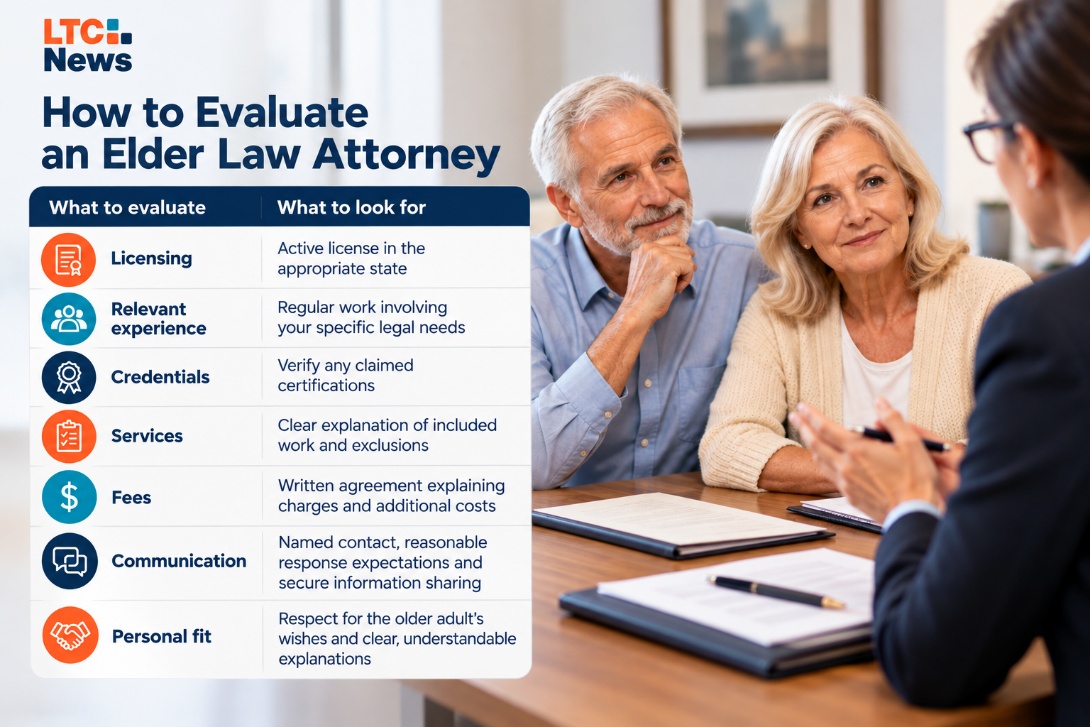
You can begin your search through the National Academy of Elder Law Attorneys, which provides resources for consumers seeking attorneys who focus on elder law and special needs planning.
A professional directory is a starting point, not a substitute for checking an attorney's license, experience and suitability. If a consultation leaves you confused or uncomfortable, continue looking. You should understand the proposed legal strategy before agreeing to it.
Family Caregiving Makes Advance Planning Even More Important
Legal planning doesn't eliminate the challenges of caring for an aging parent or spouse. It can, however, clarify responsibilities before those challenges become overwhelming. The 2025 Caregiving in the U.S. report from AARP and the National Alliance for Caregiving found that 63 million Americans, nearly one in four adults, provided ongoing care in the past year.
Many family caregivers help manage medications, arrange appointments, handle household bills, and make decisions about professional care. Without appropriate legal authority, even routine financial or health care decisions can become more complicated. Families without advance plans (like Long-Term Care Insurance) should discuss who is willing and able to take on these responsibilities, what professional assistance may be needed, and how the costs will be covered.
When care becomes necessary, the free LTC News Caregiver Directory helps families find home care agencies, assisted living communities, memory care facilities, nursing homes, and other long-term care services in their area. Enter a ZIP code to find caregivers and facilities in that area.
Families with existing Long-Term Care Insurance should also review their policies before arranging services. LTC News offers free, no-obligation LTC Insurance claims assistance to help policyholders and their families navigate the claims process and coordinate benefits with care needs.
Start Planning While You Still Have Choices
No one can predict when a spouse will have a stroke, a parent will develop dementia, or a chronic illness will make independent living difficult. But families can prepare for the decisions that may follow. An elder law attorney can help put important legal protections in place, clarify who has authority to act and explain how state laws may affect property, public benefits and future care decisions.
Just as importantly, early planning gives you or a loved one a chance to express your preferences about where you want to live, who you trust, and how you want your affairs managed. You don't have to complete every part of an estate or long-term care plan at once. Start by reviewing existing documents, identifying unanswered questions, and speaking with qualified professionals. The best time to make those decisions is before a health crisis makes them urgent.
LTC News research shows most people obtain Long-Term Care Insurance between the ages of 47 and 67. Several types of policies, in addition to partnership plans, are available, including hybrid LTC policies with death benefits and short-term cash indemnity plans with expanding underwriting rules.
LTC News provides educational information and does not offer legal, tax, or individualized financial advice. Laws and eligibility requirements vary by state and individual circumstances. Consult a qualified attorney and other appropriate professionals before making legal or financial decisions.
Frequently Asked Questions
Do you need an elder law attorney if you don't have much money?
Yes, legal planning can benefit families at nearly every income level. Even someone with modest savings may need a durable power of attorney, health care directives or guidance about Medicaid eligibility. Elder law planning is about protecting personal wishes and decision-making authority, not simply preserving an inheritance.
How do you find a qualified elder law attorney?
Start with the National Academy of Elder Law Attorneys and verify the attorney's license through the appropriate state authority. Ask how often the attorney handles cases similar to yours, request a written fee agreement and confirm any claimed specialty credentials. The National Elder Law Foundation provides information about Certified Elder Law Attorneys.
What is the difference between an elder law attorney and an estate planning attorney?
Estate planning attorneys generally focus on wills, trusts, beneficiary arrangements and the transfer of assets. Elder law attorneys may provide those services while also addressing issues that arise during a person's lifetime, including Medicaid eligibility, long-term care, guardianship and incapacity planning. The two practice areas overlap, and individual attorneys may handle both.
When should you hire an elder law attorney?
Ideally, before a serious illness, dementia diagnosis or long-term care crisis. Early planning allows you to establish powers of attorney, prepare health care directives and review your financial arrangements while you can make decisions independently. An attorney can also help during a crisis, although some planning options may be limited.
What does an elder law attorney do?
An elder law attorney helps older adults, people with disabilities and their families address legal issues involving aging, estate planning, health care decisions, Medicaid, guardianship and long-term care. Some also handle nursing home disputes, special needs planning and veterans benefits. Services vary, so choose an attorney with experience in your specific legal needs.


Sponsored