Does Medicare Cover Online Therapy and Virtual Mental Health Care?

About This Article
Medicare and many Medicare Supplement plans and traditional employer health plans help pay for online therapy and psychiatry visits in 2026. Mental health can complicate aging and long-term care. Here's what's covered and what it costs

Linda Maxwell
Linda Maxwell is a journalist who writes about aging, health, chronic illness, caregiving, and long-term care issues impacting older adults and their families.
Table of Contents
- What Virtual Behavioral Health Actually Is
- How Virtual Behavioral Health Works in Practice
- Why This Becomes More Pressing After 50
- Does Original Medicare Cover Virtual Behavioral Health?
- What You Pay
- What Does Your Medicare Supplement Cover?
- What If You're Under 65?
- Virtual Therapy vs. In-Person Therapy: How They Compare
- Mental Health Coverage Isn't Long-Term Care Coverage
- How to Get Started for Virtual Therapy
You can spend an evening with an insurance card, a provider directory, and three browser tabs open and still come away without a straight answer. One page promises “telehealth.” Another mentions “behavioral health.” None of them tells you what it costs.
What feels like a simple question, does insurance cover online therapy? That question quietly fractures into a maze: What service is actually being offered? Who is providing it. Are they in-network? How is the visit delivered? And finally, what does your specific plan actually pay?
For many people, this confusion isn’t just personal. Adult children often find themselves trying to decode these same questions on behalf of an older parent who needs support now, not after a week of research. The stakes feel higher, the urgency sharper, and the answers somehow even harder to pin down.
This guide walks through each piece, using the most current Medicare rules as of August 2026.
What Virtual Behavioral Health Actually Is
Virtual behavioral health is mental health care delivered remotely, most often by live video, sometimes by phone. It covers a range of services:
- Individual and group psychotherapy
- Psychiatric diagnostic evaluations
- Medication management visits with a psychiatrist or nurse practitioner
- Counseling for depression, anxiety, grief, substance use and adjustment to illness or caregiving
- Follow-up visits with a therapist, counselor or clinical social worker
It is not a single benefit category on your insurance card. It is a delivery method — virtual — layered on top of an existing category of medical care — behavioral health. That distinction matters because your coverage depends on both halves: the service itself must be covered, and the virtual delivery must be covered too.
For example, you might see the insurance card displaying the First Health logo. That is a common Aetna-owned national PPO network that is used by numerous health plans and payers. Whether online therapy is covered—and the deductible, copay, or coinsurance—depends on the actual health plan using the First Health network. A good first useful move is to verify your plan's teletherapy benefits. Then confirm the details through the member-services number on the insurance card or portal. The name on the card does not determine which virtual services a policy will pay for.
How Virtual Behavioral Health Works in Practice
A typical visit starts with a referral or a direct search for a provider who accepts Medicare and treats older adults. Many practices now offer a secure video portal; others use standard platforms like Zoom or FaceTime through a HIPAA-compliant link.
Through Dec. 31, 2027, beneficiaries may also continue receiving audio-only Medicare telehealth services at home, according to Telehealth.HHS.gov. Beginning Jan. 1, 2028, the behavioral health rule is scheduled to tighten: the provider must be technically capable of offering video, and audio-only visits are allowed only when the beneficiary cannot use video or does not consent to it.
Medicare covers mental health services from a range of qualified professionals, including psychiatrists, psychologists, clinical social workers, marriage and family therapists, mental health counselors and certain other Medicare-enrolled practitioners.
Marriage and family therapists and mental health counselors are a relatively recent addition to that list, becoming eligible to enroll as Medicare providers effective Jan. 1, 2024, according to CMS's provider enrollment FAQ, which widened the pool of professionals older adults can see.

Why This Becomes More Pressing After 50
Depression and anxiety are not an inevitable part of aging, but the risk factors pile up in this stretch of life in ways they simply do not earlier on. Retirement changes daily structure and identity. Spouses, siblings and lifelong friends start to pass away, and grief compounds. Chronic pain, hearing loss and mobility limits make it harder to leave the house for an office visit.
The issue reaches well beyond the person receiving care. About 63 million Americans — nearly one in four adults — now provide unpaid care for a loved one, according to an AARP and the National Alliance for Caregiving's Caregiving in the U.S. 2025 report. For millions of middle-aged adults, that means balancing careers and their own families while helping an aging parent or spouse. Virtual mental health care can remove another barrier to getting help for both the person receiving care and the person providing it.
The World Health Organization reports that the global population of adults age 60 and older was 1.1 billion in 2023 and is projected to nearly double to 2.1 billion by 2050. WHO now estimates approximately 15 percent of adults age 70 and older live with a mental disorder, most commonly anxiety or depression, according to the organization's July 2026 fact sheet on mental health of older adults.
Depression is not a normal part of aging, but the National Institute on Aging notes that older adults with depression may show less obvious symptoms or be less likely to discuss their feelings, which can make the condition harder to recognize, according to the NIA's guidance on common misconceptions about aging. The lower measured prevalence in some U.S. surveys does not mean mental health needs disappear with age.
Virtual visits remove some of the biggest barriers to getting help at this stage: no drive, no waiting room, no need to arrange transportation or coordinate a caregiver's schedule around an appointment. For someone managing arthritis, recovering from a fall, or caring for a spouse with dementia, that difference can be the reason care happens at all.
We find people attend therapy more regularly when they can get there.” — Jill Harkavy-Friedman, PhD, senior vice president of research at the American Foundation for Suicide Prevention, told AARP in March 2026.
She noted that the convenience of online therapy can be particularly important for people with physical or mobility limitations that make traveling to appointments more difficult.
Does Original Medicare Cover Virtual Behavioral Health?
Yes. Medicare Part B covers medically necessary virtual behavioral health visits under the same rules that apply to in-person visits, as long as the provider is Medicare-approved and enrolled to bill for the service.
Coverage is broader and more durable than most people realize. The Consolidated Appropriations Act of 2021 permanently removed geographic and originating site restrictions for any telehealth service used to diagnose, evaluate, or treat a mental health disorder, according to Telehealth.HHS.gov, the federal government's official telehealth resource.
Medicare beneficiaries can receive behavioral telehealth from home, anywhere in the country, permanently under that law. Broader telehealth flexibilities for non-behavioral services, along with the pause on the in-person visit requirement for behavioral health, were extended through Dec. 31, 2027, under recent legislation, according to the same federal source. Because Congress has revisited telehealth deadlines before, confirm the current status with your provider's billing office or at Medicare.gov before you rely on it.
Federal law includes an in-person visit requirement for certain Medicare mental health telehealth services, but implementation of that requirement has been repeatedly delayed and is currently paused through Dec. 31, 2027, according to CMS's telehealth FAQ. As of August 2026, beneficiaries can continue receiving qualifying mental health telehealth services from home without that in-person requirement taking effect. Because Congress has changed this deadline more than once, check Medicare.gov or ask the provider's billing office about the rules in effect when you schedule care.
What You Pay
For 2026, the standard Medicare Part B premium is $202.90 a month, and the annual Part B deductible is $283, according to CMS's 2026 Medicare Parts A and B premiums and deductibles fact sheet. That will likely increase in 2027. Once you meet the deductible, Original Medicare pays 80 percent of the Medicare-approved amount for a covered virtual behavioral health visit, and you're responsible for the remaining 20 percent coinsurance — the same split that applies to an in-person office visit.
What Does Your Medicare Supplement Cover?
A Medicare Supplement, also called Medigap, is a private insurance policy that pays some or all of the costs Original Medicare leaves behind, such as the Part B deductible and 20 percent coinsurance. Medigap does not have its own separate rules for virtual behavioral health. It simply follows whatever Original Medicare approves and pays its share of the remaining bill.
Standard Plan G, one of the most widely sold Medigap plans, generally covers the remaining Part B coinsurance once you've met the $283 Part B deductible. Plan N also covers Part B coinsurance, but may apply a copay of up to $20 for some office visits and up to $50 for certain emergency department visits.
A high-deductible version of Plan G also exists, which requires you to meet a separate, higher annual deductible before it starts paying, so confirm which version of the plan you hold. Coverage details vary by plan letter and by when you purchased your policy, so check your policy's Outline of Coverage or call your carrier to confirm how it treats telehealth-billed visits specifically.
If you have Medicare Advantage, your plan must cover Medicare-covered mental health services, but provider networks, telehealth options, referral or authorization requirements, and your out-of-pocket costs can differ from Original Medicare. Some Medicare Advantage plans also offer additional telehealth or mental health benefits beyond what Original Medicare covers. Review your plan's evidence of coverage or call member services before your first visit.
What If You're Under 65?
Not every caregiver navigating this question is on Medicare. A spouse, an adult child, or a younger family member managing their own mental health while caring for someone else is often working with an employer plan or an individual marketplace policy instead.
The rules are different, but the general answer is similar. A federal law called the Mental Health Parity and Addiction Equity Act requires most group health plans and insurers that offer mental health or substance use benefits to cover them no less favorably than medical or surgical benefits, in terms of copays, deductibles and visit limits, according to CMS's overview of the law. The law does not require a plan to cover mental health care, but if it does, it can't make that care harder to access than physical health care.
Separately, the Affordable Care Act requires individual and small-group marketplace plans to treat mental health and substance use disorder services as one of ten essential health benefits, so most plans purchased through the marketplace or a small employer include some level of mental health coverage as a baseline.
Whether a specific virtual visit is covered, and what it costs, still depends on the plan. Most major insurers now cover telehealth mental health visits in some form, but copays, deductibles, treatment limits, and network rules vary by carrier, plan, and state. Many states also have their own telehealth coverage or payment parity laws that go further than federal law, requiring insurers to cover virtual visits similarly to in-person ones.
Employer plans governed by federal ERISA rules aren't always subject to state telehealth mandates, which is part of why two people at the same company in different states can end up with different coverage.
The most reliable way to find out what you'll pay is to call the member services number on your insurance card and ask specifically about telehealth mental health visits, whether a referral is required, and which providers in your network offer virtual sessions.
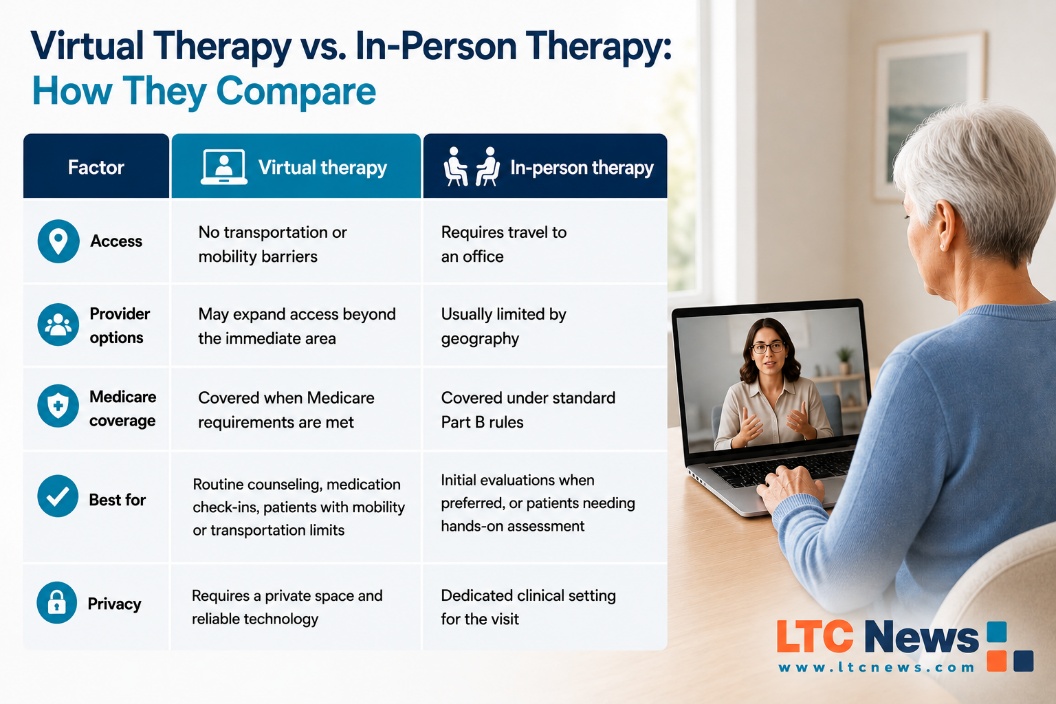
Virtual Therapy vs. In-Person Therapy: How They Compare
Mental Health Coverage Isn't Long-Term Care Coverage
Medicare's mental health coverage shouldn't be confused with long-term care coverage. Medicare can pay for covered medical and behavioral health services, but it generally does not pay for ongoing custodial care when someone needs help with activities of daily living, such as bathing or dressing, or supervision because of a cognitive impairment like dementia.
Mental health and physical health are closely connected as people age. Depression, anxiety and grief can affect sleep, activity, medication adherence, social engagement and overall well-being. Making mental health care easier to access can therefore be an important part of helping an older adult maintain independence.
People want to maintain their autonomy and make decisions for themselves.” — Tamara Baker, PhD, professor of psychiatry at the UNC School of Medicine.
Baker explains that taking independence away from older adults can contribute to depression, anxiety and withdrawal. Physical illness, medication effects, grief, isolation and changes in independence can overlap with mental-health symptoms in later life.
Dependence, the need for help with everyday living activities, is not uncommon as we age. Research from the U.S. Department of Health and Human Services finds that 56 percent of Americans turning 65 will need some form of long-term services during their lifetime. Long-Term Care Insurance benefits generally become available when a policyholder needs help with at least two of six activities of daily living or requires supervision because of cognitive impairment.
Medicare may cover limited skilled care when eligibility requirements are met, but it was never designed to pay for ongoing custodial long-term care. Medicaid may cover long-term care for people who meet financial and eligibility requirements, while Long-Term Care Insurance is designed to help pay for qualifying care at home, in assisted living or in a nursing home.
How to Get Started for Virtual Therapy
- Ask your primary care doctor for a referral, or search Medicare's provider directory for a psychiatrist, psychologist, clinical social worker, counselor or therapist who accepts Medicare assignment.
- Confirm the provider bills Medicare for telehealth visits specifically, not just in-person care.
- Ask whether the provider requires an initial in-person visit as part of the practice's own treatment policy, separate from the federal requirement discussed above.
- Call your Medicare Supplement carrier, or check your Medicare Advantage plan's member portal, to confirm what you'll owe.
- Test your video or phone connection ahead of the appointment, and pick a private, quiet space in the home.
For families juggling mental health needs alongside broader caregiving responsibilities, the LTC News Caregiver Directory can help you find local caregivers, home care agencies, senior communities and long-term care facilities. The LTC News Learning Center offers additional guidance on Medicare, caregiving and long-term care planning.
Frequently Asked Questions
Does Medicare Supplement Insurance cover virtual therapy?
Medicare Supplement Insurance, or Medigap, can help pay the costs that Original Medicare leaves behind for Medicare-approved virtual mental health services. Standard Plan G generally covers Part B coinsurance after the Part B deductible has been met. Plan N also covers Part B coinsurance but may require a copay for some office visits. Coverage depends on the Medigap plan you have.
Does Medicare Advantage cover virtual mental health care?
Medicare Advantage plans must cover Medicare-covered mental health services, but provider networks, telehealth options, authorization requirements and out-of-pocket costs can differ from Original Medicare. Some plans offer additional mental health or telehealth benefits. Check your plan's Evidence of Coverage or contact member services before scheduling care.
What if I am under age 65 and have employer or marketplace health insurance?
Many employer and individual health plans cover mental health services, but coverage for a specific virtual visit depends on the plan. Copays, deductibles, provider networks, and telehealth rules can vary. The best approach is to contact your plan and specifically ask about telehealth mental health benefits and participating virtual providers.
Why can virtual mental health care be especially helpful for older adults and caregivers?
Virtual visits can eliminate transportation, mobility, and scheduling barriers. That can make therapy easier to access for an older adult with physical limitations or for a family caregiver who has difficulty leaving a loved one unattended. About 63 million Americans — nearly one in four adults — provide unpaid care for a loved one, making accessibility particularly important for families managing caregiving responsibilities.
Does Medicare cover therapy by phone without video?
Yes, under current rules. Medicare beneficiaries can continue receiving qualifying audio-only telehealth services at home through Dec. 31, 2027. Beginning Jan. 1, 2028, current law is scheduled to impose additional requirements for audio-only behavioral health visits. Because Congress has changed telehealth deadlines before, confirm the current rules when scheduling care.
How much does online therapy cost with Original Medicare in 2026?
In 2026, the standard Medicare Part B deductible is $283. After you meet the deductible, Original Medicare generally pays 80 percent of the Medicare-approved amount, leaving you responsible for 20 percent coinsurance. Your actual cost depends on the service and Medicare-approved amount.
Who can provide Medicare-covered virtual mental health services?
Medicare covers mental health services provided by various qualified Medicare-enrolled professionals, including psychiatrists, psychologists, clinical social workers, marriage and family therapists, and mental health counselors. Marriage and family therapists and mental health counselors became eligible to enroll as Medicare providers beginning Jan. 1, 2024.
Does Medicare require an in-person visit before or after virtual mental health care?
A federal in-person requirement for certain Medicare mental health telehealth services exists in law, but implementation is currently paused through Dec. 31, 2027. Individual providers may still have their own policies requiring an initial or periodic in-person appointment.


Sponsored