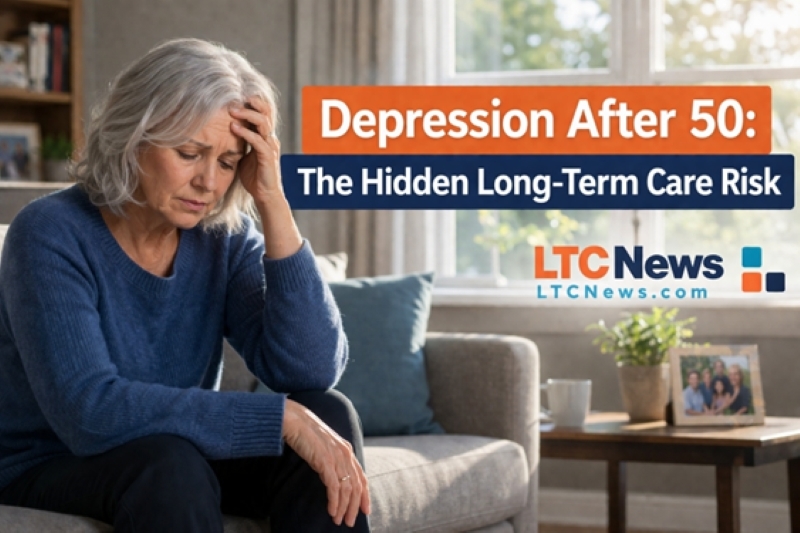
Depression After 50: A Hidden Long-Term Care Risk
About This Article
Depression after 50 is rising. Learn the causes, warning signs, and how it can impact your future long-term care needs, independence, and planning.

Beth Rush
Beth Rush writes about health and wellness to help readers learn how to make healthier lifestyle choices.
Table of Contents
- Why Depression Is Rising After 50
- Isolation Still Lingers
- Retirement Can Disrupt Purpose
- Financial Stress Doesn’t Always End
- Caregiving Adds Emotional Strain
- Substance Use Can Mask the Problem
- Depression Is Not a Normal Part of Aging
- How Depression Quietly Leads to Physical Decline
- Depression May Be the Earliest Trigger of Long-Term Care
- Real-World Progression Most People Miss
- What You Can Do Right Now
- Know When to Seek Help
- Depression - Quick Takeaways
- Role of Long-Term Care Insurance
- A Hidden Risk You Can Still Control
You may think you’re just slowing down, but subtle emotional changes could signal something more serious. Depression after 50 is increasing, and it can quietly affect your health, independence, and future long-term care needs.
Perhaps you tell yourself you’re just tired, or that it’s natural to lose interest in the hobbies that once filled your weekends. Plans get postponed. Calls go unanswered. The change feels easy to explain away.
But that withdrawal isn’t an inevitable part of getting older. It can be a warning sign.
Depression after 50 is becoming more common—and too often, it goes unrecognized until it begins affecting your health, relationships, and independence. What starts as an emotional shift can reshape your future, increasing the risk of physical decline and the need for long-term care.
Why Depression Is Rising After 50
Depression later in life rarely has a single cause. It often develops from overlapping life changes that build over time and begin to affect both emotional and physical well-being.
Late-life depression is often linked to a range of factors, including chronic medical conditions, functional decline, and social isolation. — Dr. Andrea B. Maier, professor of geriatric medicine at the National University of Singapore, quoted in a research study.
Isolation Still Lingers
Even years after the pandemic, many older adults have not returned to the same level of social engagement. Many lost regular social contact and never fully returned to it. Even now, some people are still more cautious about going out or have fallen out of old routines.
Over time, that lack of connection builds into loneliness. It’s not just about being alone. It’s about feeling unseen or disconnected from others. Loneliness has a direct link to depression and plays a major role in the link between older adults and depression today.
The Centers for Disease Control and Prevention reports that social isolation is associated with increased risks of depression, heart disease, and cognitive decline. Isolation is not just about being alone. It’s about feeling disconnected. Over time, that emotional gap can turn into chronic loneliness—one of the strongest drivers of depression in older adults.
Retirement Can Disrupt Purpose
Retirement changes more than your schedule—it can reshape your identity. For decades, work provides structure, interaction, and a sense of contribution. Some people struggle with how to spend their time. Others feel like they’ve lost a sense of identity and purpose. Depression after retirement is more common than many expect, and it’s a key reason behind the increasing rate of depression in older adults.
When that disappears, many people find themselves searching for meaning.
You may begin asking:
- What fills my day now?
- Where do I find purpose?
- Who do I connect with regularly?
The National Institute on Aging explains that major life transitions like retirement can increase depression risk, particularly when social engagement declines. Without replacing that structure, withdrawal can slowly take hold.
Financial Stress Doesn’t Always End
Financial stress does not disappear in retirement, it often shifts.
You may face ongoing concerns about:
- Rising healthcare costs
- Inflation affecting fixed income
- Outliving retirement savings
- Supporting family members
That uncertainty can quietly affect your mental health. Sleep disruptions, anxiety, and a sense of instability all contribute to depressive symptoms over time.
Caregiving Adds Emotional Strain
Many adults over 50 are balancing their own lives while caring for someone else. You may be helping a spouse, aging parent, or even grandchildren. While caregiving can be meaningful, it often comes with emotional exhaustion and little time for yourself.
What ultimately drives caregiver burnout is the lack of support, recognition, resources and isolation. — Melinda S. Kavanaugh, a professor at the University of Wisconsin-Milwaukee, quoted in the Washington Post.
More than 63 million Americans provide unpaid care. Family caregivers experience higher levels of emotional stress and depression than non-caregivers. Over time, that constant strain can lead to burnout—and depression.
Caregiver burnout is a state of physical, emotional and mental exhaustion that happens while you’re taking care of someone else. Stressed caregivers may experience fatigue, anxiety and depression. — Cleveland Clinic.
Substance Use Can Mask the Problem
Depression doesn’t always appear as sadness. Sometimes it shows up as coping. Increased alcohol use or reliance on medications may seem harmless at first, but it often masks underlying emotional distress. Substance use can deepen depressive symptoms and make it harder to seek help. This pattern is becoming more common and is closely linked to depression in older adults.
Over time, substance use can:
- Deepen depression
- Disrupt sleep
- Increase isolation
- Delay treatment
This pattern is becoming more common and is often overlooked. Not everyone recognizes depression right away. Some people try to manage their feelings on their own. In some cases, that leads to increased use of alcohol or drugs.
Depression Is Not a Normal Part of Aging
It’s easy to dismiss these changes as part of the aging process. That assumption can delay treatment. According to the National Institute of Mental Health, depression is not a normal part of aging, but it is common among older adults and can be effectively treated.
Many experts say that depression in older adults is frequently overlooked because symptoms are mistaken for other conditions, even though effective treatment is available. Recognizing depression as a medical condition—not a life stage—is the first step toward improving your health and protecting your independence.
How Depression Quietly Leads to Physical Decline
Depression does not stay emotional—it becomes physical. The process often starts subtly. You skip your usual walk. You cancel plans. Energy drops. Over time, those small changes begin to compound.
Your body responds:
- Muscles weaken from inactivity
- Balance declines, increasing fall risk
- Chronic conditions become harder to manage
A pattern often emerges:
You move less → strength declines → a minor fall or health issue occurs → confidence drops → activity decreases further.
What begins as emotional withdrawal can lead to real physical limitations.
People who've experienced depression are more likely to develop long-term physical health conditions. We need healthcare services to take an integrated approach to caring for people who have both depression and long-term physical health conditions. — Kelly Fleetwood, University of Edinburgh (Lead Researcher, PLOS Medicine, February 2025).
Depression May Be the Earliest Trigger of Long-Term Care
Depression may be one of the earliest—and most overlooked—drivers of long-term care need. The connection becomes critical when considering the impact long-term care can have on those you love.
When left untreated, it can:
- Accelerate physical decline
- Increase the risk of cognitive impairment
- Reduce your ability to manage daily life
The World Health Organization identifies depression as a leading cause of disability worldwide. That disability often translates into needing help with everyday activities such as bathing, dressing, eating, and mobility.
Real-World Progression Most People Miss
This progression rarely happens all at once. It often unfolds step by step:
- Social withdrawal begins
- Physical activity declines
- Health conditions worsen
- A fall or illness occurs
- Recovery takes longer
- Help is needed at home
Most long-term care does not begin in a facility. It starts at home—often with just a few hours of help each week. The care will increase over time, and without planning, the responsibility of caregiving usually falls on family members.
What You Can Do Right Now
If you or a loved one suffers from depression, it is treatable at any age. Early action can change your long-term outlook. Don't be afraid to tell your doctor about how you feel. Take steps now to help you deal with depression better.
Start with manageable actions:
- Talk with a doctor or therapist
- Stay socially connected, even in small ways
- Add light physical activity to your routine
- Create structure in your day
- Follow medical guidance if treatment is recommended
Small changes can rebuild momentum and improve both mental and physical health.
Know When to Seek Help
If symptoms last more than two weeks, take them seriously.
Watch for:
- Persistent low mood
- Loss of interest in activities
- Changes in sleep or appetite
- Difficulty concentrating
- Feelings of hopelessness
Early support can prevent a downward spiral and help maintain independence longer.
Speaking to a trained professional gives you a safe space to work through your feelings. Therapy can help you make sense of life changes like retirement, loss, or loneliness, and provide practical tools to manage negative thought patterns. For many people, simply being heard and understood is a powerful starting point.
However, therapy isn’t one-size-fits-all. Depending on the patient’s symptoms and the level of care needed, treatment plans and programs can require as little as 1 to 8 hours a week or up to 30 hours. Some may prefer virtual services with infrequent meetings and flexible schedules. It’s important to consider your preferences, comfort levels, and to be honest with yourself when seeking support.
Depression - Quick Takeaways
- Depression after age 50 is rising and is often overlooked.
- Isolation, retirement, and caregiving are major contributors.
- Untreated depression can accelerate long-term care needs.
- Most care begins at home, not in a facility.
- Early treatment helps protect independence and quality of life.
Role of Long-Term Care Insurance
Medicare and traditional health insurance only cover short-term skilled care—typically up to 100 days. They do not cover ongoing custodial long-term care. Long-Term Care Insurance is an affordable way to prepare for the consequences of aging before those needs arise. When you have an LTC policy, you will be ready with guaranteed tax-free funds to pay for the choice of quality care options you choose, including at home, without placing the burden on your loved ones.
An LTC policy allows you to:
- Receive care where you prefer—at home or in a facility
- Access higher-quality care options sooner
- Protect retirement income and savings from being drained by care costs
- Reduce the burden on your family

Without coverage, families often become the default caregivers—managing care, finances, and emotional strain on their own.
You can explore real-time care costs using the LTC News Cost of Care Calculator and review the LTC News Long-Term Care Insurance Learning Center, two essential tools designed to help you make informed decisions before a crisis occurs.
A Hidden Risk You Can Still Control
Depression may feel quiet—but its impact is anything but. It shapes your health, your independence, and your future. What would happen if your mental health declined, even simple depression, which impacts your overall health and well-being?
The decisions you make today—about your health, your connections, and your long-term care planning—will shape how you live later. Because the goal isn’t just to live longer, it’s to stay independent for as long as possible.
Frequently Asked Questions
What are the warning signs of depression in older adults?
Common symptoms include:
- Persistent sadness or low mood
- Loss of interest in activities
- Changes in sleep or appetite
- Fatigue or low energy
- Difficulty concentrating
- Feelings of hopelessness
If symptoms last more than two weeks, you should seek professional help.
Why is depression increasing in adults over 50?
Depression after 50 is rising due to a combination of factors, including:
- Social isolation and loneliness
- Retirement and loss of daily structure
- Financial stress in retirement
- Caregiving responsibilities
- Chronic health conditions
These overlapping challenges can gradually affect both emotional and physical well-being.
Can depression increase the need for long-term care?
Yes. Untreated depression can:
- Accelerate physical and cognitive decline
- Make daily activities harder to manage
- Increase the likelihood of needing help at home or in a care setting
It is often an early and overlooked trigger of long-term care needs.
Does Medicare cover long-term care for depression-related needs?
No. Medicare and health insurance typically cover short-term skilled care only (up to 100 days). They do not cover ongoing custodial long-term care, such as help with daily activities like bathing, dressing, or supervision.
How can you reduce your risk of depression after 50?
You can take proactive steps to protect your mental health:
- Stay socially connected
- Maintain a daily routine
- Engage in regular physical activity
- Talk to a doctor or therapist
- Address financial and caregiving stress early
Small actions can make a meaningful difference over time.
What role does Long-Term Care Insurance play in planning?
Long-Term Care Insurance helps you:
- Pay for care at home or in a facility
- Protect retirement savings from high care costs
- Reduce the burden on family caregivers
- Access better care options sooner
Planning ahead gives you more control over your future care and independence.
How does depression affect physical health as you age?
Depression doesn’t stay emotional—it can lead to physical decline. It may:
- Reduce physical activity
- Increase fall risk
- Worsen chronic conditions
- Weaken muscles and balance
Over time, this can lead to loss of independence and greater care needs.
Is depression a normal part of aging?
No. Depression is not a normal part of aging. While life changes after 50 can increase risk, depression is a medical condition that can be treated. Recognizing symptoms early helps protect your health, independence, and quality of life.
When should you seek help for depression?
You should seek help if symptoms:
- Last longer than two weeks
- Interfere with daily life
- Affect sleep, appetite, or relationships
Early treatment can prevent a downward spiral and help you maintain independence longer.

Sponsored