Curious About Your Roots? What to Know About DNA Ancestry Testing
About This Article
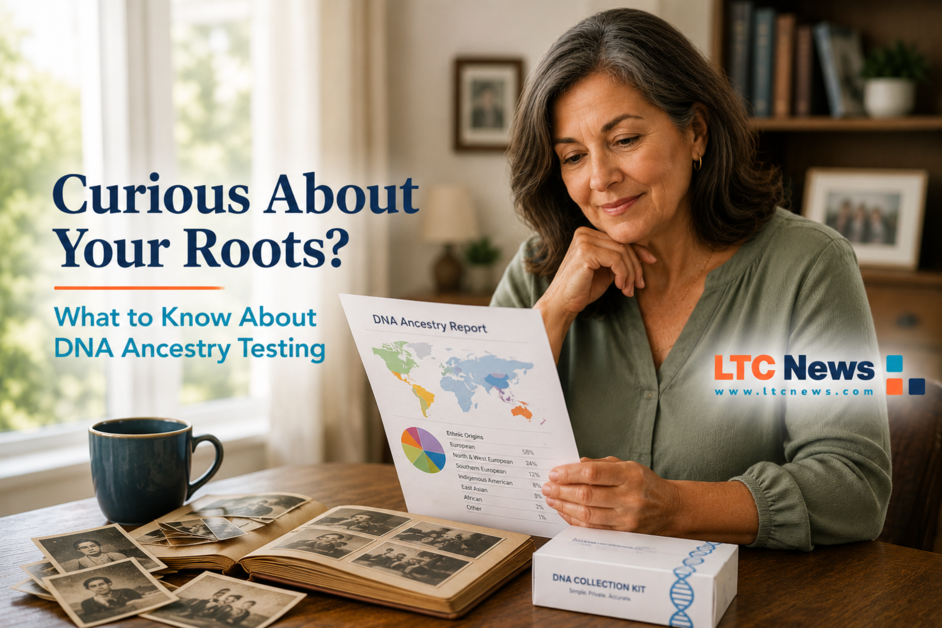
DNA ancestry testing estimates a person's geographic ancestry and can connect users with genetic relatives who have also tested. It can help fill gaps in family history, but results are estimates, not definitive records. Consumers should also understand possible privacy, health, and insurance implications before testing.

Linda Kople
Linda Kople is a freelance writer focused on caregiving, aging, health, wellness, long-term care, and retirement planning
Table of Contents
- Why Family History Matters More as We Age
- Why This Kind of Testing Took Off
- What Ancestry Testing Can Actually Tell You, and What It Can't
- Turning the Results Into Something Your Family Keeps
- A Different Kind of Testing: When DNA Becomes a Medical Question
- Before You Test, Understand the Insurance Rules
- You Can't Change Your DNA Like a Password
- Clues, Not the Whole Story
Something happens for many of us as we get older; it sure did for me. We become more interested in the people who came before us. The family stories you barely listened to at 25 suddenly matter at 55 or 65. Where did your grandparents come from? Why did the family settle where it did? Who were their parents, and what were their lives like? You may realize nobody ever wrote it down, and the people who could have told you are gone.
At the same time, there may be children or grandchildren of your own who will someday ask you those same questions. Having answers invites interest and discussion.
Consumer DNA testing has given millions of people a new tool for answering those questions. A saliva sample can help identify ancestral regions, connect you with relatives you never knew you had, and sometimes fill in gaps that birth certificates, immigration records, and old photo albums can't. Ancestry and genealogy have become among the most familiar uses of direct-to-consumer DNA testing.
Traditional genealogical research often hits roadblocks because records are missing. Natural disasters and poorly kept archives often break trails completely. War and migration can destroy physical documents in local registries.
A professional DNA test can effectively bypass these archival gaps. Their testing methodology lets users find distant relatives more easily. Finding biological connections helps individuals fill critical historical gaps.
If you've taken one of these tests, or you're thinking about it, here's a closer look at what it actually offers, and a few things worth knowing before you spit in the tube.
Why Family History Matters More as We Age
For many adults, midlife and retirement bring something career and child-rearing years didn't: time, and a different kind of motivation, to look backward instead of only forward. Parents and grandparents pass away.
Old photographs surface during a move or an estate cleanout, full of faces nobody left alive can name. Becoming a grandparent yourself can also change what feels urgent. You start wondering what story you want to hand down, and you realize the window to get it from the source is closing.
That's the appeal ancestry testing taps into. It doesn't replace family memory, but it can supplement it, sometimes at exactly the moment memory alone isn't enough anymore.
Why This Kind of Testing Took Off
A decade ago, tracing a family tree meant years of digging through courthouse records, immigration logs and church archives, often with no guarantee of success. Today it starts with a saliva sample and a smartphone app.
Grand View Research estimated the global direct-to-consumer genetic testing market at 2.32 billion dollars in 2025, with projections to climb toward 6.80 billion dollars by 2033. Ancestry and relationship testing is the segment most consumers recognize, and it's the one that first brought genetic testing into ordinary households.
A few things drove that growth. Testing kits that once required lab access most people didn't have now cost under $100. Reference databases have grown into the tens of millions of profiles, which makes matches to relatives, distant and close, far more likely and more precise than they were even a few years ago. And it's become a shared, social experience. People post their ethnicity breakdowns, discover cousins, and compare notes with siblings, which keeps drawing new customers in.
What Ancestry Testing Can Actually Tell You, and What It Can't
These tests can estimate your geographic and ethnic origins, identify genetic relatives who have also tested, help confirm or challenge branches of a family tree, and sometimes uncover unexpected biological relationships. For families with records lost to war, migration or poor recordkeeping, that can open doors documents alone never could.
It's worth being clear about the word "estimate." Ethnicity percentages are not the equivalent of a birth certificate or a historical record.
According to MedlinePlus Genetics, a resource maintained by the National Library of Medicine at the National Institutes of Health, ancestry results depend on the reference populations a company has built into its database, and information about a population can change over time as more genetic data is added to that database. A region that shows up in your results at eight percent today might read differently after a company updates its algorithm next year.
Accuracy can also vary among populations, since some parts of the world are still better represented in genetic reference databases than others. A 2025 study by geneticists Nancy Bird, Turi King and Garrett Hellenthal at University College London, published in the Annals of Human Genetics, reached a similar conclusion after reviewing the science behind ancestry inference: it's a genuinely powerful tool, but one that calls for more caution about uncertainty than most results convey. Treat the percentages as a starting point for research, not a final answer.
There's also an emotional dimension worth knowing about going in. DNA matches can uncover unexpected biological relationships, including previously unknown siblings or parentage, so not every surprise is necessarily welcome.
Turning the Results Into Something Your Family Keeps
The real value of an ancestry test usually isn't the percentage breakdown itself. It's what you do with it. Consider treating your results as the start of a small project rather than the end of one: interview the oldest living relatives while you still can, identify the people in unlabeled photographs, record names, dates, and places, and use new DNA matches as a reason to reach out to a cousin you'd never otherwise have found. Many people record grandparents or aging parents telling family stories; simple audio or video on a phone is enough, and build a family tree that ties it all together.
Megan Harris, a research specialist who conducts oral histories for the Veterans History Project at the Library of Congress, has spent years helping people capture exactly this kind of material. She points out in an article in Time that older relatives carry entire worlds most families never hear about, and that there's no way to know how much time is left to ask. As she put it, "no one can predict what will happen in the future."
That's something your children and grandchildren can inherit, and it's a far richer legacy than a spit kit result sitting unopened in an email inbox.
A Different Kind of Testing: When DNA Becomes a Medical Question
Ancestry testing has a much more clinical cousin, and it's worth understanding the difference. A doctor or genetic counselor may recommend genetic testing when a patient's personal or family medical history suggests an inherited condition or elevated disease risk, such as a strong family pattern of early-onset cancer. That kind of testing is ordered and interpreted in a medical setting, alongside a full picture of your history.
Consumer ancestry kits are a different product. Many now offer optional add-on health reports, and some flag genetic markers associated with conditions such as certain cancers or Alzheimer's disease. These reports aren't a diagnosis, and the National Human Genome Research Institute cautions that a genetic marker doesn't mean a disease will actually develop. If a consumer test result concerns you, or your family history combined with it raises questions, that's a conversation to have with a doctor or genetic counselor, who can determine whether more thorough clinical testing makes sense.
Learning more about your family's health history, even informally, can also be a useful nudge. Family history isn't destiny, but patterns of dementia, heart disease or other conditions across a family tree are worth mentioning to your doctor, and they're also a reasonable reminder that planning for later life matters. Research from the U.S. Department of Health and Human Services estimates that 56 percent of Americans turning 65 will eventually need long-term care, meaning help with daily activities such as bathing or dressing, or supervision due to cognitive impairment, for 90 days or longer.
Before You Test, Understand the Insurance Rules
There's a lesser-known wrinkle worth knowing before you order a kit, especially if you're in the age range when many people start shopping for Long-Term Care Insurance. The Genetic Information Nondiscrimination Act, known as GINA, protects Americans from genetic discrimination in health insurance and employment. It does not extend those protections to life insurance, disability insurance, or Long-Term Care Insurance.
Depending on the state and the carrier, genetic information can factor into how insurers underwrite these policies. A handful of states have passed their own laws that go further than GINA, so the rules aren't the same everywhere.
This doesn't mean every insurer asks applicants about consumer DNA testing, and underwriting practices vary by carrier and state. However, mentioning something to your doctor about a test could end up in your medical records. The practical relevance is also considerably greater when a test includes genetic health-risk information rather than simply an ethnicity breakdown. But if you're planning to apply for Long-Term Care Insurance, and most applicants do so between ages 47 and 67, it can be worth discussing timing with a licensed Long-Term Care Insurance specialist before undergoing genetic health testing or adding health-risk reports to a consumer ancestry test.
You Can't Change Your DNA Like a Password
DNA isn't like a password. You can't reset it after a breach. That's part of what makes the recent history of the ancestry-testing industry worth knowing.
In 2025, 23andMe, one of the best-known names in consumer DNA testing, filed for Chapter 11 bankruptcy following years of financial decline and a 2023 data breach that had exposed personal information tied to nearly 7 million users. As part of the bankruptcy case, a coalition of state attorneys general, including California's, formally objected to the sale of the company's genetic database, more than 15 million profiles, arguing customers hadn't consented to having their genetic data transferred.
The sale was ultimately allowed to proceed, and the buyer was TTAM Research Institute, a nonprofit founded by 23andMe's former chief executive, Anne Wojcicki. In May 2026, California Attorney General Rob Bonta sued the renamed company, Chrome Holding Co., alleging it failed to secure customer data ahead of the 2023 breach and misled the public about its severity. Those claims remain pending litigation, not adjudicated facts.
The lesson isn't that ancestry testing is unsafe. It's that your genetic information can outlive the company you gave it to, in ways a password reset or a canceled credit card never has to. Before you test, read the company's privacy policy carefully, including how long it stores your sample and genetic data, whether your information can be used for research, what deletion options are available, and what could happen to your data if the company is ever sold or shuts down.
Clues, Not the Whole Story
Your DNA results aren't really the family history. They're clues to it. The valuable part is what you do with them: a conversation with a 90-year-old aunt while she's still here to have it, a name finally attached to a face in an old photograph, an answer to why your grandfather crossed an ocean, a cousin you didn't know existed. That's worth more than any percentage breakdown, and it's a legacy your own children and grandchildren will be glad you built.
If a family history discovery does have you thinking about your own long-term care planning, the LTC News Learning Center walks through how Long-Term Care Insurance actually works. However, Matt McCann, CLTC, a leading expert in long-term care planning, says a lack of family history doesn't stop your aging.
"Advances in medical science continue to increase lifespan, not necessarily our healthspan. That difference is dependency and the need for long-term care." — Matt McCann, CLTC.
If you have a loved one who needs extended care, the LTC News Caregiver Directory can help you find providers near you.
Frequently Asked Questions
What can a DNA ancestry test actually tell you?
DNA ancestry testing can estimate your geographic and ethnic origins and identify genetic relatives who have also tested. It can help confirm or challenge parts of a family tree and sometimes fill gaps where traditional records have been lost. However, ancestry percentages are estimates rather than definitive historical records and can change as companies update their reference databases and algorithms.
What's the best way to preserve what you learn for your family?
Think of DNA results as the beginning of your family-history project rather than the finished product. Interview older relatives, identify people in old photographs, record family stories, document important names and places and build a family tree around what you discover. The lasting value isn't simply an ancestry percentage; it's preserving stories and connections that your children and grandchildren might otherwise never know.
Should you apply for Long-Term Care Insurance before getting genetic health testing?
If you're considering Long-Term Care Insurance and genetic health testing, discussing the timing with a licensed Long-Term Care Insurance specialist can be worthwhile before testing. Underwriting varies by carrier and state, and health-related genetic information or information subsequently documented in medical records could potentially become relevant during underwriting.
Why do people become more interested in family history as they get older?
For many people, midlife and retirement bring more time and motivation to explore where they came from. The loss of parents and grandparents, becoming a grandparent, discovering old photographs or realizing that family stories were never recorded can create a stronger desire to preserve that history for children and grandchildren.
Can genetic testing affect Long-Term Care Insurance?
Potentially. The federal Genetic Information Nondiscrimination Act, or GINA, provides protections involving health insurance and employment, but those federal protections do not extend to Long-Term Care Insurance, life insurance or disability insurance. State laws and insurance underwriting practices vary. The issue can be particularly relevant when testing includes genetic health-risk information rather than ancestry alone.
Is an ancestry DNA test the same as clinical genetic testing?
No. Consumer ancestry testing primarily explores ancestry and biological relationships, although some companies offer optional health reports. Clinical genetic testing may be recommended by a doctor or genetic counselor when personal or family medical history suggests an inherited condition or elevated disease risk. Consumer health reports should not be considered a medical diagnosis.
How accurate are DNA ethnicity percentages?
They should be viewed as estimates. Results depend partly on the reference populations and genetic data available to the testing company. Some populations are also better represented in genetic databases than others. As databases grow and algorithms improve, a person's reported ancestry percentages can change.
What privacy issues should you consider before taking an ancestry DNA test?
Genetic information is uniquely personal and can't be changed like a password after a data breach. Before testing, read the company's privacy policy and understand how long your DNA sample and genetic information will be stored, whether information may be used for research, what deletion options are available and what could happen to the data if the company is sold or shuts down.
Can DNA ancestry testing uncover unexpected family relationships?
Yes. DNA matching can reveal previously unknown relatives, including siblings, cousins or unexpected biological parentage. Those discoveries can be exciting, but they can also be emotionally difficult. Anyone taking an ancestry test should understand that the results may reveal family information they weren't expecting to find.
Can family history tell you whether you will develop Alzheimer's or another disease?
No. Family history and certain genetic markers can indicate increased risk for some diseases, but they generally cannot predict with certainty whether someone will develop a particular condition. Concerning results should be discussed with a doctor or genetic counselor, who can determine whether clinical testing or additional evaluation is appropriate.


Sponsored