Can Memory Care Facilities Keep Residents Behind Locked Doors? What Families Should Know
About This Article
Locked doors can protect people with dementia from wandering into danger. But a diagnosis doesn't automatically give a facility or family member the legal authority to keep someone from leaving. Recent developments in California and the United Kingdom are raising new questions about residents' rights worldwide.

James Kelly
LTC News staff writer specializing in long-term care and aging.
Table of Contents
- California Warns That Memory Care Residents Are Not Prisoners
- What Are Delayed-Exit Doors?
- What Happens When a Facility Cannot Handle Dementia-Related Behavior?
- Locked Memory Care Can Be Appropriate — But Residents Still Have Rights
- How Do Other States Protect Memory Care Residents?
- Federal Nursing Home Rules Provide Additional Protections
- What About Puerto Rico and U.S. Territories?
- How Other Countries Handle Locked Dementia Care
- Can You Use a Power of Attorney to Place a Parent in Locked Memory Care?
- Seven Questions to Ask Before Choosing Memory Care
- What If You Believe a Loved One Is Being Confined Improperly?
- Cost of Memory Care Can Complicate Decisions
- Safety Shouldn't Come at the Expense of Dignity
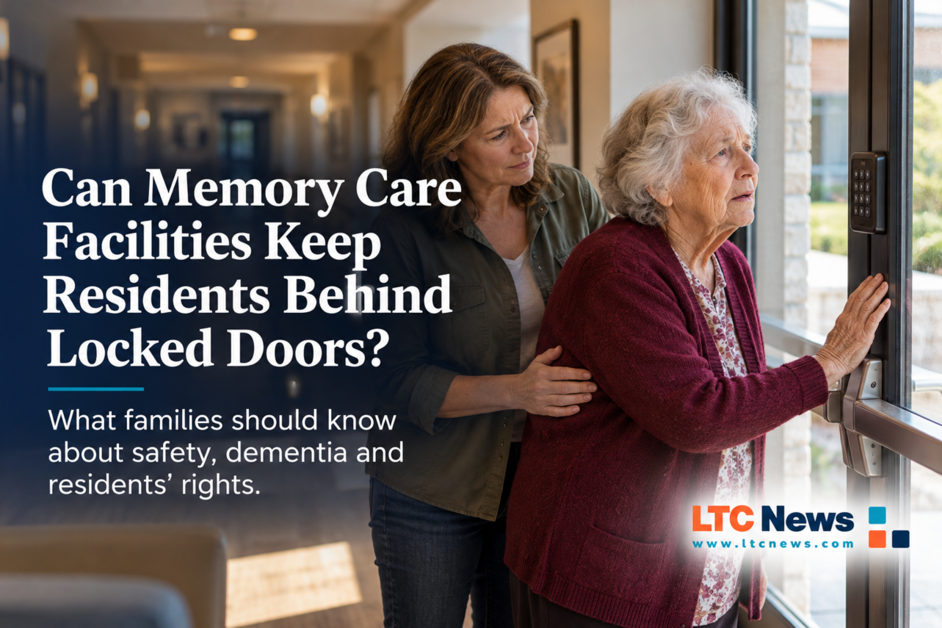
Across an aging America and an aging world, millions of families are quietly confronting one of the most heartbreaking crossroads of adult life. You stand in a sunlit hallway of a memory care community, watching your mother tug at a locked handle. She looks back at you, eyes wide with confusion and desperation, begging to "go home." You know that lock is the only thing keeping her from wandering into danger. But to her, it is a prison door, and you are the one who put her behind it.
Who decides where safety ends and personal freedom begins? Imagine your mother is 82 and living with Alzheimer's disease. After she got lost twice in her own neighborhood, panic forced your hand, and you helped her move into a secure facility. All the staff are warm, attentive, and skilled. A heavy weight lifts from your shoulders knowing she won't wander into traffic. Yet every visit brings the same gut-wrenching plea: Please take me home. The relief you expected is instantly swallowed by overwhelming guilt.
It is a deeply emotional tug-of-war, and one that forces agonizing questions about dignity, autonomy, and who holds the legal right to make life-altering choices for someone losing their memory.
The scale of this crisis is staggering. According to the Alzheimer's Association's 2026 Facts and Figures report, an estimated 7.4 million Americans age 65 and older are living with Alzheimer's dementia, a number projected to reach 13.8 million by 2060 without major medical breakthroughs.
As millions more families face the reality of residential care and the costs involved, understanding the fine line between protection and personal rights—what facilities can legally do, and what rights residents retain—has never been more urgent.
California Warns That Memory Care Residents Are Not Prisoners
In July 2026, California regulators addressed a concern that many families may never have considered. Does having dementia mean someone can be kept behind locked doors against their wishes?
During a July 30 provider information call, the California Department of Social Services discussed delayed-exit doors, secured perimeters, and residents' rights. California Advocates for Nursing Home Reform (CANHR) followed with an August 7 article titled Department of Social Services Reminds RCFEs that Residents Are Not Prisoners.
The organization emphasized that residents with dementia retain legal protections against unlawful confinement. California allows qualifying residential care facilities for older adults to operate secured memory care environments. However, the rules distinguish between operating a secured facility and obtaining the legal consent necessary to place a resident there.
Under Title 22, California Code of Regulations, Section 87705, a resident who is not under conservatorship must voluntarily consent in writing to placement in a facility with locked exterior doors or perimeter gates.
For residents under conservatorship, the facility must maintain a court order establishing the conservator's authority to approve that placement. Under California Probate Code Section 2356.5, a conservator generally needs specific court-granted dementia placement powers.
A family member cannot simply authorize locked memory care placement because they believe it is best. In California, even an agent named in an Advance Health Care Directive does not automatically have that authority. CANHR explains the distinction in its Dementia Care Checklist.
That doesn't mean families are powerless to protect a loved one who is at risk of wandering. It means they must follow the appropriate legal process.
What Are Delayed-Exit Doors?
Not every secured memory care facility uses doors that remain permanently locked. Some have delayed-egress systems. When someone pushes the exit hardware, the door remains secured briefly before releasing.
Under California Health and Safety Code Section 1569.699, qualifying systems generally must release within 15 seconds after the required activation. The responsible fire authority may approve a delay of up to 30 seconds in qualifying facilities serving people with Alzheimer's disease. These systems must also meet fire and life-safety requirements, including automatic release under specified emergency conditions.
During a facility tour, ask staff to demonstrate how the doors work, how residents can access outdoor areas, and what happens when someone repeatedly attempts to leave. A locked door is a safety feature. It isn't a substitute for trained caregivers.
What Happens When a Facility Cannot Handle Dementia-Related Behavior?
Tony Chicotel, senior staff attorney with California Advocates for Nursing Home Reform, raised another concern during an October 2026 interview on the Code WACK! podcast, "The Troubling Truth About Memory Care: What Families Need to Know."
Some communities advertise specialized dementia care but struggle when residents develop behaviors associated with the disease. A resident may repeatedly ask to leave, resist bathing, become frightened, or have difficulty communicating discomfort. These situations can challenge caregivers. They can also signal pain, illness, anxiety, or unmet needs.
Chicotel described concerns that facilities may try to discharge residents or require families to hire additional private caregivers when needs become more complicated.
What I’ve been seeing more and more is facilities that market themselves as memory care facilities, which connotes expertise in providing care for people with dementia. They talk about security, which means, you know, “we’ve got fencing and locks,” and the doors are set up in a way where people with dementia aren’t gonna be able to get out without being accompanied or observed." — Code WACK! podcast.
A family paying thousands of dollars each month for memory care may suddenly face additional charges for one-on-one supervision. Not every discharge or request for additional assistance is inappropriate. Some residents develop medical or behavioral needs that exceed a facility's licensed capabilities.
Learn More: Find current and projected costs of long-term care services, including memory care, with the LTC News Cost of Long-Term Care Services Calculator.
But families deserve to know what care is included, what may cost extra, and what happens if their loved one's dementia progresses. Also, if a loved one has Long-Term Care Insurance, will they bill the insurance company and provide them with the proper paperwork? Before admission, request the facility's policies on behavioral changes, additional staffing, and discharge.
👉You can search for caregivers and long-term care facilities, including memory care, with the LTC News Caregiver Directory. The directory has over 80,000 providers throughout the United States, Puerto Rico, and the U.S. Virgin Islands.
Locked Memory Care Can Be Appropriate — But Residents Still Have Rights
There are legitimate reasons to provide secured dementia care. Someone with advanced cognitive impairment may leave a building without recognizing traffic hazards, extreme temperatures, or unfamiliar surroundings. They may be unable to find their way back. For some residents, supervised access to outdoor spaces and secured exits are important safeguards.
However, the need for safety should be assessed individually. Someone repeatedly asking to leave may need reassurance, a familiar activity, a supervised walk, or medical evaluation. A sudden change in behavior may indicate an infection, medication problem, pain, or delirium rather than worsening dementia.
For example, although urinary tract infections (UTIs) are usually minor but painful health issues for most people, they can be far more dangerous for older adults, especially those living with Alzheimer’s disease or other dementias. In seniors, even a routine UTI can trigger delirium, a medical emergency marked by sudden confusion and changes in awareness.
Shouri Lahiri, MD, principal investigator of the Critical Care Neurodegenerative Medicine Lab and director of the Neurosciences Critical Care Unit and Neurocritical Care Research at Cedars-Sinai, says a UTI can accelerate cognitive decline and is often mistaken for an underlying neurological condition, delaying proper diagnosis and treatment.
UTIs can cause acute brain dysfunction through inflammation. An infection in the bladder releases inflammatory signals into the bloodstream, which can affect the brain and disrupt normal function, leading to delirium. Older adults are more vulnerable because their brains are often less resilient to physiological stress." — Dr. Shouri Lahiri.
Care teams should consider these possibilities before assuming a resident needs more restrictions. Good dementia care requires supervision, meaningful activities, and staff who understand how to respond to distress.
How Do Other States Protect Memory Care Residents?
California's requirements don't apply nationwide. States regulate assisted living and memory care differently. Federal nursing home regulations provide another layer of protection, but they don't automatically govern every assisted living community.
- Wisconsin has particularly clear rules governing residents placed in locked nursing home units. Under Wisconsin Administrative Code DHS 132.33, residents generally cannot be placed in a locked unit without their informed written consent, qualifying court authorization, or an applicable emergency exception.
The regulation also requires locked-unit placement to be the least restrictive environment consistent with the resident's needs. Importantly, Wisconsin distinguishes between a building secured for general safety and a locked unit that prevents a resident from leaving at will. These rules apply to nursing homes covered by the regulation, not automatically to every assisted living memory care community -Wisconsin Administrative Code DHS 132.33 — Housing Residents in Locked Units.
- Florida is strengthening oversight of assisted living facilities that provide or advertise specialized dementia care. Under Florida Statutes Section 429.076, the state established a memory care services license with additional requirements for facilities offering these services, subject to implementation and transition provisions.
The law ensures that communities advertising memory care meet specific standards rather than simply promoting secured doors or specialized services. Families should verify a facility's license, staff training, and ability to care for residents as dementia progresses.
- Illinois offers important protections for families comparing memory care communities. Under the Alzheimer's Disease and Related Dementias Special Care Disclosure Act, facilities advertising specialized Alzheimer's or dementia care must provide written information about their programs.
The disclosures address admission and discharge procedures, staffing, care planning, the physical environment, activities, family involvement, and costs.
Illinois' Assisted Living and Shared Housing Act also requires special dementia programs to maintain policies addressing residents who may wander or need assistance during emergencies. Families should ask for the written disclosures before signing an agreement.
Pay particular attention to how doors are monitored, what staffing is available overnight, and what circumstances could lead to discharge.
These disclosure requirements should not be confused with California's specific consent rules for locked-perimeter placement.
- In New York, assisted living regulations require facilities to respect residents' dignity, independence, and privacy while providing care in the least restrictive setting appropriate for their needs. Participation in assisted living must be voluntary, and residents cannot waive that right.
These protections also apply to Special Needs Assisted Living Residences (SNALRs), which have additional state certification to care for people with dementia and other special needs.
Unlike doors that remain locked until staff releases them, New York generally requires delayed-exit systems on doors accessible to SNALR residents. These doors must release within 15 seconds after someone pushes them, with an alarm sounding. The delay may be extended to 30 seconds with the required approvals. Residents must also have regular, supervised access to secure outdoor areas.
New York's regulations address another concern raised by attorney Tony Chicotel: how facilities respond when someone with dementia becomes difficult to care for. When a resident displays disruptive or aggressive behavior, staff must evaluate the situation, identify possible triggers, and develop a plan to address the behavior.
If a resident goes missing, staff must begin searching immediately and notify law enforcement and the appropriate state health department office. These requirements recognize that dementia care involves more than keeping residents behind secured doors. Facilities must understand residents' needs and respond appropriately when their behavior changes.
Federal Nursing Home Rules Provide Additional Protections
Residents of Medicare- and Medicaid-certified nursing homes have federal protections regardless of where the facility is located. Under 42 CFR Section 483.12, residents have the right to be free from involuntary seclusion and inappropriate physical or chemical restraints.
Federal rules also require residents to be free from restraints imposed for discipline or convenience and not needed to treat medical symptoms. Federal Section 483.15 establishes protections for admission, transfer, and discharge, including notice and appeal requirements when applicable.
These rules are particularly important when a nursing home says it can no longer care for someone. Assisted living communities generally operate under state licensing systems, so families should determine which laws apply to the specific facility.
What About Puerto Rico and U.S. Territories?
Puerto Rico has legal protections addressing certain voluntary and involuntary admissions, including rights to challenge confinement and seek legal assistance. However, those provisions should not be assumed to create the same secured-memory-care consent process as California.
Other U.S. territories have their own regulatory structures. Families should verify the applicable local requirements and whether federal nursing home protections apply to the facility.
How Other Countries Handle Locked Dementia Care
The challenge of protecting people with dementia while respecting their freedom isn't unique to the United States. Several countries have developed legal safeguards governing restrictions in residential care.
- United Kingdom
On June 2, 2026, the U.K. Supreme Court issued its judgment in A Reference by the Attorney General for Northern Ireland [2026] UKSC 16.
The ruling overturned the approach established in the 2014 Cheshire West decision, which had relied on a widely used test involving continuous supervision and control and whether someone was free to leave.
The court replaced reliance on that single test with a broader assessment of the individual's circumstances. The earlier test may remain relevant to identifying confinement, but it is no longer sufficient on its own to determine deprivation of liberty.
The new approach considers the nature, duration and effects of restrictions, how they are implemented, and the person's wishes and feelings. The court also recognized that someone who lacks capacity to make broader decisions about care and residence may still be capable of giving valid consent to particular arrangements. However, silence or an absence of protest does not automatically establish valid consent.
The U.K. Department of Health and Social Care published interim guidance on June 15, 2026, explaining the ruling's implications. The department said the changes are likely, over time, to significantly reduce the number of deprivation-of-liberty authorizations required. Additional guidance was still being developed as of October 2026, according to the U.K. Department of Health and Social Care.
- Australia
Australia regulates restrictive practices in government-funded residential aged care under the Aged Care Act 2024 and Aged Care Rules 2025.
Providers must consider alternatives before restricting someone's movement.
When restrictions are necessary, they must generally be the least restrictive appropriate option and used for the shortest necessary period.
Appropriate informed consent, documentation and ongoing review are required, subject to applicable exceptions.
The rules also address who can consent when an older person lacks decision-making capacity, Australian Government — Restrictive Practices in Aged Care.
- Canada
Canada regulates long-term care primarily through provincial and territorial laws. In Ontario, the Fixing Long-Term Care Act, 2021 prohibits using restraints for staff convenience or as punishment. The law distinguishes between securing a building and preventing a resident from leaving.
Locks and barriers at a long-term care home's entrances and exits are not automatically considered restraints. They become restraints when they prevent a resident from leaving. However, locks that confine someone to a room or another part of the building are treated differently. Those restrictions are generally prohibited, except in applicable emergency situations.
Ontario's legal aid educators also explain that a resident who has the mental capacity to make the decision cannot be placed in a locked unit or prevented from leaving without their agreement. For example, a facility might have a keypad at an entrance. But if a capable resident wants to leave and staff refuses to provide the access code, that restriction can raise legal concerns. Ontario has also enacted additional provisions on authorizing confinement, but they have not yet taken effect.
For families, the distinction is important. A building may have secured entrances for safety, but that doesn't automatically give staff permission to confine individual residents - Ontario — Fixing Long-Term Care Act, 2021, Section 34 and Community Legal Education Ontario.
Can You Use a Power of Attorney to Place a Parent in Locked Memory Care?
Don't assume that you can. A financial power of attorney generally authorizes financial decisions, not every decision involving personal care or residence. A health care power of attorney may authorize medical decisions, but its authority depends on the document and applicable law.
Guardianships and conservatorships may provide broader powers, although some restrictive placements require specific court authorization. California provides a particularly clear example: An Advance Health Care Directive alone does not authorize an agent to consent to placement in a locked-perimeter residential care facility.
Families facing an involuntary placement decision should consult an elder law attorney familiar with their state's requirements. The National Academy of Elder Law Attorneys provides resources for locating experienced attorneys.
Seven Questions to Ask Before Choosing Memory Care
Before signing an admission agreement, ask the administrator:
- Are the doors locked or delayed-exit? Ask for a demonstration and an explanation of how residents can safely go outdoors.
- What happens when someone asks to leave? Find out how staff respond and what alternatives they offer.
- Who authorizes secured placement? Ask what consent, assessment, or court authority is required.
- How are caregivers trained? Request details about dementia training, staffing levels, and overnight supervision.
- What happens when dementia progresses? Ask which behaviors or care needs the facility cannot manage.
- Could we be charged for private caregivers? Request written explanations of additional charges and when they may apply.
- What are the discharge and complaint procedures? Ask for the policies and contact information for the licensing agency and long-term care ombudsman.
Visit more than once if possible. Watch how caregivers respond to residents who are confused, frightened, or asking to go home. A respectful response to someone in distress can reveal a great deal about the quality of care.
What If You Believe a Loved One Is Being Confined Improperly?
Start by asking the facility to explain the restriction. Request the resident's care plan, relevant assessments, admission documents, and the legal basis for secured placement. If the resident objects, ask how staff evaluated their wishes and who has the authority to decide on placement.
Contact the state's Long-Term Care Ombudsman Program for help addressing residents' rights and care concerns. The federal Administration for Community Living provides information about the program. You may also contact the state licensing agency or consult an elder law attorney. If someone faces an immediate threat to their health or safety, seek emergency assistance and call 911.
Cost of Memory Care Can Complicate Decisions
Memory care often costs more than standard assisted living because residents may need additional supervision and specialized assistance. Expenses vary by location, facility, and the services provided. Use the LTC News Cost of Care Calculator to review long-term care costs, including memory care in your area.
Medicare does not pay for ongoing custodial care in assisted living or memory care communities. It may cover certain medically necessary skilled services under specific conditions. Medicaid may help eligible individuals with limited financial resources, although coverage for assisted living and memory care varies by state.
Long-Term Care Insurance can help pay for qualifying memory care services, but remember, you usually purchase an LTC policy before you retire, not as you require extended care. Tax-qualified Long-Term Care Insurance provides benefits when a person needs substantial assistance with at least two activities of daily living or requires substantial supervision because of severe cognitive impairment, subject to applicable certification and policy requirements.
The need for substantial supervision due to severe cognitive impairment can qualify someone for benefits even when they don't need assistance with two activities of daily living.
Get free expert help in processing a Long-Term Care Insurance claim for a loved one. LTC News partners with Amada Senior Care to provide free claim support at no cost or obligation—File a Long-Term Care Insurance Claim.
Safety Shouldn't Come at the Expense of Dignity
Choosing memory care is rarely easy. You may know that your parent is no longer safe living alone. You may also see how upsetting it is when they cannot leave a building they never wanted to enter. Both concerns deserve attention. Some people with dementia need secured environments to prevent serious harm. Others may be able to live safely with less restrictive supervision. The answer depends on the individual, the care available, and the law.
Families should expect memory care communities to provide more than security systems and locked entrances. They should provide skilled, compassionate care that responds to changing needs and respects residents as individuals.
A locked door may protect someone from danger. But what happens behind that door matters just as much.
Frequently Asked Questions
Can a facility discharge someone because their dementia becomes more advanced?
A facility may have lawful grounds for discharge if it cannot safely meet the resident's needs. Applicable laws may require notice, documentation, and opportunities to challenge the decision.
Who can help when a resident's rights are being violated?
Contact the Long-Term Care Ombudsman Program, the facility's licensing agency, or an elder law attorney. Seek emergency assistance if someone is in immediate danger.
Can a health care power of attorney authorize locked memory care?
Not automatically. In California, an agent named in an Advance Health Care Directive cannot authorize secured-perimeter placement solely through that document. Other jurisdictions have different requirements.
Does Medicare pay for memory care?
Medicare doesn't cover ongoing custodial memory care. Medicaid may help eligible individuals with limited financial resources, depending on the state and type of care.
Are delayed-exit doors legal?
They can be. California permits qualifying delayed-egress systems subject to licensing and fire-safety requirements. Other states have their own rules.
Can a memory care facility legally prevent someone from leaving?
Sometimes. Secured memory care may be lawful when the facility meets applicable requirements, and the resident's placement is properly authorized. Rules vary by state and facility type.
Does someone with Alzheimer's disease have the right to refuse memory care?
A diagnosis alone doesn't eliminate decision-making rights. Whether someone can refuse a particular placement depends on their capacity, applicable law, and any authorized substitute decision-maker.
Does Long-Term Care Insurance cover memory care?
Most policies cover qualifying memory care in assisted living or nursing home settings. Benefits depend on the policy's terms, the insured person's eligibility, and the facility's qualifications.


Sponsored