America at 250: How an Aging Nation Is Reshaping Caregiving, Retirement, and Long-Term Care
About This Article
As the U.S. turns 250, Census data shows a rapidly aging population. Learn how demographic changes are reshaping caregiving, retirement, and long-term care planning.

James Kelly
LTC News staff writer specializing in long-term care and aging.
Table of Contents
- A Nation Growing Older—At a Historic Pace
- Baby Boom Generation Is Driving the Shift
- Caregiving Crisis Is Already Here
- A System Under Pressure—and Falling Behind
- Long-Term Care Reality Most People Miss
- Aging at Home: What Americans Want
- Role of Long-Term Care Insurance
- A Defining Question at America’s 250th Birthday
- Take the Next Step
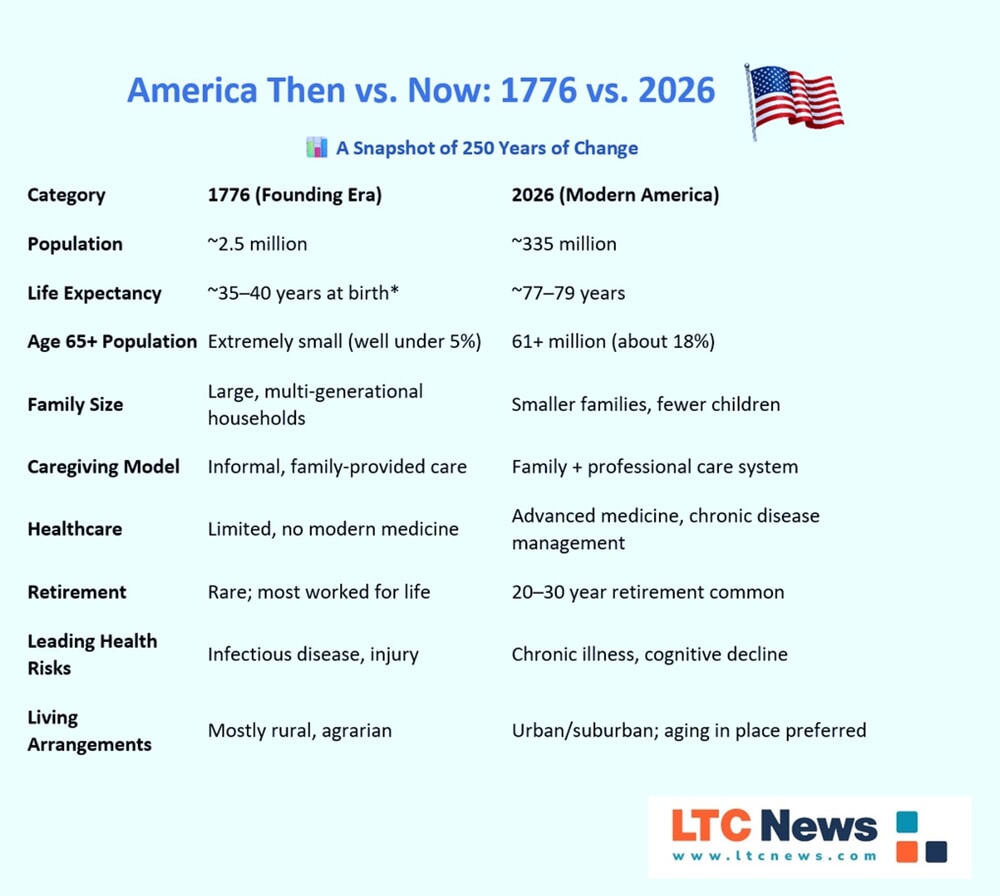
You look back at America in 1776—life was shorter, families were larger, and aging was rarely a long chapter of life. Most people never reached 65. Those who did make it to that age relied on family, not formal systems. Care happened at home, often out of necessity.
For most of human history, average life expectancy was very low, largely because so many children died young. Once people survived childhood, many lived much longer, but reaching old age was far less common than it is today. — Dr. S. Jay Olshansky, a public health and aging expert at the University of Illinois at Chicago, quoted in History.com.
Now, 250 years later, the reality is dramatically different.
Today, more than 61 million Americans are age 65 and older, and that number is growing quickly. You’re living longer. Families are smaller. And the responsibility for aging is shifting—from the family unit to an entire system struggling to keep up.
As the nation marks its 250th birthday, the data shows something clear:
Aging will define America’s next chapter—and your future.
A Nation Growing Older—At a Historic Pace
The United States is older today than at any point in its history.
- The 65+ population has grown rapidly, reaching more than 61 million
- Older adults now represent about 18 percent of the population
- In many areas, older adults are approaching—or surpassing—the number of children
This trend has accelerated in recent years.
From 2010 to 2020, the 65+ population grew 38.6 percent, the fastest rate in more than a century.
The U.S. population is aging as baby boomers move into older age groups. — Stella Ogunwole, U.S. Census Bureau.
This shift is not temporary. It’s structural, and it affects everything from healthcare demand to economic growth.
Baby Boom Generation Is Driving the Shift
At the center of this transformation is one generation: the Baby Boomers.
- About 10,000 Americans turn 65 every day
- By 2030, all Boomers will be age 65 or older
- The 65+ population could reach 95 million by 2060
Baby boomers have changed the face of the U.S. population for more than 70 years. — U.S. Census Bureau.
This generation is not only larger—it is living longer and aging differently.
You’re more likely to:
- Live into your 80s or 90s
- Manage chronic conditions for years
- Expect independence and control over your care
Reflective question: What does a 20- or 30-year retirement really look like—for you?
Caregiving Crisis Is Already Here
Caregiving is no longer a future issue. It’s a present reality.
- 1 in 4 Americans is now a caregiver
- Many provide high-intensity care, often without training
- Caregiving can last 5+ years on average
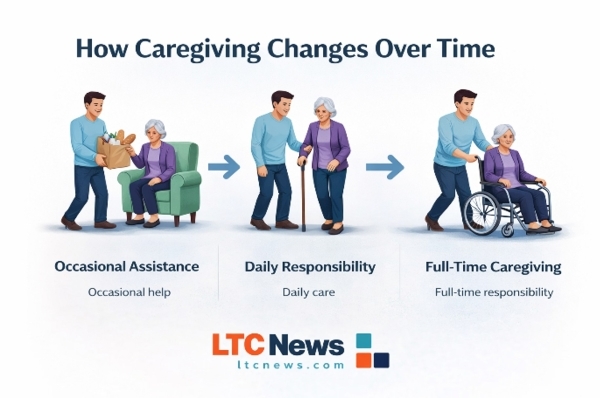
What begins as small help often becomes something much larger:
Occasional assistance → daily responsibility - Errands → hands-on personal care - Support → full-time caregiving
Family caregivers are the backbone of long-term care in this country. — Dr. Rani Snyder, The John A. Hartford Foundation.
Many caregivers don’t even identify themselves that way—until the role becomes overwhelming.
And increasingly, they are balancing:
- Careers
- Financial pressures
- Their own health challenges
A System Under Pressure—and Falling Behind
The U.S. long-term care system is facing a growing imbalance.
- The older population is growing faster than the working-age population
- Demand for care is rising rapidly
- Workforce shortages are worsening
The labor market reflects this strain:
- Home health aide jobs are projected to grow 17 percent from 2024 to 2034
- Hundreds of thousands of caregiver positions must be filled each year
Our nation will require innovative transformation of health care delivery. — Rick Pollack, CEO, American Hospital Association.
And the warning from federal policymakers is clear.
The demand for long-term services and supports will increase substantially. — U.S. Department of Health and Human Services.
This gap is already leading to:
- Higher care costs
- Limited access
- Greater reliance on family caregivers
Long-Term Care Reality Most People Miss
Many families don’t realize until it’s too late that Medicare and traditional health insurance do not cover long-term care beyond short-term skilled care. Yet, many families find themselves in a crisis when they discover they are responsible for long-term care.
Yet the need for help with daily living activities or supervision due to memory decline is something many families face.
- About 56 percent of Americans will require long-term care (HHS definition)
- Millions are living with Alzheimer’s and other cognitive conditions
Long-term care includes help with everyday activities:
- Bathing
- Dressing
- Mobility
- Toileting
- Continence
- Eating
- Cognitive supervision
Not all care means hands-on help. Sometimes you just need what’s called standby assistance, you can perform tasks on your own, but someone needs to be nearby to ensure your safety, especially if there’s a risk of falling.
Without planning, these needs often become:
- Financially overwhelming
- Emotionally exhausting
- Physically difficult
- Logistically complex
Aging at Home: What Americans Want
Despite the challenges, most people want the same thing:
To stay in their homes. That preference is reshaping care delivery.
- Home care demand is rising rapidly
- The home healthcare market is growing significantly
Aging in place is “transforming healthcare” as demand grows.
With planning, you can:
- Modify your home
- Hire in-home care
- Maintain independence longer
Longevity changes everything. Without a plan, you place most of the responsibility on others.
Without a Plan:
- Care decisions happen in crisis
- Savings can disappear quickly
- Families face physical, emotional, and financial strain
With a Plan:
- You stay in control
- You choose where care happens
- You protect your income and assets
- You reduce the burden on loved ones
Planning is no longer optional, it’s essential.
Role of Long-Term Care Insurance
Long-Term Care Insurance is becoming a key tool in modern retirement planning. According to American Health Insurance Plans:
- Insurers paid $16.8 billion in long-term care benefits in 2024
These policies help:
- Cover care at home or in facilities, like assisted living
- Protect retirement income and assets
- Provide flexibility through modern benefit designs
You may not need care today. Your risk of needing extended care will increase as you age. But the decisions you make now will determine:
- Whether you stay in your home
- Whether your family faces a tremendous burden
- Whether you have access to your choice of quality care
The earlier you plan, the more options you keep. At LTC News, you have access to comprehensive tools and trusted resources to help you understand your options, including Long-Term Care Insurance, caregiving solutions, and the real cost of care in your area.
Whether you’re planning ahead or helping an aging parent right now, you’ll find guidance to:
- Learn how long-term care works and what it really costs
- Explore Long-Term Care Insurance to protect your income and assets
- Find quality care providers near you
- Navigate the challenges of caregiving with confidence
Start making informed decisions today—because the right plan can protect your independence and reduce the burden on your family.
Explore more now: Long-Term Care Insurance Learning Center.

A Defining Question at America’s 250th Birthday
As the country reaches this milestone, one question stands out: Are you prepared for a longer life—and the care that may come with it?
The trends are undeniable:
- America is aging rapidly
- Caregiving demands are rising
- The system is under pressure
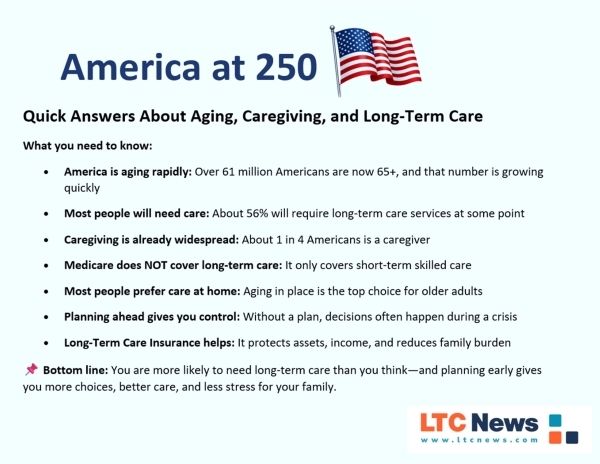
But your future doesn’t have to follow the default path. America has changed dramatically over 250 years—and aging will shape what comes next.
- More older adults than ever before
- More families providing care
- Greater need for long-term care planning
The sooner you prepare, the more control you keep.
Take the Next Step
- Review your retirement strategy
- Use the LTC News Cost of Long-Term Care Calculator to understand real costs
- Explore caregivers and long-term care facilities for older family members through the LTC News Caregiver Directory
- Talk with your family about your wishes
- Consider how Long-Term Care Insurance fits into your plan
Because aging isn’t the risk, being unprepared is.
Frequently Asked Questions
What does “aging in place” mean?
Aging in place means staying in your own home as you get older, rather than moving into a facility. It often involves:
- Home modifications
- In-home care services
- Support from family or caregivers
Most Americans prefer this option.
How does Long-Term Care Insurance help?
Long-Term Care Insurance helps by:
- Covering care at home or in facilities
- Protecting retirement savings and income
- Giving you access to better care options sooner
- Reducing the burden on your family
It allows you to choose how and where you receive care.
Why is the U.S. facing a caregiving crisis?
The U.S. is experiencing a caregiving crisis because:
- The population is aging rapidly
- People are living longer with chronic conditions
- Families are smaller and more spread out
- There is a shortage of professional caregivers
This has shifted more responsibility onto family members
How many Americans are caregivers today?
About 1 in 4 Americans currently provide care for a loved one, often without training and while balancing work and family responsibilities.
What percentage of Americans will need long-term care?
About 56% of Americans will require long-term care services based on the federal definition of needing help with at least two activities of daily living or cognitive impairment.
What is driving the growth of the older population in the U.S.?
The growth is driven by:
- The aging of the Baby Boomer generation
- Increased life expectancy
- Declining birth rates
By 2030, all Baby Boomers will be 65 or older, accelerating demand for care
Why is long-term care planning important before retirement?
Planning before retirement is important because:
- You are more likely to qualify for coverage
- Premiums are lower at younger ages
- You can protect assets before care is needed
- You avoid making rushed decisions later
Early planning gives you more flexibility and financial security.
What happens if you don’t plan for long-term care?
Without a plan:
- Care decisions are made during a crisis
- Savings can be quickly depleted
- Family members often become caregivers
- Stress—emotional and financial—increases
Planning ahead helps you stay in control and avoid these outcomes.
What is included in long-term care?
Long-term care includes help with everyday activities such as:
- Bathing
- Dressing
- Mobility
- Toileting
- Eating
- Continence
- Supervision for cognitive decline
It can also include standby assistance, where someone is present for safety even if you can perform tasks yourself.
How can families prepare for long-term care needs?
Families can prepare by:
- Discussing care preferences early
- Reviewing financial and retirement plans
- Exploring care options in advance
- Using tools like cost calculators and caregiver directories
- Considering Long-Term Care Insurance
Is long-term care only for older adults?
No. While aging increases the risk, long-term care is needed by people of all ages, especially those with chronic illness, disability, or cognitive conditions.
Does Medicare cover long-term care?
No. Medicare does not cover long-term care, such as ongoing help with bathing, dressing, or supervision due to memory loss. It only covers short-term skilled care, typically up to 100 days under limited conditions.


Sponsored