Caregiving Becomes the Wake-Up Call for Long-Term Care Planning. What It Looks Like for Most Families

About This Article
Many adults in their 40s, 50s, and 60s are already caregivers. The reality of aging and the need for long-term care cannot be ignored. Long-term care impacts families physically, emotionally, and financially.

Anna Marino
Anna Marino is a seasoned writer specializing in topics related to family, aging, and lifestyle in retirement. She shares advice on intergenerational relationships and strategies for enjoying retirement.
Hopefully, you are thinking about retirement and the fun of owning your time in the future. The reality is that retirement takes planning, and because of longevity, you should start thinking now about long-term care.
You probably think about retirement as a time you finally get your life back. More freedom. Fewer obligations. The chance to enjoy the years you worked so hard to reach. What many people do not picture is long-term care. When you start thinking about long-term care, you are probably not imagining a crisis. You are imagining control. You look at your health today, your retirement savings, and the examples around you.
You saw your parents and how they managed. You see how your friends are coping with being caregivers for their parents. You tell yourself aging will be gradual, manageable, and planned. The plan makes sense until life has a way of rewriting it.
Real life often intervenes when you least expect it. Without proper planning, these events turn into a family crisis, impacting your loved ones and your finances. You enjoy perfect health today, and tomorrow it can change.
Life changes that quickly.
Long-Term Care - Already Part of Your Life
If you are in your 40s, 50s, or 60s, long-term care is likely not an abstract idea. You have probably seen it up close. You may have helped a parent after a fall. Coordinated doctor visits. Managed medications. You stepped in when their driving was no longer safe. Maybe you are doing it right now.
Even if you have not been a caregiver yourself, you almost certainly know someone who is—a coworker who is leaving work early, a neighbor stretched thin juggling job, family, and caregiving, a friend quietly managing a parent’s decline while trying to keep everything else together.
What choice do they have? Often, there is no other choice since there was no plan for long-term care, often not even a conversation.
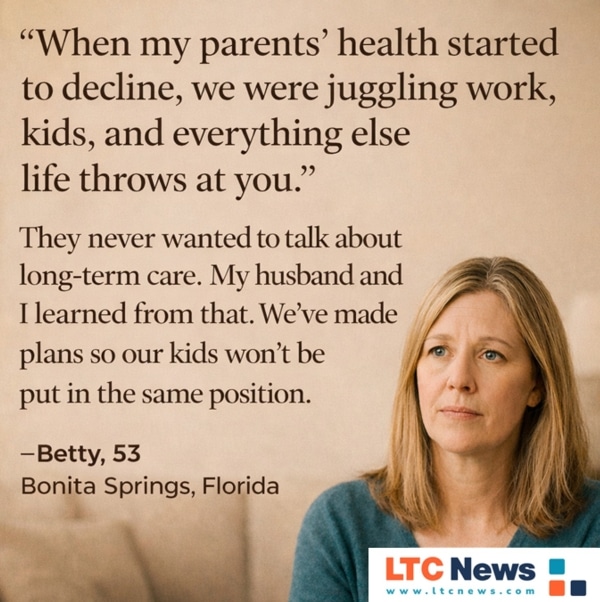
Share your thoughts and experiences about aging, caregiving, health, retirement, and long-term care with LTC News —Contact LTC News.
Long-term care has become a shared experience for many families. What often stands out is how unprepared most of them were when it all started.
You may already know what this feels like. And if you do, it naturally leads to another question. What about you? If your parents are still around, have they planned for extended care? Have they shared whether they own Long-Term Care Insurance, or has the conversation never happened?
With No Plan, Families Carry the Weight
When a parent needs long-term care without a plan in place, the burden usually falls on the family. Adult children step in first. They rearrange work schedules. They take phone calls during meetings. They spend weekends managing care instead of resting. Over time, “helping out” turns into a second job.
The emotional and physical toll of caregiving often leaves families with no choice but to seek professional help. Whether care happens at home or in settings such as assisted living, long-term care costs are significant and continue to rise each year.
Search for quality long-term care services with the LTC News Caregiver Directory. The directory has the largest database of caregivers and facilities in the country. Searching is easy. You select the type of service your loved one needs and their zip code.
The financial impact of paying for professional long-term care follows quickly. Unless your loved one has Long-Term Care Insurance, they will pay for this extended care themselves, as it is not covered by Medicare or health insurance outside of short-term skilled services.
Paying out of pocket for care, covering gaps, and selling assets earlier than expected can change lifestyle and legacy. Extended care costs rarely fit neatly into a household budget, especially when they arrive suddenly.
Caregiving also takes an emotional toll. Decision-making becomes constant. Worry never really stops. And many family caregivers struggle with the uncomfortable reality that they are providing deeply personal care to someone they love. Not easy for either party.
None of this is how most families imagined it would unfold. Yet it happens every day.
When Injuries Alter the Direction of Care Planning
Injuries can become a clear turning point in long-term care planning, particularly for older adults who were previously managing well. Falls, fractures, and similar incidents may quickly affect mobility and independence, prompting families to reassess care needs sooner than expected.
Even when recovery is possible, the period following an injury often brings new demands that reshape existing plans.
The impact of these injuries can differ depending on where the care is provided. In more densely populated states such as California, New York, or Florida, families may have access to a wide range of rehabilitation services. However, higher costs and longer wait times can be common. In states with larger rural populations, fewer options may be available, making transitions into higher levels of care more abrupt.
In states like Montana, Colorado, and Wyoming, geography plays a larger role in how care is accessed after an injury. Urban areas may offer more immediate medical and rehabilitation services, while rural regions may face challenges due to distance and provider availability.
When injuries occur in supervised settings or raise safety concerns, Shafner Law personal injury firm says families in these states sometimes consider how accountability fits into broader care decisions.
If a fall or injury was the result of someone else's negligence, your loved one may be entitled to getting their care paid for and other financial compensation.
How Health Changes Alter Care Decisions
Health changes are the most common reason long-term care plans shift.
Chronic conditions can remain stable for years before suddenly worsening. Mobility limitations often creep in quietly. Cognitive changes may go unnoticed for years until daily routines become difficult or unsafe.
When that happens, everyday activities can quickly become overwhelming. Bathing, dressing, cooking, driving, or managing medications may require help.
At that point, your care decisions are no longer theoretical. They are shaped by safety, supervision needs, and what support is realistically available.
Health changes also influence where your care happens. A home that once supported independence may no longer provide enough structure or oversight.
Your loved one may not have had a plan, and you saw the family crisis firsthand. If your parent has not yet experienced a decline in health, you still have time. A simple conversation about long-term care, their preferences, and their wishes can make a meaningful difference.
It is also the right moment to ask whether they have Long-Term Care Insurance.
It is also a good time to think about your retirement plan, including the costs and burdens of aging and long-term care.
The Moment You Start Thinking About Your Own Future
Watching a parent need care changes how you think about aging. You begin to ask questions you never asked before. What happens if my health changes suddenly? Who would step in for me? How would care be paid for? What would this mean for my children?
Most people plan carefully for retirement income, as you don't want to outlive your income. A need for long-term care will blow up the best laid plan.
The assumption is that your independence will last. You may assume that when you need help with everyday living activities, it will come gradually. You assume your family will manage it all.
Those assumptions might feel reasonable, at least until life proves otherwise.
How Long-Term Care Disrupts Retirement Plans
The need for long-term care does not follow a schedule. It is not driven by age or the calendar. It is triggered by a chronic illness, injury, cognitive change, or even frailty.
When extended care is needed, the care costs can rise quickly. Monthly income is stretched. Your assets are sold to pay for care, reducing your future income and creating tax complications as you sell them. Retirement plans that once felt solid suddenly feel fragile.
For families who lived through this as caregivers, the lesson is clear. Lack of planning shifts the burden onto loved ones. Financially. Emotionally. Physically.
It is not just about money. It is about preserving dignity, relationships, and choice.
Planning is About Protecting the People You Love
Long-term care planning is not about expecting the worst. It is about preventing unnecessary hardship.
A thoughtful plan gives you options. It allows care to happen in the setting you prefer. It keeps your children in the role of family, not full-time caregivers.
Proper planning protects the retirement you dreamed of and worked hard to build. Most families do not regret planning. They regret waiting.
If you have already watched what happens when long-term care arrives without preparation, you understand why this matters. The question is whether you want your own family to face the same challenges someday.
Long-term care planning does not eliminate uncertainty. It reduces chaos. And for most families, that makes all the difference.
LTC News has many resources to assist you in planning.
- Compare Long-Term Care Insurance Companies and Products
- Long-Term Care Education Center
- Current and Projected Cost of Long-Term Care Services Near You
- Search for Caregivers and Long-Term Care Facilities Near You
- Find Qualified Long-Term Care Insurance Specialists
- Get Free Help in Filing a Long-Term Care Insurance Claim