Why the Right Bed Matters for You and Your Aging Dog

About This Article
Back and neck pain become more common in your 50s, and for people with chronic lowback pain, research shows a mediumfirm mattress often provides better relief than a firm one. Your dog may be entering their senior years, too, and a supportive bed can make resting and getting up easier.

Anna Marino
Anna Marino is a seasoned writer specializing in topics related to family, aging, and lifestyle in retirement. She shares advice on intergenerational relationships and strategies for enjoying retirement.
Table of Contents
- Why This Overlap Is Real for Empty Nesters
- What Research Says About Your Mattress
- Choosing the Right Type of Mattress for Back and Neck Pain
- What Research Says About Your Dog's Bed
- Choosing the Right Type of Bed for an Older Dog
- The Two Beds, Side by Side
- Where This Fits Into Your Bigger Planning Picture
If you're in your 50s or 60s, your back may already be sending you messages you didn't get 20 years ago. Maybe you wake up stiff, roll your shoulders before getting out of bed, or wonder why a night in a hotel occasionally leaves you feeling better than a night in your own bedroom.
The mattress that once seemed perfectly comfortable may not feel quite as forgiving as your body changes with age. Meanwhile, another member of the household may be going through some changes of their own.
The kids are grown and gone, but the dog they left behind — or the one who became your companion after the house got quieter — is getting older, too. The puppy who once launched onto the couch without thinking may now hesitate before jumping, take a little longer to stand after a nap, or spend considerably more time looking for the most comfortable place in the room.
It might seem like your mattress and your dog's bed belong on two completely different shopping lists, but they actually have something important in common: support.
As people and dogs age, joints can become less forgiving, mobility can change, and getting comfortable and getting back up can require a little more effort. For older adults, mattress support, pressure relief, and ease of movement can become increasingly important considerations. Senior dogs can likewise benefit from bedding that provides support for aging or stiff joints.
Neither purchase will turn back the clock or treat an underlying medical condition. But both are reminders of something families sometimes overlook when thinking about aging: quality of life is often shaped by the ordinary things we use every day. A safer bathroom, better lighting, a supportive chair or the right bed can seem like small details until discomfort or declining mobility makes them matter.
So, if you're beginning to wonder whether your mattress has seen better days, take a look across the room at where your dog sleeps. You may not be the only one in the house who's outgrown the bed that used to work just fine.
Why This Overlap Is Real for Empty Nesters
Empty-nest households often revolve around one aging pet who used to be "the kids' dog." At the same time, you're at the age when back and joint pain start showing up more often. According to the Centers for Disease Control and Prevention's National Health Interview Survey, the share of adults with back pain in the past three months rises with age, from 28.4 percent among adults 18 to 29, to 44.3 percent among adults 45 to 64, to 45.6 percent among adults 65 and older.
Dogs already spend a substantial portion of the day sleeping and resting, and many senior dogs rest even more as they age. That's a lot of hours spent lying on something. If that something is a thin mat on hardwood, or a mattress that has lost its support, both of you are absorbing pressure you don't have to.
Comfort becomes part of aging safely at home. Sleep quality, joint pain, and the ease of getting in and out of bed can all affect mobility and fall risk as people get older. Small changes to the home environment often matter well before anyone needs formal long-term care. The same logic applies to a dog whose stiffness makes it harder to get up off the floor.
What Research Says About Your Mattress
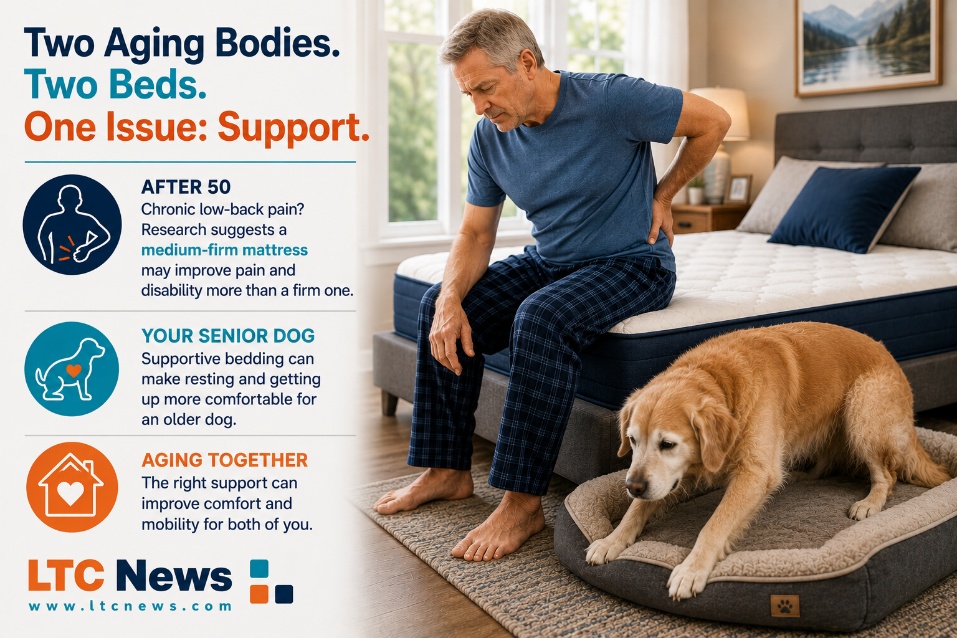
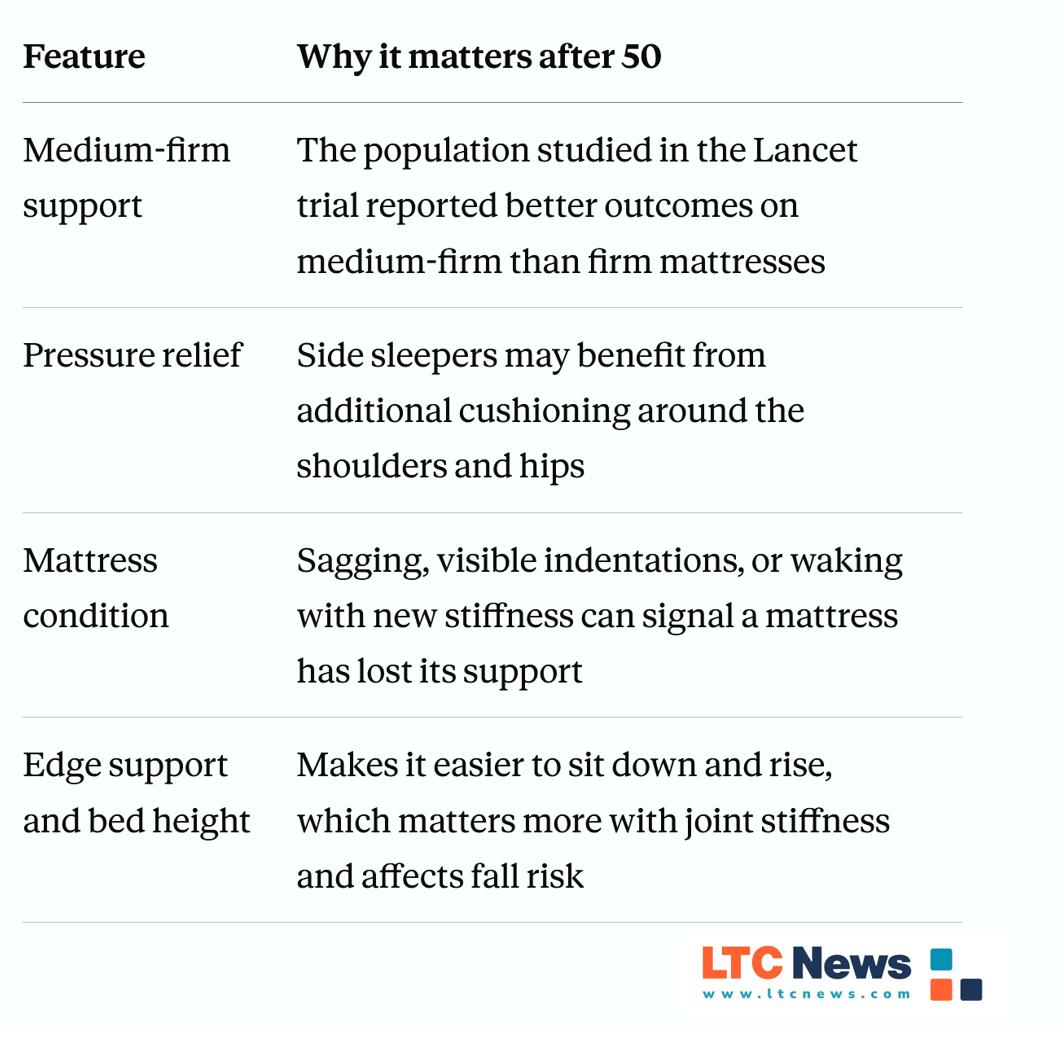
The old advice was to sleep on the firmest mattress you can find. For people with chronic non-specific low-back pain, research suggests that harder isn't necessarily better. In a randomized, double-blind, controlled trial of 313 adults with chronic non-specific low-back pain, researchers assigned participants either a firm mattress or a medium-firm mattress for 90 days. At 90 days, patients on the medium-firm mattress had better outcomes for pain in bed, pain on rising, and disability than those on the firm mattress.
The study, published in The Lancet, remains the most-cited clinical trial on the subject, but it studied one specific population; it doesn't establish that medium-firm is the right answer for everyone, or for every cause of back or neck pain. Individual needs vary based on sleep position, body type, and what's actually causing the pain.
A few other factors matter alongside firmness:
Choosing the Right Type of Mattress for Back and Neck Pain
We're not going to rank specific mattress brands here, since most of the "best mattress" roundups online are affiliate content written by the same sites that profit when you click through. That's the same conflict of interest we avoid when we cite long-term care cost data, so we're applying the same standard to bedding. Based on clinical research and sleep-position mechanics, we can tell you what to look for.
Your sleep position drives your mattress needs more than any brand name does. Side sleepers need extra cushioning at the shoulder and hip so those joints don't take the full impact of body weight. Back sleepers need consistent support under the lower back so the spine stays in a neutral line rather than arching or flattening. Stomach sleeping tends to put more strain on the neck and lower back than the other positions, which matters if you're troubleshooting persistent pain.
For neck pain specifically, the pillow matters as much as the mattress. A pillow that's too thick or too thin tilts the neck out of alignment all night. Side sleepers generally need a thicker pillow to fill the gap between the ear and shoulder, and back sleepers tend to do better with a medium loft, according to sleep-position guidance reviewed by AARP medical experts.
Mattress age matters, but there is no automatic expiration date. Many mattresses last about seven to ten years, depending on construction and use. Sagging, visible indentations, worsening sleep, or waking with more stiffness than usual are more useful signs that a mattress has lost its support than the calendar alone.
Signs Your Own Mattress Is No Longer Doing Its Job
- You wake with stiffness in your low back or neck that eases once you're up and moving
- You can see or feel a body-shaped dip in the mattress
- You sleep better in a hotel bed or guest room than at home
- Your mattress is approaching seven to ten years old and is showing signs of sagging, wear, or reduced support
What Research Says About Your Dog's Bed
Your dog can't tell you their bed hurts. Still, the pattern is familiar: less padding and less muscle to cushion joints, combined with more hours spent lying down. Osteoarthritis is one of the most common chronic conditions in dogs, according to VCA Animal Hospitals, and a thin mat on tile or hardwood offers little protection.
Older dogs with osteoarthritis or other mobility problems may also appear stiff or reluctant to move after resting, which is something owners should discuss with their veterinarian.
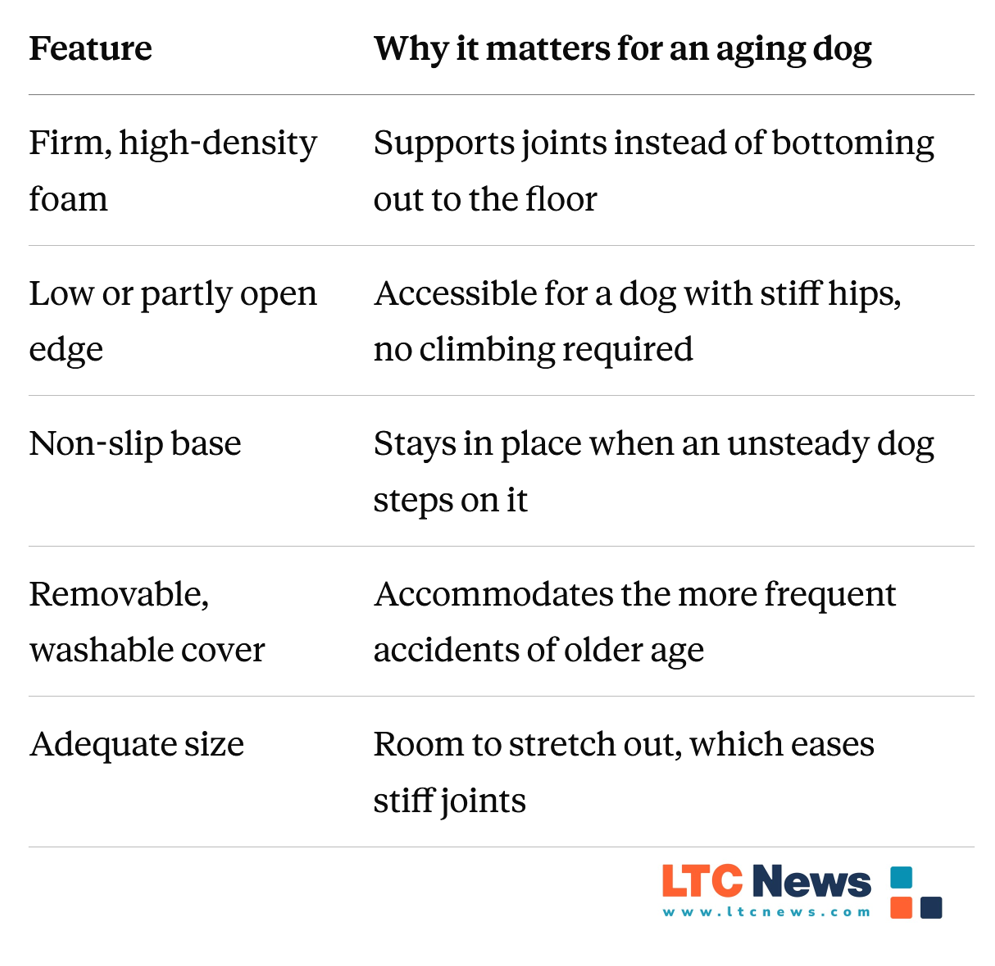
For older dogs, particularly those with mobility problems, the goal is a resting surface that provides cushioning and support while remaining easy to enter and exit. Features such as supportive foam, a non-slip base, washable materials, and a low entry point can be especially practical for senior dogs.
Choosing the Right Type of Bed for an Older Dog
When shopping, look beyond the word "orthopedic" and examine the bed's actual construction. It isn't a regulated term, and many beds use it loosely—the American Kennel Club advises checking the fill material directly, since a genuinely supportive bed uses high-density foam or memory foam, not loose polyfill that packs down within weeks.
Size the bed so your dog has enough room to lie comfortably and stretch out, and consider sizing up if they're between sizes. For dogs with diagnosed arthritis or a large or giant breed, a thicker multi-layer foam base holds up better over time than a thin one. A removable, machine-washable cover is especially practical for a senior dog. Purina's guidance notes that accidents during sleep become more common with age, and a bed you can't wash regularly will go unused. VCA Animal Hospitals specifically recommends an orthopedic or memory-foam bed for dogs with osteoarthritis, to reduce pressure on sore joints and improve sleep quality.
Look for dense, supportive foam, easy access, a non-slip bottom, and a washable cover. Several options are available; one example of a bed built around those features is Le Noof's orthopedic dog bed collection, though families should choose a bed based on their dog's size, mobility, and their veterinarian's recommendations rather than the marketing label alone.
Signs Your Older Dog May Need More Support — or a Veterinary Check
- Your dog circles repeatedly and struggles to settle, or shifts position often
- They choose the bare floor over their own bed
- They're slow or stiff to rise, particularly after sleeping
- The bed's filling has compressed, leaving them effectively on the ground
Persistent difficulty settling, new stiffness, or trouble rising can also point to arthritis, another painful condition, or in some cases a neurologic or cognitive change — not just an unsupportive bed. If any of these are new or getting worse, a veterinary visit is worth doing alongside, not instead of, a bed upgrade.
The Two Beds, Side by Side
Notice how similar the underlying logic is: both of you benefit from consistent support at the points that carry the most weight, on a surface that hasn't lost its structure over time. If you're already reviewing your own mattress because of back or neck pain, it's a natural moment to check your dog's bed too, since you're both spending more of the day lying down than you used to.
Complementary Steps That Help Both of You
- Choose a bed height and mattress edge that make sitting down and standing up easy, since that's as relevant to fall prevention as firmness is to back pain
- Position your dog's bed in a warm, draft-free spot. VCA Animal Hospitals notes that cold or damp conditions may worsen stiffness and discomfort in dogs with arthritis.
- Add ramps or steps so your dog avoids jumping on and off furniture
- Place runners or rugs over slick floors near resting areas, which helps an unsteady dog and reduces your own fall risk
- Report new stiffness in yourself or your dog to a doctor or veterinarian, since pain is treatable and best addressed early
Where This Fits Into Your Bigger Planning Picture
A new mattress or dog bed is a small, immediate decision, but it's part of a larger pattern: paying attention to comfort, mobility, and safety at home as you and the animals that grow older alongside you both age.
You and your dog may both need help as you age. Your dog is dependent on you. But when you need help, who will help with daily living activities, getting around, and even supervision if you start forgetting things?
Often it falls on the shoulders of an adult child, and that places huge physical, emotional, and financial burdens on them. You have assets, and your income and assets can pay for long-term care services, but long-term care services are very expensive.
These are reasons why many Americans add Long-Term Care Insurance to their retirement plan. An LTC policy will pay for your extended care, even at home. In some cases, with a policy with cash benefits, your caregiver might be able to care for your pal, meaning your dog. Most people purchase an LTC policy between the ages of 47 and 67.
Learn More: LTC News Long-Term Care Insurance Learning Center.
Some Long-Term Care facilities may allow your furry friend to live with you. Use the LTC News Caregiver Directory if you have a loved one who needs extended care and wants their dog or cat to stay with them. The directory includes over 80,000 providers you can search by ZIP code.
Aging well at home often comes down to noticing small problems before they become bigger ones. A worn mattress won't cause every aching back, and a better dog bed won't treat arthritis. But creating a safer, more supportive home for you and the animals that grow older alongside you can make everyday life more comfortable while helping preserve mobility and independence.
Frequently Asked Questions
Does sleep position matter when choosing a mattress?
Yes. Side sleepers generally benefit from more cushioning around the shoulders and hips, while back sleepers need consistent support that helps maintain a neutral spinal position. Stomach sleeping can place additional strain on the neck and lower back. Your pillow also matters, particularly when neck pain is an issue.
How can I tell whether my older dog needs a better bed or needs to see a veterinarian?
A compressed bed, difficulty getting comfortable or choosing the floor instead of the bed can suggest that the bedding isn't working well. However, new or worsening stiffness, trouble rising, repeated repositioning or difficulty settling can also indicate arthritis, pain, neurologic problems or cognitive changes. Those symptoms warrant a veterinary evaluation rather than simply buying a new bed.
How do I know when it's time to replace my mattress?
Age alone shouldn't determine when you replace a mattress. Many mattresses last about seven to 10 years, but signs such as sagging, visible indentations, reduced support, worsening sleep or regularly waking with increased stiffness can be more useful indicators that a mattress is no longer doing its job.
What type of mattress is best for chronic low-back pain?
There is no single mattress that's best for everyone. However, a randomized clinical trial involving adults with chronic nonspecific low-back pain found that people assigned to a medium-firm mattress had better outcomes for pain in bed, pain when getting up and disability than those assigned to a firm mattress. Individual needs can vary based on sleep position, body type and the cause of the pain.
Can a pet live with someone in a long-term care facility?
Some assisted living and other long-term care communities allow residents to bring pets, but policies vary considerably by facility. Families should ask specifically about pet rules, size or breed restrictions, fees and who is responsible for the animal's care if the resident becomes unable to provide it. The LTC News Caregiver Directory can help families search for care providers and facilities in their area.
What should I look for in a bed for an older dog?
Look for a supportive surface that's comfortable and easy for the dog to enter and exit. Supportive foam, a nonslip bottom, a low entry point and a removable, washable cover can be especially useful for senior dogs. Make sure the bed is also large enough for your dog to lie down and stretch out comfortably.
Can changing a mattress or dog bed improve mobility?
Better support can make resting and getting up more comfortable, but a mattress or dog bed isn't a treatment for an underlying medical condition. For people, bed height and edge support can also affect how easily someone sits down and stands up. For older dogs, ramps, nonslip flooring and easier access to resting areas can complement supportive bedding.
Is a firm mattress always better for back pain?
No. The traditional advice that a very firm mattress is automatically better for a bad back isn't supported for everyone. Research involving chronic nonspecific low-back pain suggests that medium-firm support may work better than a firm mattress for some people. That doesn't mean medium-firm is the right choice for every type of back or neck problem.
Are orthopedic dog beds actually better for senior dogs?
The word "orthopedic" alone doesn't guarantee that a dog bed provides better support. Because the term isn't regulated, owners should look at the bed's actual construction and materials. For dogs with osteoarthritis, veterinary guidance cited in the article recommends orthopedic or memory-foam bedding to help reduce pressure on sore joints and improve sleep quality.
Can Long-Term Care Insurance pay for care at home if mobility problems become serious?
Long-Term Care Insurance can provide benefits for qualifying long-term care needs, including care received at home, subject to the policy's benefit triggers and terms. That's different from paying for a mattress or other ordinary household purchases. The larger planning issue is having resources available if health or mobility problems eventually make help with everyday activities necessary.
What do mattresses and dog beds have to do with aging in place?
Aging in place isn't only about major home renovations or eventually needing care. Everyday factors such as sleep, joint comfort, mobility, lighting, flooring and the ability to get up safely can influence independence long before formal long-term care is needed. For empty nesters with an aging pet, reviewing both sleeping environments is one small part of creating a safer and more supportive home.


Sponsored