Ways to Pay for Long-Term Care in Canada — How It Differs from the U.S.
About This Article
Provincial programs cover portions of long-term care, but Canadian families still face accommodation charges, private care costs, and gaps while waiting for services. Several payment options exist, and planning always helps.

Jacob Thomas
Jacob Thomas writes on health, wellness, and retirement topics, including aging, caregiving, insurance, and long-term care.
Table of Contents
- Start With What Your Province Will Pay
- Retirement Income and Savings Often Pay the First Bills
- Long-Term Care Insurance Can Provide Another Source of Money
- Your Home May Be Part of the Plan
- Tax Relief Can Offset Some Care Costs
- Families Often Fill the Remaining Care Gap
- Canada and the U.S.: Different Systems, Similar Family Concerns
- Build a Plan Before Someone Needs Extended Care
Many Canadians assume the country's public health system will take care of them if they eventually need help with everyday activities or supervision because of dementia. The reality is more complicated, and many Canadian families are unprepared.
Canada's universal health system does not mean all long-term care is free. Provinces and territories organize and deliver home and community care, in addition to facility care, and Health Canada notes that individuals and families may have to pay some or all of the costs of certain services.
What the government pays, what services are available, and what an individual pays depend largely on where they live. That makes planning important, even in a country known for publicly funded health care. The situation is different in the United States. Medicare does not pay for ongoing long-term care, although it can cover qualifying short-term skilled care. Medicaid can pay for long-term care for people who have limited finances and state eligibility requirements.
In both countries, families often combine several sources of money to pay for care. All Canadian dollar figures in this article are in Canadian dollars.

Start With What Your Province Will Pay
Before paying privately for care, find out what public services are available. A provincial or territorial care assessment can determine whether someone qualifies for publicly funded home care or placement in a long-term care home.
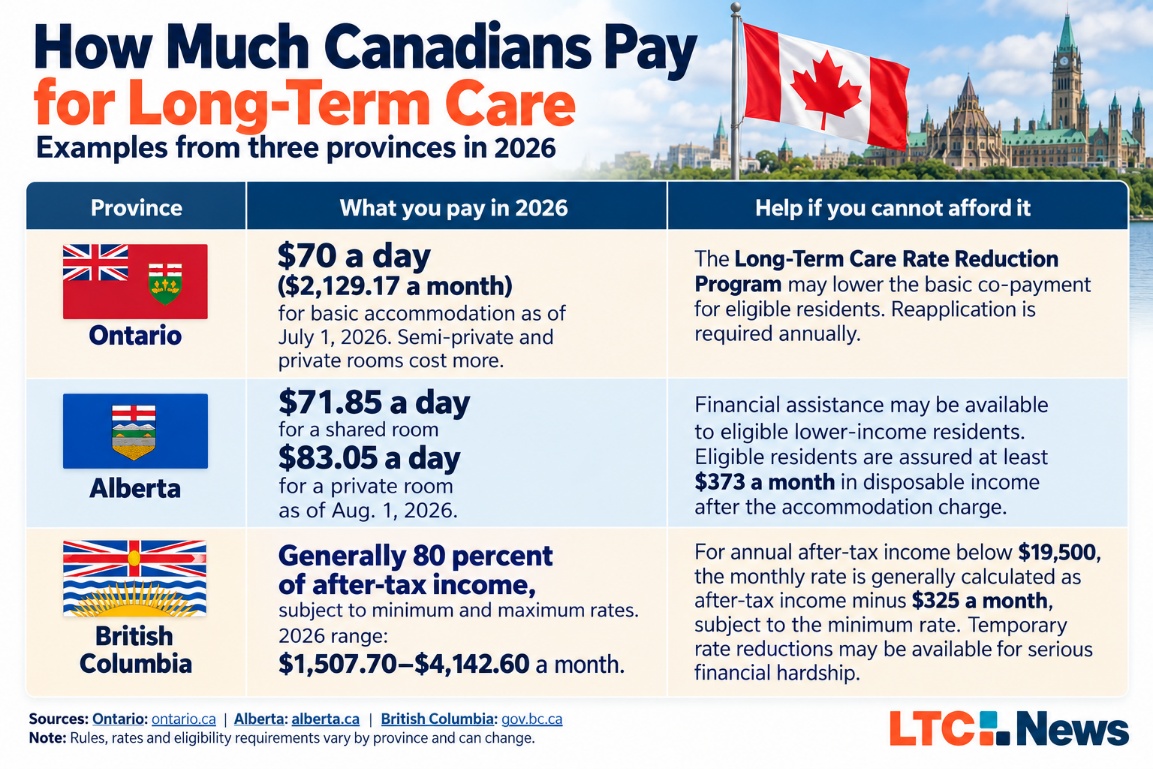
In Ontario, for example, Ontario Health atHome coordinates access to publicly funded home and community services and long-term care homes. Residents of Ontario long-term care homes contribute toward accommodation and meals. As of July 1, 2026, Ontario's maximum basic accommodation charge is $70 a day, or $2,129.17 a month. Semi-private and private accommodations cost more.
Eligible lower-income residents may qualify for Ontario's Long-Term Care Rate Reduction Program to reduce the basic accommodation charge.
Other provinces use different formulas.
British Columbia generally bases long-term care resident charges on after-tax income, subject to provincial minimum and maximum rates. Alberta also establishes maximum accommodation charges and provides financial assistance for some lower-income residents.
The key point is that Canada has no single long-term care payment system. Rules, benefits, costs and eligibility vary by province and territory. Families should ask which services are publicly funded, what they will have to pay themselves, whether financial assistance is available, and what help is available at home.
They should also ask what happens if someone qualifies for long-term care but has to wait for placement. That waiting period can become expensive. Families may need to supplement available public services with privately paid home care until a long-term care bed becomes available.
A retirement residence is also different from a publicly funded long-term care home. Retirement residences generally operate privately and set their own fees.
Retirement Income and Savings Often Pay the First Bills
Canadian families frequently use existing retirement income to cover their share of long-term care costs. That can include the Canada Pension Plan (CPP) or Quebec Pension Plan (QPP), Old Age Security (OAS), workplace pensions and personal retirement savings.
Lower-income seniors should also determine whether they qualify for the Guaranteed Income Supplement (GIS). For October through December 2026, the maximum monthly OAS payment is $762.50 for people ages 65 to 74 and $838.75 for those age 75 and older. The maximum GIS payment for a qualifying single, widowed, or divorced senior is $1,138.90 a month, subject to income requirements.
Savings can fill additional gaps, but withdrawals should be planned carefully. Money withdrawn from a Registered Retirement Savings Plan (RRSP) or Registered Retirement Income Fund (RRIF) can increase taxable income and potentially affect income-tested government benefits.
Another consideration when one spouse needs care is that the spouse remaining at home still has a household to maintain. Housing, food, utilities, transportation, and other expenses don't disappear just because part of the family's income now goes toward long-term care.
Long-Term Care Insurance Can Provide Another Source of Money
LTC Insurance exists in Canada, and if you or a parent already owns an LTC policy, locate the policy before care is needed. Don't assume you know what it covers. Find out what triggers benefits, how long the waiting period is, the amount of the benefit, and whether benefits can be used for care at home, in a retirement residence, or in a long-term care home. Canada's individual Long-Term Care Insurance market is much smaller than the U.S. market.
There are several options; for example, Sun Life continues to offer Sun Retirement Health Assist to Canadians ages 45 to 71. The policy provides an income-style benefit that can help pay for care at home, in a retirement residence, or in a long-term care facility.
However, consumers should understand its unusual timing provisions. Coverage generally becomes effective at the later of five consecutive policy years or the policy anniversary following the insured person's 65th birthday. After the coverage effective date, the policy also has a selected waiting period of either 365 or 730 days during which the insured must remain dependent before benefits begin.
Someone who already owns an older Canadian Long-Term Care Insurance policy should therefore be especially careful before considering giving it up. Replacement options may be limited. The market is much broader in the United States. Americans can purchase traditional Long-Term Care Insurance as well as hybrid life/long-term care insurance and annuity products with long-term care benefits.
Most people who purchase Long-Term Care Insurance in the United States do so between ages 47 and 67, when their health is more likely to qualify them. In Canada, exact figures are hard to get since the market is smaller. Experts tell LTC News that many consumers in Canada don't think about long-term care until a crisis forces them to, because they assume the government covers it.
Your Home May Be Part of the Plan
For many Canadians, their home is their largest financial asset. If long-term care becomes necessary, families sometimes consider selling the property, downsizing, or generating rental income. Selling isn't always the right answer, particularly when a spouse or partner continues to live in the home.
If downsizing is being considered, families should calculate what will actually remain after the mortgage, real estate commissions, legal fees, moving expenses, and the cost of replacement housing.
Another possibility is renting property. A traditional residential tenancy may produce ongoing income that can help offset care expenses. Families still need to account for property taxes, insurance, maintenance, vacancies, mortgage payments and income taxes.
Short-term rentals are another possibility in some circumstances, although local rules can make that option much more restrictive. Alice Fox, a manager at MasterHost in Toronto, tells LTC News that unused property may provide income through a residential tenancy. For eligible short-term rentals, professional management can also reduce the daily workload for an older property owner or family member.
Guest messages, turnover scheduling, price adjustments: it lands daily, and none of it needs to land on the owner.” — Alice Fox.
There is an important catch. The City of Toronto allows short-term rentals only in an operator's principal residence. A stay of fewer than 28 consecutive days is considered a short-term rental. Operators must register with the city, and an entire residence can be rented for no more than 180 nights in a calendar year.
An unused second home does not qualify simply because an owner wants to generate short-term rental income from it. Moving permanently into a long-term care home could also affect whether the former home still qualifies as the person's principal residence under Toronto's short-term rental rules.
Rules differ elsewhere, so families should check local requirements rather than assume Toronto's rules apply throughout Canada. Rental income can also have tax consequences. Families should speak with a Canadian tax professional and review their insurance coverage before converting a home to a rental.
Tax Relief Can Offset Some Care Costs
Canadian tax rules may provide some relief for families paying for care. However, what can be claimed depends heavily on the type of care and where it is provided. Canada Revenue Agency rules generally allow qualifying expenses for full-time care in a nursing home to be claimed as medical expenses.
A retirement home is treated differently. Families generally cannot claim the entire amount paid to a retirement home or home for seniors. Qualifying portions of the bill related to attendant-care salaries and wages may be eligible when CRA requirements are met. Special rules also apply to the Disability Tax Credit and claims for attendant care or full-time nursing home care. In some situations, families must choose between claiming the disability amount and claiming certain care expenses.
Keep detailed receipts and ask a retirement residence for an itemized breakdown of eligible attendant-care expenses when appropriate. A supporting family member may also be able to claim qualifying expenses for a dependent parent. Tax relief can reduce the ultimate cost of care, but it doesn't solve an immediate cash-flow problem. Families still need enough money available to pay today's bill.
Families Often Fill the Remaining Care Gap
Money is only part of the long-term care equation. Adult children frequently provide transportation, meals, supervision, household help, and personal care. Others contribute money for professional caregivers. Canada is not unique in that respect. In the United States, 63 million Americans provide unpaid care; that's about one in four U.S. adults. When family members become part of the care plan, establish expectations early.
Who will provide care? How much time can that person realistically provide? Who will contribute financially? What happens when Mom or Dad needs more help than the family can safely provide?
Unpaid caregiving should be treated as a real contribution. Without a plan, the adult child who happens to live closest can gradually become the full-time solution.
Canada and the U.S.: Different Systems, Similar Family Concerns
Canada and the United States approach long-term care differently. Canada's provinces and territories publicly fund portions of long-term care and home and community services. Residents may still pay accommodation charges and other costs, and publicly funded services may not provide all the help someone wants or needs.
The systems may be different, but families on both sides of the border eventually confront many of the same questions:
- Who will provide the care?
- Where will that care be delivered?
- And where will the money come from?
Build a Plan Before Someone Needs Extended Care
Long-term care rarely arrives as one predictable monthly expense. Someone may initially need a few hours of help at home. Later, that can become daily care, a retirement residence, memory care or a long-term care home. Start by determining which services your province will provide. Then calculate retirement income, savings, insurance benefits, and other assets that could pay for expenses the public system does not cover. Families should also discuss what happens if care needs increase.
Adult children need to understand what their parents want. Parents need to understand how much help their children can realistically provide. Planning doesn't eliminate the possibility of needing long-term care. It gives families more control over what happens when that need arrives.
The question to ask isn't simply whether the government will pay.
Ask instead: If you or a parent needed help with everyday activities tomorrow, what would pay first — and what would happen when that money or public support wasn't enough?
Frequently Asked Questions
Who pays for long-term care in Canada?
Long-term care is often paid for through a combination of provincial or territorial funding and the individual's own resources. Depending on the situation, families may use retirement income, savings, Long-Term Care Insurance, home equity, and other assets to cover expenses that public programs do not pay.
What is the biggest difference between paying for long-term care in Canada and the U.S.?
Canada's provinces and territories publicly fund portions of long-term care and home and community services, although residents can still face substantial out-of-pocket expenses. In the United States, ongoing long-term care is generally paid through personal income and assets, Long-Term Care Insurance, or Medicaid for those who qualify.
Is Long-Term Care Insurance available in Canada?
Yes, although Canada's individual Long-Term Care Insurance market is much smaller than the U.S. market. Anyone who already owns a Canadian policy should review its benefit triggers, waiting period, coverage amount, and eligible care settings before care is needed. Older policies can be particularly valuable because replacement options may be limited.
What happens if someone qualifies for publicly funded long-term care but has to wait for a bed?
Families may need to rely on available public home-care services, unpaid family caregivers and privately paid home care while waiting for placement. This gap can become expensive, which is one reason families should plan before a care crisis occurs.
Can Canadians use retirement income and savings to pay for long-term care?
Yes. Canadians may use income from CPP or QPP, Old Age Security, workplace pensions and personal savings. RRSP and RRIF withdrawals can also provide money for care, but taxable withdrawals may affect income-tested government benefits. Families should consider the tax consequences before making large withdrawals.
How much does a long-term care home cost in Canada?
There is no single national price. Costs and government subsidies vary by province or territory, the type of care and accommodation, and sometimes the resident's income. Some provinces also provide financial assistance or reduced charges for qualifying lower-income residents.
What should families do before long-term care is needed?
Start by learning what the province or territory will provide and what the individual would be expected to pay. Then review retirement income, savings, insurance, housing, and other assets. Families should also discuss who could provide care, how much help adult children can realistically offer, and what would happen if care needs become more extensive.
Does Medicare pay for long-term care in the United States?
Generally, no. Medicare does not pay for ongoing custodial long-term care. It can pay for qualifying short-term skilled care under specific circumstances. Medicaid can pay for long-term care for eligible individuals with limited income and assets, subject to state rules.
Can long-term care expenses be deducted on Canadian taxes?
Some qualifying expenses may be claimed as medical expenses under Canada Revenue Agency rules. Eligibility depends on the type of care, the setting, and the individual's circumstances. Full-time nursing home care and attendant-care expenses can be treated differently, so families should keep detailed records and seek professional tax advice when necessary.
Is long-term care free in Canada?
No. Canada's publicly funded health system does not mean all long-term care is free. Provinces and territories fund and organize long-term care and home and community services, but individuals may still be responsible for accommodation charges, privately purchased care, and other expenses.
Can a Canadian use their home to help pay for long-term care?
Yes. Some families sell or downsize a home, use rental income or otherwise draw on home equity to help pay for care. However, selling may not make sense when a spouse or partner continues to live in the home. Rental arrangements can also create tax, insurance and regulatory considerations.


Sponsored