Tracing Your Family Roots: Why Every Family Should Record the Stories of Older Loved Ones
About This Article
Recording the stories of an older parent, grandparent, or family friend preserves history that no photograph or public record can capture. These conversations strengthen family bonds and may support the older adult's mood and sense of connection.

Anna Marino
Anna Marino is a seasoned writer specializing in topics related to family, aging, and lifestyle in retirement. She shares advice on intergenerational relationships and strategies for enjoying retirement.
Table of Contents
- Every Older Loved One Carries a Lifetime Worth Remembering
- Questions That Turn Into Stories, Not Interviews
- These Conversations May Support Well-Being, Too
- Preserve the Story Behind Every Photo and Keepsake
- Build a Simple Digital Archive Before Time Takes Its Toll
- Record Voices While You Still Can
- Use Online Research to Fill In the Gaps
- Family History Opens the Door to Future Care Planning
- Start This Weekend: A Simple Family Legacy Project
- Why This Matters
- The Story Is the Legacy
You probably have an older relative whose stories have never been written down. It could be your mother, father, grandmother, grandfather, an aunt, an uncle, or a lifelong family friend. They have lived through decades of history, celebrated milestones, overcome hardships, and built up wisdom that no birth certificate or family tree can capture. One day, those stories will be gone. Not because they weren't important. Because no one thought to ask.
Family health history deserves the same care as any other family record. Start by asking loved ones about major medical conditions, age at diagnosis, and cause and age at death, then write it down rather than trusting memory alone. The Centers for Disease Control and Prevention notes that even an incomplete family health history can help a healthcare provider decide which screening tests you need and when to start them, so it's worth recording what you know now rather than waiting until you have every detail.
RECOMMENDED: Update the health record whenever a new diagnosis comes up in the family, store a copy somewhere every family member can access, and bring it along to doctor's appointments. A free tool like the Surgeon General's My Family Health Portrait can help organize the information in one place.
For many families, that realization comes too late. Sometimes it happens while cleaning out a parent's home after a move to assisted living. A box of photographs turns up in the back of a closet, and no one can name half the faces staring back. A faded postcard arrives from a country no one remembers visiting. A military medal surfaces from a drawer, and the story behind it disappeared with the person who earned it.
Almost every family has a moment like this. Someone quietly says, "I wish I had asked." That regret is common, and it's almost entirely preventable. One conversation today can save memories that would otherwise disappear forever.
Genealogy Records: 'What Happened.' Conversations Explain 'Why It Mattered'
When people think about family history, genealogy usually comes to mind first: names, birth dates, marriage records, census documents. Those records matter. Online databases and historical archives have made that kind of research easier than ever. Genealogy tells only part of the story, though.
A record might confirm when your grandparents married. It won't tell you how they met. A census document might confirm where your family lived in 1950. It can't explain why they packed up and moved across the country. A military service record lists dates of enlistment and discharge. It says nothing about what it felt like to leave home for the first time.
The most meaningful parts of family history live in conversation. They explain why a tradition began, why certain values got passed down, why your grandmother never missed Sunday dinner or why a handwritten recipe has stayed in the family for 70 years. Those stories shape a family's identity in ways no official document ever will.
Every Older Loved One Carries a Lifetime Worth Remembering
Older adults have witnessed extraordinary change. Many remember when television first arrived in American homes. Some watched the moon landing live. Others served during wartime, built a business from nothing, raised a family through hard economic times, or immigrated to the United States looking for a better life.
Even the experiences that feel ordinary to the person living them often sound extraordinary to a younger generation. What was gasoline like at 20 cents a gallon? What was the neighborhood like before they built condos? How did you meet your spouse?
Questions like these rarely get a one-word answer. They open a door, and the conversation that follows often becomes a memory in its own right. Children start to see grandparents as young people who once had dreams, fears, and ambitions of their own. Adult children discover stories their parents never thought to share. And the older adult realizes someone genuinely wants to understand the life they built.
Questions That Turn Into Stories, Not Interviews
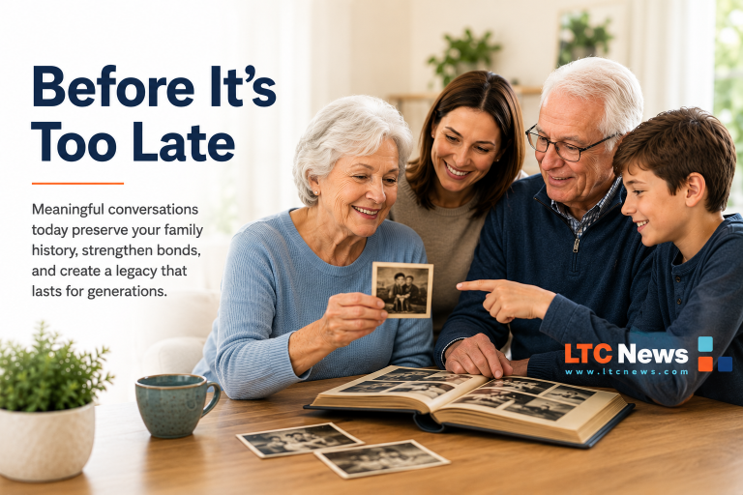
You don't need a formal interview. The best conversations usually happen naturally while looking through an old photo album, preparing a family recipe, or driving through a childhood neighborhood. A single photograph can unlock a dozen stories: Who is standing next to Grandpa? What happened right after this picture was taken? Why did this day matter so much?
If you want a starting point, try open-ended questions organized around different chapters of a life:
- Childhood: What is your earliest memory? What games did you play with friends? Who influenced you most growing up?
- Work: What was your first job? What is a lesson you learned early in your career? What accomplishment makes you proudest?
- Family: How did you meet your spouse? What family tradition means the most to you? What was your favorite family vacation?
- Life lessons: What decision are you most grateful you made? What challenge changed your life? What advice would you give your grandchildren?
One question tends to lead to another. An afternoon can turn into a journey through decades of family history, and the person sharing those memories will feel heard. In a season of life when many conversations revolve around medications and appointments, being asked about the happiest day of their life is a reminder that their story is far bigger than their age.
These Conversations May Support Well-Being, Too
Preserving family stories isn't only about future generations. It may benefit the person telling them right now. The National Institute on Aging's guidance on cognitive health notes that staying socially connected and engaged with others is an important part of healthy aging, and that higher social engagement has been associated with better cognitive health in later life. No single conversation prevents dementia or cognitive decline, but maintaining strong relationships is linked to better overall well-being as people age.
Dr. Amit A. Shah, a geriatrician, internist, and palliative care specialist at Mayo Clinic in Arizona, says "it's the quality, duration and nature of your relationships that seem to matter most" as people age. He adds that engaging with others functions like a workout for the brain, supporting cognitive flexibility in ways that go beyond typical brain games.
Psychologists have also studied what's known as reminiscence or life review, where older adults reflect on meaningful experiences from their past. A 2023 systematic review and meta-analysis published in the journal Healthcare found that life review and reminiscence activities were associated with meaningful improvements in quality of life and life satisfaction among older adults across a range of care settings. The benefits vary by individual, and reminiscence isn't a treatment for dementia or any other neurological condition, but it's one more reason a simple conversation is worth the time.
This article discusses general research on well-being and isn't medical advice. Talk with a doctor about any specific health or memory concerns affecting you or a loved one.
Preserve the Story Behind Every Photo and Keepsake
A photograph without names eventually becomes a mystery. A medal without an explanation becomes a curiosity. A handwritten recipe without a story is just another recipe.
As you gather photographs and keepsakes, ask a few questions that preserve the meaning behind each one:
- Full names of everyone pictured
- Approximate date and location
- What the occasion was and why it mattered
- Who took the photograph
- What happened afterward
Look beyond the photo albums, too. Some of the richest family history sits in file folders and storage boxes: family Bibles with handwritten records, letters from military service, diaries, wedding invitations, school diplomas, immigration papers, newspaper clippings, property deeds, and old tax records. Combined with a family member's own account, those documents help explain not just where a family lived, but why they moved and how they built a life over generations. The records provide the facts. Your loved ones provide the meaning.
Build a Simple Digital Archive Before Time Takes Its Toll
Paper fades. Photographs crack. Videotapes deteriorate. Even digital files can become hard to access if they aren't maintained. You don't need expensive equipment to preserve what you have. Most smartphones can scan a photograph or document in seconds, and cloud storage lets multiple family members access the same collection from anywhere.
As you digitize materials, sort them into clearly labeled folders, such as photographs, interviews, military records, recipes, letters, and important documents. Keep at least two backups, one stored locally and another in the cloud.
Record Voices While You Still Can
A photograph captures a moment. Video captures personality. Audio captures something even more personal, like the way your father laughs or the pause before your grandmother delivers the punch line to a favorite story.
With permission, use your smartphone to record conversations during birthdays, holidays, or a quiet afternoon together. Don't worry about lighting or a polished interview style. Natural conversations usually make the most meaningful recordings, and years from now, hearing a loved one's voice again may become one of your family's greatest treasures.
Use Online Research to Fill In the Gaps
A conversation with your parents or grandparents will only take you so far. Older relatives don't always remember exact dates, and some branches of a family tree reach back further than anyone alive can recall firsthand. That's where online research comes in, and it has never been easier to search.
Start with free government archives. The National Archives (archives.gov) holds census records, military service files, immigration and naturalization records, and land patents going back centuries. The Library of Congress's Chronicling America project lets you search digitized newspapers by name, date, and location, which is a great way to find an obituary, a wedding announcement, or a mention of an ancestor in a local paper. USCIS keeps historical immigration and naturalization records for relatives who came to the United States.
Use a genealogy platform to connect the dots: Sites like FamilySearch, run by the nonprofit Church of Jesus Christ of Latter-day Saints, offer free access to billions of historical records, along with tools to build a family tree. Subscription services such as Ancestry and MyHeritage add searchable newspaper archives, immigration manifests, and DNA matching that can connect you with living relatives you didn't know existed. Many public libraries offer free in-library access to these paid services, so check with your local branch before paying for a subscription.
Search state and county-level records for specifics: Vital records offices in most states can provide certified copies of birth, marriage, and death certificates. County courthouses and historical societies often hold property deeds, probate records, and local newspaper archives that have never been digitized. If a relative served in the military, the National Personnel Records Center can help locate service records, and the Department of Veterans Affairs can confirm eligibility for veterans' benefits.
Search old addresses: To see who lived at an address before, a simple property search on that old address is often the first move - pulling up the deed, the tax history, and whatever ownership records the county still has on file. From there, a reverse address lookup can help identify who else has been tied to that same address over the decades, which is often how a forgotten relative's name resurfaces. A reverse address search works well when the address itself is only partially legible, allowing a broader sweep of nearby records to fill in the gaps.
For families that are scattered across several homes over generations, a reverse address finder can trace that string of addresses and help rebuild the sequence of where everyone actually lived. And a full reverse property search - combining deed transfers, ownership changes, and tax records - is often the clearest way to see how a piece of land moved through a family before anyone thought to write it down.
Cross-check what you find with family memory: A record gives you a date. A conversation gives you the reason behind it. If a census record shows your family moved from Ohio to Illinois in 1952, ask your grandmother why. If a ship manifest lists your great-grandfather's arrival in 1911, ask what he told his children about that voyage. The documents and the stories work best together, not as replacements for one another.
Keep your research organized as you go: Save digital copies of every record you find, label them clearly, and store them in the same folders you're using for family photos and interviews. A simple spreadsheet with names, dates, sources, and links can save hours of duplicate searching later, especially as more relatives contribute to the project.
Online research won't replace the conversations that give your family's history its meaning, but it can confirm dates, uncover relatives you never knew about, and give you sharper questions to ask the next time you sit down with someone who remembers.
Family History Opens the Door to Future Care Planning
As families grow more comfortable talking about the past, the conversation often turns naturally toward the future. That's a healthy sign, not something to avoid. Parents begin describing what independence means to them. Grandparents explain the kind of care they would want if they could no longer live on their own. Adult children start asking thoughtful questions instead of making assumptions during a crisis.
Without forcing the topic, many families find themselves discussing where legal documents are kept, whether an advance directive is in place, who should make healthcare decisions if needed and whether Long-Term Care Insurance has been purchased, or why it hasn't. You can use the LTC News Cost of Long-Term Care Services Calculator to see current care costs in your area and the LTC News Learning Center to better understand available planning options.
These conversations are rarely easy, and they're almost always easier before a hospitalization, stroke, or dementia diagnosis makes it harder for someone to explain their own wishes. Planning ahead isn't about expecting the worst. It's about protecting choices while everyone still has a voice in the decision.
Start This Weekend: A Simple Family Legacy Project
You don't need to preserve everything at once. Start small. Choose one person. Think about the oldest generation in your family. Who has stories only they can tell? Begin there.
Schedule the conversation: Don't wait for the holidays or assume you'll get to it eventually. Set aside an afternoon, turn off the television, and silence your phone.
Bring memory triggers: Old photographs, letters, a favorite recipe card or a piece of music often unlock memories faster than a direct question can. Instead of asking, "Tell me about your childhood," try, "Tell me what was happening the day this picture was taken."
Record it: With your loved one's permission, capture short videos or audio clips rather than worrying about a lengthy, formal interview. Label every recording with names, dates and locations, and save copies in more than one place.
Let it grow: One conversation usually leads to another. Your father mentions an old neighbor. That neighbor's family still has photographs. A cousin turns up a box of letters. Family history isn't built in a single afternoon. It grows through many small conversations over time.
Why This Matters
One of the biggest challenges any caregiver faces is caring for someone they don't yet know well. A medical chart lists diagnoses. It won't mention that someone loved gardening, never missed a grandchild's softball game or spent 40 years teaching children to read.
The Alzheimer's Association describes person-centered care as an approach built around understanding an individual's needs, preferences, and life history rather than focusing only on tasks and schedules. Knowing a person's favorite music, lifelong routines, career and important relationships helps any caregiver, whether family or professional, see the person behind the diagnosis. If a loved one's needs eventually go beyond what family can manage alone, the LTC News Caregiver Directory can help you find local in-home care providers and long-term care facilities that take that kind of person-centered approach.
The Story Is the Legacy
Homes eventually get sold. Furniture wears out. Money gets spent. Stories are different. Once they're lost, they can't be recreated. Every conversation you have today preserves a piece of your family's history that no archive or genealogy website can replace. You don't have to interview every relative, and you don't have to finish a family history project this year.
You just have to begin. Sometimes all it takes is one question: "Tell me about the day your life changed." Who in your family has a story that's never been recorded, and what's stopping you from asking them this week?
Frequently Asked Questions
What is "life review" or reminiscence?
Life review, sometimes called reminiscence, is the process of reflecting on important life experiences. Researchers have studied these conversations for decades, and some studies suggest they may improve mood, increase life satisfaction, and reduce loneliness for many older adults when conducted in supportive settings.
How do old property records and addresses help family research?
Property deeds, tax records, and historical addresses can reveal where earlier generations lived, when they moved, and how property passed from one generation to another. When combined with family interviews, they help explain not only where your family lived, but why they moved and how they built their lives.
What family records should I preserve?
Consider organizing and digitizing:
- Photographs
- Family Bibles
- Letters and postcards
- Military records
- Diaries and journals
- Recipes
- Marriage and birth certificates
- Immigration papers
- Property deeds
- Newspaper clippings
- Home movies and audio recordings
These materials help document your family's history and provide valuable context for future generations.
Should I record audio or video?
Either works well. Audio preserves voices, while video captures facial expressions, body language, and personality. With permission, many families simply use a smartphone to create lasting recordings.
Do I need to conduct a formal interview?
No. The most meaningful conversations usually happen naturally while looking through old photographs, preparing family recipes, taking a drive through a childhood neighborhood, or sharing a meal together.
When is the best time to begin recording family stories?
The best time is now. Waiting for a family reunion, retirement, or "the right time" often means missed opportunities. Even a single afternoon spent talking with an older loved one can preserve memories that might otherwise be lost forever.
Why is family history more than genealogy?
Genealogy identifies names, dates, and places. Personal stories explain the people behind those facts—their sacrifices, values, traditions, dreams, and decisions. Together, documents and conversations provide a complete picture of your family's history.
Why should families discuss future care while recording family history?
Many conversations about the past naturally lead to discussions about the future, including independence, healthcare wishes, legal documents, caregiving preferences, and Long-Term Care Insurance. These discussions are generally easier before a health crisis occurs, when everyone can participate in the decision-making process.
How can I preserve old photographs?
Label every photograph with:
- Full names
- Approximate date
- Location
- Occasion
- The story behind the photograph
Without that information, future generations may never know who is pictured or why the image mattered.
Can these conversations benefit older adults?
Research suggests that maintaining meaningful social connections and participating in conversations about life experiences may support emotional well-being and social engagement as people age. While reminiscing is not a treatment for dementia or other neurological conditions, many older adults enjoy sharing meaningful memories with family members.
Why should I record my family's health history?
Your family's medical history can help physicians better understand inherited health risks and recommend appropriate preventive screenings. Recording family health history while older relatives are available makes the information more accurate and easier to share with healthcare providers.
What online resources can help me research my family history?
Several trusted resources can help verify family information, including:
- The National Archives
- The Library of Congress
- FamilySearch
- State archives
- County recorder or clerk offices
- Local historical societies
- Military service records
- Newspaper archives
Combining these records with family conversations often produces the most complete picture of your family's history.
How can preserving family history help with future caregiving?
Learning about an older loved one's life, values, routines, career, military service, hobbies, and relationships helps family members and professional caregivers provide more personalized, person-centered care if assistance is ever needed.
Why should I record the stories of my parents or grandparents?
Every older adult has experiences, traditions, and life lessons that cannot be found in public records or family trees. Recording those stories preserves your family's history, strengthens relationships across generations, and creates a lasting legacy for children and grandchildren.
What are the best questions to ask an older loved one?
Open-ended questions encourage storytelling. Consider asking:
- What is your earliest childhood memory?
- How did you meet your spouse?
- What was your first job?
- What challenge changed your life?
- What family tradition do you hope continues?
- What advice would you give your grandchildren?
- What accomplishment makes you most proud?


Sponsored