The First 24 Hours After a Loved One With Dementia Wanders

About This Article
If your loved one with dementia wanders, search your home and yard immediately, then call 911 if they are not found within 15 minutes. Tell responders about the dementia diagnosis, communication limits, and any medical needs.

Jacob Thomas
Jacob Thomas writes on health, wellness, and retirement topics, including aging, caregiving, insurance, and long-term care.
Table of Contents
- What Does Dementia Wandering Mean?
- What Should You Do During the First 15 Minutes?
- When Should You Call 911?
- What Is a Silver Alert?
- What Information Should You Give Emergency Responders?
- What Should You Do Once Your Loved One Is Found?
- Call the Doctor If You Notice Any of These Signs
- Why People With Dementia Wander
- Medical Conditions That Can Trigger Wandering
- What Should You Change in the Rest of the First 24 Hours?
- How Can You Lower the Chance of Another Wandering Episode?
- How Can Identification and GPS Technology Help?
- When Should the Overall Care Plan Be Reassessed?
- How Long-Term Care Insurance Fits In
- Helpful LTC News resources:
- What Should You Avoid After a Wandering Incident?
- From Crisis to a Safer Tomorrow
When the phone rings in the middle of the night, or you suddenly realize the house is too quiet, a cold wave of panic can hit you before you even form the words: Where are they? In that instant, you’re not just a family “caregiver” anymore; you’re a terrified spouse, child, or friend, torn between searching every room and calling for help, fighting the rising dread that something has gone terribly wrong. This is the reality of dementia-related wandering: it doesn’t announce itself; it explodes into your life in a single, heart-stopping moment that can change everything.
Finding out that your loved one with dementia has wandered off is one of the most frightening moments a family caregiver can face. Your heart races, your mind jumps to worst-case scenarios, and every minute feels critical. Wandering is one of the leading safety risks tied to dementia, and it can turn life-threatening quickly, since many people with dementia lose the ability to recognize danger, communicate where they live, or find their way home.
Wandering can result in potentially life-threatening outcomes such as malnutrition, increased risk of falls, injury, exhaustion, hypothermia, becoming lost and death." — Associate Professor Margie MacAndrew of Queensland University of Technology, whose research focuses on dementia-related wandering risk.
You are not alone in this experience. According to the Alzheimer's Association, six in 10 people living with dementia will wander at least once, and many do so repeatedly.
Knowing what to do in the first minutes and the first full day can make the difference between a frightening scare and a tragedy. Here is a step-by-step guide for what to do right now, what to change before it happens again, and how a wandering incident often reshapes your loved one's long-term care needs.
What Does Dementia Wandering Mean?
Dementia-related wandering occurs when your loved one leaves a familiar setting, becomes confused about their surroundings, or tries to reach a place associated with an earlier part of their life. They may believe they need to go to work, return to a childhood home, meet a relative, or finish an old responsibility.
It may be they want to go home, even though they're already in their home, but the home that they're in now doesn't feel right. Sometimes people leave because they gotta get to work, in that job that they retired from 30 years ago, or they need to pick the kids up, the kids who are all grown." — Elizabeth Edgerly, Ph.D., Senior Director of Community Programs and Services, Alzheimer's Association — a licensed clinical psychologist specializing in geropsychology who has led the Association's care and support programs since 1995, quoted in an NPR story.
The behavior is not always random. Pacing near an exit, repeatedly asking to go home, taking longer than expected on a familiar route, or getting ready to leave at unusual hours can all signal rising risk.
Changes in memory, judgment, and spatial awareness may keep your loved one from realizing they are lost. Getting lost can happen at any stage of dementia, including the early stage, so an unexpected departure always deserves a prompt response.
What Should You Do During the First 15 Minutes?
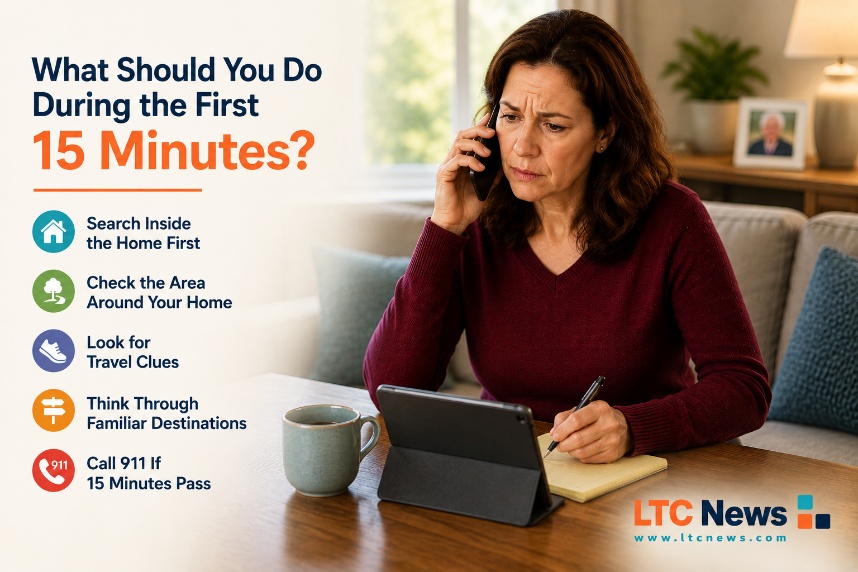
Begin searching immediately and divide the first tasks among anyone available to help.
- Search Inside the Home First
Check bedrooms, bathrooms, closets, the garage, basement, porch, and any rarely used space where your loved one might be resting or unable to answer. Call their name calmly, then pause between rooms to listen for movement or a quiet response.
- Check the Area Around Your Home
Look through the yard, neighboring properties, sidewalks, driveways, and usual walking routes. Give priority to roads, parking areas, bodies of water, wooded spaces, and any place where your loved one could become injured, trapped, or hard to see.
- Look for Travel Clues
Find out whether keys, a vehicle, a bicycle, a wallet, a coat, a mobile phone, or a transit card is missing. These details tell you whether your loved one left on foot or traveled beyond the neighborhood.
- Think Through Familiar Destinations
Former homes, workplaces, stores, places of worship, parks, and relatives' houses often carry strong memories. Share these possibilities with law enforcement rather than sending relatives out on their own, uncoordinated searches.
- Call 911 If 15 Minutes Pass
Call 911 once your initial search has not located your loved one within 15 minutes. Tell the dispatcher that the missing adult has dementia and may struggle to communicate, follow directions or recognize danger. Call sooner when weather, traffic, water, limited mobility, or medication needs raise the stakes.
When Should You Call 911?
You should not wait 24 hours out of fear of overreacting. Most law enforcement agencies treat a missing person with dementia as an urgent, vulnerable-adult case from the start, and many states also run a Silver Alert or similar rapid-notification system for missing older adults with cognitive impairment. If a quick check of the home and surrounding area turns up nothing, get emergency services involved right away.
Limited mobility, essential medication, extreme temperatures, nearby water, heavy traffic, or access to a vehicle can make a situation urgent the moment you notice your loved one is gone. Give the dispatcher a clear physical description and explain any communication or mobility difficulties up front.
What Is a Silver Alert?
A Silver Alert is a state-run public notification system that broadcasts information about a missing older adult, similar to how an Amber Alert works for a missing child. Once local police confirm the case meets the state's criteria, generally a minimum age plus a diagnosed or suspected cognitive impairment, the alert goes out through highway signs, radio and television broadcasts, text alerts, and sometimes automated calls to residents near where your loved one was last seen.
There is no single national Silver Alert program. Most states run one under that name, and a handful of others use a similar system with a different name and their own age and diagnosis requirements. Only law enforcement can request activation, so your first call is always 911, not a Silver Alert hotline. Ask the responding officer whether your state's program applies to your loved one's situation.
Limited mobility, essential medication, extreme temperatures, nearby water, heavy traffic, or access to a vehicle can make a situation urgent the moment you notice your loved one is gone. Give the dispatcher a clear physical description and explain any communication or mobility difficulties up front.
What Information Should You Give Emergency Responders?
Prepare a concise description that helps police recognize your loved one and narrow the search.
- Basic details: Full name, preferred name, age, height, build, and identifying features
- Current photo: A recent close-up and full-body image
- Last seen: Time, location, clothing, and possible direction of travel
- Health needs: Diagnosis, essential medication, medical conditions, and mobility concerns
- Communication limits: Hearing, speech, language, or vision difficulties
- Likely places: Former addresses, workplaces, stores, and meaningful destinations
- Travel access: Missing keys, vehicle, bicycle, phone, or transit card
- Nearby hazards: Water, highways, railway lines, wooded areas, or construction sites
- Tracking tools: Details for a smartwatch, mobile phone, or GPS (Global Positioning System) device
Keep this information in one accessible file rather than gathering it during a crisis. A recent photograph, medical summary, and list of familiar destinations can save valuable time.
What Should You Do Once Your Loved One Is Found?
Approach slowly and use a calm, familiar voice. Avoid crowding them, raising your tone, or demanding an explanation for why they left. "Try to avoid raising your voice or arguing," says Christopher Norman, a board-certified geriatric nurse practitioner with PACE CNY in East Syracuse, New York.
Instead, take a deep breath, remain calm and listen to what the agitated person is saying." — Christopher Norman.
Norman says that the parts of the brain responsible for regulating emotion gradually lose their ability to function as many dementias progress, leaving the person with powerful feelings they can’t always interpret, control, or express in ways that seem “appropriate.”
Simple reassurance usually works better than correction. A phrase such as "You're safe now" can reduce fear and make it easier to guide your loved one toward a quiet place.
Check for cuts, falls, pain, wet clothing, dehydration, exhaustion, overheating, or cold exposure. Seek urgent medical care if you notice signs of injury, breathing problems, unusual drowsiness, reduced alertness, or a missed dose of essential medication.
Call the Doctor If You Notice Any of These Signs
Contact your loved one's doctor after any wandering event, even a minor one, if you notice:
- A sudden change in behavior or alertness
- A recent medication change
- Fever
- Confusion that seems worse than usual
- A suspected fall, even without visible injury
These signs can point to an underlying medical cause rather than dementia alone, and your loved one's doctor needs to know a wandering event occurred either way. Once you have addressed immediate health concerns, let your loved one rest. Questions about what happened can wait until everyone is settled.
Why People With Dementia Wander
An unplanned departure may reflect memory loss, but it can also point to discomfort or a change in health. Hunger, thirst, constipation, pain, loneliness, boredom, or an unmet need to use the bathroom can show up as pacing or repeated attempts to leave.
Changes in the surroundings can raise confusion, too. A new caregiver, an unfamiliar visitor, a noisy room, poor lighting, disrupted sleep, or a move to a different setting can make even a familiar home feel strange.
Older memories sometimes guide the behavior. A loved one who retired years ago may still believe they need to reach a workplace, pick up a child, or return to a previous address. Arguing about dates rarely helps. Acknowledge the concern, respond to the emotion behind it, and redirect attention toward a familiar activity instead.
Medical Conditions That Can Trigger Wandering
A sudden increase in wandering or exit-seeking is not always a sign that dementia itself has worsened. Report a sudden change to your loved one's doctor, since these common and treatable conditions can all raise confusion and restlessness:
- Urinary tract infection (UTI): A frequent, often overlooked cause of sudden confusion in older adults
- Dehydration: Even mild fluid loss can worsen disorientation
- Medication reactions or interactions: A new prescription or dosage change can trigger agitation
- Delirium: A sudden, acute state of confusion that requires prompt medical evaluation
- Pain: Untreated pain, including from arthritis or an injury, can drive restlessness
- Constipation: Physical discomfort that a person with dementia may not be able to describe
- Sleep disorders: Poor sleep and sundowning can increase nighttime wandering
A doctor's exam can rule out or treat these causes and often reduce the risk of wandering faster than home modifications alone.
What Should You Change in the Rest of the First 24 Hours?
Use the rest of the day to improve supervision, reduce unnoticed exits, and build a clear household plan.
- Arrange Reliable Coverage
Assign one named adult to each part of the day and night, with a direct handoff whenever responsibility changes. When relatives cannot provide enough coverage on their own, consider a trusted companion, respite provider, adult day program, or in-home caregiver.
- Install Door Alarms and Exit Alerts
A bell, contact alarm, or motion alert can notify your household when an exterior door opens. For nighttime movement, a pressure-sensitive mat near the bed or doorway may give you an earlier warning.
- Make Navigation Easier
Use night lights between the bedroom and bathroom, remove clutter from walking paths, and reduce confusing shadows. Familiar objects and simple signs can make important rooms easier to recognize.
- Review Exits and Vehicles
Store keys, wallets, coats, bags, and suitcases out of sight when they seem to prompt leaving. Locks or visual barriers can help in some homes, but every change must preserve a safe fire exit and allow quick evacuation.
- Write a Response Plan
Decide who will contact police, search the property, check nearby routes, and stay at the last-known location. Keep this plan beside a recent photograph, medical summary, emergency numbers, and a short list of meaningful destinations.
Home safety measures should reduce danger without stripping away more independence than necessary. A layered approach, combining supervision, alerts, and identification, is usually more practical than relying on a single lock, alarm, or caregiver.
How Can You Lower the Chance of Another Wandering Episode?
A steady daily rhythm may reduce restlessness when discomfort, boredom, or confusion contributes to wandering.
- Meet basic needs: Offer food, drinks, and bathroom breaks at regular intervals
- Encourage movement: Include supervised walks or another safe form of exercise
- Provide purpose: Use familiar tasks such as folding laundry, gardening, or sorting objects
- Reduce stimulation: Limit noise, crowding, and unnecessary changes during difficult periods
- Watch patterns: Note whether attempts to leave happen at a particular time or after a specific event
- Respond calmly: Ask where your loved one wants to go before redirecting them toward something familiar
- Inform neighbors: Share a current photograph and contact number with a small group of trusted people nearby
These adjustments may lower the likelihood of another episode, but no routine can guarantee it will not happen again. Household alerts, identification, and a prepared plan remain important during calmer periods, too. These same dementia home safety habits also reduce everyday fall and injury risk, not just wandering.
How Can Identification and GPS Technology Help?
A medical bracelet, pendant, or visible ID card can help responders reconnect your loved one with family when they cannot provide an address or phone number. Clothing labels may work better when wearable identification is likely to be removed.
You can also consider a dedicated device such as the Family1st Senior GPS Tracker. Its official product information lists real-time location and geofence alerts as features, which may help relatives respond when the tracker leaves a selected area.
There are several types of tracking and identification tools available, and each has strengths and limits:
- GPS watches and dedicated trackers: Purpose-built for wandering risk, these devices show real-time location and can send an alert when your loved one leaves a set boundary. Battery life, comfort, and how easily the device can be removed vary by brand.
- Consumer trackers like Apple AirTags: These rely on Bluetooth and nearby devices to relay location rather than continuous GPS, so tracking can lag or fail in areas with little foot traffic, and the tag is easy for a confused person to remove or leave behind. They were designed to find lost objects, not to serve as a primary safety device for a person.
- Medical ID bracelets and pendants: Low-tech and reliable as long as they are worn, these give responders an immediate way to identify your loved one and contact you.
- Project Lifesaver: A nonprofit program used by many local sheriff's offices and police departments that equips enrolled individuals with a radio-frequency wristband. Trained search teams can track the signal even indoors or in areas with weak cell coverage, and most recoveries take well under an hour. Availability depends on your county or local public safety agency.
- MedicAlert + Alzheimer's Association Safe Return: A national enrollment and 24-hour emergency response service that connects a wearable ID to your loved one's medical information and your contact details.
No device is fail-safe. It may be left behind, removed, lose power, or provide an imprecise signal, so tracking technology works best alongside visible identification, door alerts, and attentive supervision. Talk with your loved one's doctor or a local Alzheimer's Association chapter about which option fits your household, since needs and reliability vary by product and by where you live.
When Should the Overall Care Plan Be Reassessed?
A first wandering episode is reason enough to review whether your current care arrangement still fits. Waiting for another disappearance can leave the same gaps unresolved.
Consider whether time alone is still appropriate, whether access to a vehicle needs to change, and whether evenings or overnight hours now call for more help. Wandering often marks the point where a family caregiver's ability to keep everyone safe outpaces what one person can reasonably manage alone, and caregiver burnout is a real and common result of trying to provide 24-hour supervision without support.
Depending on your loved one's needs and your own capacity, options to discuss with your care team include:
- Home care: A trained aide who provides supervision, companionship, and help with daily activities in your loved one's own home, for a few hours a day or around the clock
- Adult day care: Structured, supervised programs during daytime hours that give family caregivers a reliable break while keeping your loved one engaged and safe
- Assisted living: A residential setting with staff supervision, meals, and activities for people who no longer need round-the-clock nursing care but should not be left alone
- Memory care: A secured, specially staffed environment designed specifically for people with dementia, including wandering-prevention features built into the building itself
👉 You can use the LTC News Caregiver Directory to search for experienced, caring caregivers and long-term care facilities. The directory has over 80,000 providers that you can search by zip code.
How Long-Term Care Insurance Fits In
A wandering incident is often the event that convinces a family that additional supervision is necessary, and it is exactly the kind of documented incident an LTC Insurance claim can cite, if your loved one has an LTC policy.
Tax-qualified Long-Term Care Insurance policies pay benefits once a licensed health care practitioner certifies that your loved one needs substantial supervision due to a severe cognitive impairment, such as Alzheimer's disease or a related dementia. Under this cognitive impairment trigger, benefits can begin even before your loved one loses the ability to perform activities of daily living like bathing or dressing, unlike the separate ADL trigger, which generally requires a 90-day certification. Some LTC policies will also cover technology to help someone remain in their home, which is especially helpful for someone who may be wandering.
👉 What are LTC Insurance Benefit Triggers
If your loved one has an LTC policy, this is a good time to review the benefit triggers and elimination period with the insurance company or a qualified agent. LTC News, in cooperation with Amada Senior Care, will help your family in processing a Long-Term Care Insurance claim without cost or obligation — File a Long-Term Care Insurance Claim.
It is also worth understanding that Medicare pays only for limited, short-term skilled care, such as a hospital stay followed by rehabilitation, and does not pay for ongoing custodial supervision at home, in adult day care, in assisted living or in memory care. That gap is often the largest unplanned expense families face after a dementia diagnosis, and it is precisely what Long-Term Care Insurance is designed to address. However, LTC Insurance is medically underwritten, so a policy must be purchased when you are in reasonably good health, often before you retire.
When possible, include your loved one in decisions about identification, tracking, household changes, and outside services. Safety measures are easier to accept when they preserve privacy, comfort, and as much independence as circumstances allow.
Helpful LTC News resources:
- Cost of Care Calculator: Costs for home care, adult day care centers, assisted living, memory care, and nursing homes vary dramatically by location. The LTC News Cost of Long-Term Care Services Calculator provides current monthly cost estimates for these services nationwide, so you can see what dementia care actually costs in your area before you need it.
- Caregiver Directory: Families can search the LTC News Caregiver Directory to compare qualified home care agencies, adult day programs, assisted living communities, and memory care providers near you.
- Education Center: Visit the LTC News Education Center to learn how Long-Term Care Insurance benefit triggers work and how policies typically pay for dementia-related home care and facility care.
What Should You Avoid After a Wandering Incident?
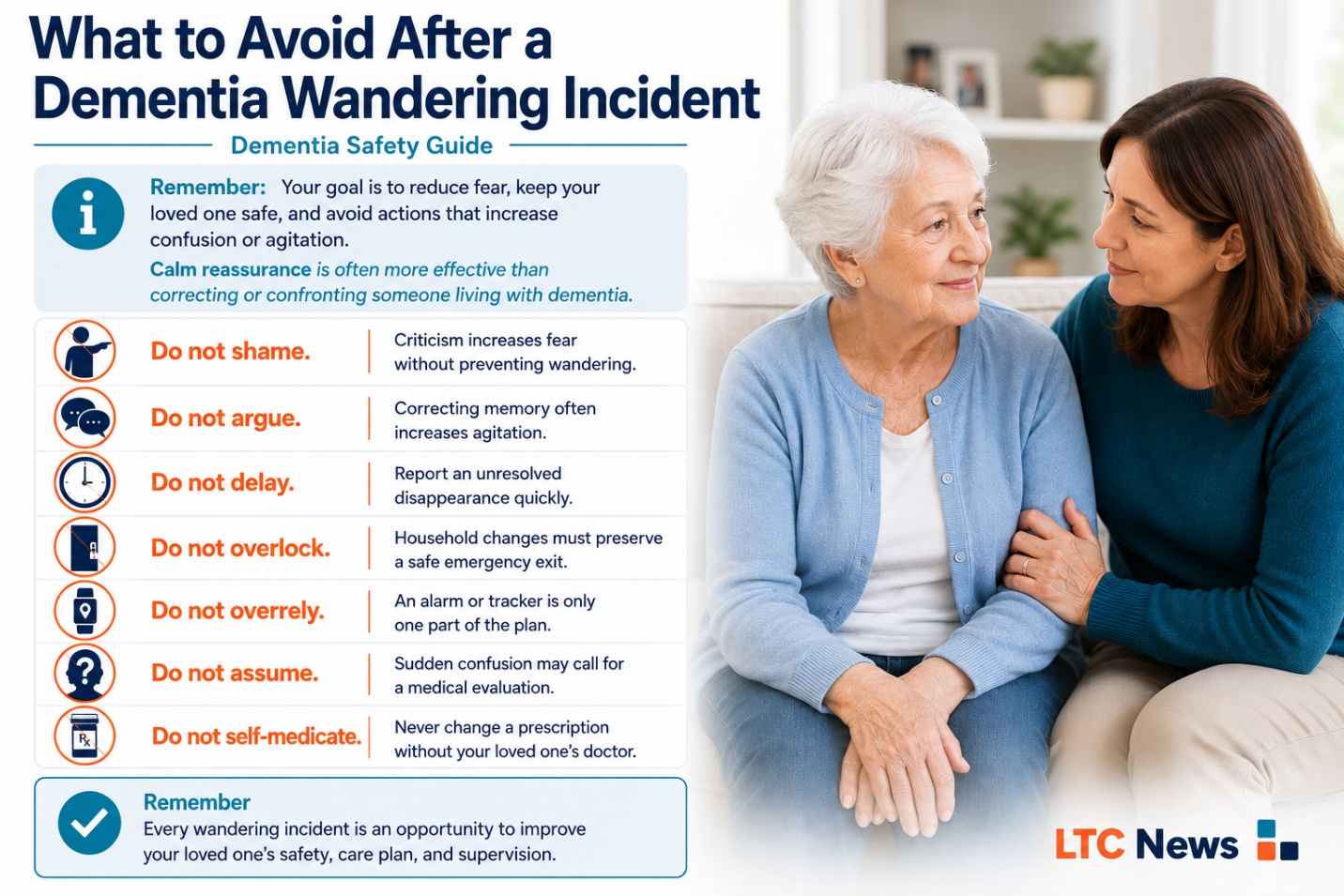
The goal is not to punish the behavior. It is to understand what prompted it and make the environment easier to manage.
From Crisis to a Safer Tomorrow
A wandering incident is frightening, but it can also become the moment your family finally closes the gaps that put your loved one at risk. Patterns, triggers, and vulnerabilities that were easy to miss before often come into sharp focus once you have lived through a real scare, and many families look back on this day as the turning point that reshaped how they approach dementia caregiving.
Once the immediate danger has passed, put your energy into reliable supervision, visible identification, and a plan everyone in the family can follow if it happens again. These steps protect your loved one's safety without stripping away the comfort and dignity that matter just as much.
Have you and your family talked through what you would do in the first 15 minutes after a wandering incident? Building that plan now, before a crisis, is one of the most protective steps a caregiving family can take.
This article is for general informational purposes and is not a substitute for medical advice. Speak with your loved one's doctor about a personalized safety plan.
Frequently Asked Questions
What should I do after my loved one is found?
Remain calm and reassure your loved one rather than criticizing or arguing. Check carefully for injuries, dehydration, heat or cold exposure, or signs of illness. If anything seems unusual—or if medications were missed—seek medical attention. Afterward, review what happened and update your home's safety measures and emergency plan.
What is a Silver Alert?
A Silver Alert is a state-operated emergency notification system that helps locate missing older adults with cognitive impairment, including dementia. Like an Amber Alert for children, it may use highway message boards, television, radio, and mobile alerts to quickly notify the public. Since requirements vary by state, law enforcement determines whether a case qualifies.
Does Medicare pay for dementia supervision or memory care?
Generally, no. Medicare covers limited short-term skilled medical care but does not pay for ongoing custodial supervision, adult day care, assisted living, or most memory care services. Families frequently discover these costs become significant after a wandering incident.
Do GPS trackers help?
GPS watches, dedicated tracking devices, medical ID bracelets, and programs such as Project Lifesaver or MedicAlert® + Alzheimer's Association Safe Return® can improve safety. However, no technology is foolproof. Devices can lose power, be removed, or fail to provide an accurate location, so they should supplement—not replace—supervision and home safety measures.
How can I reduce the risk of another wandering incident?
Helpful strategies include:
- Installing door alarms or motion sensors
- Keeping a consistent daily routine
- Providing regular exercise
- Meeting basic needs such as meals, hydration, and bathroom breaks
- Reducing clutter and improving lighting
- Removing visual cues that encourage leaving
- Keeping a written emergency response plan
- Informing trusted neighbors about the situation
A layered approach usually provides the greatest protection.
What is dementia wandering?
Dementia wandering occurs when a person living with Alzheimer's disease or another form of dementia leaves a familiar place and becomes confused about where they are or where they intended to go. They may believe they need to return to a childhood home, go to work, or complete a responsibility from many years ago. Wandering can happen during any stage of dementia and should always be taken seriously.
Can Long-Term Care Insurance help pay for dementia care?
Yes, in many cases. Tax-qualified Long-Term Care Insurance policies may begin paying benefits when a licensed health care practitioner certifies that a person has a severe cognitive impairment requiring substantial supervision. Benefits may help cover home care, adult day care, assisted living, memory care, and other covered long-term care services, depending on the policy.
How common is wandering in people with dementia?
Wandering is one of the most common safety risks associated with dementia. According to the Alzheimer's Association, about six in 10 people living with dementia will wander at least once, and many experience multiple wandering episodes over the course of their illness.
How long should I search before calling 911?
If your initial search does not locate your loved one within about 15 minutes, call 911 immediately. Do not wait several hours or 24 hours. A missing adult with dementia is considered a vulnerable person, and early involvement by law enforcement greatly improves the chances of a safe recovery.
When should our family reconsider the current care plan?
A wandering incident often signals that additional supervision is needed. Families should evaluate whether their loved one can still remain home safely or whether additional support—such as home care, adult day care, assisted living, or memory care—is appropriate. Many families find that this event marks a turning point in long-term care planning.
What information should I provide to emergency responders?
Be prepared to provide:
- A recent photograph
- Full name and physical description
- Clothing worn when last seen
- Dementia diagnosis
- Medical conditions and medications
- Communication difficulties
- Places they may try to visit
- Information about vehicles, phones, or GPS devices
- Nearby hazards such as lakes, highways, or wooded areas
Having this information prepared before an emergency can save valuable time.
Why do people with dementia wander?
Wandering is often triggered by confusion, memory loss, or unmet physical or emotional needs. Common reasons include:
- Looking for a former home
- Trying to go to work
- Searching for family members
- Hunger or thirst
- Pain or discomfort
- Loneliness
- Boredom
- Sleep disturbances
- Changes in routine or surroundings
Understanding the reason behind the behavior can help reduce future wandering episodes.
What should I do first if my loved one disappears?
Start searching your home immediately, including bedrooms, closets, bathrooms, the garage, basement, and yard. At the same time, have another family member check nearby sidewalks, streets, and familiar walking routes. Look for clues such as missing keys, a vehicle, a wallet, or a cell phone that may indicate where they went.
What should families avoid after a wandering incident?
Avoid actions that increase fear or confusion. Do not:
- Shame or criticize your loved one
- Argue about facts or memories
- Delay calling 911 when they are missing
- Create unsafe exits by overlocking doors
- Depend entirely on alarms or GPS devices
- Ignore sudden behavioral changes that may require medical evaluation
- Change medications without consulting a physician
The goal is to improve safety while preserving your loved one's dignity, comfort, and independence whenever possible.
Can a medical problem suddenly increase wandering?
Yes. A sudden increase in wandering may signal an underlying medical problem rather than progression of dementia alone. Common causes include urinary tract infections (UTIs), dehydration, medication side effects, delirium, untreated pain, constipation, or sleep disorders. Any sudden behavioral change should be reported promptly to your loved one's physician.

Sponsored