Social Connections: How to Combat Loneliness in Seniors
About This Article
Strong social ties are more than a luxury; they are a medical necessity for healthy aging. As recent research confirms, maintaining a vibrant social circle can reduce the risk of dementia and chronic disease as effectively as many clinical interventions.

Anna Marino
Anna Marino is a seasoned writer specializing in topics related to family, aging, and lifestyle in retirement. She shares advice on intergenerational relationships and strategies for enjoying retirement.
Table of Contents
- Loneliness Cure: Why Your Social Circle is Your Best Medicine
- Understanding Health Risk
- Why This Matters Today
- Building Connections Through Senior Social Clubs
- Senior Clubs as Entry Points
- 55 Plus Communities and Purpose-Built Neighborhoods
- Choosing the Right Environment
- Senior Wellness Programs: More Than Just Exercise
- Role of Programmed Engagement
- Taking the First Step Toward Connection
Loneliness in older adults is now recognized as a critical public health priority, with recent data linking isolation to a 50% increase in dementia risk. This guide explores how senior social clubs, retirement living options, and wellness programs serve as "social medicine" to improve both mental and physical health.
You might remember a time when your front porch was the neighborhood hub, or when the office breakroom provided a natural rhythm of daily chatter. As we age, those spontaneous moments often fade, replaced by a quiet that can feel heavy.
If you have noticed your world getting smaller lately, or if you have noticed your older parents experiencing these feelings, you are not alone.
According to the 2024 National Poll on Healthy Aging, one in three older adults continue to experience regular loneliness. While the world has largely moved past the isolation of previous years, the health stakes for those left behind remain dangerously high.
Loneliness Cure: Why Your Social Circle is Your Best Medicine
Former U.S. Surgeon General Dr. Vivek Murthy famously compared the health impact of social isolation to smoking 15 cigarettes a day. In his 2024 updates on the "Loneliness Epidemic," Dr. Murthy emphasized that social connection is a "healing hiding in plain sight."
Given the significant health consequences of loneliness and isolation, we must prioritize building social connection the same way we have prioritized other critical public health issues." — Dr. Vivek Murthy.
Loneliness carries measurable health and aging consequences comparable to established risk factors like smoking or inactivity, including elevated inflammation, higher blood pressure, weakened immune response, and increased vulnerability to conditions such as stroke, diabetes, and dementia.
For older adults, this can be especially concerning and is why many assisted living facilities focus on social activities to alleviate loneliness and promote a better quality of life. Julianne Holt-Lunstad, Ph.D., a psychology and neuroscience professor at Brigham Young University, has published extensively on social connection and health, including a landmark 2010 meta-analysis on mortality risk and a 2023 framework outlining strategies for assessment and intervention.
Social connection is not a luxury — it’s a fundamental part of health. Being socially connected can reduce the risk of early death, heart disease, and cognitive decline more than many traditional health interventions.” — Julianne Holt-Lunstad, Ph.D., psychologist and director of the Social Connection and Health Lab at Brigham Young University
There are many good examples across the United States and Canada of assisted living facilities that focus on combating loneliness. One example in Canada is Currie Green assisted living. They prioritize vibrant community life, with amenities such as fitness centres, arts programs, and social events, to help residents form lasting relationships and feel genuinely supported in their daily routines.
Senior wellness programs further integrate movement classes, creative sessions, and dining experiences that naturally encourage connection. Use the LTC News Caregiver Directory to search for long-term care facilities near you.
Understanding Health Risk
Recent studies published in The Journals of Gerontology in late 2025 show a direct causal link between social isolation and a faster decline in brain function. Loneliness doesn't just make us feel sad; it triggers a physiological stress response.
- Heart Disease and Stroke: Chronic isolation can increase the risk of heart disease by 29 percent and stroke by 32 percent.
- Cognitive Decline: New 2025 data suggest that "socially frail" seniors have a 50 percent higher risk of developing dementia than those with strong ties.
- Immune Function: Persistent loneliness elevates cortisol levels, weakening the immune system and making it harder to recover from common illnesses.
Why This Matters Today
Recent 2025 data from the World Health Organization (WHO) reveal that loneliness now accounts for an estimated 871,000 deaths annually worldwide. In the U.S., social isolation among older adults is linked to an estimated $6.7 billion in excess Medicare spending each year due to higher rates of hospitalization and emergency care.
In addition, the increased need for long-term care has a significant impact on an individual's family and finances, as Medicare only covers short-term skilled care. With the increasing cost of extended care services throughout the United States and the world, the cost of long-term care resulting from loneliness and depression can be life-changing for families.
👉 Learn How Long-Term Care Insurance Can Help Pay for Extended Care
👉 Compare Long-Term Care Insurance Companies and Products
Building Connections Through Senior Social Clubs
If you are looking for an entry point back into the community, senior social clubs offer the lowest barrier to entry. These groups are designed for repetition—the secret ingredient to turning an acquaintance into a friend.
“Over many years of taking care of older patients, I’ve learned that the factors many people think are most important for aging well — such as physical health or longevity in your family — do not guarantee a positive experience with getting older. It’s the quality, duration and nature of your relationships that seem to matter most.” — Amit A. Shah, M.D., geriatrician at the Mayo Clinic.
Senior Clubs as Entry Points
These clubs often center on shared interests like gardening, walking, or "Pickleball," which has seen a massive surge in senior participation through 2025.
- Low Cost: Most municipal senior centers offer these programs for free or a nominal annual fee.
- Consistency: Attending a weekly book club or card game builds "passive familiarity," making it easier to strike up conversations over time.
55 Plus Communities and Purpose-Built Neighborhoods
For those considering a move, "active adult" or 55+ communities are designed to make social interaction unavoidable. A 2025 Purdue University study found that seniors living in "cognitively stimulating neighborhoods"—those with proximity to parks, libraries, and social hubs—maintained their mental sharpness significantly longer.
Professional managers often curate calendars that include dances, guest speakers, hobby workshops, and volunteer opportunities, all proven to increase interaction rates.
Here are the most effective community formats currently available:
- Active adult neighborhoods with independent homes and shared recreation centers
- Condominium-style 55+ buildings with rooftop terraces and game rooms
- Land-lease communities offering affordable entry and extensive amenity packages
- Hybrid models that blend independent living with optional support services
Example: Retirement Communities in Calgary and Structured Group Living
A good example is full-service retirement communities in Calgary, Alberta, Canada, which represent the highest level of intentional social design. These campuses integrate dining halls, theatres, fitness studios, and scheduled transportation so that participation requires minimal effort.
Pro Tip: When evaluating any community, request the actual monthly activity calendar and resident participation rates, not rendered images. Real attendance numbers reveal true social vitality.
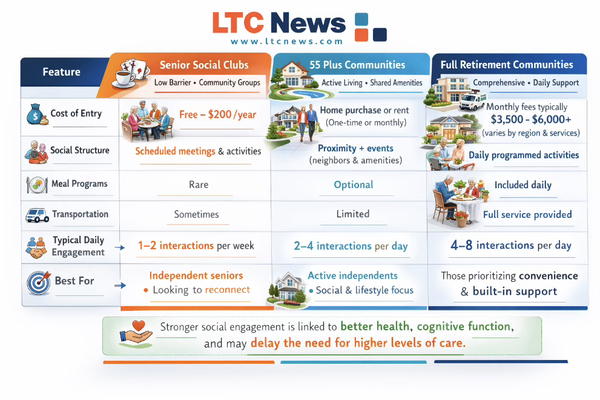
Structured social environments provide increasing levels of daily engagement, which research links to better emotional health, cognitive function, and independence as we age.
“Social interaction isn’t just something nice to have. It plays a central role in brain function, emotional resilience, and even longevity.” — Dr. Suvi Neukam, geriatrician at Oregon Health & Science University.
Choosing the Right Environment
No matter where you are searching for 55+ communities, be sure to evaluate your options and consider how the architecture supports your social life.
Look for:
- Centralized Amenities: Pools and gyms that serve as natural gathering spots.
- Curated Calendars: Communities with dedicated social directors who organize guest speakers and hobby workshops.
- Proximity: The ability to walk to a neighbor’s home for coffee without needing a car.
|
Feature |
Senior Social Clubs |
55 Plus Communities |
Full Retirement Communities |
|
Typical Interaction |
1–2 per week |
2–4 per day |
4–8 per day |
|
Social Structure |
Scheduled meetings |
Proximity + events |
Daily programmed activities |
|
Best For |
Independent seniors |
Active independents |
Those seeking maximum ease |
Senior Wellness Programs: More Than Just Exercise
Modern senior wellness programs have evolved. They no longer focus solely on physical fitness but prioritize "dual functionality"—keeping the body and the mind engaged simultaneously.
Role of Programmed Engagement
Programs that pair movement with social interaction, such as group Tai Chi or creative arts therapy, have shown the best outcomes for mood regulation.
- Intergenerational Events: Many programs now link seniors with local students, which helps combat feelings of being "invisible."
- Volunteer Coordination: Helping others is a powerful loneliness fighter. 2025 data from UT Austin shows that regular volunteering can slow cognitive decline by 15% to 20%.
Taking the First Step Toward Connection
Addressing loneliness is a foundational strategy for healthy aging, much like a balanced diet or regular check-ups with your doctor.
Have you considered how many meaningful interactions you have had in the last 48 hours? It can be family, friends, neighbors, or church, but social interaction is vital to the overall quality of life.
This video provides an expert breakdown of the 2024 National Poll on Healthy Aging, explaining the specific trends in loneliness and how they impact your long-term health.
Being prepared for the consequences of aging will make getting older a more rewardable experience for you and your family.

Sponsored