Short-Term Health Insurance: Bridging the Gap to Medicare

About This Article
Retiring before age 65 can leave you without employer-sponsored health insurance while you wait to become eligible for Medicare. Short-term health insurance may help bridge that gap, but these policies have important limitations, including exclusions for pre-existing conditions and no coverage for custodial long-term care.

James Kelly
LTC News staff writer specializing in long-term care and aging.
Table of Contents
- What Is Short-Term Health Insurance?
- Don't Confuse with Short-Term Care Policies
- Who Should Consider Short-Term Health Insurance?
- What Does Short-Term Health Insurance Cover—and What Doesn't It Cover?
- Is Short-Term Health Insurance Available Where You Live?
- Choosing the Right Short-Term Health Insurance Plan
- Key Takeaways
For millions of Americans, retirement doesn't begin at age 65. The average retiree leaves the workforce around age 61 or 62, several years before becoming eligible for Medicare, creating a potentially expensive gap in health insurance coverage. While many retirees continue coverage through a spouse's employer, elect COBRA, or purchase an Affordable Care Act marketplace plan, others look to short-term health insurance as a temporary bridge until Medicare begins. Understanding how these policies work—and what they don't cover—can help you make better decisions as you prepare for retirement.
While the dream of early retirement is appealing, the transition to Medicare can be a complex journey. Planning for early retirement requires a comprehensive approach to health care.” — Stephen M. Weber, CFP®, CLTC®, wealth planning strategist at Vanguard and lead author of Six Steps to Creating a Health-Aware Retirement Plan.
If you're retiring before Medicare begins, short-term health insurance may provide temporary protection against unexpected illnesses or injuries until another form of comprehensive coverage becomes available.
Short-term health insurance provides temporary medical coverage for people between health plans or waiting to become eligible for Medicare at age 65. While federal rules governing plan duration have shifted in recent years, availability still depends on state law. These policies generally exclude pre-existing conditions and, like Medicare, do not cover custodial long-term care.
What Is Short-Term Health Insurance?
Short-term health insurance, sometimes called temporary medical insurance, is designed to provide limited medical coverage during a temporary gap between comprehensive health plans. Unlike traditional health insurance, these policies are intended to serve as a bridge rather than a permanent solution.
For many Americans approaching retirement, that bridge becomes especially important. Someone who retires before turning 65 may lose employer-sponsored health insurance months or even years before becoming eligible for Medicare.
These plans are attractive because they start fast, often by the next day, and cost less than comprehensive coverage. The trade-off is depth. According to UnitedHealthcare, short-term plans are meant for people who are between health plans or outside an enrollment period and need coverage in case of an emergency. Most policies help pay for unexpected medical expenses such as physician visits, urgent care, emergency treatment, hospitalization, and certain diagnostic services. Some plans also include limited prescription drug coverage.
However, these policies are medically underwritten, meaning applicants can be declined based on their health history. Benefits also vary considerably among insurers and from one state to another. Although lower premiums make short-term plans attractive, they should never be viewed as a substitute for comprehensive health insurance.
Don't Confuse with Short-Term Care Policies
Don't confuse short-term health insurance with short-term care insurance, which is often offered as a cash indemnity policy. Although their names sound similar, they serve entirely different purposes. Short-term health insurance is health insurance. Short-term care insurance, by contrast, is designed to pay cash benefits when you need assistance with activities of daily living or experience cognitive impairment.
Depending on the policy, benefits may be used to help pay for care provided at home, in an assisted living community, memory care residence, or nursing home. While these policies typically provide benefits for a limited period—often up to one year—they address a need that traditional health insurance, Medicare, and short-term health insurance generally do not cover.
Who Should Consider Short-Term Health Insurance?
Short-term health insurance is best suited for people facing a clearly defined, temporary gap in medical coverage.
Examples include:
- Early retirees waiting to become eligible for Medicare.
- Individuals between jobs.
- Workers whose employer-sponsored coverage has ended.
- People who missed the Affordable Care Act open enrollment period and need temporary protection until they can enroll in comprehensive coverage.
For adults approaching retirement, the transition to Medicare is often the most common reason to consider a short-term policy.
Most Americans become eligible for Medicare at age 65. However, enrollment is not always automatic. Individuals who are not already receiving Social Security retirement benefits generally must enroll during their Initial Enrollment Period. Missing enrollment deadlines can delay coverage and may result in permanent late-enrollment penalties.
Planning can help prevent both unnecessary costs and gaps in health insurance coverage. Fortunately, relatively few Americans in this age group are uninsured. According to KFF, adults aged 55 through 64 continue to have one of the lowest uninsured rates among working-age adults. For those who unexpectedly lose employer-sponsored insurance, however, a short-term policy may provide valuable protection while a permanent solution is arranged.
If you have chronic medical conditions, ongoing prescriptions, or expect regular medical treatment, carefully compare short-term coverage with COBRA or an ACA marketplace plan before enrolling. Comprehensive coverage is often the better choice despite the higher premiums.
What Does Short-Term Health Insurance Cover—and What Doesn't It Cover?
Short-term health insurance is designed to protect against unexpected medical events—not ongoing healthcare needs.
Most plans provide benefits for:
- Emergency room treatment
- Hospitalization
- Physician visits
- Urgent care
- Diagnostic testing
- Certain surgeries and medical procedures
Coverage varies significantly among insurers and states, making it important to review the policy carefully before purchasing. Consumers are often surprised by what these plans exclude.
- Pre-existing conditions
Most short-term policies exclude medical conditions diagnosed, treated, or symptomatic before coverage begins. Cigna notes that short-term plans generally do not cover conditions diagnosed or treated within 2 to 5 years or longer.
- Essential health benefits
Unlike ACA-compliant health insurance, short-term plans generally are not required to cover the Affordable Care Act's essential health benefits.
Coverage for services such as maternity care, mental health treatment, preventive care, rehabilitation services, and prescription medications may be limited—or absent altogether.
- Medical underwriting
Unlike ACA marketplace plans, short-term policies typically require applicants to answer health questions. Individuals with certain medical conditions may be declined or have coverage limitations.
- Higher out-of-pocket costs
Although premiums are generally lower than comprehensive coverage, deductibles and out-of-pocket maximums are often substantially higher. A lower monthly premium doesn't necessarily translate into lower overall healthcare costs if a serious illness or injury occurs.
Before enrolling, compare not only premiums but also deductibles, coinsurance, covered services, provider networks, prescription benefits, and maximum out-of-pocket exposure.
Is Short-Term Health Insurance Available Where You Live?
Unlike Medicare or Affordable Care Act (ACA) marketplace plans, short-term health insurance is not available nationwide. Whether you can purchase a policy and how long it can remain in force depends on the laws in your state.
Some states prohibit the sale of short-term health insurance altogether, while others limit how long policies can last or restrict renewals. States including California, Illinois, New Jersey, and New York prohibit the sale of short-term health insurance, while many others continue to allow these policies under varying rules.
Even in states where short-term coverage is available, consumers may find significant differences in:
- Maximum policy duration.
- Renewal options.
- Available insurance companies.
- Covered benefits.
- Premiums.
- Underwriting requirements.
State laws—not federal rules alone—ultimately determine what insurers can sell. Because legislatures and insurance regulators periodically revise these rules, it's important to verify your state's current requirements before shopping for coverage. A licensed insurance professional familiar with your state's regulations, like Custom Health Plans, can explain the available options and whether another solution, such as COBRA or an ACA marketplace plan, may offer better protection.
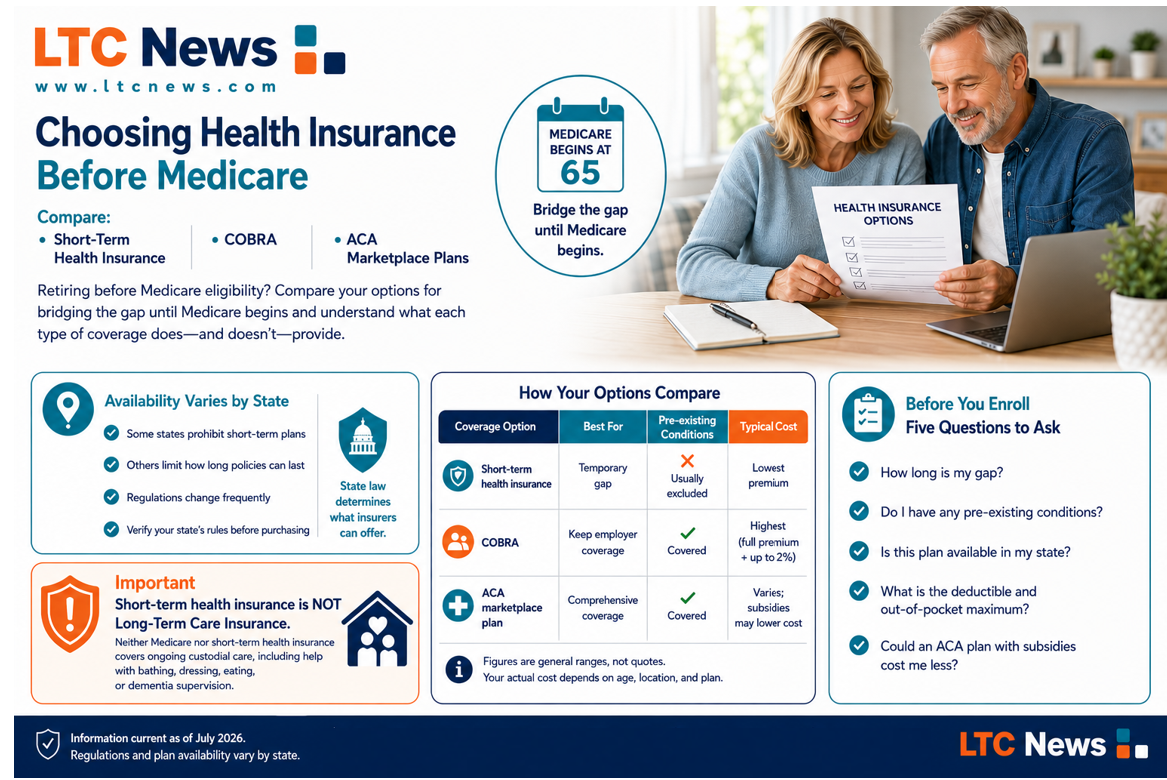
How Does Short-Term Health Insurance Compare with COBRA and ACA Marketplace Plans?
For many people retiring before Medicare eligibility, three primary options are available to replace employer-sponsored health insurance:
- Short-term health insurance
- COBRA continuation coverage
- An Affordable Care Act marketplace plan
Each serves a different purpose.
Short-term health insurance generally offers the lowest monthly premium, making it attractive for healthy individuals facing a temporary gap in coverage. However, lower premiums often come with higher deductibles, greater out-of-pocket costs, and exclusions for pre-existing medical conditions.
COBRA allows you to keep your employer-sponsored health insurance after leaving your job. Although it generally provides the most comprehensive continuity of care, including your existing physicians, hospitals, and prescription coverage, you typically pay the full premium yourself, plus up to a 2% administrative fee. For many retirees, this makes COBRA the most expensive option.
Affordable Care Act marketplace plans provide comprehensive coverage regardless of your medical history. Premium tax credits are based primarily on household income rather than assets, so many early retirees qualify for financial assistance that substantially reduces monthly premiums. Marketplace plans also cover pre-existing conditions and include important consumer protections not required under short-term health insurance.
Choosing the Right Short-Term Health Insurance Plan
The best policy is the one that matches both your health needs and the length of your coverage gap. Before enrolling, ask yourself these questions:
- How long will I need temporary coverage? Match the policy to your expected transition period.
- Do I have any pre-existing medical conditions? If so, a short-term policy may not provide the protection you need.
- Is short-term health insurance available where I live? State laws determine whether these policies can be sold.
- What are the deductible and maximum out-of-pocket costs? A lower premium may result in higher expenses if you need medical care.
- Could an ACA marketplace plan cost less after premium subsidies? Many early retirees qualify for financial assistance based on income.
Comparing all of your options before enrolling can help prevent unexpected costs and ensure you have the protection you need until Medicare or another long-term health plan begins.
Key Takeaways
- Short-term health insurance is designed to bridge temporary gaps in medical coverage—not replace comprehensive health insurance.
- Federal enforcement of previous duration limits has been relaxed, allowing many insurers to once again offer longer policy terms where permitted by state law.
- Availability varies by state.
- These policies generally exclude pre-existing conditions and are not required to provide many of the consumer protections included in the Affordable Care Act (ACA) marketplace plans.
- Like Medicare and traditional health insurance, short-term plans do not pay for ongoing custodial long-term care.
Before enrolling:
- Compare a short-term plan with COBRA and an Affordable Care Act marketplace plan.
- Verify that short-term coverage is available where you live.
- Confirm the maximum policy duration currently permitted in your state.
- Carefully review exclusions, especially for pre-existing medical conditions and prescription medications.
- Remember that neither short-term health insurance nor Medicare pays for most long-term custodial care.
Frequently Asked Questions
Is short-term health insurance the same as short-term care insurance?
No. Although the names are similar, they are entirely different products. Short-term health insurance provides temporary medical coverage during a gap between comprehensive health plans. Short-term care insurance, often offered as a cash indemnity policy, pays benefits when you need help with activities of daily living or have a qualifying cognitive impairment. Depending on the policy, benefits may be used for care at home, in assisted living, memory care, or a nursing home.
Does short-term health insurance cover pre-existing medical conditions?
Generally, no. Most short-term health insurance policies exclude medical conditions that existed before your coverage began. Applicants usually answer health questions during the application process, and some may be declined based on their health history. If you have ongoing medical needs, compare your options carefully before choosing a short-term policy.
Does short-term health insurance cover long-term care?
No. Short-term health insurance is intended to pay for medical care related to unexpected illnesses or injuries. Like Medicare and most traditional health insurance, it does not cover ongoing custodial care, such as assistance with bathing, dressing, eating, transferring, or supervision due to Alzheimer's disease or other forms of dementia.
How do I choose the right health insurance before Medicare?
Start by determining how long you'll need coverage and evaluating your healthcare needs. Compare short-term health insurance, COBRA, and ACA marketplace plans based on premiums, deductibles, provider networks, prescription drug coverage, and out-of-pocket costs. If you have pre-existing medical conditions or ongoing treatment, comprehensive coverage through COBRA or an ACA marketplace plan may provide greater value despite a higher monthly premium.
Is short-term health insurance less expensive than COBRA?
Usually, yes. Short-term health insurance often has lower monthly premiums than COBRA because it provides fewer benefits and excludes many services covered under employer-sponsored health plans. COBRA allows you to keep your existing coverage, including treatment for pre-existing medical conditions, but you'll generally pay the full premium yourself, plus up to a 2% administrative fee.
Can I qualify for Affordable Care Act subsidies if I retire early?
Possibly. Premium tax credits for ACA marketplace plans are based primarily on household income rather than total assets. Many early retirees living on retirement savings or investment income qualify for subsidies that significantly reduce their monthly premiums. Compare marketplace plans alongside COBRA and short-term health insurance before making a decision.
How long can a short-term health insurance policy last?
That depends on where you live. Federal rules governing short-term health insurance have changed in recent years, and state laws ultimately determine how long policies may remain in force. Some states prohibit these plans altogether, while others allow coverage for several months or longer. Always verify your state's current rules before purchasing a policy.
Is short-term health insurance available in every state?
No. Availability varies by state. Several states, including California, Illinois, New Jersey, and New York, prohibit the sale of short-term health insurance. Other states permit these policies but may limit how long they can last or restrict renewals. Because regulations change, check with a licensed insurance professional or your state's insurance department before shopping for coverage.
Why should I think about long-term care while planning for Medicare?
Preparing for Medicare protects your access to health insurance, but it doesn't address one of retirement's largest financial risks: the cost of extended long-term care. Medicare generally doesn't pay for ongoing custodial care provided at home, in assisted living, memory care, or nursing homes. Understanding how you'll pay for those services before you retire can help protect your savings, preserve more choices about where you receive care, and reduce the financial burden on your family.
Is short-term health insurance a good option if I retire before Medicare?
It can be. Short-term health insurance is designed to help bridge a temporary gap in medical coverage, such as retiring before becoming eligible for Medicare at age 65. These policies generally have lower monthly premiums than comprehensive health insurance, but they also provide fewer benefits and typically exclude pre-existing medical conditions. Before enrolling, compare a short-term plan with COBRA and an Affordable Care Act (ACA) marketplace plan.
Will Medicare pay for nursing home or assisted living care?
Generally, no. Medicare may cover a limited period of skilled nursing or rehabilitation following a qualifying hospital stay, but it does not pay for ongoing custodial care provided in assisted living communities, memory care residences, or nursing homes. Medicaid may help pay for long-term care after individuals meet financial eligibility requirements, while many families choose Long-Term Care Insurance to help protect their savings and expand future care options.


Sponsored