Saving for an Aging Parent's Care: Where to Keep Money You'll Need Soon

About This Article
If an aging parent may need home care or assisted living within the next one to three years, protecting savings and having money when it's needed should take priority over higher investment returns. Savings accounts, certificates of deposit, and short-term Treasury bills can help families prepare for care expenses while limiting financial risk.

Jacob Thomas
Jacob Thomas writes on health, wellness, and retirement topics, including aging, caregiving, insurance, and long-term care.
Table of Contents
- Why Money for a Parent's Care Shouldn't Ride the Stock Market
- How Much Money Should You Set Aside for a Parent's Care?
- Understand What Medicare and Other Insurance Will Pay
- Does Your Parent Have an LTC Policy?
- Look for Other Sources of Long-Term Care Funding
- Can You Purchase LTC Insurance for an Aging Parent?
- Where Should You Keep Short-Term Care Savings?
- High-Yield Savings Accounts
- Money Market Deposit Accounts
- Short-Term U.S. Treasury Bills
- When CDs Make Sense for Planned Care Expenses
- No-Penalty CDs Offer Greater Flexibility
- Understand How Brokered CDs Work
- How to Build a Simple CD Ladder for Care Costs
- Keep an Emergency Care Reserve
- Protect Your Own Retirement Savings While Helping a Parent
- Understand Medicaid Rules Before Moving a Parent's Money
- Don't Overlook Your Own Future Long-Term Care Needs
- Build a Care Savings Plan Before a Crisis
It often starts with a small moment you can’t quite shake. Your dad hesitates at the top of the stairs, gripping the banister a little tighter than he used to. Or you leave your mom’s house after a weekend visit, realizing she needs far more day-to-day help than you can give while juggling a job and kids of your own. Then you start searching long-term care providers on the LTC News Caregiver Directory and then calling assisted living communities, but the monthly price tags leave you staring at the phone in shock.
When an aging parent’s health, mobility, or memory begins to slip, the emotional weight is heavy enough. The financial reality often hits even faster. If your parents never bought Long-Term Care Insurance, you have limited options.
You want your loved ones to have the best quality care so they can maintain a good quality of life. If you anticipate paying for a parent's long-term care within the next one to three years, where you keep that money matters almost as much as how much you save.
Start by establishing whose money you're managing. If the money belongs to your parent, generally keep it in their name and separate from your own savings. If you're setting aside your own money to help pay for their care, keep it in a separate account in your name.
Account ownership affects who pays taxes on interest, which assets Medicaid considers, and whether transfers between family members may be treated as gifts.
Why Money for a Parent's Care Shouldn't Ride the Stock Market
You might be comfortable leaving your retirement savings invested through a rough year on Wall Street. Money earmarked for your parent's care is different, especially when you know bills are coming. If the stock market drops just before an assisted living deposit is due, you may have to sell investments at a loss. With only one to three years before you need the money, there may not be enough time for your investments to recover.
The cost of long-term care leaves little room for financial setbacks. According to the LTC News Cost of Long-Term Care Services Calculator, the national median monthly costs of long-term care services include:
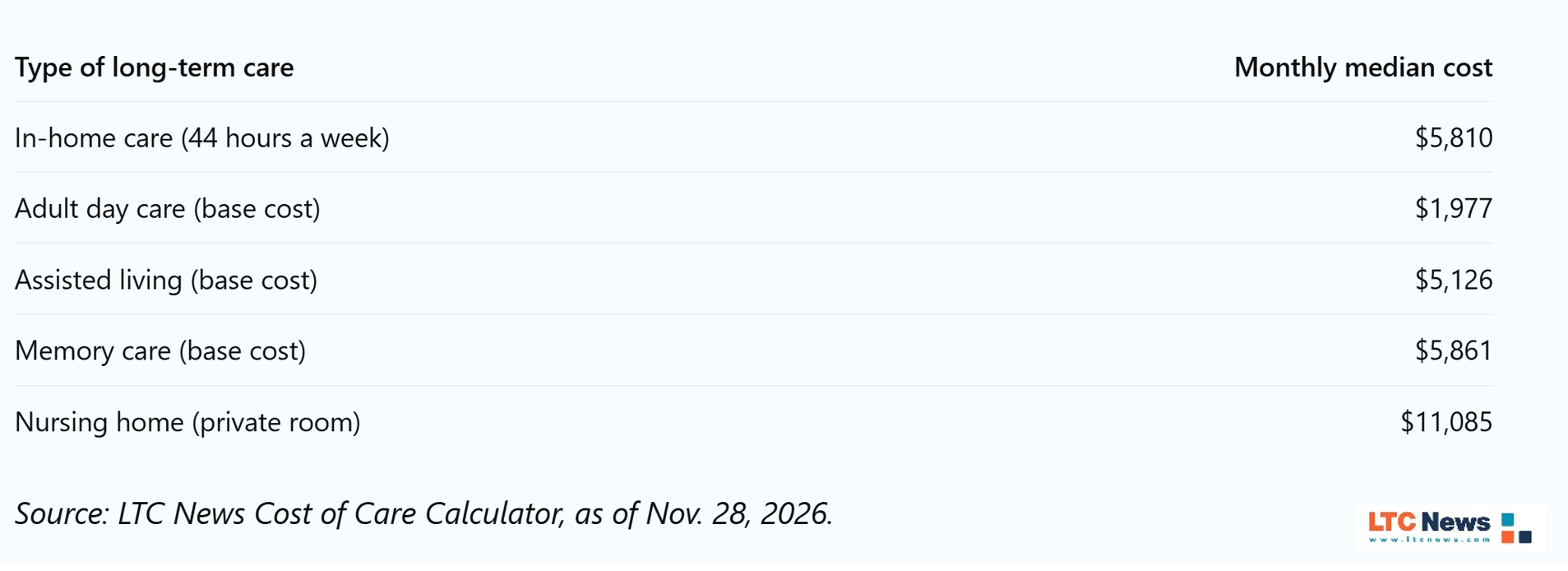
Assisted living and memory care communities often charge additional fees, often called "levels," based on the level of personal care and supervision a resident requires. These surcharges increase the actual cost of care services.
Costs vary considerably depending on where your parent lives, the type of care they need, and how much assistance they require. Your parent may initially need only a few hours of help each week, but these expenses can grow as their health or mobility declines.
Even if you protect your savings from stock market losses, rising care costs can reduce what that money will buy. Allow for future increases when estimating expenses.
How Much Money Should You Set Aside for a Parent's Care?
Before opening a savings account or purchasing a certificate of deposit (CD), sit down with your parent and identify expenses you can reasonably anticipate. Your parent might need a walk-in shower this winter, help at home several days a week, or money for an eventual move to assisted living.
Potential expenses include:
- Home accessibility modifications, including ramps, grab bars, and accessible bathrooms.
- Professional in-home caregivers.
- Adult day care services.
- Assisted living deposits, moving expenses, and monthly fees.
- Medical equipment and personal care supplies.
- Temporary additional care following an illness, injury, or hospitalization.
- Memory care services if your parent develops dementia.
Put an estimated cost and date beside each expense. You can update those numbers as you receive quotes and learn more about your parent's changing needs.
Next, review your parent's Social Security benefits, pension income, savings, and existing insurance coverage. Determine how much of their monthly income can be used for care after accounting for other living expenses and, if applicable, the needs of a spouse remaining at home.
The difference between anticipated care expenses and your parent's available income and insurance benefits will help you determine how much additional money you may need.
NOTE: The LTC News Cost of Care Calculator can help you estimate current and future expenses in your parent's community. You can also use the LTC News Caregiver Directory to find and compare more than 80,000 long-term care providers nationwide.
Understand What Medicare and Other Insurance Will Pay
Before deciding how much money to set aside, determine what your parent's existing insurance will cover. Many families are surprised to discover how little traditional health insurance pays toward ongoing long-term care.
Medicare, Medicare Supplement Insurance, and most traditional health insurance policies do not cover ongoing custodial long-term care, which is assistance with everyday activities such as bathing, dressing, eating, and using the bathroom.
Medicare may cover up to 100 days of skilled nursing facility care per benefit period when eligibility requirements are met, but often falls short in practice. Medicare also covers certain qualifying home health services, but it does not pay for ongoing personal care or supervision when that is the only care needed.
Medicaid pays for long-term care services for individuals with limited income and assets who meet the functional eligibility requirements. In addition, your loved one would have to use Medicaid providers, which limit your options.
Without Long-Term Care Insurance or Medicaid eligibility, your parent's income and assets will generally be the primary sources of funding for ongoing care. You and other family members may also contribute financially or provide unpaid care.
Before signing an agreement with a care provider, understand whether you're signing on your parent's behalf or personally accepting financial responsibility for their care.
Does Your Parent Have an LTC Policy?
If your parent owns LTC Insurance, review the policy before assuming your family will need to cover the full cost of care. Tax-qualified LTC Insurance provides tax-free benefits for eligible care at home and in assisted living communities, memory care facilities, and nursing homes, subject to policy provisions and applicable federal tax limits.
Under federal guidelines, eligibility for benefits generally requires certification by a licensed health care practitioner that your parent needs substantial assistance with at least two of six activities of daily living (ADLs) for an expected period of at least 90 days or requires substantial supervision because of severe cognitive impairment.
Some policies have an elimination period, a waiting period before benefits become payable. Depending on the policy, that period may be measured in calendar days or days on which your parent receives qualifying care.
For example, if your parent's policy has a 90-service-day elimination period and a professional caregiver visits twice a week, satisfying that requirement could take approximately 45 weeks. However, some policies credit seven days toward the elimination period for each week in which your parent receives at least one day of qualifying paid care. Other policies use calendar days or have no elimination period for qualifying home care. Depending on the policy benefits and design, the amount the family has to cover could be minimal.
Review your parent's monthly or daily benefit, remaining benefit pool, inflation protection, elimination period, and covered services. Some policies also include professional care coordination that can help your family arrange appropriate care.
If your parent owns a qualified Long-Term Care Partnership policy, they may also receive dollar-for-dollar asset protection. For every dollar in qualifying benefits paid by the policy, an additional dollar of otherwise countable assets can generally be protected when determining Medicaid eligibility, subject to state Partnership program requirements.
The LTC News Long-Term Care Insurance Claims resource can help you understand the claims process. Through its partnership with LTC News, Amada Senior Care offers free LTC Insurance claims assistance.
Look for Other Sources of Long-Term Care Funding
Your parent may have additional benefits or financial resources that can help reduce out-of-pocket care expenses.
- VA Aid and Attendance: Eligible veterans and surviving spouses who qualify for a VA pension may receive additional monthly benefits to help with care expenses. Financial, military service, and medical eligibility requirements apply. Learn more through the U.S. Department of Veterans Affairs.
- Life insurance with long-term care riders: Some life insurance policies allow access to benefits during the policyholder's lifetime to pay for qualifying care. Using these benefits may reduce the remaining death benefit.
- Hybrid life and long-term care policies: Your parent may own a policy specifically designed to provide long-term care benefits and a death benefit. Some annuities also include long-term care benefits. There are hybrid LTC policies with limited underwriting, allowing even someone with health issues to get a policy.
Review existing insurance contracts and benefit statements with your parent. They may have coverage they purchased years ago and have since forgotten about.
Can You Purchase LTC Insurance for an Aging Parent?
Even if your parent has limited financial assets, you and your siblings may want to help purchase an LTC policy for them. The value of coverage extends beyond asset protection. Having insurance benefits can give your parent more choices about where they receive care, including the ability to remain in their own home with professional assistance.
Coverage can also reduce the financial and caregiving responsibilities that might otherwise fall on family members. Your parent must participate in the application process and meet the insurance company's age, health, and underwriting guidelines at the time of application.
If your parent already needs substantial assistance or has significant health or cognitive issues, obtaining coverage may be difficult or impossible. An experienced LTC Insurance specialist can help determine whether coverage remains an option.
Where Should You Keep Short-Term Care Savings?
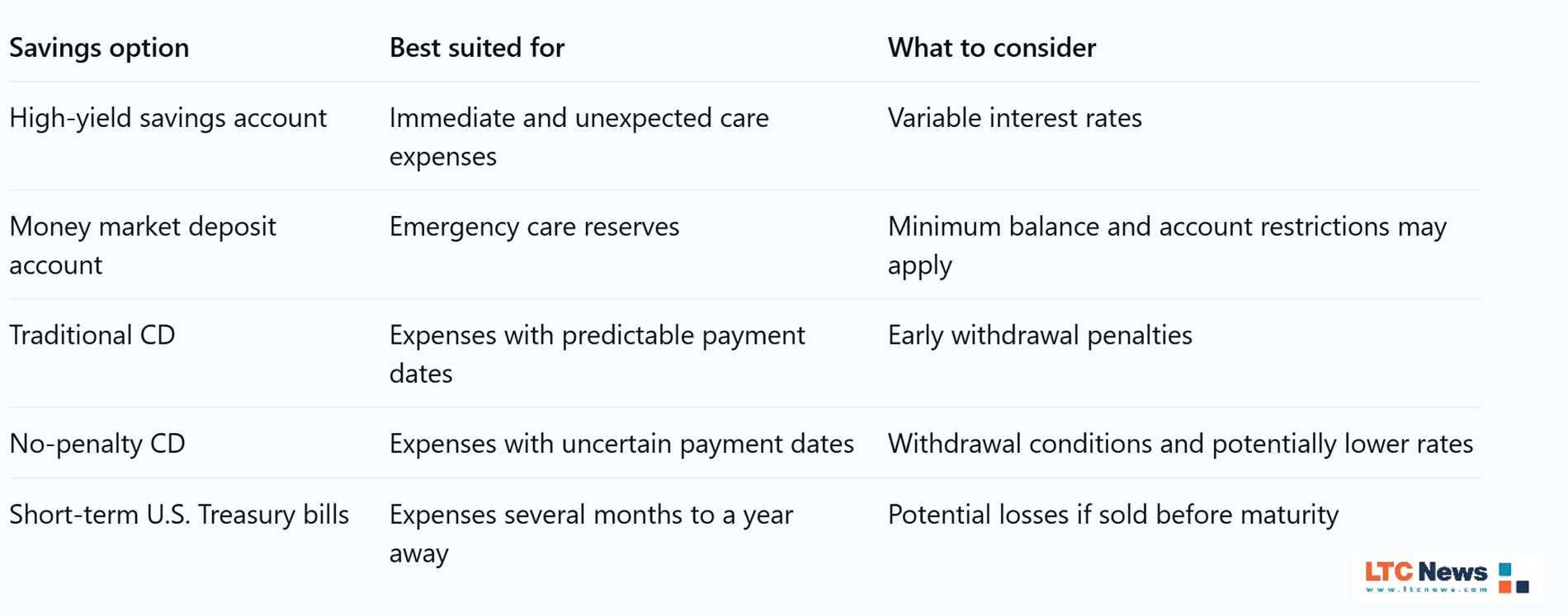
Money you could need next week should be easy to access. Money earmarked for a planned expense next year may have more flexibility. You don't necessarily need to keep everything in one account. Dividing savings based on when you expect to need the money can help you earn interest without tying up funds you may need sooner.
High-Yield Savings Accounts
A high-yield savings account can be a good place to keep money you may need on short notice. You can earn interest without committing your savings to a specific term, although the bank can change its interest rate.
Savings accounts, money market deposit accounts, and CDs at federally insured banks are protected by the Federal Deposit Insurance Corporation (FDIC) up to $250,000 per depositor, per insured bank, per ownership category.
That limit applies to your combined deposits within the same ownership category at a bank, not each individual account. Federally insured credit unions offer similar protection through the National Credit Union Administration (NCUA).
Money Market Deposit Accounts
A money market deposit account may offer competitive interest rates while providing convenient access to funds. Some accounts offer check-writing privileges, which could be helpful when paying caregivers or other service providers. Check minimum balance requirements, fees, and withdrawal restrictions before opening an account.
Don't confuse a bank's money market deposit account with a money market mutual fund. Money market mutual funds are investment products and are not protected by FDIC deposit insurance.
Short-Term U.S. Treasury Bills
U.S. Treasury bills are backed by the federal government and offered with maturities ranging from four weeks to 52 weeks. Treasury bills may be appropriate for money you don't expect to need immediately. Interest earned is subject to federal income tax but generally exempt from state and local income taxes. However, if your parent's circumstances change and you need to sell a Treasury bill before maturity, you could receive less than you originally invested.
Treasury bills purchased directly through TreasuryDirect generally must be transferred to a bank or brokerage before they can be sold on the secondary market. The process may make them less practical for emergency care expenses.
When CDs Make Sense for Planned Care Expenses
A certificate of deposit can make sense when you have a reasonably predictable spending date and can afford to leave the money untouched until then. Suppose your parent plans to move into assisted living next fall. You could choose a CD that matures several weeks before the anticipated move, giving yourself time to transfer the funds and pay the deposit. With a traditional fixed-rate CD, you'll know the interest rate you'll earn throughout the term.
When comparing online bank CDs, pay attention to the available terms and the rate. A CD that earns slightly more may be inconvenient if it keeps your money tied up past the date you need it. An 11- or 14-month term could fit your plans better than a standard one-year option. Check the current APY, minimum deposit, and withdrawal rules before choosing one. When comparing bank or credit union CDs, pay attention to the term, annual percentage yield (APY), minimum deposit requirements, and early withdrawal rules. A CD that earns slightly more interest may not be the better choice if it keeps your money tied up longer than you need it.
Also, find out what happens when the CD matures. Many CDs renew automatically unless you withdraw the money during a specified grace period. The new interest rate may be different. Put the maturity date and withdrawal deadline on your calendar when you open the account.
Review early withdrawal penalties as well. Some CDs do not allow partial withdrawals, and others may require you to close the entire account. Depending on the terms, an early withdrawal penalty could reduce your principal.
No-Penalty CDs Offer Greater Flexibility
If you're uncertain when your parent will need additional care, a no-penalty CD may offer a middle ground between a traditional CD and a savings account. These CDs typically provide a fixed interest rate while allowing early withdrawals without penalties, subject to the account's terms.
Some banks require you to wait a specified number of days after opening the account before making a withdrawal. Others require you to withdraw the entire balance rather than just a portion. No-penalty CDs may offer lower interest rates than comparable traditional CDs, but the flexibility could be worth more than the additional interest when your parent's health and care needs are unpredictable.
Understand How Brokered CDs Work
Brokered CDs, purchased through brokerage firms rather than directly from a bank, work differently from traditional bank CDs. Brokered CDs issued by FDIC-insured banks are generally eligible for FDIC protection within applicable limits, provided deposit insurance requirements are met. Include any other deposits you hold at the issuing bank when determining your total coverage.
However, if you need your money before maturity, you may have to sell the CD on the secondary market. Changes in interest rates and market conditions could result in receiving less than you originally invested. FDIC insurance protects qualifying deposits against bank failure, not losses resulting from selling a CD before maturity.
How to Build a Simple CD Ladder for Care Costs
A CD ladder involves opening several CDs that mature at different times. Instead of committing all your money to one account, you can arrange maturity dates around your parent's anticipated care expenses.
For example, suppose you have $30,000 earmarked for planned expenses after establishing a separate emergency care reserve.
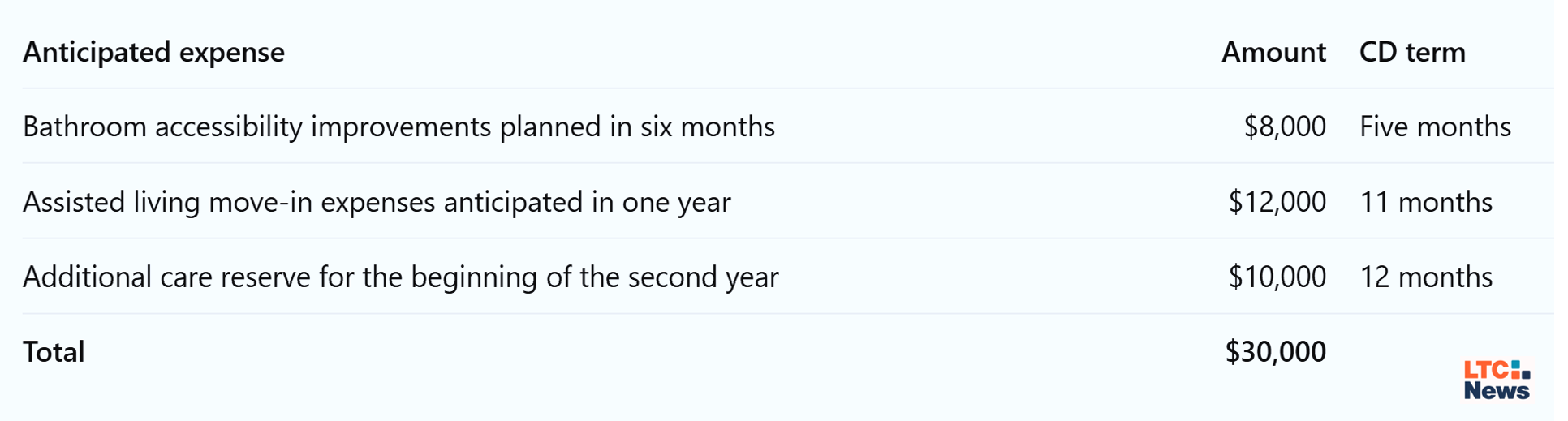
Choose terms that allow the money to mature before you expect to pay the bills.
If plans change, you can evaluate whether withdrawing money early from one CD makes sense rather than disturbing all your savings. For recurring monthly expenses, such as professional home care, a series of shorter-term CDs or Treasury bills with staggered maturity dates may be more practical than a single longer-term CD. You could arrange for funds to mature monthly or quarterly as care bills come due.
Of course, your parent's health may not follow your financial timetable. A fall, stroke, hospitalization, or worsening dementia could create an immediate need for professional care.
Keep an Emergency Care Reserve
Consider keeping several months of anticipated out-of-pocket care expenses in an easily accessible, federally insured savings account.
For example, if your parent needs part-time home care a few days a week costing about $3,000 a month, keeping three to six months of those expenses within reach would mean setting aside $9,000 to $18,000. The appropriate amount will depend on your parent's health, income, insurance coverage, and other financial resources.
Not every family can afford to establish that much of a reserve. Start with what you can reasonably afford and build your savings as circumstances allow. Emergency funds can help your parent receive additional care when needed, rather than waiting for a CD to mature or selling investments at an unfavorable time.
Protect Your Own Retirement Savings While Helping a Parent
Small payments can add up before you realize how much you're contributing. You cover a prescription, pay for a few extra caregiver visits, and pick up personal care supplies on your way to your parent's home. Eventually, those expenses can become a significant part of your household budget.
According to AARP's 2026 Caregiving Out-of-Pocket Costs Study, family caregivers spend an average of $11,508 annually on caregiving expenses—approximately 59 percent more than reported in 2021. The financial consequences extend beyond direct expenses. AARP also found that 65 percent of employed family caregivers experienced at least one work-related disruption because of their caregiving responsibilities.
Reducing work hours, turning down promotions, or retiring earlier than planned can affect your income, retirement contributions, and future financial security. Debra Whitman, AARP executive vice president and chief public policy officer, discussed the financial impact of caregiving in November 2026.
“Caregivers often pay a heavy toll on their own financial security to help a loved one,” said Debra Whitman, Executive Vice President and Chief Public Policy Officer at AARP.
When working caregivers reduce their hours or need to quit their job entirely, they lose not only their current salary and benefits but also opportunities to save for retirement and build future Social Security benefits costing them an average of $120,500 over their lifetimes.”—Debra Whitman.
The financial cost of caregiving doesn't end when caregiving does. If you start withdrawing money from a traditional 401(k) or individual retirement account (IRA) to pay for your parent's care, those withdrawals generally create taxable income. Withdrawals before age 59½ may also trigger an additional 10 percent federal tax unless an exception applies.
However, there may be some tax relief if you're paying qualifying medical or long-term care expenses for a parent who meets applicable dependency requirements. According to the Internal Revenue Service, qualifying unreimbursed medical expenses may be deductible if you itemize deductions and your eligible expenses exceed 7.5 percent of your adjusted gross income. Ask a tax professional whether you qualify under the guidelines in effect for the applicable tax year.
You want your parent to receive quality care, but sacrificing your retirement security could leave you financially vulnerable when you need care yourself. If siblings are sharing expenses, discuss how those costs will be divided before a crisis occurs. Keeping your own care contributions in a separate account can help you avoid spending more than you can afford.
Understand Medicaid Rules Before Moving a Parent's Money
If you're helping manage your parent's finances, keep their money separate from yours and maintain records of expenses you pay on their behalf. Make sure you have the appropriate legal authority, such as a durable financial power of attorney. Ideally, your parent should establish that authority while they can still make informed decisions.
Adding yourself to a parent's bank account, transferring money between family members, or changing ownership of assets can have unintended tax, estate planning, and Medicaid eligibility consequences.
Savings accounts, CDs, and Treasury bills owned by your parent generally count as assets when determining financial eligibility for Medicaid long-term care benefits, subject to applicable exemptions. Putting money in a CD does not shield it from Medicaid's asset eligibility requirements.
Medicaid generally examines certain asset transfers made during the five years before an application for nursing home care or certain other long-term care benefits. The federal Deficit Reduction Act of 2005 says that transfers for less than fair market value may result in a period of ineligibility. Even a financial decision made with good intentions could complicate your parent's ability to qualify for Medicaid later.
An elder law attorney familiar with your state's Medicaid rules and eligibility guidelines at the time can help your family understand the consequences before transferring assets or changing account ownership.
Don't Overlook Your Own Future Long-Term Care Needs
Helping an aging parent navigate long-term care often provides a firsthand look at the financial and emotional consequences of growing older. Research from the U.S. Department of Health and Human Services estimates that 56 percent of Americans turning 65 between 2020 and 2024 will need long-term services and supports because of a severe disability during their remaining lifetime. While short-term savings strategies can help address a parent's immediate care needs, planning years or decades in advance gives you more options.
Tax-qualified LTC Insurance can protect your income and retirement assets and reduce the financial and caregiving responsibilities otherwise placed on your family. Many people purchase LTC Insurance coverage in their 40s, 50s, or 60s, when their age and health may qualify them for more affordable options.
Your experience helping a parent can serve as a reminder to prepare for your own future care needs before changes in your health limit your choices.
Build a Care Savings Plan Before a Crisis
Start with the expenses you already know about. Write down what your parent may need over the next three years, roughly what it will cost, and when you expect to pay for it. Review your parent's income, savings, and insurance coverage. Keep money for immediate needs and unexpected expenses within reach, then consider CDs or short-term Treasury bills for expenses you can schedule with greater confidence.
Check federal deposit insurance coverage across accounts, and note maturity dates and withdrawal deadlines. Review your financial plan at least every six months or sooner if your parent's health, mobility, or memory changes.
You can't predict every expense. A doctor's appointment, a fall, or a conversation with your parent may change your plans considerably.
Having a financial plan gives you more room to adjust. When your parent needs another day of home care or can no longer live safely alone, you will be better prepared to make decisions based on their needs rather than scrambling to find the money.
Frequently Asked Questions
How much money should I keep accessible for a parent's long-term care?
Consider keeping three to six months of anticipated out-of-pocket care expenses within reach if your family's finances allow. The appropriate amount depends on local care costs, your parent's health, income, insurance coverage and the likelihood of needing additional services.
Are CDs and savings accounts protected from Medicaid?
No. CDs, savings accounts and Treasury bills owned by your parent generally count as assets when determining Medicaid long-term care eligibility. Certain exemptions and qualified Long-Term Care Partnership policies may provide asset protection, but placing money in a CD does not.
Where is the safest place to keep money for an aging parent's care?
Federally insured high-yield savings accounts, money market deposit accounts and traditional CDs are generally low-risk options when deposits remain within applicable insurance limits. Short-term U.S. Treasury bills are another option backed by the federal government. Money needed immediately should remain in an easily accessible account.
Are CDs a good option for long-term care savings?
CDs can be useful for care expenses with reasonably predictable payment dates. However, early withdrawal penalties can make traditional CDs less suitable for emergencies. No-penalty CDs may offer greater flexibility when an older adult's care needs are unpredictable.
Does Medicare pay for an aging parent's long-term care?
Medicare generally does not pay for ongoing custodial long-term care. It may cover up to 100 days of skilled nursing facility care per benefit period when eligibility requirements are met, along with certain qualifying home health services.
Can transferring a parent's money affect Medicaid eligibility?
Yes. Medicaid generally reviews certain asset transfers made during the five years before an application for nursing home care or certain other long-term care benefits. Gifts or transfers for less than fair market value may result in a period of ineligibility. Consult an elder law attorney before transferring assets or changing account ownership.
Can I deduct long-term care expenses I pay for a parent?
You may be able to deduct qualifying unreimbursed medical and long-term care expenses if your parent meets applicable dependency requirements, you itemize deductions and your eligible expenses exceed 7.5 percent of your adjusted gross income. Consult a tax professional to determine your eligibility.
Can adult children purchase LTC Insurance for their parents?
Yes. Adult children can help arrange and pay for coverage if their parents participate in the application process and meet the insurance company's age, health and underwriting guidelines. Even parents with limited assets may benefit from coverage that provides greater choices in care settings and reduces the burden on family members.

Sponsored