Recovery at Home After Surgery: Benefits and Extended Care Options in Canada

About This Article
More Canadians are recovering at home after surgery. Recovering at home after surgery can lower infection risk and improve comfort.

Jacob Thomas
Jacob Thomas writes on health, wellness, and retirement topics, including aging, caregiving, insurance, and long-term care.
Table of Contents
- Why Post-Surgery Care Is Moving Home in Canada
- Do Patients Recover as Well at Home?
- What Home-Based Recovery in Canada Typically Includes
- What Provincial Health Plans Cover
- When Recovery Turns into Long-Term Support
- Role of Private Insurance and Financial Planning
- Risks of Unsupported Home Recovery
- Technology Is Expanding Home Recovery Across Canada
- When Home Recovery May Not Be Appropriate
- The Bigger Question: Are You Prepared?
- Early Planning
You want to recover safely—but you also want to return home. If you or a loved one had surgery tomorrow, would your home be ready for recovery?
Across Canada, hospitals are increasingly discharging patients earlier after surgery. Capacity pressures, improved surgical techniques, and “home first” health strategies are reshaping recovery today. For many adults, especially older adults, healing at home can reduce complications and improve comfort—if proper supports are in place.
Why Post-Surgery Care Is Moving Home in Canada
Hospitals are designed for acute treatment, not extended recovery. According to the Public Health Agency of Canada (PHAC), approximately 1 in 9 Canadian patients acquires a healthcare-associated infection during hospital care.
Older adults face an elevated risk due to weakened immune systems and underlying chronic conditions. Private care for the elderly at home counters this by placing individuals in familiar settings that foster relaxation, improved rest, and family support, factors directly linked to accelerated healing.
Hospital stays are essential for acute treatment, but prolonged exposure to complex clinical environments increases the likelihood of healthcare-associated infections and other avoidable harms. Supporting recovery in the home with coordinated care teams can reduce these risks while preserving patient comfort and independence. — Dr. Michael Seth Silverman, Chief of Infectious Diseases at St. Joseph’s Health Care London, Ontario, Canada and clinical researcher on infection prevention.
Why this matters: Even a short hospital stay increases exposure to pathogens not present at home.
Prolonged inpatient recovery can also lead to:
- Muscle loss and deconditioning
- Sleep disruption
- Falls
- Anxiety and confusion
Returning home sooner under professional supervision can lower those risks while promoting functional recovery.

Do Patients Recover as Well at Home?
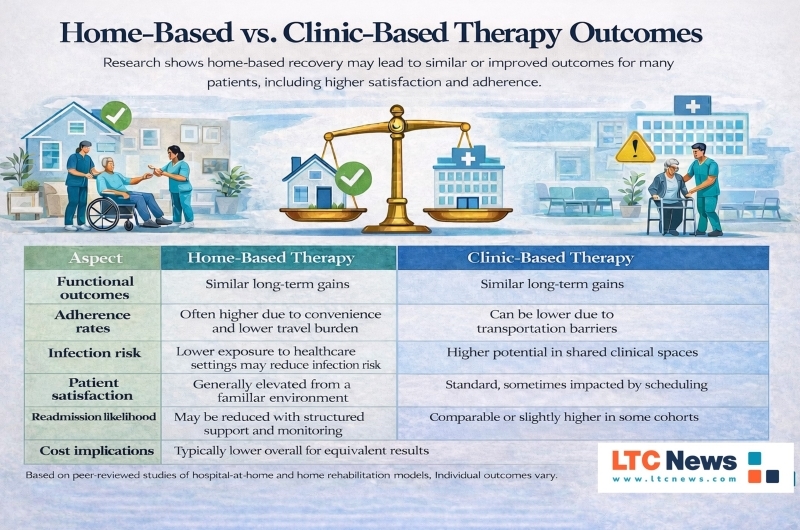
Evidence supports home-based recovery for many stable patients. Hospital-at-home and early discharge models have expanded in provinces including Ontario, British Columbia, and Alberta. Research published in peer-reviewed journals, including JAMA Network Open (Levine et al., 2023), found that hospital-at-home programs for eligible patients were associated with lower complication rates and higher patient satisfaction than traditional inpatient care.
While that study was U.S.-based, Canadian health systems are implementing similar models with comparable goals: reducing infection risk, improving patient comfort, and lowering costs.
For orthopedic procedures such as hip and knee replacements, studies indexed in PubMed show similar long-term functional outcomes between home-based physiotherapy and clinic-based rehabilitation for medically stable individuals.
Home recovery is not suitable for everyone. But for carefully selected patients, it is safe and effective.
What Home-Based Recovery in Canada Typically Includes
Successful recovery at home requires coordination.
Skilled Nursing
- Wound monitoring and dressing changes
- Vital sign checks
- Early identification of complications
Physiotherapy
- Strength and mobility exercises
- Gait and balance training
- Fall prevention strategies
Occupational Therapy
- Home safety assessments
- Bathroom modifications
- Energy conservation techniques
Medication Management
- Discharge reconciliation
- Monitoring for side effects
- Adherence support
Most care teams recommend the first home visit occur within 24 to 48 hours after discharge.
What Provincial Health Plans Cover
Canada does not have a single national home-care system. Coverage varies by province.
In general:
- Provincial health plans may fund limited short-term home nursing or rehabilitation following hospital discharge.
- Access is typically based on assessed medical need.
- Duration and frequency vary by province and resource availability.
- Wait lists may occur in high-demand regions.
For example:
- Ontario (OHIP): Home and Community Care Support Services coordinate publicly funded home care.
- British Columbia: Health authorities provide publicly funded home support based on assessment.
- Alberta: Alberta Health Services offers short-term home care after surgery when medically necessary.
Unlike the United States, Canada does not rely on the “homebound” rules of Medicare. However, public funding may not cover extended personal care needs.
Many families supplement with private home care services when public resources are limited.
When Recovery Turns into Long-Term Support
If recovery extends beyond short-term rehabilitation and you require help with activities of daily living (ADLs) such as bathing, dressing, transferring, toileting, eating, or continence, public coverage may be limited.
According to Statistics Canada, nearly 1 in 4 Canadians aged 65 and older receives some form of home care, with rates rising sharply after age 75. The Canadian Institute for Health Information (CIHI) also reports growing demand for long-term care and home support services nationwide.
Canada’s population is aging rapidly, which means increasing demand not only for long-term care but for home care and community supports that help older adults remain in their homes for as long as possible. — Dr. Kenneth Rockwood, a geriatric medicine and aging research expert.
Why this matters: A surgical setback can accelerate long-term care needs.
Planning ahead—financially and logistically—helps protect independence.
Role of Private Insurance and Financial Planning
Long-Term Care Insurance is more common in the United States than in Canada. However, some Canadian insurers offer:
- Long-term care coverage
- Critical illness insurance
- Disability protection
Many Canadians instead rely on:
- Personal savings
- Retirement income
- Provincial long-term care systems
Public long-term care facilities may have wait lists, depending on the province and the level of care required. Understanding the costs of private home care, assisted living, or long-term care facilities in your province is essential before a health event occurs.
Risks of Unsupported Home Recovery
Home recovery without structured support increases the risk of:
- Missed infection signs
- Medication errors
- Falls
- Delayed rehabilitation
Hospital discharge planning is critical. Families should request:
- Written care instructions
- Equipment coordination (walkers, raised toilet seats)
- Follow-up appointments
- Clear warning signs requiring emergency care
Technology Is Expanding Home Recovery Across Canada
Virtual care and remote monitoring have expanded significantly since 2020.
Patients may now use:
- Telehealth physiotherapy sessions
- Remote vital sign monitoring
- Digital wound photo tracking
- Medication reminder applications
These tools improve access, particularly in rural or remote communities.
When Home Recovery May Not Be Appropriate
Home recovery may not be ideal if:
- Continuous medical monitoring is required
- The home environment is unsafe
- Reliable support is unavailable
- Cognitive impairment limits adherence
In such cases, short-term inpatient rehabilitation may be recommended before returning home.
The Bigger Question: Are You Prepared?
Surgery can be a turning point. If you are over 50, ask yourself:
- Is my home prepared for limited mobility?
- Do I understand what my province covers?
- Would my family know how to arrange additional care quickly?
Planning improves not just recovery—but long-term independence.
Early Planning
Recovering at home after surgery is increasingly common across Canada in 2026. For medically stable patients, it can lower infection risk, improve comfort, and support faster functional recovery.
But success depends on structured professional support and early planning.
Understanding what your province covers—and where private services may be needed—can prevent unnecessary stress during an already vulnerable time.
Healing is not just about leaving the hospital. It is about returning home safely—and staying independent long after recovery ends.