Making a Home Dementia Friendly

About This Article
If you have a loved one with dementia, they will need a safe environment and supervision. You can make their home more dementia-friendly to allow them to stay at home longer.

Jessica Bishop
A freelance writer who loves travel. Therefore, her primary focus is writing about her travel adventures and helping people find the best place for their new life.
Dementia is becoming more commonplace as someone in the world develops some form of dementia every 3 seconds. The Alzheimer's Association reports that about 6.2 million Americans aged 65 and older lives with Alzheimer's dementia in 2021. As more people live longer lives, more will suffer from some type of cognitive decline before they pass away.
If a family member has been diagnosed with dementia and wants to stay at home as long as possible, there are several ways to make your home dementia-friendly. It will considerably increase the quality of life for a dementia patient. You may also want to consider getting a dog, as pets can help with these conditions.
Alzheimer's and other types of dementia usually affect a patient's memory and the ability to recognize people and items. Moreover, it can warp spatial awareness, hindering mobility and coordination. In some cases, there could even be incontinence issues.
All of these symptoms deem specific alterations to the person's home necessary. They will make life more comfortable for the person with dementia. The environment adapted to their particular needs will help your loved one function if they have trouble remembering how specific things work or where they are. That way, the person in question can stay in their home safely and be independent for as long as possible.
The best way to approach these home modifications is to consult a professional. They will help you assess your home, considering the individual needs of the person with dementia. Caring for a person with dementia long-term is challenging. Therefore, we have a few tips to help you with providing the care that they need.
Improve Lighting
It's essential for anyone with a neurodegenerative disease to live in surroundings with excellent lighting. It will help them see things more clearly, be better oriented, and improve their well-being altogether. It can reduce confusion and lower the risk of falls.
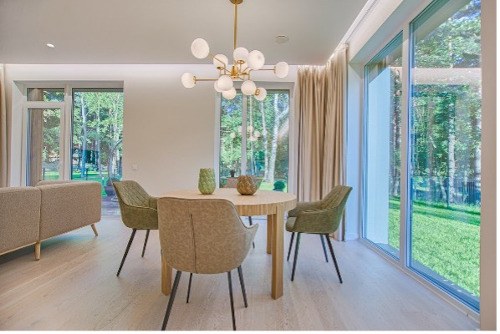
A dining room with big windows and good lighting, a way to make your home dementia friendly.
Of course, natural light is always the best. So, try to ensure that enough natural light comes into the house by removing anything that could block it. Push back heavy curtains or replace them with those made of a light fabric and in light color, and open blinds.
Besides improving visibility, natural light can help establish day and night rhythm, which can help with sleeping. Also, you can put the dementia patient's favorite chair by the window. It will ensure they get a lot of natural light and let them see what is happening outside.
Moreover, light switches must be accessible and simple. Even better, install automatic light sensors. That way, the lights will automatically turn on when a person passes by.
But, at night, the place where the person with dementia sleeps must be dark enough. Good night's sleep is crucial for these patients, and you don't want anything disrupting it. Therefore, the bedroom is where you should keep the heavier curtains.
Eliminate Excessive Patterns - Use Contrasting Colors
One of the problems that dementia can cause is the difficulty of distinguishing colors. Therefore, it's imperative to help the patient recognize floors, walls, different furniture, and other items in the home. You can do this by using brightly colored furniture that will contrast it from the walls and floors.
Contrast can help dementia patients find things more easily. For example, you can get chairs, tables, and bedding in bold colors. In the bathroom, it may be helpful to use a toilet seat in a contrasting shade to the rest of the space.
Moreover, the floors should be in contrast with the walls. If they are similar in color, it can intensify confusion. Also, avoid anything shiny and reflective. It can be mistaken for wet and slippery.
Finally, keep patterns to the minimum or avoid them altogether. Stripes, for instance, are particularly bad as they can cause disorientation. And don't use different colors of flooring throughout the house as a dementia patient can perceive the changes as steps or water, and they may avoid stepping onto them.
Clutter-Free Home Includes Avoiding Trip Hazards
Dementia, as it progresses, will affect the patient's mobility due to the lack of fine motor control. As a result, the patient will develop a shuffling gait. It is a way of walking in which the person drags their feet. Thus, one of the ways to make your home dementia-friendly is to remove all possible obstacles.
So, rugs will have to go. But you can consider wall-to-wall carpeting. Also, hide wires and cables behind furniture and tape them tightly so they don't move. Do not leave chargers plugged in when not in use. Finally, consider installing handrails in the halls.
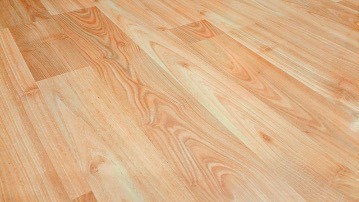
Floors must be uniform and free of trip hazards.
Furthermore, clutter is your worst enemy for a person with dementia. It will impede moving around the house. So, make the home neat and tidy and eliminate everything you think could create a fall risk.
Also, anything that is not used regularly will be best taken away from the home. You can consider renting a storage unit. It is an excellent place for items that you don't use and everything you need but is best kept away from your loved one. And you will know your belongings are safe at all times.
Finally, when you declutter the home, keep in mind that everything the person with dementia uses should be easily accessible and placed where they can see them with no difficulty.
Dementia-Friendly Means Noise Reduction
Curtains, cushions, and carpets can go a long way in absorbing background noise. Consider wall-to-wall carpeting, especially if you have vinyl or laminate floors. The sound is louder when walking on these floors, making the person with dementia uncomfortable. Also, turn off the TV or radio when nobody is watching or listening.
Labels Help with Navigation
You can label rooms as well as cupboards to indicate what is in them. And try to use pictures rather than words as it can make it easier to recognize. And don't change the systems because that can be very confusing.
Remove Mirrors
Sometimes, people with dementia cannot recognize themselves in the mirror. They may perceive the person staring at them from the mirror as a stranger, which can be a highly distressing and frightening experience.
But the same goes for other reflective surfaces. So, you may also want to close the curtains at night, so there is no reflection on the windows.
Keep the Wardrobe to a Minimum
It can be overwhelming for a person with dementia to look at a wardrobe full of clothes every morning. To help them, you can pick the clothing for the next day. It will let the patient dress independently without any confusion. Also, if the patient sees you have changed into the nighttime clothes, it will tell them they should do the same.

A full wardrobe can be overwhelming for a dementia patient.
Don't Forget About Safety
Everything you do will ensure the person with dementia is safe in your home. So, you should install smoke alarms and heat detectors and remember to check the batteries frequently. Also, there are movement sensors you can add to the bed. It will alert you if the patient has got up.
For the bathroom or kitchen, you can get special plugs that automatically drain water. This will prevent flooding when sinks and tubs become too full.
Lastly, keep all harmful chemicals locked and out of reach.
If you make a home dementia-friendly, it can significantly impact a dementia patient's life in the most positive way. It will enable them to stay in the comfort of their home for the longest possible time, delaying the move to an assisted living facility.