More States Are Allowing Cameras in Assisted Living. Illinois Is the Latest
About This Article
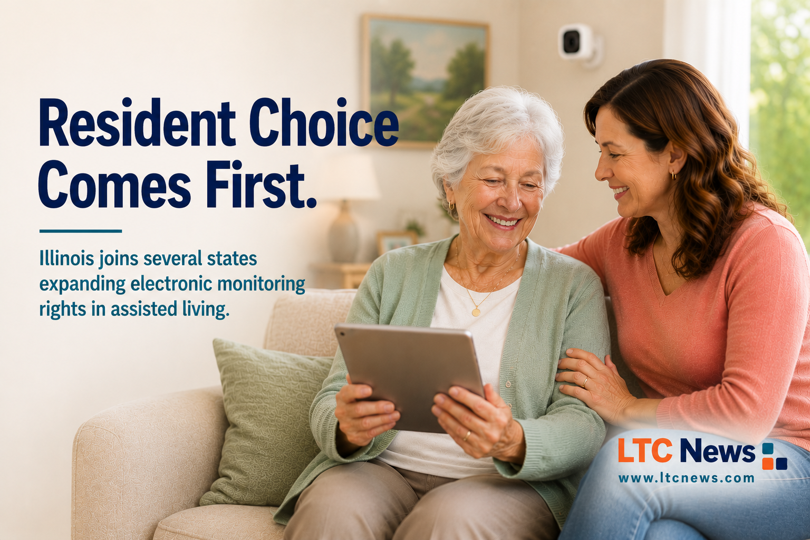
Illinois has become one of the latest states to expand residents' rights to voluntarily install electronic monitoring devices in assisted living. The new Illinois law extends protections that previously applied only to nursing homes, reflecting a growing national movement toward greater transparency, resident choice, and family involvement in long-term care.

James Kelly
LTC News staff writer specializing in long-term care and aging.
Table of Contents
- A Law That Reflects Today's Long-Term Care Reality
- A Growing National Movement
- Why Supporters Say the Law Matters
- Cameras Are One Tool—Not the Entire Solution
- Technology Cannot Replace Family Involvement
- How House Bill 4517 Works: Understanding Consent, Privacy, and Resident Rights
- Accountability Works Both Ways
- Cameras Cannot Replace Family Advocacy
- Illinois Is Part of a Growing National Movement
- States Have Adopted Different Models
- Notes
- Why Interest Has Grown
- Cameras Can Protect Residents—and Caregivers
- Privacy Remains the Most Challenging Issue
- Cameras Are Especially Important for Some Families
- Technology Cannot Replace Choosing the Right Community
- What Families Should Consider Before Installing a Camera
- Questions to Ask Before Installing a Camera
- Choosing the Right Community Still Matters Most
- Electronic Monitoring Is Not Long-Term Care Planning
- Technology Will Continue to Shape Long-Term Care
- Perspective
If someone you love lives in an assisted living community, you probably wish you could be there every day. Even when you trust the staff and believe your family member is receiving excellent care, work, distance, and life's responsibilities can make frequent visits difficult.
For many families, that distance creates a lingering question: "What happens when I'm not there?"
Several states have addressed this, and Illinois lawmakers believe residents should have another option to help answer that question. With the enactment of House Bill 4517 into law, Illinois has expanded its electronic monitoring law beyond nursing homes, allowing residents of assisted living and shared housing establishments to voluntarily install electronic monitoring devices—including video cameras and audio recording equipment—in their own rooms under carefully defined legal safeguards.
Gov. JB Pritzker (D-IL) signed the legislation into law on June 26, 2026. The Governor's Office highlighted the measure again in a July 7 announcement that outlined several recently enacted laws affecting older adults and other vulnerable Illinois residents.
While the legislation applies only in Illinois, its significance extends far beyond state borders. Across the country, lawmakers are increasingly recognizing electronic monitoring as one way to strengthen resident rights while balancing privacy, dignity, accountability, and family involvement. Illinois now joins a growing list of states updating long-term care laws to reflect how, and where, older Americans receive care today.
A Law That Reflects Today's Long-Term Care Reality
Illinois first established residents' rights to use electronic monitoring devices in licensed nursing homes nearly a decade ago. Much has changed since then. Assisted living has become one of the fastest-growing segments of long-term care as many older adults seek supportive services in a more residential setting before nursing home care becomes necessary. Until now, however, residents living in assisted living communities and licensed shared housing establishments did not have the same statutory protections available to nursing home residents.
House Bill 4517 closes that gap. The law now extends electronic monitoring rights to approximately 28,600 residents living in Illinois assisted living and shared housing establishments, recognizing that today's long-term care continuum extends well beyond skilled nursing facilities.
Under Illinois law, a shared housing establishment provides housing combined with personal assistance and supportive services in a residential environment licensed separately from assisted living communities. While many families may be unfamiliar with the term, these settings serve thousands of older adults who need help with daily activities but do not require nursing home care.
Importantly, the legislation does not require electronic monitoring. Instead, it gives residents another choice. Participation remains entirely voluntary and is subject to privacy protections, consent requirements, and other safeguards established by state law.
A Growing National Movement
Illinois is not creating a new concept. Rather, it is becoming part of a broader national trend. Over the past decade, numerous states have adopted laws allowing residents to voluntarily install electronic monitoring devices in long-term care settings. Although each state's requirements differ, the underlying philosophy is remarkably consistent: residents should have the right to decide whether electronic monitoring provides additional peace of mind for themselves and their families.
That movement reflects changing demographics. Americans are living longer. Families are more geographically dispersed. Adult children frequently live hours—or even states—away from aging parents. Technology has become one way to help families remain connected while respecting a resident's independence and autonomy.
Why Supporters Say the Law Matters
Supporters emphasize that the legislation is fundamentally about resident choice. Illinois State Long-Term Care Ombudsman Kelly Richards said the new law allows residents of assisted living and shared housing establishments to install video or audio recording devices in their rooms, providing additional peace of mind for both residents and their families. Richards noted that some residents may feel more comfortable knowing loved ones can observe changes in their health, mobility, or daily routines.
Gov. Pritzker described the legislation as another tool to help residents protect themselves, document concerns, and strengthen efforts to ensure long-term care settings remain free from abuse and neglect. State Sen. Graciela Guzmán, the bill's Senate sponsor, emphasized that residents deserve both dignity and meaningful choices regarding their care.
People living in assisted living and shared housing establishments deserve safety, dignity and the ability to make informed choices about their own care. When someone's daily care is placed in the hands of others, residents and their families deserve peace of mind." — State Sen. Graciela Guzmán (D-IL).
House Assistant Majority Leader Ann Williams, who sponsored the measure in the House, noted that electronic monitoring can also help families remain connected with loved ones who cannot always visit in person, reducing isolation while offering reassurance from a distance.
Cameras Are One Tool—Not the Entire Solution
Electronic monitoring is sometimes referred to as a "granny cam," but supporters say that label oversimplifies the issue. Families often consider cameras because they want reassurance that a loved one is safe. That may be especially true when someone is living with Alzheimer's disease or another form of dementia. Cognitive impairment can make it difficult for residents to describe changes in care, remember events accurately, or communicate concerns to family members.
Electronic monitoring may help families observe changes in mobility, routines, or overall well-being. It may also document quality care, clarify what happened after a fall, or help resolve misunderstandings between families and providers. At the same time, cameras raise legitimate questions about privacy—for residents, roommates, visitors, and caregivers alike. Illinois lawmakers sought to balance those competing interests by making electronic monitoring voluntary while establishing detailed rules governing consent, visibility, and the use of recorded footage.
Those safeguards are one reason electronic monitoring laws continue to receive bipartisan attention in legislatures across the country.
Technology Cannot Replace Family Involvement
Even supporters of electronic monitoring caution that cameras should never replace personal involvement. A camera cannot recognize loneliness. It cannot participate in a care conference. It cannot advocate for changes to a medication regimen or notice subtle personality changes that often become apparent only through regular interaction.
Families should continue to visit often, communicate with caregivers, attend care planning meetings, and remain actively involved in a loved one's care. Electronic monitoring works best as one component of a broader strategy built on communication, trust, transparency, and ongoing advocacy.
For readers of LTC News, House Bill 4517 is more than a story about cameras. It reflects a broader evolution in long-term care—one in which families increasingly expect transparency, meaningful communication, strong resident rights, and opportunities to remain active partners in the care of someone they love.
How House Bill 4517 Works: Understanding Consent, Privacy, and Resident Rights
Electronic monitoring may sound simple: install a camera and begin recording. In practice, Illinois law establishes a carefully balanced framework designed to protect resident safety while respecting privacy, dignity, and personal choice.
House Bill 4517 does not authorize unrestricted surveillance inside assisted living communities or shared housing establishments. Instead, it extends the protections of Illinois' Authorized Electronic Monitoring in Long-Term Care Facilities Act to additional residential care settings while preserving safeguards for residents, roommates, visitors, caregivers, and providers.
- House Bill 4517 at a Glance
The law, which takes effect January 1, 2027, expands electronic monitoring rights for residents of Illinois assisted living and shared housing establishments.
It:
- Makes electronic monitoring entirely voluntary.
- Requires informed resident consent.
- Requires roommate consent in shared accommodations.
- Prohibits hidden monitoring devices.
- Requires electronic monitoring devices to be installed in a visible location.
- Requires signage outside monitored resident rooms.
- Prohibits unauthorized tampering with approved devices.
- Allows recordings to be considered as evidence in civil, criminal, or administrative proceedings when legal evidentiary requirements are met.
- Resident Choice Comes First
Perhaps the most important feature of the law is what it doesn't do. Illinois is not requiring cameras in assisted living communities. Facilities are not expected to install, operate, or monitor recording devices, and employees are not required to participate in electronic monitoring programs.
Instead, the decision belongs to the resident whenever possible, or to a legally authorized representative when appropriate. Illinois State Long-Term Care Ombudsman Kelly Richards emphasized that the legislation provides another option for residents who want additional oversight and peace of mind for themselves and their families.
That distinction is important. The law is about resident autonomy, not institutional surveillance.
- Who Pays for the Equipment?
Families often assume facilities will provide cameras. Generally, they do not. Residents who choose electronic monitoring are typically responsible for purchasing, installing, operating, and maintaining their own equipment.
Illinois law also authorizes financial assistance for certain Medicaid-eligible residents, subject to legislative appropriations. Whether funding is available depends on future state budget decisions.
Before purchasing a system, families should also consider:
- Internet or Wi-Fi availability if remote viewing is desired.
- Password protection and cybersecurity.
- Cloud storage or subscription fees.
- Electrical access and battery backup.
- Whether the equipment complies with facility safety requirements.
The cost of ownership often extends well beyond purchasing the camera itself.
- Shared Rooms Require Shared Consent
Privacy rights do not disappear simply because one resident wants electronic monitoring. When two residents share a room, Illinois law requires written consent from both individuals before monitoring may begin.
If consent is withdrawn later, electronic monitoring must stop unless the facility is able to accommodate the residents separately. Similarly, if a new roommate moves into the room, new consent must be obtained before recording resumes.
Those requirements reflect one of the law's central principles: One resident's right to monitor cannot override another resident's right to privacy.
- Cameras Must Be Visible
Illinois prohibits hidden cameras. Electronic monitoring devices must be installed in a location that is plainly visible, helping ensure transparency for residents, visitors, caregivers, and regulators.
Rooms where authorized electronic monitoring is taking place must display signage notifying anyone entering that recording may occur. Unlike some earlier proposals, House Bill 4517 focuses on notifying individuals entering monitored resident rooms rather than requiring broad facility-wide notice.
Supporters say these requirements reduce confusion while reinforcing that monitoring is authorized—not secretive.
- Can Staff Disable a Camera?
Generally, no. Illinois law prohibits intentionally obstructing, damaging, disconnecting, or otherwise interfering with an authorized electronic monitoring device without proper legal authority.
Limited exceptions exist, for example, when required consent is no longer valid, or another provision of the law must be enforced. Those protections are intended to ensure that residents who choose electronic monitoring can reasonably expect their equipment to remain operational.
- Can Recordings Be Used as Evidence?
Potentially. Illinois law allows recordings created through authorized electronic monitoring to be introduced in civil, criminal, or administrative proceedings if they comply with applicable rules of evidence.
That does not mean every recording automatically becomes courtroom evidence. Judges may still consider questions involving authenticity, completeness, chain of custody, relevance, and other evidentiary standards before deciding whether a recording is admissible.
Supporters nevertheless believe that the possibility that recordings may document events can deter abuse, clarify disputed incidents, and protect both residents and caregivers when questions arise.
Accountability Works Both Ways
Electronic monitoring is often discussed as a tool for identifying neglect or abuse. It can also protect professional caregivers. A recording may demonstrate that staff responded promptly to an emergency, followed an established care plan, or provided appropriate assistance after a resident experienced a fall.
That objective record can help resolve misunderstandings that might otherwise be resolved solely through conflicting memories or incomplete accounts. For families, recordings may also provide reassurance by helping them observe:
- Response times after call lights are activated.
- Mobility assistance.
- Daily routines.
- Changes in physical functioning.
- General activity levels.
Experts say that electronic monitoring can offer valuable insight. It cannot tell the entire story.
Cameras Cannot Replace Family Advocacy
Even the most sophisticated monitoring system cannot replace a caring family member. A camera cannot participate in a care conference. It cannot ask why medications changed. It cannot recognize emotional well-being, loneliness, or subtle cognitive decline that often becomes apparent only through personal interaction.
Families should continue to visit regularly, communicate with physicians and caregivers, attend care planning meetings, and remain actively engaged in their loved one's care. Electronic monitoring works best when it complements—not replaces—those relationships.
Illinois Is Part of a Growing National Movement
Illinois did not create the concept of electronic monitoring in long-term care. It joined a growing movement that has been gaining momentum for more than two decades.
Across the United States, lawmakers have increasingly recognized that residents should have the right to voluntarily use electronic monitoring devices in their own rooms while preserving privacy protections for roommates, visitors, and caregivers. Although each state's law differs, the underlying goal is remarkably consistent: improve transparency without sacrificing resident dignity or personal choice.
Rep. Bride Rose Sweeney (D-Westlake) of the Ohio House of Representatives has said that this type of law is a reasonable step to ensure transparency and accountability of care, especially when a loved one is vulnerable and unable to advocate for themselves.
Every Ohioan deserves to be safe and treated with dignity in long-term care settings." — Rep. Bride Rose Sweeney.
Unlike federal nursing home regulations, there is no nationwide law governing electronic monitoring in long-term care facilities. Instead, each state determines whether residents have that right and under what conditions. That means a family moving a loved one from one state to another may discover that the rules surrounding cameras change dramatically.
States Have Adopted Different Models
Illinois' law is among the newer examples of states expanding electronic monitoring beyond traditional nursing homes. Some states enacted electronic monitoring laws years ago. Others have adopted more recent legislation or continue debating similar proposals.
The details vary, but most address several common issues:
- Who may authorize electronic monitoring.
- Whether roommate consent is required.
- Whether cameras must be visible.
- Required notification or signage.
- Protection against retaliation.
- Admissibility of recordings during investigations or court proceedings.
How Illinois Compares: State Electronic Monitoring Laws for Nursing Homes and Assisted Living
Verified July 2026. This table summarizes statutory frameworks governing authorized resident-requested electronic monitoring. It does not address separate state privacy, wiretapping, or eavesdropping laws that may apply to undisclosed recording.
| State | Nursing Homes | Assisted Living | Roommate Consent | Notice / Signage | Notes |
| Texas | Yes | Yes | Yes | Required | First state to authorize resident-requested electronic monitoring in nursing homes (2001); assisted living added in 2003. |
| Oklahoma | Yes | Yes | Yes | Required | Nursing Home Care Act enacted in 2013; expanded to assisted living and continuing care communities in 2020. |
| Louisiana | Yes | Limited* | Yes | Required | Virtual Visitation Act (2018). Assisted living coverage is limited and should be interpreted according to facility type. |
| Minnesota | Yes | Yes | Yes | Required | Comprehensive electronic monitoring law covering nursing homes and assisted living. Signed 2019; effective Jan. 1, 2020. |
| Ohio (Esther's Law) | Yes | No | Yes | Optional (facility may post notice) | Esther's Law applies only to nursing homes. Proposed assisted living legislation (SB 154/HB 809) remained in committee as of July 2026. |
| Illinois (HB 4517 / Public Act 104-0494) | Yes | Yes | Yes | Required | Expands Illinois' authorized electronic monitoring law to include assisted living and shared housing establishments under the Assisted Living and Shared Housing Act. Signed June 26, 2026; effective Jan. 1, 2027. |
| Rhode Island | Yes | Yes | Yes | Required | Single statutory framework covering nursing homes and assisted living. Effective Jan. 30, 2025. |
| Connecticut | Yes | No | Yes (NH only) | Required (NH only) | Public Act 21-55 applies only to nursing homes. Assisted living is outside the statute's authorized-monitoring framework. |
Notes
Limited* — Coverage applies only to certain licensed assisted living settings or facility types under state law.
No — Current law does not establish a statutory framework authorizing resident-requested electronic monitoring in assisted living facilities.
Optional notice (Ohio) — Ohio Revised Code §3721.64 provides that a facility may post notice of authorized monitoring; unlike most states in this comparison, posting is not mandatory.
State electronic monitoring laws continue to evolve through legislation and regulation. This comparison is intended as a general editorial overview and should not be considered legal advice. Families should review current state statutes, facility policies, and consult legal counsel when questions arise regarding electronic monitoring, consent, or privacy.
Why Interest Has Grown
Several demographic trends are driving the discussion. Americans are living longer than previous generations. Adult children are more geographically dispersed. Retirement communities increasingly attract residents whose children may live several states away.
Assisted living has also become one of the fastest-growing segments of long-term care, creating new expectations about communication, transparency, and family involvement.
The COVID-19 pandemic accelerated those expectations. During periods when visitation was restricted, many families searched for additional ways to remain connected with loved ones living in residential care communities. Electronic monitoring became one option for some families seeking reassurance when in-person visits were temporarily limited. Even after visitation resumed, many families continued using cameras because they appreciated the additional visibility into a loved one's daily routine.
Cameras Can Protect Residents—and Caregivers
Electronic monitoring is often discussed primarily as a way to detect abuse or neglect. That is certainly one potential benefit. Supporters also point to another important advantage: recordings can protect professional caregivers. Long-term care staff frequently assist residents who have dementia, hearing loss, impaired communication, or memory disorders. Following a fall, medical emergency, or unexpected injury, family members may understandably have questions about what occurred.
An authorized recording may help:
- Clarify how an incident occurred.
- Confirm that staff followed the resident's care plan.
- Demonstrate that assistance was provided promptly.
- Resolve misunderstandings before they escalate.
- Support investigations conducted by regulators or law enforcement.
That objectivity benefits everyone involved. Electronic monitoring is not simply about documenting poor care. It can also document excellent care.
Privacy Remains the Most Challenging Issue
The strongest criticism of electronic monitoring is not about technology. It is about privacy. A camera installed in a resident's room may capture physicians, nurses, therapists, hospice personnel, family members, clergy, volunteers, maintenance workers, and other residents who enter the room throughout the day.
Some of the most sensitive moments in a person's life also occur inside that room.
- Personal care.
- Bathing assistance.
- Medical treatment.
- Hospice care.
- End-of-life conversations.
Illinois lawmakers attempted to balance those competing interests by requiring resident consent, roommate consent when applicable, visible devices, and room-specific notification. Those safeguards recognize that residents have both a right to monitor their own care and a responsibility to respect the privacy of others who may be recorded.
Cameras Are Especially Important for Some Families
Families caring for someone living with Alzheimer's disease or another dementia often express particular interest in electronic monitoring. Memory loss may prevent a resident from accurately describing changes in care, reporting concerns, or recalling the circumstances surrounding a fall or injury.
A camera cannot diagnose dementia. Nor can it determine whether care decisions are clinically appropriate. It may, however, help family members recognize changes in mobility, eating habits, sleep patterns, or daily routines that warrant additional conversations with physicians or facility staff.
For those families, electronic monitoring becomes another source of information—not a substitute for medical judgment or personal involvement.
Technology Cannot Replace Choosing the Right Community
No camera can compensate for poor leadership, inadequate staffing, or weak communication. Families evaluating an assisted living community or nursing home should continue asking questions about:
- Staff turnover.
- Dementia training.
- Emergency response procedures.
- State inspection reports.
- Complaint history.
- Resident satisfaction.
- Infection prevention.
- Communication with families.
- Care planning meetings.
Technology can improve transparency. It cannot create a culture of compassion. The strongest long-term care communities are those that welcome family involvement, encourage open communication, and view relatives as partners in a resident's care rather than outside observers.
For readers of LTC News, that may be the most important lesson from Illinois' new law. Electronic monitoring is not replacing relationships. It is reinforcing them.
What Families Should Consider Before Installing a Camera
Electronic monitoring is not the right choice for every resident. For some older adults, a camera provides reassurance and a greater sense of security. Others may feel it intrudes on their privacy or changes the feeling of home they value in an assisted living community.
That is precisely why Illinois' new law and similar laws in other states focus on one guiding principle: resident choice. Whenever possible, the decision belongs to the resident.
Before purchasing or installing an electronic monitoring device, families should have an open conversation with the resident, facility leadership, physicians, and, when appropriate, an elder law attorney. Understanding both the benefits and the limitations of electronic monitoring can help families make an informed decision that reflects the resident's wishes and circumstances.
Questions to Ask Before Installing a Camera
Technology should solve a specific concern—not create unnecessary complexity. Before installing a monitoring device, consider asking:
- Why are we considering electronic monitoring?
- Does our loved one understand and support the decision?
- If the room is shared, has the roommate provided written consent?
- Who will have access to live video or recorded footage?
- How will recordings be stored and protected?
- How often will someone actually review the recordings?
- What happens if the camera captures a medical emergency or another concerning event?
- Could additional visits, private-duty care, or more frequent communication with staff address our concerns just as effectively?
Electronic monitoring works best when expectations are clear before the camera is ever turned on.
Choosing the Right Community Still Matters Most
A camera cannot compensate for poor staffing, weak leadership, or inadequate communication. Families should continue evaluating long-term care communities based on the factors that most influence quality of life and quality of care, including:
- Staff stability and retention.
- Emergency response procedures.
- Dementia training and specialized memory care services.
- Resident and family communication.
- Inspection reports and complaint history.
- Care planning meetings.
- Opportunities for meaningful family involvement.
Communities that encourage transparency and welcome family participation are often better positioned to build trust over the long term. Electronic monitoring should complement those relationships—not replace them.
👉 Use the LTC News Caregiver Directory to search for caregivers and facilities for a loved one to help ensure access to a better quality of life.
Electronic Monitoring Is Not Long-Term Care Planning
One of the most important lessons from Illinois' new law has nothing to do with cameras. It is that planning before a health or age-related crisis remains the best way to preserve independence and expand future care options.
Electronic monitoring may help families oversee care after a loved one enters a residential setting. It does not answer another critical question: How will that care be paid for?
Many families are surprised to learn that Medicare generally covers only limited, short-term skilled care when strict eligibility requirements are met. It does not pay for extended custodial long-term care in assisted living, memory care, or nursing homes.
Instead, extended care is typically financed through a combination of personal savings, Long-Term Care Insurance, and Medicaid for individuals who meet financial eligibility requirements.
👉 Learn more about Long-Term Care Insurance by reviewing the LTC Insurance Learning Center.
Planning well before retirement will provide more choices about where care is received, how it is delivered, and how family members share caregiving responsibilities and, perhaps most importantly, give loved ones the time to be family instead of caregivers. If a long-term care facility is required, you will have access to quality facilities.
Technology Will Continue to Shape Long-Term Care
Electronic monitoring is only one example of how technology is changing senior care. Remote health monitoring, wearable medical devices, fall detection systems, artificial intelligence, telehealth, and smart-home technologies are becoming increasingly common in both residential care communities and private homes.
Each innovation raises similar questions:
- How can technology improve safety without reducing dignity?
- How can families remain informed without sacrificing privacy?
- How can innovation strengthen—not replace—the human relationships that define quality care?
Illinois' new law represents one answer to those questions.
It is unlikely to be the last. As more states revisit electronic monitoring laws, policymakers will continue balancing transparency, resident autonomy, caregiver protections, and privacy.
Perspective
For Illinois families, House Bill 4517 is about much more than cameras. It reflects a larger shift in expectations about aging and long-term care. Families increasingly expect transparency. Residents expect to remain active participants in decisions affecting their lives.
Providers recognize that open communication and family involvement build confidence and trust. Technology can strengthen those relationships when used thoughtfully. It cannot replace compassionate caregivers. It cannot replace regular visits from loved ones. And it cannot replace careful planning for the financial realities of aging.
The most successful long-term care journeys combine all of those elements:
- A quality care provider.
- Active family involvement.
- Respect for resident rights.
- Thoughtful financial planning.
- Appropriate use of technology.
Together, they help preserve the independence, dignity, and quality of life every older adult deserves.
More states are expected to consider similar legislation. As electronic monitoring laws evolve nationwide, families will increasingly have new tools to stay connected with loved ones—but those tools are most effective when paired with informed decisions, personal involvement, and a comprehensive plan for the future.
Editor's Note: Electronic monitoring laws vary significantly from state to state and continue to evolve through legislation and regulation. Before installing a camera or audio recording device in any long-term care setting, review your state's current laws, the facility's policies, and applicable privacy requirements. Families should also consult an elder law attorney when questions arise regarding consent, admissibility of recordings, or other legal issues.


Sponsored